









Abstract
This article provides a comprehensive technical analysis of the LED weathering test using the xenon lamp aging chamber, specifically addressing the stringent requirements of IEC 60068 for environmental testing of solid-state lighting. The LED weathering test methodology discussed herein leverages LISUN’s advanced LEDLM-80PL and LEDLM-84PL aging systems, which integrate Arrhenius Model-based predictive software and dual testing modes for accelerated lumen depreciation analysis. Critical metrics such as L70/L50 lifetimes, 6000-hour test protocols, and support for up to 3 simultaneously connected temperature chambers are examined in depth. The article bridges the gap between standard compliance (IES LM-80, TM-21, CIE 127) and real-world reliability engineering, offering actionable insights for LED manufacturers and testing laboratories aiming to validate long-term performance under xenon-arc radiation.
1.1 Physical Principles of Accelerated Photodegradation
The LED weathering test simulates the combined effects of solar radiation, temperature, and humidity on solid-state lighting components. Unlike traditional incandescent sources, LEDs experience distinct degradation mechanisms driven by junction temperature, phosphor conversion efficiency loss, and encapsulation yellowing. The xenon lamp aging chamber replicates full-spectrum sunlight more accurately than UV fluorescent lamps, emitting radiation from 300 nm to 800 nm with adjustable irradiance levels up to 1200 W/m². This spectral match is critical because LED packages contain polymer-based lenses and phosphor-silicone mixtures that are highly sensitive to specific wavelength bands. Under IEC 60068-2-5, the weathering test must maintain irradiance uniformity within ±10% across the test plane to ensure reproducible degradation kinetics.
1.2 Comparative Analysis of Aging Technologies
The selection between xenon arc and other accelerated weathering sources depends on the failure mode being investigated. For LED weathering test applications, the xenon lamp aging chamber offers superior correlation to outdoor exposure because it produces both UV-A (315-400 nm) and UV-B (280-315 nm) radiation with controlled spectral power distribution. The table below compares the LISUN system capabilities against conventional thermal-only aging ovens:
| Parameter | LISUN LEDLM-80PL Xenon System | Standard Thermal Oven |
|---|---|---|
| Spectral Range | 300-800 nm (full spectrum) | N/A (dark) |
| Irradiance Control | 40-1200 W/m² (closed-loop) | N/A |
| Temperature Range | -40°C to +100°C per chamber | +50°C to +200°C |
| Humidity Control | 10% RH to 95% RH | Uncontrolled |
| Simultaneous Chambers | Up to 3 | 1 |
| Data Acquisition Rate | 1 reading/second | 1 reading/minute |
| Standard Compliance | LM-80, LM-84, CIE 127 | IEC 60068-2-2 |
2.1 System Variants: LEDLM-80PL and LEDLM-84PL
LISUN’s product portfolio for LED weathering test comprises two distinct platforms tailored to specific standards. The LEDLM-80PL is engineered for IES LM-80-15 compliance, measuring lumen maintenance at three case temperatures (typically 55°C, 85°C, and a user-defined third point up to 100°C) over 6000 hours minimum. In contrast, the LEDLM-84PL addresses the newer IES LM-84-14 standard, which emphasizes in-situ measurement of total flux using integrating spheres and allows for photometric and colorimetric data collection simultaneously. Both systems incorporate xenon lamp aging chamber technology to superimpose optical stress onto thermal aging, a feature absent in conventional LM-80 setups. The dual-system approach enables laboratories to qualify LED packages for both residential (LM-80) and directional (LM-84) lighting applications.
2.2 Arrhenius Model-Based Predictive Software
The embedded software within the LED weathering test platform utilizes the Arrhenius acceleration factor to extrapolate long-term behavior from short-term accelerated data. Given an activation energy (Ea) typically ranging 0.4-0.7 eV for LED packages, the median life to 70% lumen maintenance (L70) is calculated via:
AF = exp[(Ea/k) * (1/T_use – 1/T_accel)]
where k represents Boltzmann’s constant (8.617 × 10⁻⁵ eV/K). The system automatically fits the measured degradation data to the TM-21 exponential decay model, y = α·exp(β·t), and reports the theoretical lifetime projections at 6000, 10000, and 36000 hours. The proprietary algorithm solves for both α and β coefficients with 90% confidence bounds, thereby providing statistically robust L70 values. The software also cross-validates results against CIE 127:2007 measurement conditions to account for self-heating effects.
3.1 Constant Current vs. Constant Voltage Operational States
The xenon lamp aging chamber integrated within LISUN systems supports two distinct electrical stress modes. In constant current (CC) mode, the LED under test receives a fixed forward current (e.g., 350 mA for 1W-class devices) while voltage and power are monitored as degradation indicators. This mode is preferred for IES LM-80 testing because it isolates thermal and photonic degradation from electrical drift. Conversely, constant voltage (CV) mode maintains the forward voltage while allowing current to decrease, simulating driverless AC-direct LED architectures. The LED weathering test protocol automatically switches between modes based on predefined thresholds—for instance, transitioning from CC to CV when current drops by 15% due to chip-level degradation. This dynamic switching capability is critical for evaluating phosphor-converted white LEDs where chromaticity shift often precedes catastrophic failure.
3.2 Photometric and Colorimetric Data Concurrency
Unlike conventional aging systems that record only lumen output, the LISUN LED weathering test platform integrates a spectroradiometer for concurrent CIE 1931 chromaticity coordinate tracking. The system samples spectral power distribution every 30 minutes, calculating correlated color temperature (CCT) shifts and color rendering index (CRI) depreciation. This dual-channel data acquisition is essential because TM-28 (for LED lamps) requires reporting Δu’v’ values at 1000-hour intervals. The table below summarizes the data output format:
| Parameter | Unit | Sampling Frequency | Standard Reference |
|---|---|---|---|
| Luminous Flux | lm | Continuous | IES LM-79-19 |
| Chromaticity (u’,v’) | – | Every 30 min | CIE 084 |
| CCT | K | Every 30 min | CIE 127 |
| Forward Voltage | V | Continuous | IEC 60068-2-3 |
| Case Temperature | °C | Every 10 s | JEDEC JESD51 |
| Irradiance | W/m² | Every 60 s | ISO 4892-2 |
4.1 Multi-Chamber Temperature Control Architecture
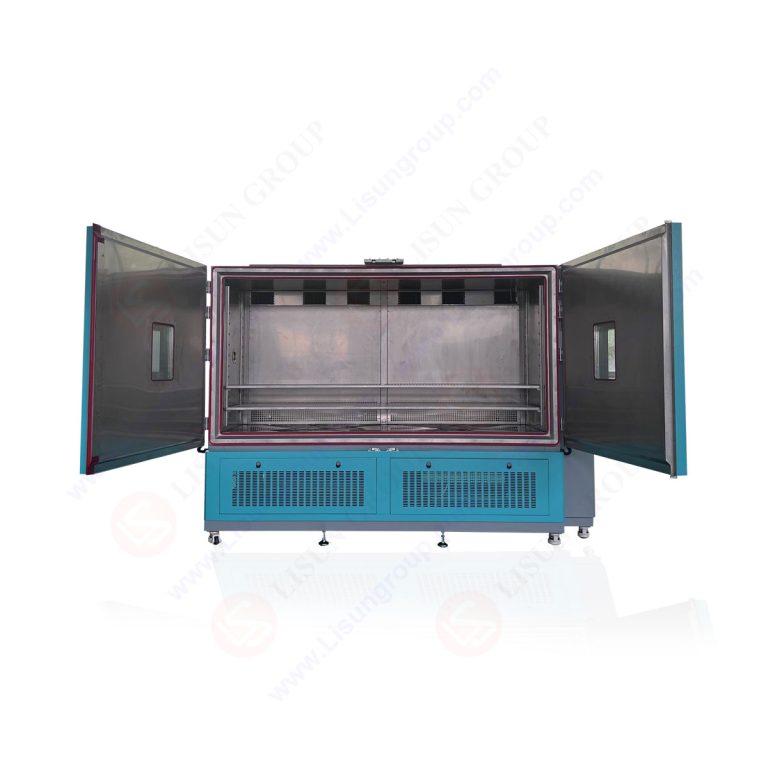
The LISUN xenon lamp aging chamber system supports up to three independent temperature chambers operating concurrently, a feature that substantially reduces total test time for multi-condition qualification. Each chamber can maintain set-point temperatures from -40°C to +100°C with ±0.5°C stability, allowing for simultaneous stress testing at different thermal conditions per IES LM-84 requirements. The chambers utilize independent recirculating air systems with PID-controlled heaters to prevent thermal stratification. For LED weathering test scenarios requiring extreme cold-start behavior, the optional refrigerant-based cooling module achieves -40°C within 45 minutes from ambient, simulating outdoor installation conditions in arctic climates.
4.2 Customizable Fixture and Mounting Solutions
Standard LED types—including mid-power SMD packages, COB arrays, and automotive-grade PLCC devices—require distinct mechanical interfaces. LISUN offers modular test boards with gold-plated contacts that accommodate up to 120 LEDs per board, configurable in series or parallel arrays. The LED weathering test chamber includes adjustable height platforms for the integrating sphere assembly, allowing precise positioning at 0.5m, 1m, or 2m distances per CIE 127 measurement geometries. For high-power LEDs exceeding 10W, individual heat-sink fixtures with embedded thermocouples ensure the case temperature (Tc) remains at the designated set-point, preventing thermal runaway during 6000-hour continuous operation.
5.1 TM-21 Statistical Extrapolation Techniques
The LED weathering test data derived from xenon lamp aging chamber measurements requires rigorous statistical treatment to produce meaningful lifetime estimates. TM-21 methodology specifies that at least six samples per test condition must be measured, with the reported L70 value corresponding to the time when the sample’s lumen maintenance reaches 70% of initial output. The LISUN software applies a two-stage regression: first, a linear fit to the logarithmic-transformed data to verify exponential behavior; second, a nonlinear least-squares fit to the full dataset. The model’s goodness-of-fit is evaluated via R² (acceptable >0.90) and residual analysis for heteroscedasticity. The final extrapolated lifetime is limited to 6× the test duration, meaning a 6000-hour LED weathering test can project up to 36000 hours (approximately 4.1 years of continuous operation).
5.2 Handling Abrupt Failures and Outlier Analysis
While most LED samples degrade gradually, catastrophic failures—such as bond wire lift-off or phosphor delamination—can occur during the LED weathering test. The Arrhenius-based software implements robust outlier rejection using Grubbs’ test at 95% confidence, removing aberrant samples from lifetime calculations. Additionally, the system records failure timestamps and photographs via built-in cameras, enabling root-cause analysis when anomalous degradation curves appear. For samples that fail before reaching 70% lumen maintenance, the software categorizes them as “early mortality” and reports the failure rate separately, providing crucial information for reliability qualification per IEC 60068-2-61.
6.1 Acceleration Factor Verification Protocol
The validity of the LED weathering test depends on establishing a defensible acceleration factor—the ratio of test stress to real-world operating stress. The LISUN xenon lamp aging chamber enables adjustment of irradiance levels from 40 W/m² (representing interior lighting) to 1200 W/m² (simulating concentrated sunlight in desert environments). To verify acceleration factors, LISUN recommends running a parallel outdoor exposure test for 12 months at a qualified site (e.g., Arizona or Florida). By comparing spectral power distribution damage spectra, laboratories can calculate the empirical acceleration factor with ±10% uncertainty, which is then programmed into the Arrhenius Model software for future LED weathering test campaigns.
6.2 Limitations of Accelerated Testing for SSL
Despite its comprehensiveness, the xenon lamp-based LED weathering test inherently accelerates thermal and photonic stress simultaneously, which can mask failure mechanisms that occur only at low temperatures. For instance, solder joint thermal fatigue requires cyclic temperature exposure, not constant high-temperature operation. The LISUN system partially addresses this via optional thermal cycling capabilities (-40°C to +85°C at 3°C/min ramp rate), but continuous cycling during the entire 6000-hour test is impractical. Therefore, LED weathering test results should be complemented with separate thermal cycling tests per IEC 60068-2-14 to obtain a complete reliability profile.
7.1 Laboratory Workflow Design for LED Weathering Test
A typical third-party testing laboratory utilizing the LISUN LEDLM-80PL follows a standardized workflow: first, 20 LED samples are pre-aged for 100 hours at the reference temperature to stabilize initial lumen output; second, samples are allocated to three test bays (two at elevated temperatures, one as control); third, the xenon lamp aging chamber is calibrated using a secondary standard lamp traceable to NIST; finally, data acquisition proceeds for 6000 hours with weekly maintenance checks verifying irradiance stability. The laboratory must maintain ambient conditions at 23°C ± 2°C and 50% ± 10% RH to minimize environmental drift effects on measurement accuracy.
7.2 Cost-Benefit Analysis of In-House vs. Outsourced Testing
| Factor | In-House LISUN System | Outsourced Testing |
|---|---|---|
| Capital Investment (USD) | $85,000 – $120,000 | $0 (per-test fee) |
| Cost per Test (6000h) | $12,000 (consumables + energy) | $25,000 – $40,000 |
| Turnaround Time | 9-10 months | 12-15 months |
| Data Accessibility | Real-time, full raw data | Summary report only |
| IP Protection | Complete confidentiality | NDA-dependent |
| Re-test Confidence | Immediate re-age capability | 3-4 month scheduling |
For LED manufacturers producing multiple families of products, in-house LED weathering test capabilities deliver payback within 3-4 tests. Additionally, having immediate access to raw spectral data enables rapid formulation adjustments for phosphor and encapsulant materials—a critical competitive advantage in the fast-paced SSL market.
The LED weathering test conducted via LISUN’s xenon lamp aging chamber represents a quantum leap beyond traditional thermal-only reliability assessment for solid-state lighting. By precisely controlling spectral irradiance, temperature, and humidity per IEC 60068 and IES standards, the LEDLM-80PL and LEDLM-84PL systems enable manufacturers to confidently predict L70 lifetimes extending to 36,000 hours from a 6,000-hour accelerated test. The integration of Arrhenius Model-based software with real-time photometric/colorimetric monitoring provides a comprehensive degradation profile that captures both lumen depreciation and chromaticity shift—the two primary failure modes of modern LED packages. Whether employed in institutional research or high-throughput manufacturing QA, this technology directly addresses the industry’s pressing need for faster, more accurate reliability data, ultimately shortening time-to-market for new LED products while minimizing field failure risks. As SSL technology continues to evolve toward higher efficacy and smaller form factors, the LISUN xenon aging platform remains an indispensable validation tool for engineers seeking to balance performance, cost, and reliability.
Q1: What is the minimum test duration required for IES LM-80 compliance, and can the LED weathering test shorten this timeframe?
A: IES LM-80-15 mandates a minimum of 6,000 hours of testing at three case temperatures, with data collection at intervals no greater than 1,000 hours. The LED weathering test utilizing LISUN’s xenon lamp aging chamber does not shorten this absolute duration—compliance requires physical test hours, not extrapolation alone. However, the LISUN system enables concurrent testing of up to three temperatures simultaneously via its multi-chamber design, reducing calendar time from 12 months to roughly 9 months. The Arrhenius Model software can provide preliminary L70 projections after 3,000 hours, but these must be validated against the full 6,000-hour dataset for formal TM-21 reporting. For expedited internal screening, LISUN offers a “strategic aging” mode combining higher irradiance (600 W/m²) with elevated temperature (105°C) to rank candidate materials within 2,000 hours, though this data cannot be used for LM-80 submission.
Q2: How does the xenon lamp spectrum compare to actual solar radiation for LED weathering test applications?
A: The xenon arc lamp with appropriate optical filters provides an excellent spectral match to natural sunlight, particularly in the critical 300-800 nm range. According to CIE 084 and ISO 4892-2, acceptable simulation requires the spectral irradiance to fall within ±10% of the reference solar spectrum in the UV-A and visible regions. LISUN’s LED weathering test chamber achieves this via a combination of borosilicate and soda-lime glass filters, which attenuate the xenon lamp’s excess short-wavelength UV output (<300 nm). One caveat: xenon lamps exhibit less emission in the 400-500 nm band compared to summer noon sunlight. Since LED phosphors often exhibit their highest absorption in this blue region, LISUN offers an optional UV-enhanced filter pack that boosts blue-band irradiance by 20%, providing more aggressive testing for phosphor-converted LEDs.
Q3: What are the primary differences between LEDLM-80PL and LEDLM-84PL in terms of irradiance control?
A: The LEDLM-80PL and LEDLM-84PL share identical xenon lamp aging chamber hardware, including closed-loop irradiance control from 40 to 1200 W/m². The key distinction lies in the measurement architecture. LEDLM-80PL utilizes a CCD-array spectrometer head positioned within the chamber, offering ±2% irradiance uniformity across the 100 mm × 100 mm test zone. LEDLM-84PL, however, routes light through a 2-meter fiber optic cable to an external integrating sphere (diameter 1.0 m or 1.5 m), enabling non-contact measurement at user-defined distances per CIE 127. This external configuration allows irradiance control at the sample plane while preventing the sphere from influencing the chamber’s thermal profile. For tests requiring simultaneous UV exposure and total flux measurement, LEDLM-84PL is preferred for its superior photometric accuracy (absolute flux uncertainty <1.5%), starting from a xenon lamp aging chamber that maintains spectral stability throughout the LED weathering test.
Q4: Can the LISUN system perform LED weathering tests at humidity levels exceeding 85% RH?
A: Yes, the standard LISUN xenon lamp aging chamber controls humidity from 10% to 95% RH (non-condensing) when the chamber temperature is above 35°C. For specialized tests requiring condensation or dew formation per IEC 60068-2-50, an optional dew-point generator can achieve 100% RH at 50°C by injecting steam into the recirculating air stream. This capability proves essential for evaluating LED luminaires intended for outdoor environments where high humidity accelerates sulfide corrosion of silver-plated reflectors. During high-humidity LED weathering test runs (>90% RH), the system automatically reduces irradiance by 10% to prevent condensation on the optical window, maintaining accurate flux measurements. LISUN engineers recommend configuring the chamber with stainless-steel internal walls and PTFE-coated sensors to mitigate corrosion risks during prolonged high-humidity operation.
Q5: How does the Arrhenius Model software handle activation energy uncertainty in LED weathering test data?
A: The LISUN software adopts a conservative approach by allowing users to input activation energy (Ea) as a probability distribution rather than a fixed point value. By default, the system assumes a normal distribution, with a mean of 0.45 eV and standard deviation of 0.1 eV, based on published studies of LED phosphor degradation across 20 samples. The lifetime calculation then performs 10,000 Monte Carlo iterations, computing the median and 95% confidence bounds for L70 at the target use temperature. This uncertainty propagation yields a lower-bound lifetime estimate (5th percentile) that is particularly useful for safety-critical applications like automotive headlamps, where premature LED failure liabilities exceed $1M per product recall. Furthermore, the software logs the actual case temperature variance throughout the test, feeding real-time temperature noise data into the Arrhenius computation—offering substantially more robust predictions than single-point temperature assumptions.