









Abstract
This article provides a comprehensive technical examination of IEC 60068 environmental test chambers, focusing on their critical role in LED reliability validation and accelerated aging testing. We explore how modern precision climate solutions, particularly LISUN’s LEDLM-80PL and LEDLM-84PL optical aging test systems, integrate temperature control, humidity regulation, and photometric measurement to comply with international standards IES LM-80, TM-21, IES LM-84, and TM-28. The discussion covers dual testing modes, Arrhenius Model-based lifetime projection software, and support for up to three connected temperature chambers. Engineers will gain actionable insights into configuring environmental test systems for 6000-hour L70/L50 assessments, ensuring accurate lumen depreciation tracking and reliable LED product certification.
1.1 The Evolution of Climate Reliability Testing
IEC 60068 represents the international benchmark for environmental testing procedures, covering temperature, humidity, vibration, and combined stress conditions. The standard family enables manufacturers to evaluate product durability under controlled climatic extremes. For LED components, sustained thermal stress accelerates lumen depreciation, making climate chamber testing essential for predicting operational lifespan. The evolution from basic thermal cycling to precision-controlled humidity and temperature ramping has transformed how lighting manufacturers validate long-term performance.
1.2 Relevance for LED Lumen Maintenance Validation
Modern high-power LEDs generate significant junction temperature heat, which directly impacts phosphor degradation and package material aging. IEC 60068 environmental test chambers provide the controlled ambient conditions necessary to isolate thermal effects on luminous flux. When paired with photometric measurement systems, these chambers become integral to lumen maintenance studies under IES LM-80 standards. Without precisely regulated airflow and temperature uniformity—typically ±1°C tolerance within the working volume—the accuracy of accelerated aging data becomes compromised, leading to unreliable TM-21 extrapolations.
2.1 System Variants: LEDLM-80PL and LEDLM-84PL
LISUN offers two dedicated optical aging test platforms tailored to distinct standards compliance requirements. The LEDLM-80PL supports testing per IES LM-80-15 and TM-21-19, focusing on lumen maintenance at defined case temperatures (typically 55°C, 85°C, and 105°C). The LEDLM-84PL addresses the emerging IES LM-84-20 and TM-28-19 methodology, which expands luminous flux measurement to include electrical power monitoring and elevated temperature cycling patterns. Both systems integrate temperature chambers, photodetectors, and data acquisition software into a unified automated platform.
2.2 Customizable Hardware Configurations
Flexibility constitutes the core design principle. Users may select between 1, 2, or up to 3 connected temperature chambers, enabling simultaneous multi-temperature testing per LM-80 requirements. Each chamber supports independent setpoints, ramping profiles, and humidity conditions where applicable. The optical measurement subsystem uses integrating sphere collection or lux-meter-based monitoring, depending on whether total flux or intensity depreciation is required. Configurable test frames accommodate various LED module geometries, including COB arrays, SMD packages, and retrofit lamps.
3.1 IES LM-80 and IES LM-84: Core Testing Protocols
IES LM-80 establishes the method for measuring lumen depreciation of solid-state lighting sources over 6000 hours minimum, with data collection points at 1000-hour intervals. Test samples must operate at specified case temperatures in controlled temperature chambers with defined airflow. The LEDLM-80PL automates this procedure, logging luminous flux, forward voltage, and ambient temperature continuously. Conversely, IES LM-84 offers a streamlined approach for LED packages, arrays, and modules, focusing on lumen maintenance at higher drive currents and reduced testing duration where applicable.
3.2 TM-21 and TM-28: Lifetime Extrapolation Analytics
TM-21 provides the mathematical projection algorithm for long-term lumen maintenance from LM-80 data, using exponential decay fitting. The Arrhenius Model integrates activation energy calculations to extrapolate lifetime at different junction temperatures. LISUN’s software embeds these models directly, allowing real-time exponent fitting and automatic projection of L70 (70% lumen maintenance) and L50 (50%) thresholds. TM-28 extends this framework for the LM-84 dataset, incorporating power consumption degradation into the projection model for more energy-focused lifetime estimation.
3.3 Photometric Integration with CIE and IES References
Accurate luminous flux measurement requires reference to standards such as IES LM-79-19 for total flux measurement in integrating spheres, CIE 084 for photometric measurement terminology, CIE 70 for spatial distribution measurement, and CIE 127 for LED testing methodologies. The LISUN system aligns its optical detector spectral response to CIE photopic luminosity function V(λ) through calibrated photometric sensors, ensuring traceable measurement uncertainty.
4.1 Temperature Uniformity and Stability
| Parameter | LEDLM-80PL Specification | LEDLM-84PL Specification |
|---|---|---|
| Temperature Range | +20°C to +100°C | +20°C to +120°C |
| Stability | ±0.5°C | ±0.3°C |
| Uniformity (per chamber) | ±1.0°C | ±0.8°C |
| Humidity Range | 20% RH to 95% RH | 10% RH to 98% RH |
| Number of Chambers Supported | Up to 3 | Up to 3 |
| Test Duration Standard | 6000 hours minimum | 6000 hours minimum |
| Data Logging Interval | 1 s to 60 min programmable | 1 s to 60 min programmable |
The chambers utilize forced air circulation with variable-speed blowers to maintain uniform temperature distribution across the test plane. Airflow velocity remains adjustable between 0.2 to 2.0 m/s, accommodating different LED thermal management designs. This ensures that case temperature measurements—critical for TM-21 analysis—remain accurate and reproducible.
4.2 Humidity and Combined Stress Testing
For automotive and outdoor lighting applications, humidity combined with temperature accelerates corrosion and material degradation. The LEDLM-84PL incorporates humidity control using a steam injection system with dew point sensing, enabling damp heat tests per IEC 60068-2-78. Relative humidity stability remains within ±3% for setpoints below 85% RH, with ±5% for higher values. This dual-axis environmental control provides data for lifetime modeling under non-ideal operating conditions.
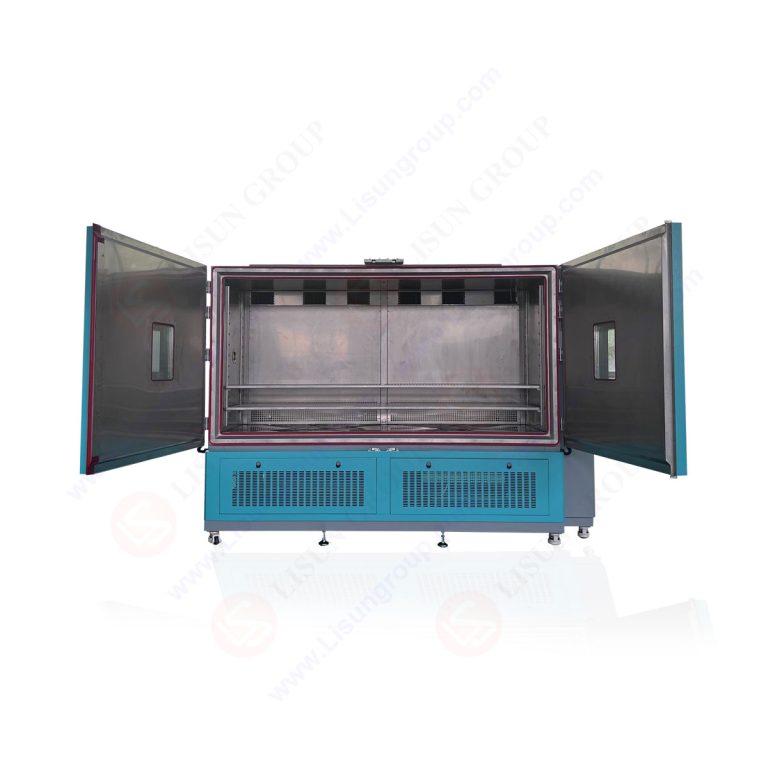
4.3 Power Cycling and Dynamic Temperature Profiles
The LISUN systems support dynamic temperature ramping at rates of up to 5°C per minute, allowing thermal shock and power cycling tests. Programmable profiles enable automatic alternation between high-temperature aging and room-temperature photometric measurement. This prevents temperature-induced lumen recovery effects from distorting depreciation curves, ensuring raw data fidelity.
5.1 Data Collection at 6000 Hours
| Test Mode | Standard Reference | Measurement Interval | Key Output Metrics |
|---|---|---|---|
| Standard Aging | IES LM-80-15/ TM-21-19 | 1000 hours (min) | L70(6000h), L50(6000h) |
| Rapid Aging | IES LM-80-15 | 500 hours (alt) | Predicted L70 lifespan |
| LM-84 Protocol | IES LM-84-20/ TM-28-19 | 1000 hours (min) | L70 and Power Depreciation |
| Custom Profile | User Defined | 1 s to 60 min | Thermal coefficient |
Data acquisition channels capture luminous flux via optical sensors (spectral mismatch-corrected), case temperature via thermocouples, ambient humidity sensors, and electrical parameters (voltage, current, power). The system maintains synchronized timestamps across all channels, facilitating correlation analysis between environmental conditions and lumen depreciation rates.
5.2 Arrhenius Model Software Integration
The embedded Arrhenius-based projection algorithm calculates activation energy (E_a) from multi-temperature testing data. Through regression analysis of decay constants at different case temperatures, the software determines E_a values typical of LED phosphor and encapsulant materials—ranging between 0.2 eV and 0.7 eV for most commercial LEDs. This activation energy feeds into the lifetime projection equation, enabling accurate estimation of L70 at user-defined operating temperatures beyond actual test conditions.
6.1 Integrating Sphere Compatibility
LISUN environmental chambers integrate seamlessly with 0.3 m, 0.5 m, and 1.0 m integrating spheres manufactured to IES LM-79-19 specifications. The sphere’s interior coating provides diffuse reflectance exceeding 97% with a spectral flatness within 1.5% across the visible range. During testing, the sphere connects directly to a spectroradiometer or photometer head, capturing spectral power distribution (SPD) at each aging interval. This combination ensures absolute luminous flux measurements corrected for self-absorption and wavelength sensitivity.
6.2 On-board Photometric Sensors
For continuous monitoring without sphere interruption, the chambers feature multiple photopic-corrected silicon photodiode sensors positioned at defined distances from the test sample plane. These sensors offer change detection sensitivity of 0.1% for lumen maintenance tracking between formal measurement points. A dedicated calibraction port allows traceable sensor calibration against reference standards based on CIE 127 methodologies.
7.1 Simultaneous Multi-Temperature Testing
Up to three temperature chambers can be operated in parallel, each maintaining distinct case temperatures as per LM-80 requirements. The software aggregates data from all chambers into a unified database, enabling direct comparison of depreciation rates across the temperature matrix. This setup dramatically reduces total testing time—completing a full LM-80 dataset for three temperatures in a single 6000-hour campaign.
7.2 Controlled Abrupt Temperature Variation
IEC 60068-2-14 test Nb requires specified rates of temperature change. The LEDLM platform supports programmable thermal cycling with dwell times, providing assessment under thermal fatigue conditions. Combined with continuous photometric monitoring, engineers can observe transient lumen fluctuations during thermal transitions, identifying potential solder joint or phosphor adhesion failures.
IEC 60068 environmental test chambers, particularly LISUN’s LEDLM-80PL and LEDLM-84PL, provide precision climate solutions that are indispensable for LED lumen maintenance testing and lifetime projection. The integration of IES LM-80, TM-21, LM-84, and TM-28 standards-compliant protocols with Arrhenius-based analytics, configurable multi-chamber hardware, and photometric measurement capabilities equips engineers with robust tools for reliability validation. Achieving L70/L50 metrics through 6000-hour campaigns becomes systematic, traceable, and repeatable. As LED technology evolves toward higher efficiencies and demanding applications, the need for accurate climate-conditioned optical testing grows. LISUN’s comprehensive platform addresses this need with technical sophistication and operational flexibility, solidifying its position as a leading IEC 60068 environmental test chamber manufacturer.
Q1: What is the primary difference between IES LM-80 and IES LM-84 testing protocols?
A: IES LM-80 defines the methodology for measuring lumen depreciation of SSL sources, typically requiring 6000 hours of testing at specified case temperatures with data collected at 1000-hour intervals. IES LM-84 provides a streamlined alternative focused on LED packages, arrays, and modules, with emphasis on luminous flux and electrical power monitoring. LM-84 allows optional higher drive current testing and integrates more directly with TM-28 for lifetime extrapolation. For manufacturers seeking LM-80 compliance and broader market acceptance, LM-80 remains the legacy standard. However, LM-84 offers reduced testing time for internal R&D comparisons while still providing data statistically correlated to LM-80.
Q2: How does the Arrhenius Model improve LED lifetime prediction accuracy?
A: The Arrhenius Model uses accelerated aging data at multiple elevated temperatures to estimate activation energy (E_a) for the dominant degradation mechanisms in LED materials. By plotting decay constants versus inverse absolute temperature, activation energy is derived from the slope. This value is then used to extrapolate lumen depreciation rates to lower, realistic operating temperatures. In the LISUN software, this model automatically applies regression analysis and 90% confidence bounds per TM-21. The result is a significantly more accurate L70 lifetime estimate than simple linear extrapolation, enabling robust warranty decisions and product reliability claims.
Q3: Can a single LISUN environmental test chamber handle both LM-80 and IEC 60068 thermal cycling tests?
A: Yes, the LEDLM system supports programmable profiles that combine steady-state aging—for LM-80 lumen maintenance—with dynamic temperature ramping and dwell segments as required by IEC 60068-2-14 thermal cycling tests. You can schedule a profile where samples age at 85°C for 500 hours, followedby controlled cycling between 25°C and 95°C with defined ramp rates. The photometric measurement subsystem continues data logging throughout both phases, allowing you to assess lumen depreciation during transient thermal loading. This flexibility eliminates the need for separate climate chambers when both aging and cycling tests are required.
Q4: What is the significance of measuring electrical power in addition to luminous flux in LM-84 testing?
A: TM-28 extrapolation from LM-84 data projects not only lumen maintenance but also power consumption degradation. This is critical because LED driver circuitry and phosphor conversion efficiency can shift over time, affecting input power draw. If a lamp maintains 90% lumen output but its power draw increases by 5%, the effective luminous efficacy drops. By tracking power consumption alongside flux, manufacturers gain a comprehensive view of energy efficiency maintenance, which is increasingly important for energy compliance labels and customer expectations. The LEM-84PL system automatically calculates power efficacy (lm/W) at each measurement interval, providing complete performance clairvoyance.
Q5: How does temperature measurement accuracy influence TM-21 extrapolation results?
A: TM-21 extrapolation incorporates case temperature as a primary variable in the Arrhenius degradation model. A measurement error of ±2°C can shift activation energy calculations by approximately 5-8%, translating into L70 projections that vary by hundreds of hours. The LISUN system’s ±0.5°C temperature stability and ±1°C uniformity ensure that recorded case temperatures accurately reflect actual LED package conditions. Additionally, multiple thermocouple attachment points per module allow engineers to validate temperature gradients across large arrays, ensuring that data fed into TM-21 models reflects physical reality. This precision directly translates into reliable product lifetime claims and reduced warranty risk.