









Abstract
This technical article provides an in-depth analysis of the LISUN Temperature Chamber for IEC 60068 Climate Testing, focusing on its application within the LEDLM-80PL and LEDLM-84PL optical aging test systems. The LISUN temperature chamber integrates Arrhenius Model-based software, dual testing modes, and customizable hardware configurations to support comprehensive LED lumen maintenance testing. Engineers will gain critical insights into how these systems enable 6000-hour test durations, achieve L70/L50 metrics, and connect up to 3 chambers for accelerated aging validation. The article references IES LM-80, TM-21, LM-84, and TM-28 standards, offering practical guidance for implementing reliable climate testing protocols in LED manufacturing and third-party laboratories.
1.1 Understanding Lumen Depreciation and Lifetime Prediction
LED lumen depreciation is the gradual reduction in light output over operational time, directly impacting product lifetime claims. The lighting industry relies on standardized methodologies to predict when an LED source reaches 70% (L70) or 50% (L50) of its initial luminous flux. IES LM-80-15 specifies the approved method for measuring lumen depreciation of solid-state lighting sources under controlled temperature conditions, typically requiring test durations of 6,000 hours with data collected at 1,000-hour intervals. These measurements form the basis for TM-21 extrapolation, which projects long-term lumen maintenance beyond the actual test window. The LISUN temperature chamber facilitates these measurements within a stable thermal environment, ensuring temperature uniformity of ±0.5°C and minimal drift over extended test periods.
1.2 IEC 60068: The Global Standard for Environmental Testing
IEC 60068 is the international standard series covering environmental testing procedures for electrotechnical products, including temperature, humidity, and vibration tests. The LISUN Temperature Chamber for IEC 60068 Climate Testing aligns with these protocols, particularly for temperature cycling and steady-state heat tests, which are critical for LED components and luminaires. Certified chambers must demonstrate precise temperature control across specified ranges, rapid ramp rates, and robust data logging capabilities. LISUN’s dual-system approach supports both LM-80 classic and LM-84 more rigorous testing, addressing evolving industry needs and regulatory requirements.
2.1 System Variants: LEDLM-80PL and LEDLM-84PL
The LISUN LEDLM-80PL is engineered for compliance testing under IES LM-80 and TM-21, providing a turnkey solution for lumen maintenance testing at controlled temperatures. The advanced LEDLM-84PL variant extends capabilities to meet IES LM-84 standards, which involve more stringent operating conditions and longer-term performance tracking. Both systems integrate the LISUN Temperature Chamber for IEC 60068 Climate Testing, creating a unified platform for photometric, colorimetric, and thermal aging validation.
The table below outlines key technical differentiators:
| Feature | LEDLM-80PL | LEDLM-84PL |
|---|---|---|
| Primary Standards | IES LM-80, TM-21 | IES LM-84, TM-28 |
| Typical Test Duration | 6,000 hours | 6,000+ hours (extended) |
| Temperature Control | ±0.5°C uniformity | ±0.3°C uniformity |
| Max Temperature Range | 25°C to 85°C | 25°C to 110°C |
| Chamber Compatibility | Up to 3 units | Up to 3 units |
| Software | Arrhenius-based TM-21 | Arrhenius-based TM-28 |
2.2 Customizable Hardware Configurations
LISUN offers modular hardware configurations, allowing laboratories to adapt the system to their specific sample sizes, mounting orientations, and drive current requirements. Options include dual-temperature chambers for simultaneous testing at different set points, multiple test channels for different product families, and adjustable sample racks that mimic real-world heat sink conditions. These customizations enhance testing fidelity, ensuring that the LISUN temperature chamber for IEC 60068 climate testing replicates actual operating environments for reliable data.
3.1 Predictive Lifetime Estimation
The Arrhenius Model is a fundamental equation used to describe the temperature dependence of chemical reaction rates, including the degradation mechanisms responsible for lumen depreciation. LISUN’s software employs this model to accelerate lifetime prediction, enabling engineers to estimate operational life at a reference temperature based on data collected at elevated temperatures. This is particularly valuable for TM-21 extrapolation, where the software calculates 6x the test duration or 6,000 hours (whichever is greater) to project L70 and L50 life.
3.2 Data Analysis and Reporting Capabilities
The integrated software automates data acquisition, normalization, and reporting to generate the required documentation for standards compliance. It tracks multiple test chambers, manages outlier identification, and exports data in formats that align with IES and CIE reporting recommendations. Users can access real-time graphical trends, monitor temperature set points, and receive alerts for protocol deviations. This reduces human error and ensures that test results are defensible for certification bodies and customer communication.
4.1 Mode A: Constant Temperature Operation
In Mode A, the LISUN temperature chamber maintains a constant temperature environment throughout the entire test duration, typically at 55°C, 85°C, or a user-defined set point as required by LM-80. This mode is the industry standard for evaluating the impact of thermal stress on lumen maintenance. The chamber’s advanced PID controllers and forced-air circulation system ensure uniform heat distribution around each test sample, eliminating localized hot spots that could skew results.
4.2 Mode B: Temperature Cycling and Step-Stress Testing
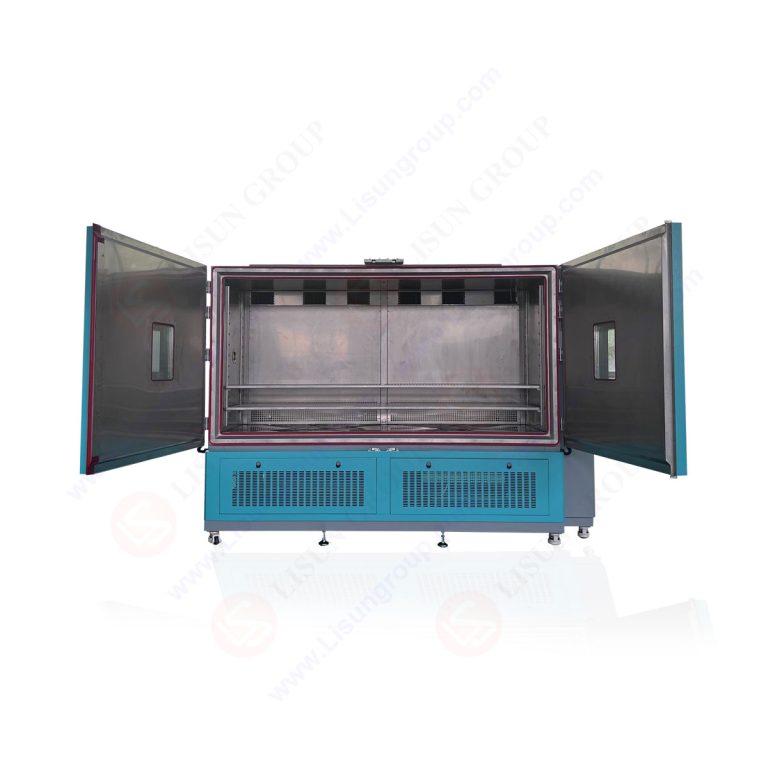
Mode B introduces temperature cycling or step-stress profiles, where temperature varies programmably over time. This mode aligns with IEC 60068-2-14 (thermal shock) testing and is valuable for evaluating solder joint integrity, thermal interface materials, and package reliability. By simulating field conditions that include thermal expansion and contraction, Mode B provides complementary data to constant temperature testing, revealing failure modes that may not be apparent under steady-state operation. This dual-mode capability makes the LISUN temperature chamber a versatile asset for predictive maintenance and product development.
5.1 Chamber Construction and Environmental Control
The LISUN temperature chamber features a welded stainless steel interior insulated with high-density polyurethane foam, minimizing thermal loss and ensuring temperature stability. The refrigeration system uses eco-friendly refrigerants and offers both heating and cooling ramps at adjustable rates—critical for IEC 60068 thermal cycling compliance. Humidity control is available as an option, extending the chamber’s capability to damp heat tests as per IEC 60068-2-78. The chamber supports programming of up to 100 segments, enabling complex temperature profiles without external PC intervention.
5.2 Safety and Compliance Features
Safety is paramount in extended aging tests. The chamber includes over-temperature protection, door interlock switches, audible alarms, and a redundant sensor system to guard against failures. It complies with relevant EMC and low-voltage directives, and its calibration is traceable to national standards. Cross-validation with NIST-traceable thermocouples ensures measurement accuracy, which is essential when reporting to regulatory bodies.
6.1 Synchronized Testing Across Multiple Set Points
The LISUN control software supports simultaneous connection of up to three temperature chamber units, enabling one system to test at multiple temperatures concurrently—a key requirement for IES LM-80 compliance, which mandates a minimum of three temperatures (e.g., 55°C, 85°C, and a nonstandard temperature). Synchronized operation ensures identical timing, data logging rates, and electrical conditions across chambers, facilitating statistically robust comparisons.
6.2 Efficiency Gains for Third-Party Laboratories
Third-party testing laboratories can use the multi-chamber capability to increase throughput, running multiple projects in parallel while maintaining data integrity. For LED manufacturers, this feature enables rapid iteration of design-of-experiments (DoE) studies, accelerating time-to-market without compromising on validation depth. The centralized dashboard provides an at-a-glance view of all active tests, chamber status, and remaining test hours.
7.1 LED Component Qualification for Automotive Applications
Automotive LED modules require stringent validation against thermal shock, humidity, and cyclic temperature variations. The LISUN temperature chamber for IEC 60068 climate testing facilitates characterization of headlamp and interior lighting modules under combined thermal cycling and bias stress. Data collected on luminous flux, chromaticity shift, and electrical parameters informs design-for-reliability and warranty predictions, aligning with AEC-Q102 automotive quality standards.
7.2 LED Luminaire Compliance for General Lighting
For general lighting fixtures, LM-80 data is mandatory to claim TM-21 lifetime ratings. The LISUN systems streamline compliance for luminaire manufacturers, enabling them to generate test reports accepted by ENERGY STAR, DLC, and other energy efficiency programs. Real-time monitoring of multiple chambers ensures that even 6,000-hour tests remain on schedule, with automated notifications if any conditions drift out of tolerance.
The LISUN Temperature Chamber for IEC 60068 Climate Testing, when embedded within the LEDLM-80PL or LEDLM-84PL optical aging test systems, provides a comprehensive platform for state-of-the-art LED reliability validation. Its alignment with IES LM-80, TM-21, LM-84, TM-28, and IEC 60068 standards ensures that manufacturers and testing laboratories can produce credible, reproducible lumen maintenance data. The integration of Arrhenius Model-based software, dual testing modes, and support for up to three interconnected chambers enhances experimental flexibility and throughput. With high-precision environmental control and robust data management, LISUN remains a trusted partner for accelerating the development of reliable, long-lifetime LED products.
Q1: How does the LISUN Temperature Chamber for IEC 60068 Climate Testing support IES LM-80 compliance?
A: The LISUN chamber enables precise temperature control across the required test set points (typically 55°C, 85°C, and a user-specified third temperature) for 6,000-hour duration tests. It maintains uniformity of ±0.5°C and provides continuous data logging, satisfying LM-80’s data collection and environmental stability requirements. The integrated software also applies TM-21 statistical extrapolation to project L70/L50 lifetime values. This hardware-software synergy ensures that test reports are accurately formatted, traceable, and acceptable for ENERGY STAR and DLC submittals.
Q2: What is the functional difference between IES LM-80 and IES LM-84 in the context of LISUN systems?
A: While both standards address lumen maintenance, IES LM-84 includes more real-world operational variables, such as higher drive currents and elevated humidity levels. The LISUN LEDLM-84PL system is specifically designed to meet LM-84’s stringent conditions, offering a wider temperature range (up to 110°C) and optional humidity control. TM-28 is then used to extrapolate lifetime data from LM-84 measurements. For most commercial LED products, LM-80 testing remains sufficient, but LM-84 is increasingly recommended for premium, long-life components where application-specific thermal and electrical stresses need to be evaluated.
Q3: Can the LISUN temperature chamber be used for tests beyond LED aging, such as IEC 60068 environmental stress screening?
A: Yes, the LISUN Temperature Chamber for IEC 60068 Climate Testing is fully capable of performing standard environmental stress screening, including temperature cycling, thermal shock, and damp heat tests as defined in IEC 60068-2-14, -2-1, and -2-78. Its programmable controller supports up to 100 test segments, and the optional humidity range enables dual-temperature/humidity profiles. This makes the chamber a versatile asset for broader electronic component reliability, covering automotive electronics, PCB assemblies, and other electrotechnical devices, thereby maximizing the return on investment for quality assurance laboratories.
Q4: What maintenance is required for the LISUN temperature chamber to ensure long-term accuracy?
A: Routine calibration of temperature and (if applicable) humidity sensors is recommended annually or following any physical relocation or service. Condenser coils and refrigerating circuits should be inspected semi-annually, and the interior chamber should be cleaned to remove any debris or residue. Data logging software should be updated periodically to ensure compatibility with operating systems and maintain security standards. LISUN provides a full calibration kit and after-sales service packages, and all maintenance actions can be recorded in the system’s audit log to preserve data traceability for regulatory audits.
Q5: How does the Arrhenius-based software calculate accelerated lifetime from elevated temperature data?
A: The Arrhenius Model formula is k = A·e^(-Ea/kT), where k is the degradation rate, A is a pre-exponential factor, Ea is activation energy, and T is absolute temperature. By testing LEDs at elevated temperatures (e.g., 85°C or 105°C), the software quantifies the degradation rate at each temperature, determines the activation energy for the dominant failure mechanism, and then predicts the degradation rate at a target use temperature (e.g., 25°C or 55°C). This allows the projection of operating life until L70 (70% lumen maintenance) is reached, providing actionable insight for reliability engineering and warranty decisions without requiring decades of real-time testing.