









Abstract
The High Precision Temperature Humidity Cycling Chamber for IEC 60068 is a critical instrument for evaluating LED component and luminaire reliability under accelerated environmental stress. This article explores the LISUN LEDLM-80PL and LEDLM-84PL optical aging test systems, which integrate precision chambers with Arrhenius Model-based software to predict lumen depreciation and lifespan. Key technical insights include test durations up to 6,000 hours, quantification of L70/L50 metrics, and support for three connected chambers—enabling simultaneous multi-temperature testing. The article bridges IEC 60068 environmental testing standards with IES LM-80, TM-21, LM-84, and TM-28 methodologies. For LED manufacturing engineers and testing lab technicians, this comprehensive analysis provides actionable guidance on implementing high-accuracy humidity and temperature cycling to achieve standardized, reproducible photon flux degradation data.
1.1 The Role of Temperature Humidity Cycling in LED Failure Mechanisms
LEDs are semiconductor devices whose performance degrades through multiple physio-chemical mechanisms, including phosphor thermal quenching, solder joint fatigue, and encapsulation delamination. Temperature humidity cycling accelerates these failure modes by introducing cyclic thermo-mechanical stress, promoting moisture ingress, and facilitating electrochemical migration. According to IEC 60068-2-38, the combined application of temperature and humidity cycling creates a more realistic failure profile than steady-state exposure. The High Precision Temperature Humidity Cycling Chamber for IEC 60068 must exhibit temperature uniformity within ±0.5°C and relative humidity stability of ±2.5% RH to produce statistically valid acceleration factors.
1.2 Accelerated Testing Protocols and the Arrhenius Relationship
The Arrhenius equation underpins accelerated aging theories: failure rate increases exponentially with respect to temperature activation energy. LISUN’s proprietary software applies this model to thermal data, converting rapid degradation at elevated junction temperatures (e.g., 85°C, 105°C) into projected lifetimes at operating temperatures (typically 25°C–55°C). For humidity-sensitive packages, the Peck’s model further incorporates relative humidity as a stressor. The precision chamber maintains a dew-point tolerance that ensures the partial pressure of water vapor remains constant, thereby validating the dominant acceleration factor.
2.1 Dual-System Variants: Configurations for LM-80 vs. LM-84
| System Feature | LEDLM-80PL (LM-80/TM-21) | LEDLM-84PL (LM-84/TM-28) |
|---|---|---|
| Maximum Test Duration | 6,000 hours (typical) | 6,000 hours (typical) |
| Temperature Chambers Supported | Up to 3 units | Up to 3 units |
| Temperature Range | 0°C to 100°C (optionally -20°C) | 0°C to 100°C |
| Humidity Range | 20% to 95% RH | 20% to 95% RH |
| Photometric Measurement | Integrating sphere (1.5m or 2.0m) | Integrating sphere per CIE 127 |
| Extrapolation Software | TM-21 compliant | TM-28 compliant |
| Key Application | LED packages, modules, arrays | LED luminaires and light engines |
The LEDLM-80PL is engineered for component-level testing per IES LM-80, which requires specific temperature sets (typically 55°C, 85°C, and a third optional temperature). Conversely, the LEDLM-84PL addresses full luminaire testing under IES LM-84, accommodating larger physical dimensions and higher thermal mass. Both systems integrate a High Precision Temperature Humidity Cycling Chamber for IEC 60068, ensuring the environmental test conditions comply with the operational limits of IEC 60068-2-78 (damp heat) and IEC 60068-2-30 (damp heat cyclic).
2.2 Data Acquisition through Photometric and Chromatic Measurement
Each system integrates a spectral-based measurement solution, typically a CCD-array spectroradiometer coupled with a benchtop integrating sphere. The measurement architecture supports rapid spectral scanning at intermittent time points without disturbing DUT (Device Under Test) temperature. This is crucial because the chamber door must remain sealed to maintain humidity saturation. Measurement probes are retractable, and the photometric chain is calibrated against NIST-traceable standard lamps. The system also records chromaticity coordinates (u’, v’) and correlated color temperature (CCT) to track phosphor degradation separately from chip degradation.
3.1 Thermal and Humidity Control Engineering
The High Precision Temperature Humidity Cycling Chamber for IEC 60068 utilizes a cascade refrigeration system for rapid temperature transitions (up to 5°C/min) and low-temperature capability. An ultrasonic humidifier provides fine mist generation, while a dry-air purge system prevents condensation on the optical window. Chamber air is continuously circulated through a HEPA filter to reduce particle contamination which could influence spectral measurements. Temperature uniformity across the test plane is maintained within ≤ 0.5°C at 85°C and ≤ 1.0°C at 105°C, meeting test condition requirements for IES LM-80-20 and combining reproducibility criteria of IEC 60068-3-5.
3.2 Multi-Chamber Synchronization and Software Integration
LISUN’s test software supports simultaneous operation of up to three independent temperature humidity chambers connected to a single optical measurement system. This configuration is essential for the LM-80 protocol, which mandates testing at three temperature nodes: typically 55°C, 85°C, and 105°C (or an optional third). The software orchestrates a rotation schedule whereby the integrating sphere is robotically switched between chambers via an optical alignment rail. This measurement multiplexing markedly reduces equipment costs while maintaining data integrity. Each chamber records its own temperature-humidity profile in compliance with IEC 60068-3-6 (guidance for performance verification).
4.1 Alignment with IES LM-80-20 and TM-21-19
IES LM-80-20 details the approved method for measuring lumen maintenance of LED light sources, mandating testing at 55°C, 85°C, and one additional higher temperature. Total test duration is typically 6,000 hours with measurement points at 1,000-hour intervals initially, then at 500-hour intervals after 6,000 hours. The LISUN LEDLM-80PL records photometric data at each interval, and the software automatically calculates the reported lumen maintenance (LM) values. Subsequently, TM-21-19 extrapolates the data using an exponential least-squares fit to estimate L70 (time to 70% lumen output) or L50 metrics. The software applies this methodology with suitable statistical bounds for upper/lower confidence intervals at 90%.
4.2 Integration of IES LM-84-19 and TM-28-19 for Luminaires
For complete luminaires, IES LM-84-19 prescribes a similar but adapted test, incorporating the effects of thermal management integrated into the luminaire design. TM-28-19 provides an extrapolation guideline based on lumen output data collected per LM-84. The LEDLM-84PL system handles larger format DUTs within its chamber (approximate volume up to 800 liters) and includes an auxiliary thermocouple interface for tracking case temperature, driver temperature, and ambient temperature. This data enables thermal derating analyses using models that delineate LED package degradation from driver electronics degradation.
4.3 Photometric and Colorimetric Standards (IES LM-79-19, CIE 127)
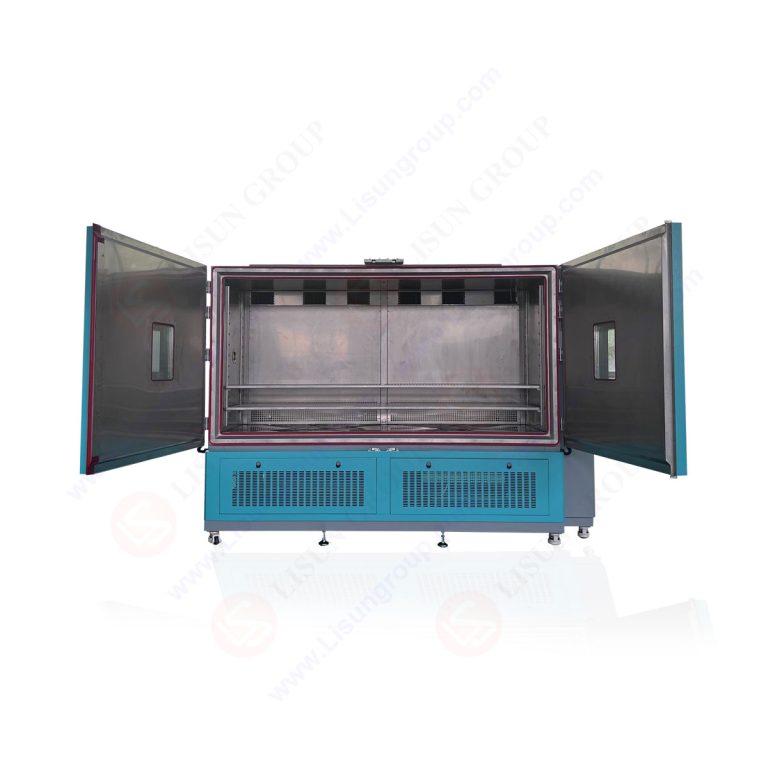
Prior to long-term aging and during periodic measurement intervals, LISUN systems support compliance with IES LM-79-19 for the electrical and photometric measurements of solid-state lighting products. The integrating sphere-based goniophotometric data is collected in accordance with CIE 084 (measurement of luminous flux) and CIE 127 (LED intensity measurement). The precision chamber includes a spectrally neutral internal coating (barium sulfate, ≥97% reflectance) that maintains its properties under high humidity, thereby preserving measurement accuracy across the 6,000-hour campaign.
5.1 Predictive Modeling with Arrhenius Activation Energy Extraction
The software suite within the LEDLM-80PL performs nonlinear regression on photometric data to extract the Activation Energy (Ea) for each LED technology. For instance, typical phosphor-converted white LEDs exhibit Ea values ranging between 0.2 eV and 0.7 eV depending on the dominant degradation path. The Arrhenius model extrapolates photometric decay at benign temperatures—a process enabling 50,000-hour lifetime prediction from 6,000 hours of accelerated data. The software presents results in a tabular and graphical format, highlighting L70 and L50 life projections at specified operating currents and temperatures.
5.2 Interactive Dashboards and Compliance Reporting
Engineers can generate custom test reports that integrate data from the High Precision Temperature Humidity Cycling Chamber for IEC 60068, photometric measurements, ambient conditions, and operator annotations. The reporting engine aligns with the format required by ENERGY STAR® and DLC (Design Lights Consortium) submissions, which require TM-21 extrapolated L70 values at 6,000-hour data points. Additionally, the software supports CSV, Excel, and PDF exports for integration into internal LIMS (Laboratory Information Management System) databases.
| Test Parameter | IEC 60068-2-78 (Damp Heat) | IEC 60068-2-30 (Damp Heat Cyclic) | Typical LISUN Settings |
|---|---|---|---|
| Temperature | 40°C ± 2°C | 25°C to 55°C (cycle) | 85°C (LM-80) |
| Relative Humidity | 93% ± 3% RH | 95% RH (high temp phase) | 85% RH (cyclic) |
| Test Duration | 96 to 1000 hours | 24-hour cycles | 1,000-hour cycles |
| Measurement Intervals | None (end of test) | Every 24 hours | Every 500 hours |
6.1 Integration into LED Quality Control Workflows
For LED manufacturers, the LISUN LEDLM-80PL becomes a gating station in qualification and incoming quality control (IQC). The High Precision Temperature Humidity Cycling Chamber for IEC 60068 supports variable ramp rates, allowing engineers to simulate daily temperature cycles in tropical climates (e.g., 35°C to 65°C cycles at 90% RH). This environmental data helps pinpoint quality escapes related to casting resins, SiC substrates, or wire-bond materials. The system’s modular design permits retrofitting chambers, allowing future expansion as LED production volumes increase.
6.2 Reducing Total Cost of Ownership via Multi-Node Testing
By supporting up to three chambers, the system avoids the purchase of three separate complete measurement stations. A single photometric measurement chain (integrating sphere + spectroradiometer) is shared across chambers, amortizing the capital cost. With typical LM-80 test campaigns spanning 6,000 hours, the system allows batch testing of different LED colors (e.g., cool white, neutral white, warm white) concurrently at different humidity settings, thereby tripling laboratory throughput.
7.1 Maintaining Chamber Performance over Long Durations
Calibrating temperature sensors and humidity transmitters is mandatory per ISO/IEC 17025 standards—LISUN recommends recalibration every 12 months or after 5,000 hours of operation. Additionally, the chamber’s internal fan speed should be verified to ensure the air velocity (typically 0.5 – 2.0 m/s) does not significantly cool the DUT below the setpoint due to forced convection. LISUN’s system includes a radiant shield to minimize radiative cooling asymmetry.
7.2 Data Integrity and Traceability
All environmental data—temperature, humidity, and dew point—is logged continuously at 1-minute intervals into a tamper-evident logfile. This is crucial to defending data against audits by regulatory bodies, including Energy Star or European ErP directives. The LISUN system also generates a timestamped ASCII log that matches photometric measurements with chamber states, ensuring the acceptance criteria of no temperature overshoot during sampling windows are respected.
The High Precision Temperature Humidity Cycling Chamber for IEC 60068 is an indispensable tool for modern LED reliability engineering. LISUN’s LEDLM-80PL and LEDLM-84PL systems deliver end-to-end solutions—combining precision environmental control, multi-chamber scalability, and intelligent TM-21/TM-28 extrapolation—to achieve 6,000-hour accelerated aging with high confidence. By aligning test conditions with IES LM-80, LM-84, CIE 127, and IEC 60068 standards, these systems enable engineers to quantify L70/L50 metrics accurately, forecast field performance, and validate design robustness. The integration of Arrhenius models and real-time photometric data simplifies compliance reporting and reduces total time-to-market for new LED products. For manufacturers and third-party laboratories, investing in this combined environmental-optical platform represents a forward-looking approach to semiconductor-based lighting quality assurance.
Q1: What is the relationship between IEC 60068 and IES LM-80 standards?
A: IEC 60068 defines generic environmental test methods for electronic equipment, including temperature humidity cycling procedures (e.g., IEC 60068-2-38). IES LM-80-20 specifically adapts these principles for LED light sources, prescribing exact temperatures, humidity levels, and measurement intervals. LISUN’s chamber meets both standards by providing programmable temperature/humidity profiles that conform to IEC 60068’s performance criteria while executing the 6,000-hour schedule mandated by LM-80. This dual compliance makes it suitable for international certification bodies.
Q2: How does the LISUN LEDLM-80PL extrapolate L70 lifetimes from 6,000-hour data?
A: The LEDLM-80PL software applies statistical regression per IES TM-21-19. It uses a nonlinear least-squares method to fit the lumen depreciation data to an exponential decay curve. From this fitted curve, the program computes the projected time at which luminous flux reaches 70% of initial (L70). The Arrhenius equation is then applied to shift L70 predictions between temperatures using an activation energy estimated from multiple chamber setpoints (e.g., 55°C, 85°C, 105°C). Confidence bounds of 90% are also calculated.
Q3: Can the system test multiple LED types simultaneously in different chambers?
A: Yes. LISUN’s system supports up to three independent temperature humidity cycling chambers connected to a single integrating-sphere measurement station. Through its rotation mechanism, the software sequentially locks each chamber’s optical port to the sphere. Therefore, an engineer can run three distinct experiments concurrently—for example, testing SMD LEDs at 55°C/85% RH, COB modules at 85°C/40% RH, and LED filaments at 105°C/30% RH—maximizing throughput without cross-contamination of environmental conditions.
Q4: What are the main differences between the LEDLM-80PL and LEDLM-84PL regarding measurement geometry?
A: The LEDLM-80PL tests LED packages, modules, and arrays using an integrating sphere that collects total luminous flux from the small fixture, per CIE 127 standard. In contrast, the LEDLM-84PL is designed for complete luminaires (e.g., troffers, downlights) and may use either a large integrating sphere (2.0m) or a goniophotometer to measure spatial intensity distribution. The LEDLM-84PL also incorporates additional high-current power supplies (up to 20A) to drive luminaires during extended testing under LM-84-19 guidelines.
Q5: How vital is humidity control in LED lumen maintenance testing?
A: Humidity control is critical for packages with unsealed or partially sealed encapsulants, where moisture-driven degradation of phosphor and metal migration accelerates in humid environments. The High Precision Temperature Humidity Cycling Chamber for IEC 60068 maintains ±2.5% RH tolerance, ensuring that the water vapor partial pressure remains constant over time. This precision distinguishes between temperature-driven degradation (Arrhenius) and humidity-driven paths (Peck’s model), allowing accurate failure mechanism identification.