









Precision Solid-State Lighting Electrical Testing with Digital Power Meter
Abstract
Precision solid-state lighting electrical testing with digital power meter technology represents the cornerstone of modern LED product validation and quality assurance. This article examines the critical role of high-accuracy AC/DC digital power meters in solid-state lighting electrical testing, highlighting their application in LED manufacturing, automotive electronics, and EMC compliance laboratories. The LS2050 series digital power meters integrate advanced digital sampling waveform analysis, automatic range switching, and comprehensive harmonic measurement capabilities to deliver reliable electrical parameter validation. These instruments measure voltage, current, power, power factor, and displacement factor across a frequency range of 0.5Hz to 100kHz, supporting compliance with EN/IEC61000-3-2, LM-79, and IEC 61010 standards. For electrical testing engineers and quality control managers, understanding the technical capabilities and measurement methodologies of precision power meters ensures accurate product characterization and regulatory compliance.
1. Evolution of Power Measurement in Solid-State Lighting
1.1 The Measurement Challenges of LED Technology
Solid-state lighting presents unique electrical testing challenges that distinguish it from conventional lighting technologies. LED drivers incorporate non-linear switching components that generate harmonic distortion and produce complex current waveforms. Traditional analog power meters cannot accurately capture true RMS values under these distorted waveform conditions. The digital sampling methodology implemented in modern precision power meters addresses this fundamental limitation through high-speed analog-to-digital conversion and waveform reconstruction. The precision solid-state lighting electrical testing with digital power meter requires capturing instantaneous voltage and current values simultaneously for accurate power calculation.
1.2 Digital Sampling Methodology
The LS2050 series employs digital sampling waveform analysis that acquires voltage and current data at high sampling rates, reconstructing the complete waveform for mathematical analysis. This approach enables accurate measurement of distorted waveforms with crest factors that exceed those found in sinusoidal systems. The measurement engine calculates true RMS values, active power, apparent power, reactive power, and power factor from the sampled data points. Digital sampling eliminates the errors inherent in analog multiplier circuits, which exhibit significant inaccuracies when measuring non-sinusoidal waveforms characteristic of LED drivers. The fundamental measurement accuracy extends from 50Hz through 100kHz, accommodating both standard mains frequencies and high-frequency electronic ballast outputs.
1.3 Automatic Range Switching for Dynamic Measurements
LED products exhibit significant variations in current draw during warm-up periods and dimming operations. The automatic range switching functionality in precision power meters maintains optimal measurement accuracy across these dynamic conditions. The instrument continuously monitors input signals and selects the appropriate measurement range without interrupting data acquisition. This feature proves essential for testing LED luminaires that incorporate occupancy sensors or daylight harvesting controls, where power consumption fluctuates throughout the testing sequence. The LS2050 series provides instantaneous maximum voltage capacity of 1600V and current capacity of 50A, ensuring robust overload protection during abnormal operating conditions.
2. Comprehensive Harmonic Analysis Capabilities
2.1 Harmonic Measurement for Compliance Verification
Harmonic current emissions represent a critical compliance parameter for solid-state lighting products connected to public power distribution networks. The LS2050C-IEC model performs harmonic analysis up to the 50th harmonic using the IEC/CSA measurement method, providing the data required for EN/IEC61000-3-2 compliance verification. This standard establishes limits for harmonic currents injected into the public supply system by equipment with input current up to 16A per phase. LED luminaires with capacitive smoothing circuits and switching power supplies characteristically generate third, fifth, seventh, and higher-order harmonics that must fall within regulated limits.
2.2 Distinguishing Power Factor from Displacement Factor
Precision solid-state lighting electrical testing with digital power meter technology requires differentiation between power factor and displacement factor measurements. Power factor represents the ratio of active power to apparent power, encompassing both the phase displacement between voltage and current and the distortion component. Displacement factor specifically quantifies the cosine of the phase angle between fundamental voltage and fundamental current components. LED drivers employing active power factor correction circuits achieve high power factor values while maintaining low displacement factors. The LS2050 series measures both parameters independently, enabling engineers to evaluate front-end power factor correction circuit effectiveness separately from overall power quality performance.
2.3 Harmonic Data Analysis for R&D Applications
Research and development teams utilize harmonic spectrum analysis to optimize LED driver design and minimize electromagnetic interference. The harmonic data provided by precision power meters reveals which switching frequencies and circuit topologies generate problematic emissions. Engineers can correlate harmonic measurements with conducted emission test results from EMC laboratories, reducing the number of compliance testing iterations. The 0-50 harmonic analysis range covers the frequency spectrum relevant to international EMC regulations, ensuring comprehensive characterization of harmonic behavior under various load conditions.
3. Model Configurations for Different Testing Requirements
3.1 LS2050B Standard Accuracy Configuration
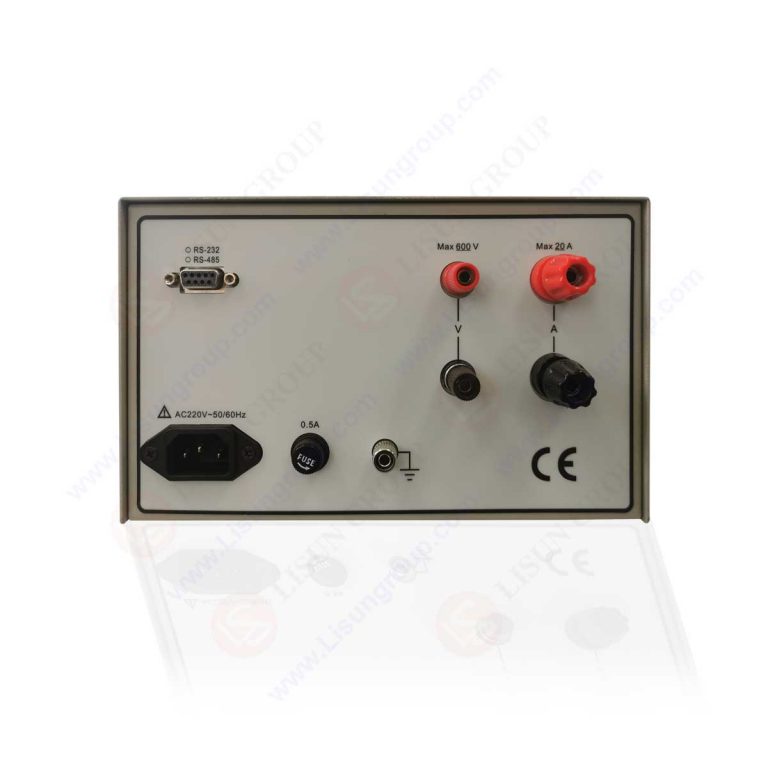
The LS2050B model provides standard accuracy for production line testing and quality control applications where throughput and reliability take priority over extreme measurement precision. This configuration delivers sufficient accuracy for pass/fail testing criteria established by manufacturing specifications. Production testing stations benefit from the RS232 communication interface, enabling automated data acquisition and statistical process control integration. The standard accuracy model accommodates the majority of LED manufacturing test requirements while maintaining cost-effectiveness for multiple test stations.
3.2 LS2050C High Accuracy Configuration
The LS2050C model enhances measurement accuracy for laboratory and calibration applications requiring extended precision. High-accuracy power measurement proves essential for photometric testing per LM-79 standards, which requires electrical measurements as input parameters for efficacy calculations. LM-79 testing operates on the integration of photometric and electrical measurements to determine luminaire efficacy in lumens per watt. Any electrical measurement error directly propagates to the efficacy calculation, potentially affecting ENERGY STAR qualification decisions. The LS2050C provides metrology-grade measurements that support defensible efficacy declarations and inter-laboratory measurement consistency.
3.3 LS2050C-IEC EMC Harmonic Compliance Configuration
The LS2050C-IEC configuration adds dedicated harmonic analysis firmware specifically designed for EN/IEC61000-3-2 compliance testing applications. This model performs the complete harmonic measurement sequence required by the standard using the specified IEC measurement method. EMC laboratories validate harmonic emissions against the applicable equipment class limits for LED lighting products. The instrument automatically calculates the percentage of the limit value for each harmonic order and provides a comprehensive compliance summary.
Table 1: Technical specification comparison of LISUN LS2050 series digital power meters
| Parameter | LS2050B | LS2050C | LS2050C-IEC |
|---|---|---|---|
| Power accuracy | ±0.5% | ±0.1% | ±0.1% |
| Harmonic analysis | Not available | 0-50th order | 0-50th order |
| Harmonic method | N/A | IEC/CSA | IEC/CSA |
| EN/IEC61000-3-2 compliance reporting | No | No | Yes |
| Frequency range | 0.5Hz-100kHz | 0.5Hz-100kHz | 0.5Hz-100kHz |
| Max instantaneous voltage | 1600V | 1600V | 1600V |
| Max instantaneous current | 50A | 50A | 50A |
| Communication ports | RS232/RS485 | RS232/RS485 | RS232/RS485 |
| Power factor measurement | Yes | Yes | Yes |
| Displacement factor measurement | Yes | Yes | Yes |
| AC/DC measurement capability | Yes | Yes | Yes |
4. Application in LED Manufacturing Testing
4.1 Production Line Electrical Validation
LED manufacturing facilities implement precision solid-state lighting electrical testing with digital power meter technology at multiple production stages. Incoming component inspection verifies that LED modules and drivers meet electrical specifications before assembly. Final product testing validates complete luminaire assemblies for compliance with rated power consumption, power factor, and standby power requirements. Test stations equipped with LS2050B instruments detect units that deviate from specification limits, triggering rejection or rework procedures. The communication interfaces enable integration with automated test equipment and manufacturing execution systems for comprehensive quality traceability.
4.2 Automotive Electronics Testing Requirements
Automotive LED lighting systems operate under stringent electrical environment conditions, including transient voltage variations and wide temperature ranges. The DC measurement capability of the LS2050 series supports testing LED lighting components designed for automotive power systems. Engineers evaluate current consumption and power dissipation across the voltage range from 9V to 16V as specified in automotive electrical system standards. Power measurement precision affects thermal design validation, as inaccurate power readings lead to incorrect thermal management decisions. Automotive lighting modules increasingly incorporate complex control electronics that require comprehensive electrical characterization during design validation.
5. EMC Compliance Testing Integration
5.1 Pre-compliance Harmonic Measurements
The precision solid-state lighting electrical testing with digital power meter serves as a pre-compliance tool for EMC testing laboratories. Manufacturers performing internal pre-compliance testing reduce the risk of failure during formal compliance testing at accredited laboratories. Pre-compliance harmonic testing identifies problematic harmonic sources and validates corrective circuit modifications before submission for formal certification. This approach reduces product development costs and accelerates time-to-market by minimizing compliance testing iteration cycles.
5.2 Standards Compliance Framework
Solid-state lighting products must comply with multiple international standards defining electrical performance and safety characteristics. EN/IEC61000-3-2 addresses harmonic current emissions for equipment connected to public low-voltage distribution systems. IEC 61010 specifies safety requirements for electrical equipment used in measurement, control, and laboratory applications. UL 1989 covers surge protective devices incorporated into lighting systems. The LS2050C-IEC supports the measurement methodology required by EN/IEC61000-3-2, while the instrument itself conforms to IEC 61010 safety requirements for laboratory equipment.
6. Communication and Data Integration
6.1 Automated Data Acquisition Systems
Modern manufacturing environments require automated data collection for statistical process control and quality management systems. The RS232 and RS485 communication interfaces on the LS2050 series enable seamless integration with industrial control systems and laboratory information management systems. Test data flows directly from the power meter to central databases without manual transcription, eliminating transcription errors and enabling real-time quality monitoring. Automated data acquisition supports comprehensive traceability from component-level testing through final product verification.
6.2 Communication Protocol Implementation
The RS232 interface provides point-to-point connectivity for laboratory applications, while the RS485 interface supports multi-drop configurations for production line installations. Standard command sets enable straightforward programming integration with LabVIEW, Python, and other test automation platforms. Engineers develop custom measurement sequences that configure measurement parameters, initiate data acquisition, and collect results in automated test scripts. The communication architecture supports simultaneous measurement of multiple parameters, reducing test cycle times in high-volume production environments.
7. Validation of Safety and Measurement Integrity
7.1 Overload Protection for Fault Conditions
Precision power meters used in testing environments encounter abnormal conditions during product fault testing and destructive analysis. The LS2050 series provides instantaneous maximum voltage capacity of 1600V and current capacity of 50A, protecting the instrument during transient overload events. This overload capability prevents instrument damage during ESD events, short-circuit conditions, and component failure scenarios commonly encountered in reliability testing. The robust input protection extends instrument service life and maintain measurement accuracy over extended operational periods.
7.2 Measurement Confidence in Compliance Testing
Compliance testing requires measurement instruments with demonstrated calibration traceability to national standards. The LS2050 series undergoes factory calibration with traceability to international measurement standards, providing the measurement confidence required for regulatory submissions. Regular calibration programs maintain measurement accuracy throughout the instrument operational life, with documented calibration certificates supporting audit and quality system requirements.
8. Conclusion
Precision solid-state lighting electrical testing with digital power meter technology provides the measurement foundation for LED product validation, quality assurance, and regulatory compliance. The LS2050 series digital power meters integrate digital sampling waveform analysis, harmonic measurement capabilities, and robust communication interfaces to address the unique challenges of solid-state lighting electrical characterization. The model differentiation between LS2050B, LS2050C, and LS2050C-IEC enables testing facilities to select the appropriate measurement precision and compliance features for their specific applications. The advanced measurement capabilities directly support compliance with EN/IEC61000-3-2 harmonic requirements, LM-79 photometric testing protocols, and IEC 61010 safety standards. Manufacturing, research and development, and EMC testing laboratories benefit from reliable electrical data that informs design decisions, validates product performance, and supports regulatory submission. Precision power measurement remains essential for advancing LED technology and ensuring product quality in increasingly demanding lighting applications.
FAQ (Frequently Asked Questions)
Q1: What is the difference between power factor and displacement factor measurements in solid-state lighting testing?
A: Power factor represents the ratio of actual power consumed to apparent power drawn from the supply, calculated as active power divided by apparent power. This comprehensive metric includes effects from both phase displacement and waveform distortion caused by non-linear loads. Displacement factor specifically measures the cosine of the phase angle between fundamental voltage and fundamental current components, isolating the phase relationship from harmonic distortion effects. In LED lighting products, the power factor typically falls below the displacement factor because of harmonic current components generated by switch-mode driver circuits. The LS2050 series measures both parameters independently, enabling engineers to evaluate power factor correction circuit effectiveness separately from overall distortion effects. This distinction becomes important when verifying EN/IEC61000-3-2 harmonic compliance and evaluating total power quality.
Q2: How does harmonic analysis support EN/IEC61000-3-2 compliance testing for LED luminaires?
A: EN/IEC61000-3-2 establishes limits on harmonic current emissions for equipment connected to public power networks, with specific classification categories for lighting equipment. The LS2050C-IEC performs harmonic analysis up to the 50th harmonic using the IEC/CSA measurement method specified by the standard. The instrument measures the harmonic components of the input current waveform and compares them against the applicable limits for the equipment classification. Compliance evaluation requires measurement under defined test conditions and confirmation that the equipment operates at rated power during testing. The instrument provides automated reporting that indicates the measured value, limit value, and percentage of limit for each harmonic order. EMC laboratories use this data to issue compliance statements and test reports supporting product certification. Pre-compliance harmonic testing during product development reduces certification time and cost for LED manufacturers.
Q3: Why does LM-79 testing require high-accuracy electrical power measurements for LED luminaires?
A: LM-79, the IES approved method for electrical and photometric measurements of solid-state lighting products, requires integrated electrical and photometric measurements to determine total luminaire efficacy. The efficacy calculation divides total luminous flux output by total input power, meaning any power measurement inaccuracy directly affects the computed efficacy value. Given that efficacy thresholds must be met for ENERGY STAR qualification and regulatory compliance programs, accurate power measurement is essential. The LS2050C high-accuracy configuration provides power measurement accuracy of ±0.1%, minimizing the uncertainty contribution from the electrical measurement component. Standard accuracy power meters with ±0.5% accuracy would introduce significantly larger uncertainty into the efficacy calculation, potentially affecting certification decisions for products operating near compliance thresholds. High-accuracy power meters ensure defensible efficacy measurements and consistency between testing laboratories.
Q4: What communication capabilities does the LS2050 series provide for automated testing systems?
A: The LS2050 series includes both RS232 and RS485 communication interfaces, enabling flexible integration with automated test systems. RS232 provides direct point-to-point communication between the power meter and a single controller, suitable for laboratory test stations. RS485 supports multi-drop networks with up to 32 devices on a single bus, enabling coordinated measurement systems in production environments. The communication interface enables bidirectional data exchange, allowing controllers to configure measurement parameters, initiate measurement cycles, and retrieve measurement results. Test automation software such as LabVIEW and Python can directly integrate with the instrument using standard command protocols. Automated data acquisition eliminates manual reading errors and supports comprehensive statistical process control programs. The communication capabilities enable implementation of closed-loop testing systems that automatically adjust test conditions based on measured parameters.
Keywords: precision solid-state lighting electrical testing, digital power meter, harmonic analysis, power factor measurement, LED compliance testing, EN/IEC61000-3-2, LM-79