









The automotive lighting industry demands rigorous validation of LED lumen maintenance and lifespan prediction to meet safety and reliability standards. This article examines the LISUN Automotive LED Lighting Aging Tester for Lumen Maintenance & L70 Prediction, focusing on the LEDLM-80PL and LEDLM-84PL systems. These instruments implement IES LM-80, TM-21, LM-84, and TM-28 methodologies along with the Arrhenius Model for accelerated aging. The systems support 6000-hour tests, L70/L50 metrics, and simultaneous connection of up to 3 temperature chambers. Key technical insights include dual-mode operation (constant current and constant temperature), customizable channels, and precise photometric measurements. For engineers, this guide provides data-driven approaches for compliance testing, lifetime extrapolation, and predictive maintenance in automotive LED applications.
1.1 The Importance of Lumen Depreciation Testing
Automotive LEDs operate under extreme thermal and electrical stress, causing gradual lumen depreciation. Lumen maintenance, expressed as a percentage of initial output, is the primary indicator of LED longevity. In applications like headlamps and daytime running lights, maintaining ≥70% luminous flux (L70) is critical for safety and user satisfaction. Testing up to 6000 hours is standard to observe degradation trends, allowing engineers to predict when an LED reaches its L70 threshold.
1.2 Key Standards: IES LM-80, TM-21, LM-84, and TM-28
The LISUN Automotive LED Lighting Aging Tester for Lumen Maintenance & L70 Prediction adheres to IES LM-80, which specifies measuring lumen depreciation of LED packages, arrays, and modules. TM-21 provides a mathematical method for long-term extrapolation (e.g., predicting L70 beyond 6000 hours) using exponential curve fitting. For newer applications, IES LM-84 and TM-28 cover full luminaires and complete systems, offering broader data for system-level reliability assessments. CIE 084 and CIE 070 supply photometric and thermal guidelines that complement these standards.
2.1 Dual System Configurations: LEDLM-80PL and LEDLM-84PL
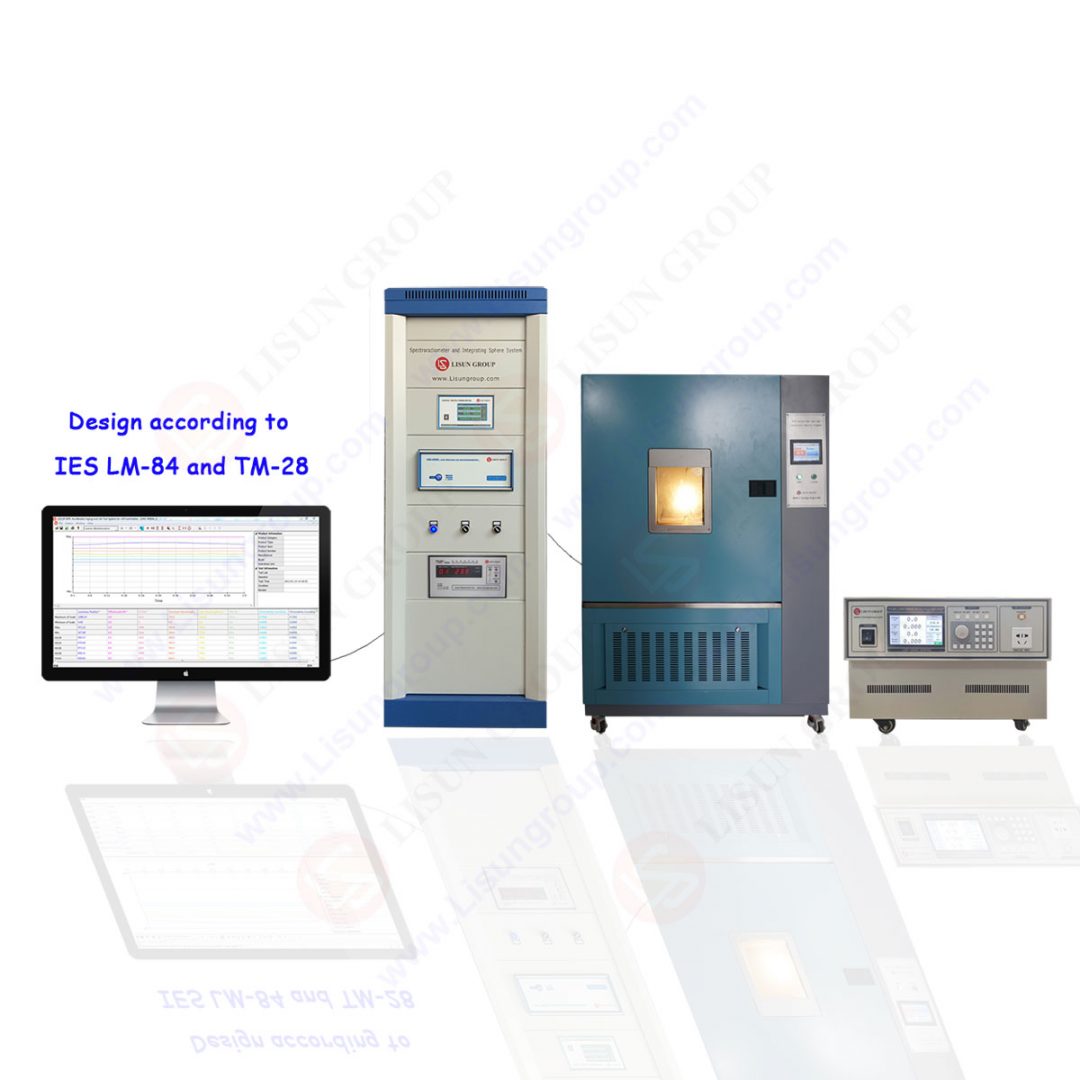
LISUN offers two primary variants within the LISUN Automotive LED Lighting Aging Tester for Lumen Maintenance & L70 Prediction. The LEDLM-80PL is optimized for IES LM-80 and TM-21 compliance, testing LED packages, arrays, and modules, while the LEDLM-84PL is designed for LM-84 and TM-28 application to complete LED luminaires. Both systems integrate high-precision integrating spheres, spectroradiometers, and temperature-controlled chambers for seamless data acquisition.
2.2 Hardware Customization and Channel Flexibility
The systems support customizable configurations to suit diverse automotive LED shapes and sizes. Users can configure up to 3 temperature chambers simultaneously, each with independent temperature control (typically 55°C, 85°C, and 105°C). Each chamber accommodates multiple test channels—up to 18—allowing parallel testing of different current and temperature parameters. Thus, engineers can accelerate aging while precisely monitoring individual LED performance in compliance with LM-80.
3.1 Constant Current Mode for Lumen Maintenance
In constant current mode, the LISUN Automotive LED Lighting Aging Tester for Lumen Maintenance & L70 Prediction maintains a fixed drive current (e.g., 350 mA, 700 mA) while measuring luminous flux at defined intervals. This aligns with IES LM-80 requirements, which specify current values typical for automotive applications. The system logs flux data every 1000 hours, providing a clear degradation curve. Longer testing (e.g., 6000 hours) improves the fidelity of TM-21 extrapolations.
3.2 Constant Temperature Mode and the Arrhenius Model
The Arrhenius Model is fundamental for accelerated aging predictions. By testing LEDs at elevated temperatures (e.g., 105°C for 6000 hours), the LISUN system derives activation energy values. These parameters allow engineers to estimate L70/L50 lifespans at lower operating temperatures using the exponential relationship between temperature and degradation rate. This dual-mode capability, where temperature is fixed while current varies, proves particularly valuable for automotive thermal management scenarios.
4.1 TM-21 Exponential Curve Fitting
The LISUN software automates TM-21 curve fitting, calculating projected L70 and L50 values. By inputting collected lumen maintenance data, the software applies the exponential decay equation, yielding projected lifetimes with confidence intervals. For instance, a 6000-hour test might predict an L70 of 50,000 hours. This statistical rigor is essential for automotive OEMs that demand verifiable long-term warranties.
4.2 Integration with LM-84 and TM-28 for System-Level Insights
For automotive luminaires, LM-84 data gathered via the LEDLM-84PL can be processed using TM-28, which accounts for optical, thermal, and electrical interactions in the complete fixture. The software supports multi-system data merging, enabling comprehensive analysis of both component-level (LM-80) and luminaire-level (LM-84) reliability. This holistic approach assists engineers in identifying failure modes such as solder joint degradation or phosphor thermal quenching.
5.1 Integrating Sphere and Spectroradiometer Integration
Accurate lumen maintenance data requires precise flux measurements. The LISUN Automotive LED Lighting Aging Tester for Lumen Maintenance & L70 Prediction integrates a 2-meter (or 1-meter) integrating sphere and a spectral flux measurement system. The sphere’s high-reflectance coating (≥97%) ensures minimal measurement uncertainty. A calibrated spectroradiometer captures spectral power distribution, enabling calculations of chromaticity shift over time—a key reliability indicator.
5.2 Compliance with IES LM-79-19 and CIE 127
Electrical and photometric measurements follow IES LM-79-19, which specifies methods for LED luminaires and integrated lamps. CIE 127 provides guidelines for LED intensity measurements, ensuring traceability. Regular calibration of the LISUN system with standard lamps (e.g., NIST-traceable) maintains accuracy within ±2% for total flux. This attention to measurement fidelity makes the system suitable for third-party testing laboratory accreditation.
6.1 Temperature and Humidity Control
Each temperature chamber in the LISUN system maintains stability within ±2°C of the set point (ambient to 105°C). Humidity control (20% to 90% RH) prevents condensation-related measurement errors. For automotive LEDs subjected to harsh environments, these conditions replicate engine bay or headlamp housing thermal loads, ensuring relevant aging data.
6.2 Electrical Drive and Monitoring
For each test channel, the LISUN Automotive LED Lighting Aging Tester for Lumen Maintenance & L70 Prediction provides programmable current sources up to 1.5 A with 0.1% accuracy. Voltage and power monitoring occur in real-time, enabling detection of early electrical failures. The system logs forward voltage and power factor changes, which correlate with thermal stress and junction temperature fluctuations, enriching the reliability analysis dataset.
7.1 Specification Comparison Table
| Feature / Parameter | LEDLM-80PL (LM-80/TM-21) | LEDLM-84PL (LM-84/TM-28) | Industry Requirement |
|---|---|---|---|
| Test Duration | 6000 hours (standard) | 6000 hours (standard) | Minimum 6000 h (LM-80) |
| Temperature Chambers | Up to 3 | Up to 3 | ≥3 for multi-point testing |
| Test Channels | 18 per chamber | 12 per chamber | Flexible per user |
| Lumen Metrics | L70, L50 | L70, L50 | L70/L50 extrapolation |
| Drive Current | 0–1.5 A (0.1% accuracy) | 0–1.5 A (0.1% accuracy) | Application-specific |
| Measurement Method | Integrating Sphere + Spectroradiometer | Integrating Sphere + Spectroradiometer | Conform LM-79-19 |
| Software Extrapolation | TM-21 | TM-28 | Standard-based |
| Humidity Control | Yes (20–90% RH) | Yes (20–90% RH) | Optional |
7.2 Practical Implications for Testing Laboratories
Third-party laboratories adopting the LISUN Automotive LED Lighting Aging Tester for Lumen Maintenance & L70 Prediction can efficiently meet accreditation requirements across IES standards. The dual-system architecture allows expanding service offerings without reinvestment in separate hardware. Consequently, laboratories can provide automotive clients with accelerated aging, photometric testing, and lifetime predictions under one umbrella, significantly reducing turnaround times for compliance reports.
The LISUN Automotive LED Lighting Aging Tester for Lumen Maintenance & L70 Prediction represents a robust solution for automotive LED reliability engineering. By supporting IES LM-80, TM-21, LM-84, and TM-28, its dual-system design enables comprehensive component and luminaire testing. The integration of Arrhenius Model-based software permits scientifically sound acceleration of aging tests, reducing product development cycles. Technical features such as up to 3 temperature chambers, 6000-hour test capability, and high-accuracy photometric measurement ensure compliance with global standards like IES LM-79-19 and CIE 127. The LISUN systems provide engineers with the precise data needed for L70/L50 prediction, thereby enabling informed warranty decisions and design optimizations. For industries demanding stringent quality assurance—automotive OEMs, LED manufacturers, and testing laboratories—LISUN’s tester offers the convergence of accuracy, flexibility, and standards alignment essential to progress in this competitive field.
Q1: How does the LISUN Automotive LED Lighting Aging Tester perform L70 prediction beyond the actual 6000-hour test duration?
A: The LISUN tester uses TM-21 data analysis on collected lumen maintenance data points (typically hourly or 1000-hour intervals). The software applies an exponential decay model, mathematically relating lumen output to time. For example, if after 6000 hours a device retains 85% of initial flux, the software extrapolates to the point where 70% remains, potentially predicting 40,000–60,000 hours. The Arrhenius Model further enhances prediction by incorporating temperature dependence, allowing estimation at multiple operating conditions. This approach is statistically validated per IES TM-21 and TM-28 guidelines, and engineers can adjust confidence intervals based on data variance. Ultimately, the system provides reliable lifetime predictions without waiting years for real-time aging.
Q2: Can the LEDLM-84PL be used for complete automotive headlamp assemblies, and how does TM-28 differ from TM-21?
A: Yes, the LEDLM-84PL accommodates complete headlamps or tail lamp assemblies. TM-28 extrapolation differs from TM-21 because it encompasses luminaire system degradation—considering optics, electronics, and thermal management interactions. While TM-21 focuses solely on LED packages, arrays, and modules, TM-28 provides application-specific projections. The LISUN system supports this by allowing lumen and chromaticity measurements of larger devices in comparable temperature chambers, ensuring compliance with LM-84. For automotive engineers, combining TM-28 results with TM-21 data helps distinguish component-level failure from system-level degradation, crucial for identifying warranty liabilities.
Q3: What is the significance of the Arrhenius Model in the LISUN software for automotive LED testing?
A: Automotive LEDs often operate at high temperatures (e.g., 80–120°C). The Arrhenius Model in LISUN software calculates activation energy (EA) from multiple temperature aging tests, typically at 55°C, 85°C, and 105°C. This thermal acceleration factor allows extrapolating high-temperature test results to lower, real-world operating temperatures, saving time and resources. For example, a test at 105°C for 6000 hours might be equivalent to 20,000 hours at 60°C. Without this model, waiting for real-time lifespans would be infeasible. The software automatically fits EA to experimental data, enhancing the credibility of L70 predictions for automotive OEMs.
Q4: What are the requirements for connecting 3 temperature chambers, and how does data synchronization work?
A: The LISUN system supports simultaneous operation of up to 3 chambers, each with independent temperature and current settings. The main controller synchronizes data acquisition across chambers, integrating measurement intervals (e.g., every 1000 hours). This allows engineers to test multiple LED batches or different current/temperature conditions concurrently, accelerating R&D. For example, one chamber might test the impact of high current (700 mA) at 85°C, another low current (350 mA) at 85°C, and a third high humidity condition (90% RH). The LISUN software aggregates all datasets, facilitating complete ANOVA analysis to isolate degradation factors.
Q5: How does the system ensure measurement accuracy for luminous flux in long-duration tests?
A: During 6000-hour tests, instrument drift must be mitigated. The LISUN integrating sphere features a high-stability coating with minimal degradation, and the system includes an in-situ calibration function using an auxiliary lamp mounted inside the sphere. Before each measurement, it recalibrates the sphere’s spectral response. Additionally, the spectroradiometer operates with a cooled CCD to maintain low dark current (≤0.02%) even after prolonged usage. The system’s software also applies correction factors for self-absorption caused by the LED and fixture geometry, ensuring flux accuracy within ±2% traceable to NIST standards.