









Abstract
Third-Party LED Testing Lab Services for LISUN Aging Testers represent a critical bridge between manufacturers’ internal validation and independent, standards-compliant certification. This article examines how LISUN’s LEDLM-80PL and LEDLM-84PL systems enable third-party laboratories to conduct rigorous lumen maintenance testing, leveraging Arrhenius Model-based software for accelerated aging predictions. We explore IES LM-80, TM-21, IES LM-84, and TM-28 standards integration, dual testing modes for flexible workflows, and hardware configurations supporting up to three connected temperature chambers. The content provides technical professionals with actionable insights into 6000-hour test protocols, L70/L50 metric calculations, and the operational advantages of independent testing services. Readers will gain a comprehensive understanding of how LISUN aging testers enhance reliability, compliance, and market acceptance for LED products.
1.1 Why Independent Validation Matters
Third-Party LED Testing Lab Services for LISUN Aging Testers have become indispensable for manufacturers seeking market credibility. Independent laboratories provide objective, unbiased data that internal testing teams may inadvertently compromise through familiarity with expected outcomes. When an automotive electronics component supplier submits LED modules for LM-80 testing, the resulting report carries legal weight in contractual disputes, regulatory audits, and customer procurement decisions. The separation between production and validation ensures data integrity, which is foundational for establishing the 6000-hour lumen maintenance datasets that TM-21 extrapolation requires.
Moreover, third-party labs often possess accreditations that manufacturers cannot reasonably obtain. ISO/IEC 17025 accreditation demonstrates technical competence and traceability, which many automotive and aerospace customers mandate as a precondition for supplier approval. Independent test houses also stay current with evolving standards, ensuring that their test methodologies reflect the latest CIE 127 measurement guidelines and IES LM-79-19 photometric requirements.
1.2 Economic Implications of Test Outsourcing
The capital investment for a complete LED aging test facility with thermal chambers, integrating spheres, and spectroradiometers can exceed hundreds of thousands of dollars. For small-to-medium LED manufacturers, outsourcing to third-party facilities using LISUN equipment presents a financially rational alternative. Laboratories can amortize equipment costs across multiple clients, offering per-test pricing that scales with project complexity. The LISUN LEDLM-84PL, for instance, supports simultaneous testing of multiple device samples, maximizing throughput and reducing per-sample costs for the lab and the client.
Time-to-market pressures further drive outsourcing decisions. A 6000-hour LM-80 test represents approximately 250 days of continuous operation. Third-party labs operating LISUN aging testers can manage multiple concurrent campaigns, allowing manufacturers to parallelize validation efforts across product lines. This acceleration directly impacts product launch timelines and revenue forecasts, making independent testing services strategically valuable.
2.1 LEDLM-80PL: The LM-80/TM-21 Workhorse
The LISUN LEDLM-80PL system is engineered specifically for IES LM-80-08 and IES LM-80-15 compliant testing. Its dual-channel architecture supports both constant current and constant voltage modes, accommodating diverse LED packages, arrays, and modules. The system’s integrating sphere assembly captures total luminous flux, ensuring that the photometric measurements align with IES LM-79-19 requirements for spatial flux distribution. Temperature control within ±2°C tolerance meets the stringent environmental stability criteria that LM-80 mandates, while the data acquisition interval can be programmed from 1 minute to 24 hours, allowing laboratories to balance resolution with data storage efficiency.
The LEDLM-80PL’s control software performs automatic TM-21 extrapolation using the Arrhenius Model. This mathematical foundation calculates the activation energy from test data at elevated case temperatures (typically 55°C, 85°C, and 105°C), then projects lumen maintenance to the 6000-hour (or 10000-hour) reporting intervals. The software’s curve-fitting algorithms select between exponential and power-law decay models based on statistical goodness-of-fit, ensuring the extrapolated L70 and L50 values are statistically defensible.
2.2 LEDLM-84PL: Advancing to LM-84/TM-28 Protocols
For laboratories addressing newer IES LM-84-19 and TM-28-14 standards, the LISUN LEDLM-84PL offers enhanced capabilities. This system incorporates four independent test channels with individual temperature control, enabling simultaneous characterization of different LED types under varied thermal conditions. The LEDLM-84PL’s expanded measurement range extends to 200,000 lux, suitable for high-brightness LED chips used in automotive headlamps and horticultural lighting applications. Its photometric sensor integrates a Class A spectral response correction filter, minimizing errors when measuring phosphor-converted white LEDs with distinct spectral power distributions.
The system’s TM-28 software module supports the nonlinear least-squares fitting required for lumen depreciation projections beyond the 6000-hour data collection window. Unlike TM-21’s assumption of exponential decay, TM-28 accommodates more complex degradation trajectories, including those exhibiting a plateau followed by rapid decline. This flexibility is particularly valuable for third-party labs serving clients with non-standard LED chemistries or novel packaging architectures.
Table 1: LISUN Aging Tester System Comparison
| Parameter | LEDLM-80PL | LEDLM-84PL |
|---|---|---|
| Compliance Standard | IES LM-80-15, TM-21-11 | IES LM-84-19, TM-28-14 |
| Test Channels | 2 (multi-position) | 4 (independent) |
| Temperature Control | ±2°C | ±1.5°C |
| Maximum Luminous Flux Range | 200,000 lm | 200,000 lm |
| Data Acquisition Interval | 1 min – 24 hr | 10 sec – 24 hr |
| Temperature Chambers Supported | Up to 3 | Up to 4 |
| Extrapolation Model | TM-21 (Arrhenius) | TM-28 (Nonlinear LS) |
| Typical Test Duration | 6000 – 10000 hours | 6000 – 10000 hours |
| Measurement Uncertainty | ±2% | ±1.5% |
| Spectral Correction | Class B | Class A |
3.1 IES LM-80 and LM-84 Methodologies
Third-Party LED Testing Lab Services for LISUN Aging Testers must anchor their reporting procedures to recognized standards. IES LM-80 (Approved Method: Measuring Lumen Maintenance of LED Light Sources) prescribes a minimum 6000-hour test duration with luminous flux measurements taken at least every 1000 hours following an initial 500-hour stabilization period. The standard mandates that samples be tested at three different case temperatures: one at 55°C, one at 85°C, and recommended third at 105°C, though the exact temperatures may vary based on the LED’s rated maximum. LISUN’s LEDLM-80PL accommodates these requirements through its multi-chamber configuration, which can independently maintain three temperature zones for simultaneous comparative analysis.
IES LM-84-19 extends this framework by introducing shorter test pathways and functional operation modes. The standard permits 3000-hour minimum testing when samples exhibit predictable degradation patterns, with data collection protocols that align with TM-28’s statistical requirements. Third-party labs employing the LEDLM-84PL can offer clients expedited LM-84 validation, which is particularly advantageous for bridge luminaires and retrofit kits where time-to-market dominates engineering decisions.
3.2 TM-21 and TM-28 Projection Methodologies
TM-21 (Projecting Long Term Lumen Maintenance of LED Light Sources) applies exponential curve fitting to LM-80 data, calculating the rate of lumen depreciation and projecting the time to reach L70 (70% initial lumen output) or L50 (50% initial output). The standard’s statistical requirements mandate that the projection period not exceed 5.5 times the test duration, capping reputable projections at 33,000 hours for a 6000-hour test. LISUN’s Arrhenius Model implementation within the LEDLM-80PL software automatically applies these statistical constraints, generating confidence intervals that labs can report alongside point estimates.
TM-28 provides an alternative projection pathway based on IES LM-84 data, incorporating both lumen maintenance and color shift observations. The standard’s nonlinear regression approach accommodates biphasic degradation patterns that TM-21’s linear-exponential assumption may misrepresent. Third-party labs performing TM-28 projections must carefully document the selection of fitting models, as the choice between power-law and exponential decay significantly impacts projected lifetime values. The LISUN LEDLM-84PL software provides diagnostic plots of residuals, enabling lab technicians to validate model assumptions before issuing final reports.
4.1 Sample Preparation and Socket Configuration
Establishing a robust testing workflow begins with sample preparation that mirrors application conditions. Third-party labs must exercise control over sample mounting orientation, thermal interface materials, and lead wire gauge—factors that materially affect case temperature measurements. The LISUN aging testers accommodate standard 2-pin and 4-pin LED packages, with interchangeable sockets designed for different mechanical footprints. For chip-on-board (COB) LED arrays, laboratory technicians employ custom thermal fixtures that replicate the thermal resistance of production heat sinks, ensuring that the junction temperature during testing approximates real-world operating conditions.
Each test position within the LEDLM-84PL system includes its own current source with ±0.5% accuracy, configured via software-controlled digital-to-analog converters. The system logs current and voltage values continuously, providing traceability for photometric measurements. Laboratory standard operating procedures should specify verification checks using calibrated reference LEDs at 1000-hour intervals, ensuring that system drift does not introduce systematic errors into the lumen maintenance dataset.
4.2 Data Acquisition and Report Generation
Third-Party LED Testing Lab Services for LISUN Aging Testers generate comprehensive datasets that support both internal decision-making and external certification. The LISUN software exports data in CSV and XML formats, facilitating integration with laboratory information management systems (LIMS). Automated report templates structure the final output according to IES technical memorandum guidelines, including mandatory sections for environmental conditions, electrical driving conditions, and photometric measurement uncertainty budgets.
The Arrhenius Model analysis within the software calculates the degradation rate constant (k) at each test temperature, then determines the activation energy (Ea) via linear regression of ln(k) versus 1/T (Kelvin). This thermally activated kinetics approach assumes that lumen depreciation follows first-order decay processes, which is empirically validated for most phosphor-converted white LEDs operating within their rated temperature envelope. The software outputs the projected L70 lifetime at application-specific temperatures, allowing clients to assess warranty risk and replacement schedules for their products.
5.1 Dual Testing Modes: Lumen Maintenance and Color Shift
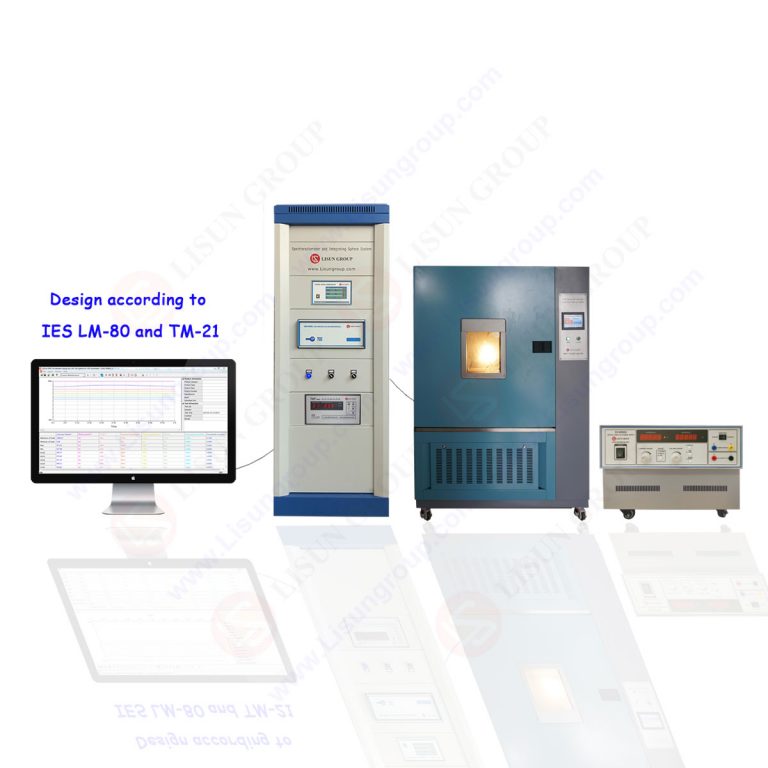
The LISUN aging testers’ dual testing modes extend beyond simple lumen flux tracking. The LEDLM-84PL simultaneously monitors chromaticity coordinates (u’, v’ per CIE 1976 UCS diagram), correlated color temperature (CCT), and color rendering index (CRI). This comprehensive spectral analysis addresses the growing industry concern over color shift, which may occur at different rates than luminous flux degradation. IES TM-28 explicitly acknowledges the importance of chromaticity maintenance in its projection methods, and third-party labs can provide dual datasets that give clients a complete reliability picture.
The instrument’s integrating sphere design incorporates a spectroradiometer with 1 nm wavelength resolution, enabling detection of spectral power distribution changes over the 6000-hour test period. This capability allows detection of phosphor degradation, which typically manifests as a relative decrease in long-wavelength emission beyond what luminous flux alone would indicate. For automotive signal lighting applications, where color consistency is safety-critical, such detailed photometric characterization proves essential for compliance evaluation.
5.2 Thermal Chamber Integration and Environmental Control
Each LISUN aging tester supports up to three connected temperature chambers, enabling simultaneous testing at different thermal setpoints. The chambers employ forced-air circulation with proportional-integral-derivative (PID) temperature controllers to maintain setpoint stability within ±1°C across the chamber volume. Humidity control options allow labs to explore combined temperature-humidity stress conditions, though standard LM-80 protocols stipulate low-humidity environments to isolate thermal effects.
The system’s software coordinates chamber temperature logging with photometric data collection, creating synchronized timestamps that facilitate time-dependent degradation analysis. Laboratories can program thermal cycling profiles (e.g., 25°C to 85°C transitions with specified dwell times) to evaluate thermomechanical stress effects on solder joints and wire bonds. This accelerated testing capability supports clients investigating failure modes that emerge under thermal expansion mismatch, providing third-party labs with a differentiated service offering beyond standard LM-80 compliance testing.
6.1 Calculating Lumen Maintenance Thresholds
The L70 and L50 metrics define the operational lifetime of LED products at 70% and 50% of initial luminous flux, respectively. TM-21 extrapolations provide the projected time to reach these thresholds under specified thermal conditions. For example, a high-brightness LED tested at 85°C may exhibit an L70 of 45,000 hours, whereas the same LED operated at 55°C case temperature might project L70 beyond 120,000 hours. Third-party labs must clearly communicate that these values represent statistical projections, not physical measurements to failure.
LISUN’s software automatically calculates both metrics with 90% confidence intervals, aligning with the statistical rigor expected in engineering reliability assessments. The confidence bounds account for sample-to-sample variation within the test batch, the fitting model’s residual uncertainty, and the projection horizon’s inherent extrapolation risk. Accredited laboratories should report these confidence intervals alongside point estimates, giving downstream users the data necessary for conservative design margins.
6.2 Communicating Results to Diverse Stakeholders
Technical data from aging tests must be translated into actionable information for different audiences. For procurement engineers, the L70 lifetime and its associated warranty implications dominate purchasing decisions. For reliability teams, activation energy values provide input for system-level lifetime predictions across varied operating environments. For regulatory affairs specialists, the standards-compliance statement carries legal significance for market access in jurisdictions that mandate LM-80 data submission.
Third-Party LED Testing Lab Services for LISUN Aging Testers should include interpretation services in their offerings. Experienced laboratories contextualize results against industry benchmarks—for instance, comparing a client’s LED modules against the performance of comparable products from prior test campaigns. This benchmarking adds value beyond raw data, positioning the third-party lab as a trusted technical partner rather than a mere data collection service. Thorough documentation of test conditions, system configurations, and statistical methodologies ensures reproducibility and defends against future quality disputes.
7.1 Internal Proficiency Testing and Equipment Calibration
Maintaining accreditation requires systematic quality assurance programs. Third-party labs must calibrate photometric equipment against national standards traceable to organizations such as NIST or PTB, typically on an annual cycle. LISUN aging testers incorporate calibration ports for reference standard lamps, enabling in-situ verification of system accuracy without instrument disassembly. The software logs calibration dates and results, generating audit trails that satisfy ISO/IEC 17025 documentation requirements.
Proficiency testing programs, where laboratories measure identical LED samples and compare results against peer institutions, provide external validation of measurement competency. LISUN systems’ measurement repeatability, typically within ±0.5% for consecutive flux measurements, ensures that inter-laboratory comparisons yield meaningful results. Laboratories should maintain participation in at least one proficiency testing scheme per accreditation cycle, demonstrating technical competence to assessors.
7.2 Data Integrity and Cybersecurity Considerations
The digital transformation of test laboratories introduces cybersecurity risks that third-party providers must address. LISUN’s software implements user authentication with role-based access controls, maintaining a complete audit trail of data modifications. Tests conducted under good automated laboratory practice (GALP) frameworks benefit from these features, as regulatory bodies increasingly scrutinize electronic data integrity. The software’s electronic signatures comply with 21 CFR Part 11 expectations, supporting pharmaceutical and medical device lighting applications where data authentication is mandatory.
Network-connected instruments require robust security protocols. Laboratories should segment test equipment networks from general office IT systems, implementing firewall rules and intrusion detection that prevent unauthorized data access. The LISUN aging tester’s local data storage capability ensures test continuity even during network disruptions, with automated synchronization to central servers upon reconnection. This resilience aligns with the operational continuity expectations of commercial testing contracts.
Third-Party LED Testing Lab Services for LISUN Aging Testers provide the independent validation essential for LED products seeking market acceptance across automotive, horticultural, architectural, and consumer lighting sectors. LISUN’s LEDLM-80PL and LEDLM-84PL systems embody the technical rigor required for IES LM-80, IES LM-84, TM-21, and TM-28 compliance, delivering 6000-hour lumen maintenance data with statistical confidence that manufacturers can leverage for warranty development and regulatory submissions. The Arrhenius Model-based software accelerates time-to-insight, while support for up to three connected temperature chambers enables comprehensive thermal characterization in a single campaign.
Third-party laboratories offering these services differentiate themselves through operational excellence—controlled sample preparation, meticulous data acquisition, and transparent reporting. The dual testing modes for lumen maintenance and color shift position LISUN-based test houses at the forefront of reliability engineering, addressing emerging industry concerns about spectral stability. For manufacturers evaluating LED components, partnering with an accredited third-party lab operating LISUN equipment provides the technical credibility that internal testing cannot replicate. As lighting technology evolves toward smarter, more integrated systems, independent validation becomes not merely a compliance requirement but a strategic differentiator. LISUN’s commitment to standards alignment, measurement accuracy, and user-centric software ensures that third-party testing services remain relevant and valuable in the dynamic photometric testing landscape.
Q1: What is the difference between LM-80 and LM-84 testing protocols, and why would a third-party lab choose the LEDLM-84PL for LM-84 tests?
A: IES LM-80 is the traditional standard that mandates a minimum 6000-hour test duration with specific case temperature requirements, typically using three temperature setpoints. LM-84 is a more recent standard allowing shorter testing periods (3000 hours minimum) and directly supports functional operation modes. The LISUN LEDLM-84PL is specifically designed for LM-84 compliance, offering four independent test channels versus the LEDLM-80PL’s dual channels, which enables higher sample throughput in shorter test windows. LM-84 also integrates with TM-28 projection methodology, which accommodates nonlinear degradation patterns that TM-21’s exponential model may not capture. Laboratories serving clients with rapid product iteration cycles often prefer LM-84 validation to reduce time-to-market, while maintaining statistical rigor through TM-28’s nonlinear least-squares fitting approach.
Q2: How does the Arrhenius Model in LISUN aging testers improve the accuracy of lifetime projections?
A: The Arrhenius Model describes the temperature-dependent rate of chemical reactions, which applies to many LED degradation mechanisms such as phosphor conversion efficiency loss and die-attach solder fatigue. LISUN’s software applies this model to the lumen depreciation data collected at various case temperatures (e.g., 55°C, 85°C, 105°C). By plotting the natural logarithm of the degradation rate constant against the reciprocal of absolute temperature, the software derives the activation energy—a measure of temperature sensitivity. This parameter enables extrapolation of lumen maintenance to application-specific operating temperatures, not just the tested setpoints. The model’s predictive accuracy improves with testing across a wider temperature range because more data points constrain the regression. However, the Arrhenius assumption of single-mechanism kinetics may not hold for all LED constructions, which is why LISUN systems also support TM-28’s model flexibility for complex degradation profiles.
Q3: Can third-party testing laboratories use LISUN aging testers to evaluate LED color shift in addition to lumen maintenance?
A: Yes, the LISUN LEDLM-84PL system incorporates spectroradiometric measurement capabilities that record full spectral power distributions at each data collection interval. This functionality allows simultaneous determination of chromaticity coordinates (u’, v’), correlated color temperature, and rendering metrics alongside luminous flux data. TM-28 projection methodology can analyze color shift rates, providing L70/B50-type metrics that incorporate color angularity changes. This dual-parameter characterization is increasingly critical for applications such as museum lighting and horticultural cultivation, where spectral quality affects output quality. Third-party labs can generate comprehensive reliability reports that communicate both lumen depreciation and chromaticity drift, giving downstream product developers the full dataset needed for application-specific lifetime assessments.
Q4: What statistical confidence intervals should third-party laboratories report with TM-21 projections?
A: TM-21 requires that projected lifetimes be reported with a 90% confidence interval, typically calculated using the t-distribution corresponding to the number of samples tested. For a standard LM-80 test with 20 samples, the degrees of freedom (n-1 = 19) yield a t-value of approximately 1.73 for two-tailed 90% confidence. LISUN’s software automatically computes these intervals, incorporating the residual error from curve fitting and the sample-to-sample variance in measured flux values. Laboratories should also report the projected interval relative to the test duration; TM-21 explicitly states that projections beyond 5.5 times the test duration lack statistical validity. For a 6000-hour test, this caps defensible projections at 33,000 hours. Clients requesting longer projections should be advised that extended testing (e.g., 10000-hour LM-80 campaigns) provides the empirical basis for longer lifetime claims.
Q5: What are the key considerations for integrating a LISUN aging tester into an ISO/IEC 17025 accredited test laboratory?
A: ISO/IEC 17025 accreditation requires documented procedures covering equipment calibration, personnel training, environmental condition monitoring, and quality control verification. For integration of LISUN aging testers, laboratories must first perform an initial equipment qualification, including installation verification and operational performance checks. Calibration should establish photometric traceability using reference lamps certified by a national metrology institute. Personnel must demonstrate competency in operating the software, interpreting statistical outputs, and maintaining the system to prevent measurement drift. The laboratory’s quality manual should incorporate procedures for test method validation against reference standards, often achieved through inter-laboratory comparisons. Standard operating procedures must specify instrument maintenance schedules—typically annual photometric calibration and quarterly electrical accuracy checks. The LISUN system’s data logging and audit trail capabilities support compliance with the standard’s data integrity requirements.