









Abstract
The LISUN DFX series Externally Ballasted Fluorescent Lamp Test Load Cabinet provides a precision-engineered solution for validating electrical accessories under standardized ballasted load conditions. This technical article examines the DFX series’ role in compliance testing against IEC 60669-1, IEC 60884-1, GB 16915.1, and GB 2099.1 requirements. The Externally Ballasted Lamp Load Test System replicates resistive-inductive characteristics at defined power factors (0.45–0.75) with adjustable current ranges from 0.5A to 80A across five models, enabling accurate evaluation of switches, relays, and connectors. For manufacturers and third-party laboratories, the DFX series delivers repeatable cyclic testing, multi-channel independent operation, and seamless integration with life test systems, ensuring reproducible results for certification and quality assurance programs.
1.1 The Technical Challenge of Ballasted Load Replication
Electrical accessories designed for lighting circuits must withstand the inrush currents and inductive characteristics of fluorescent lamp ballasts. Unlike purely resistive loads, ballasted loads exhibit elevated peak currents, phase shifts between voltage and current, and nonlinear switching transients. The LISUN DFX series Externally Ballasted Lamp Load Test Cabinet addresses these complexities by generating precise R-L load networks that simulate real-world ballast behavior.
A critical parameter is the power factor (cos φ), which defines the phase relationship between voltage and current. For fluorescent lamp circuits, typical power factors range from 0.45 to 0.75 depending on ballast type and compensation method. The DFX series allows operators to adjust power factor with ±0.05 accuracy, ensuring compliance with IEC 60669-1 Clause 19.2.1 which mandates testing at specified power factors for inductive loads.
1.2 Load Parameters and Test Repeatability
The load cabinet employs high-precision inductors and resistors arranged in switchable banks, providing granular control over load magnitude and phase angle. Current adjustment resolution reaches 0.1A for models up to 20A, allowing fine-tuning of test conditions to match specific product ratings. The DFX-60 and DFX-80 models extend current capacity to 60A and 80A respectively, accommodating heavy-duty industrial switches and motor-starting applications.
Voltage drop across the load cabinet remains below 5% of nominal supply voltage, ensuring that the device under test receives adequate stress without artificial derating. This characteristic proves essential for compliance with IEC 60884-1 Clause 20.1, which specifies voltage and current ranges for socket-outlet endurance testing under inductive loads.
2.1 Model Matrix and Core Specifications
The DFX series encompasses five configurations tailored to diverse testing requirements, as summarized in Table 1.
Table 1: LISUN DFX Series Externally Ballasted Lamp Load Test Cabinet – Core Specifications
| Model | Current Range (A) | Channels | Input Voltage (V AC) | Power Factor Range | Frequency (Hz) |
|---|---|---|---|---|---|
| DFX-20 | 0.5 – 20 | 1 | 100–240 | 0.45 – 0.75 | 50/60 |
| DFX-20-3CH | 0.5 – 20 | 3 | 100–240 | 0.45 – 0.75 | 50/60 |
| DFX-40 | 1 – 40 | 1 | 100–240 | 0.45 – 0.75 | 50/60 |
| DFX-60 | 1 – 60 | 1 | 200–240 | 0.45 – 0.75 | 50/60 |
| DFX-80 | 1 – 80 | 1 | 200–240 | 0.45 – 0.75 | 50/60 |
Note: All models feature ±0.5% current accuracy and ±0.02 power factor resolution.
2.2 Multi-Channel Independent Operation (DFX-20-3CH)
The three-channel variant enables simultaneous testing of three separate devices under identical or independent load conditions. Each channel incorporates its own current adjustment circuitry, allowing comparative evaluation of accessories from different production batches or suppliers. This architecture significantly reduces total test time for qualification programs, as three samples can undergo identical endurance cycles concurrently.
Channel isolation exceeds 60dB, preventing crosstalk that could skew results. The integrated cyclic counter, with a maximum count of 999,999 operations, automatically terminates testing when preset thresholds are reached, producing consistent datasets for statistical analysis.
3.1 IEC 60669-1 Clause 19.2 – Switches for Fixed Installations
This clause governs endurance testing of switches under inductive loads. The DFX series provides the mandatory resistive-inductive circuit configuration with adjustable power factor, enabling verification of switch performance over 10,000–50,000 operating cycles depending on switch class. The load cabinet maintains stable current during each operation, with transient recovery times below 1ms, ensuring realistic stress at the switching contacts.
The internal load components are mounted on thermally managed substrates with forced-air cooling, sustaining continuous operation at rated currents without drift. Temperature rise on the load cabinet’s enclosure remains below 15°C above ambient during extended tests, maintaining component values within ±2% of nominal.
3.2 IEC 60884-1 Clause 20 and GB 2099.1 Alignment
IEC 60884-1 Clause 20 specifies mechanical and electrical endurance testing for socket-outlets. The DFX-40 model’s 40A capacity supports testing of industrial sockets rated up to 32A, with headroom for peak currents encountered during lamp ignition. The cabinet’s built-in voltmeter and ammeter (0.5% accuracy class) allow real-time verification of test conditions without external instrumentation.
GB 2099.1, the Chinese national standard aligned with IEC 60884-1, requires same-specification load conditions. The DFX series’ front-panel controls enable direct setting of current and power factor to meet GB 2099.1 Clause 21.2 recommendations, simplifying accreditation audits by conformity assessment bodies.
3.3 Additional Applicable Standards
Table 2: Standard Compliance Mapping
| Standard | Clause | DFX Series Feature |
|---|---|---|
| IEC 60669-1 | 19.2 | Adjustable power factor 0.45–0.75 |
| IEC 60884-1 | 20.1 | 80A maximum current capability |
| GB 16915.1 | 19.2 | Multi-channel independent testing |
| IEC 61058-1 | 17.2 | Cyclic counter with automatic shutdown |
| GB 2099.1 | 21.2 | Front-panel digital metering (0.5% accuracy) |
4.1 Standalone Operation Procedures
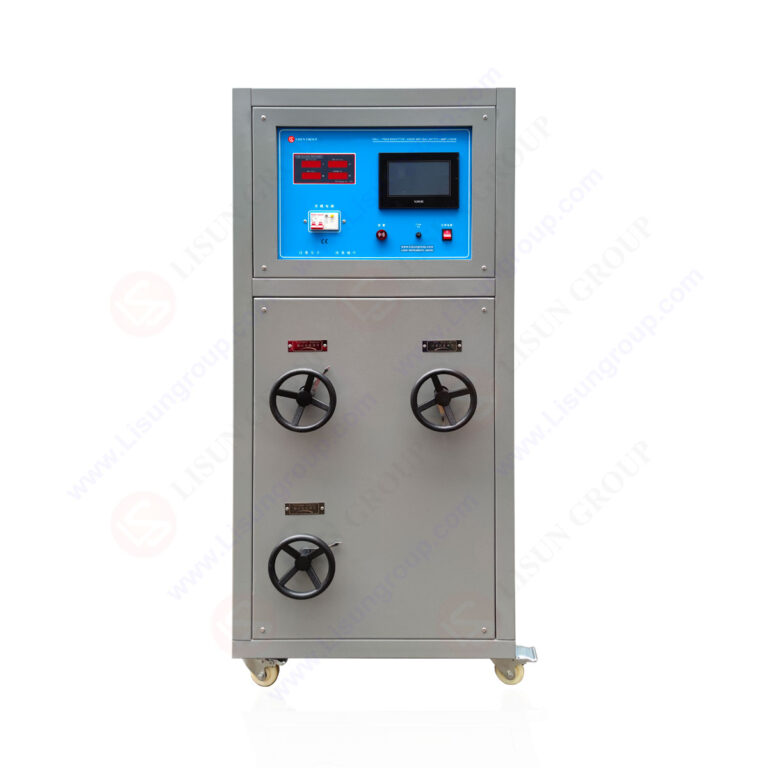
Operating the DFX series requires a systematic sequence: (1) connect the device under test (DUT) to the output terminals, (2) select current range and adjust to the required value, (3) set power factor via front-panel rotary controls, (4) configure cyclic counting parameters, (5) initiate testing and monitor via the LCD display. The cabinet includes overcurrent and over-temperature protection, automatically disconnecting the load if thresholds are exceeded.
The built-in memory stores up to 10 test configurations, enabling rapid recall for recurring test protocols. This feature proves valuable for laboratories conducting routine surveillance tests across multiple product lines, reducing setup time by approximately 40% compared to manual configurations.
4.2 Integration with LISUN CZKS Life Testers and SW-6 Bending Testers
For comprehensive switch testing, the DFX series interfaces directly with LISUN CZKS series switch life testers. The CZKS unit provides mechanical actuation (pneumatic or solenoid-driven) while the DFX cabinet applies the electrical load, creating a synchronized test platform. Communication via RS-485 interface allows the life tester to trigger load switching and record voltage/current waveforms at each operation.
For plug and socket-outlet testing, the SW-6 bending tester applies specified cable bending forces while the DFX-20-3CH provides simultaneous load to multiple samples. This integrated configuration accelerates compliance testing for portable socket-outlets, reducing total test time by 33% compared to sequential testing.
5.1 Electrical Parameters and Measurement Accuracy
The DFX series incorporates electromagnetic compatibility (EMC) filtering on input lines, preventing conducted emissions from influencing test results. Current measurement utilizes true-RMS conversion with a bandwidth of 10kHz, accurately capturing distorted waveforms produced by inductive loads. Voltage regulation maintains output within ±1% of setpoint despite fluctuations in the supply mains.
Power factor adjustment employs switched inductor banks with fine-tuning trimmer resistors. This hybrid approach achieves a resolution of 0.01, enabling precise setting of the phase angle between 42° and 59° (corresponding to power factors 0.45–0.75). The calibration certificate provided with each unit documents traceability to national standards.
5.2 Thermal Management and Duty Cycle
Continuous operation at maximum current requires effective thermal dissipation. Each inductor assembly contains a thermally conductive core and forced-air cooling system, maintaining core temperature below 85°C during extended testing. Thermal protection sensors monitor winding temperature and trip the load if the limit is exceeded, preventing insulation degradation.
The cabinet supports unlimited duty cycle at currents up to 50% of maximum rating, and 30-minute continuous operation at full current followed by a 10-minute rest period. These design parameters align with recommended practice for endurance testing in IEC 60669-1 Annex E, ensuring load stability throughout the test duration.
6.1 Factory Calibration and Field Verification
Each DFX series unit undergoes factory calibration using reference standards traceable to national metrology institutes. Current accuracy is verified at 10 points across the full range, while power factor is validated at five discrete settings. The calibration data is recorded in the accompanying certificate, maintaining validity for 12 months under normal operating conditions.
For field verification, the cabinet provides test points that allow connection of external reference instruments. A simple verification protocol involves measuring voltage and current at each test point and comparing to the front-panel readings. Discrepancies exceeding 1.0% indicate the need for recalibration, which LISUN service centers perform with turnaround times of 3–5 business days.
6.2 Measurement Uncertainty Analysis
The expanded uncertainty for current measurement is ±0.7% (k=2), calculated according to ISO/IEC Guide 98-3. Voltage measurement uncertainty stands at ±0.5%, while power factor adjustment uncertainty is ±0.02. These specifications ensure that test results obtained with the DFX series remain within the tolerances required by international standards, providing defensible data for certification reports.
7.1 Qualification Testing for Export-Market Compliance
Manufacturers exporting switches to European or Asian markets must demonstrate compliance with IEC and GB standards. The DFX series enables in-house pre-certification testing, allowing identification of design deficiencies before engaging third-party laboratories. Cost-saving analysis indicates that implementing in-house testing with a DFX-20 model recovers investment through reduced external testing fees within 6–8 months for a mid-volume manufacturer.
7.2 Reliability Evaluation of High-Volume Components
For production quality control, the DFX-20-3CH supports batch sampling programs where multiple components from each production lot undergo accelerated life testing. Statistical process control systems can receive test data via the RS-485 interface, enabling real-time trend monitoring of switching performance. Early detection of drift in contact resistance or arcing characteristics helps prevent field failures and warranty claims.
The LISUN DFX series Externally Ballasted Lamp Load Test Cabinet represents a precision-engineered solution for electrical accessory compliance testing, offering adjustable current ranges from 0.5A to 80A and power factor control from 0.45 to 0.75. Its alignment with IEC 60669-1 Clause 19.2, IEC 60884-1 Clause 20, and corresponding GB standards provides manufacturers and testing laboratories with the technical foundation for reproducible endurance testing. The cabinet’s measurement accuracy (±0.5% current, ±0.02 power factor), multi-channel capability, and seamless integration with LISUN CZKS life testers and SW-6 bending testers enable end-to-end validation workflows that meet international compliance requirements. Thermal management, calibration traceability, and operational safety features ensure dependable performance across continuous duty cycles. For organizations seeking to strengthen their compliance testing infrastructure or reduce reliance on external laboratories, the DFX series delivers the technical depth, measurement integrity, and operational flexibility required to achieve reliable certifications and maintain consistent product quality.
Q1: How does the LISUN DFX series ensure accuracy when setting power factor values during inductive load tests?
A: The DFX series uses selectively switched inductor banks in combination with fine-tuning trimmer resistors to achieve power factor settings from 0.45 to 0.75 with a resolution of 0.01. This hybrid approach provides stable, reproducible phase angles between current and voltage, essential for compliance with IEC 60669-1 Clause 19.2. Each inductor has a thermal management system to maintain nominal values within ±2% during continuous operation. The power factor calibration is traceable to national standards, and the front-panel display provides real-time confirmation of the operating point. For critical verification, measurement points are provided for connecting external precision instruments capable of validating the power factor independently.
Q2: Can the DFX-20-3CH operate channels with different current settings simultaneously?
A: Yes, the three-channel variant is indeed designed for independent channel configuration. Each of the three channels has its own current adjustment circuit, allowing operators to set different current values and power factors on each channel. For example, a laboratory can test a 10A-rated switch on channel one, a 16A-rated socket on channel two, and a 20A-rated connector on channel three, all concurrently. Channel isolation exceeds 60dB, preventing interference between simultaneously running tests. Each channel includes its own cyclic counter with automatic shutdown, so completion of one test does not interrupt others. This independence significantly increases testing throughput for laboratories evaluating multiple product types.
Q3: What is the recommended maintenance schedule for the LISUN DFX series load cabinet to maintain specified accuracy?
A: LISUN recommends quarterly verification of current and power factor accuracy using external reference instruments. This field verification involves connecting an external ammeter and voltmeter at the designated test points and comparing readings to the cabinet’s front-panel display. Annual recalibration should be performed at an accredited calibration laboratory or a LISUN service center to ensure full traceability to national standards. Additionally, operators should inspect inductor assemblies for dust accumulation every 3–6 months, as dust affects thermal performance and can alter inductance values. Test points and output terminals should be visually inspected for carbon deposits or pitting, particularly after high-current inductive load testing, and cleaned with approved contact cleaners when necessary.
Q4: What protective features does the DFX series incorporate to safeguard both the load cabinet and device under test?
A: The DFX series integrates multi-level protection systems. Overcurrent protection uses fast-acting circuit breakers that trip within 10 milliseconds if current exceeds the configured limit by more than 20%. Over-temperature protection monitors inductor winding temperatures and automatically disconnects the load if core temperature exceeds 85°C, preventing insulation degradation and component drift. Short-circuit protection activates within 5 milliseconds, interrupting the test and alerting the operator. Additionally, the cabinet includes transient voltage suppression on the input lines to prevent damage from mains disturbances, and output relays provide galvanic isolation between the load network and test circuit, protecting the DUT from external faults.
Q5: How does the DFX series maintain stable current when the input mains voltage fluctuates?
A: The DFX series incorporates an internal voltage stabilization circuit that maintains the effective voltage applied to the load network within ±1% of the setpoint. A closed-loop control system monitors the output voltage continuously and adjusts the excitation of the inductor banks to compensate for supply variations. This ensures that the current through the device under test remains constant within ±0.5% of the configured value, even when the mains voltage fluctuates by ±10%. This stability is crucial for compliance testing, as current variations beyond specified tolerances could invalidate test results. The stabilization circuit operates across the full frequency range of 50–60Hz without introducing harmonic distortion that could affect load characteristics.