









Abstract
In manufacturing, precise color-difference analysis for QC compliance is non-negotiable, as even minor deviations can lead to product rejection and brand erosion. The LISUN HSCD series portable spectrophotometers (HSCD-780, HSCD-800, and HSCD-860) deliver lab-grade accuracy in a field-ready form, empowering quality control managers and R&D engineers to enforce strict tolerances. These instruments utilize advanced grating spectroscopy and dual-beam optics to calculate color differences (dE*ab) across diverse materials—from plastics to automotive interiors. This article details the core technologies, standard compliance, model comparisons, and practical applications, demonstrating how the HSCD series facilitates objective, data-driven color-difference analysis for QC compliance, ultimately reducing waste and improving supply chain consistency.
1.1 The Financial and Brand Impact of Color Mismatch
Color inconsistency is a leading cause of customer complaints in consumer goods. For manufacturers, a visual assessment is subjective and insufficient for maintaining batch-to-batch uniformity. The financial cost of a rejected shipment due to an off-spec color can be substantial, including scrap, rework, and logistical delays. A robust color-difference analysis for QC compliance provides objective, repeatable measurements that align production output with design intent. By establishing numerical tolerances—rather than relying on human perception—companies can ensure that a product produced in one factory matches the standard set by another, regardless of ambient lighting conditions or operator bias.
1.2 Moving Beyond Visual Assessment
The human eye is sensitive to color variation, but it cannot quantify it, and it is easily fatigued. A given pair of samples may appear identical under one light source but mismatch under another, a phenomenon known as metamerism. Quantitative instruments measure spectral reflectance, which describes how an object reflects light across the visible spectrum (400-700 nm). The LISUN HSCD series uses this data to calculate color coordinates (L, a, b) and subsequent color-difference values like dEab. This transforms color control from a subjective argument into a documented, auditable metric, forming the foundation of a reliable color-difference analysis for QC compliance protocol. It enables the setting of actionable pass/fail criteria tied to industry standards.
2.1 Grating Spectroscopy and Dual-Beam Optical Design
The HSCD series distinguishes itself through its optical architecture, which ensures high fidelity in spectral data capture. The instruments utilize a concave diffraction grating to separate polychromatic light into its constituent wavelengths. This design minimizes stray light and enhances wavelength accuracy, which is crucial for detecting subtle color shifts. Furthermore, the dual-beam optical system measures the sample and the internal reference source simultaneously. This configuration continuously corrects for any drift in the light source or detector, providing exceptional stability. The result is a photometric range of 0 to 200%, ensuring that even very dark or highly reflective samples are measured accurately, supporting reliable color-difference analysis for QC compliance across a wide range of materials.
2.2 Zirconium Calibration Whiteboard and Nano-Integrated Optics
Calibration is the bedrock of measurement accuracy. The HSCD series employs a zirconium calibration whiteboard, a material known for its high stability and resistance to yellowing over time. Unlike traditional white standards that degrade, the zirconium reference provides a durable, consistent baseline, ensuring that the instrument’s calibration remains valid for longer periods. Complementing this, the series features nano-integrated optical devices. These micro-scale components reduce the instrument’s overall footprint while improving light-path stability and signal-to-noise ratio. This integration allows the HSCD series to achieve a measurement repeatability of within 0.05 dEab, a specification that underscores its capability for rigorous and dependable dEab color-difference analysis for QC compliance.
3.1 Model Variations for Application Needs
Choosing the correct spectrophotometer model is critical for optimizing performance and return on investment. The LISUN HSCD series offers three primary configurations to suit different material types and measuring conditions. A comprehensive comparison of their key parameters is essential for a successful color-difference analysis for QC compliance. The table below outlines the fundamental differences.
| Parameter | LISUN HSCD-780 | LISUN HSCD-800 | LISUN HSCD-860 |
|---|---|---|---|
| Measurement Apertures | Ø 8 mm / Ø 4 mm | Ø 8 mm / Ø 4 mm | Ø 8 mm / Ø 4 mm / Ø 1×3 mm |
| Light Source Type | Combined LED & Xenon | Combined LED & Xenon | Combined LED & Xenon |
| Measurement Repeatability | Within 0.05 dE*ab | Within 0.03 dE*ab | Within 0.03 dE*ab |
| Inter-Instrument Agreement (Avg.) | 0.20 dE*ab | 0.15 dE*ab | 0.15 dE*ab |
| Color Measurement Geometry | d/8° (Diffuse/8°), SCI & SCE | d/8° (Diffuse/8°), SCI & SCE | d/8° (Diffuse/8°), SCI & SCE |
| Wavelength Range | 400–700 nm | 400–700 nm | 400–700 nm |
| Connectivity | USB, Bluetooth | USB, Bluetooth, Wi-Fi | USB, Bluetooth, Wi-Fi, RS-232 |
3.2 Evaluating Specifications for Your Workflow
The HSCD-780 is a robust entry-level solution, offering high accuracy for standard quality control tasks. The HSCD-800 and HSCD-860 provide tighter inter-instrument agreement, making them ideal for supply chain management where multiple devices are in use. The HSCD-860, with its additional 1×3 mm aperture, is specifically designed for measuring small or curved surfaces, such as electronic components or bottle rims. The inclusion of both SCI (Specular Component Included) and SCE (Specular Component Excluded) modes is vital, as it allows users to evaluate color as it appears to the human eye (SCE) or to measure the true physical color of the object disregarding surface gloss (SCI), enabling a more nuanced color-difference analysis for QC compliance.
4.1 Streamlined Workflow with PC Software
Raw data is only valuable if it can be analyzed and shared effectively. The LISUN HSCD series is equipped with powerful PC software that transforms the instrument into a comprehensive quality control hub. The software allows users to create and manage extensive color standard libraries, set pass/fail tolerances based on various color difference formulas (e.g., CIE76, CIE94, CIEDE2000), and generate detailed inspection reports. These reports can be customized to include spectral curves, color data tables, and trend charts, providing a complete audit trail. This digital workflow centralizes information, making it easy to review historical data for process improvement and to prove compliance with internal and external quality requirements.
4.2 Seamless Integration and Data Analysis
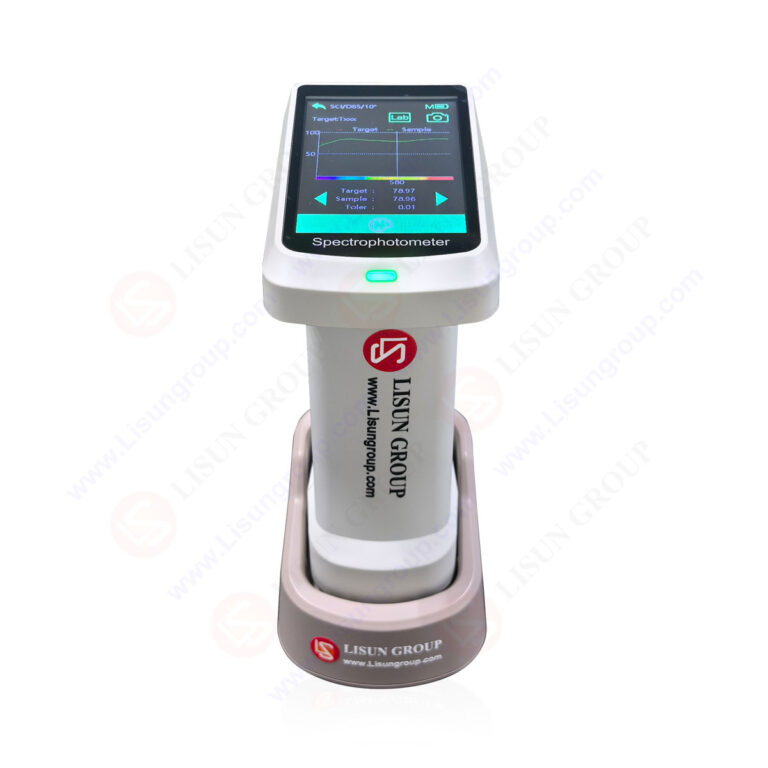
In a modern factory, data silos are a liability. The HSCD-800 and HSCD-860’s Wi-Fi connectivity facilitates direct data transfer to a central server or cloud-based quality management system. This allows for real-time monitoring of production line color performance from a central location. The Bluetooth interface (available on all models) enables mobile data collection through a dedicated app, offering flexibility for inspectors on the factory floor. By integrating the spectrophotometer into the digital ecosystem, the LISUN HSCD series provides the actionable data needed for proactive quality control. This connectivity ensures that the findings from every measurement are immediately available to stakeholders, expediting decisions and reinforcing the integrity of the entire color-difference analysis for QC compliance framework.
5.1 Compliance with CIE, ISO, and ASTM Standards
The validity of a color measurement is defined by its adherence to recognized standards. The LISUN HSCD series is designed to comply with a comprehensive set of international norms, ensuring measurements are globally recognized and reproducible. This compliance is a cornerstone of color-difference analysis for QC compliance.
- CIE No.15: Specifies the standard method for measuring and calculating colorimetry data. The HSCD’s geometry and data processing are aligned with this fundamental document.
- ISO 7724-1 and ASTM E1164: These standards address the general principles of color measurement and the instrument specifications for reflectance measurements. The HSCD series meets these requirements, guaranteeing its measurements are valid on a global scale.
- DIN5033 Teil7 and GB/T 3978: These standards detail color measurement conditions and standard illuminants. The instrument’s software includes these parameters, enabling accurate simulation of D65, C, and other light sources.
- ASTM E313 and ASTM D1925: For whiteness and yellowness indices, the HSCD series provides calculations per these standards, which is essential for industries like paper, textiles, and plastics to monitor material degradation.
5.2 Application-Specific Standards for Material Testing
Beyond general colorimetry, the HSCD series supports standards specific to materials and performance. For instance, GB 2893 covers safety colors, and GB/T 18833 pertains to retroreflective sheeting used for road signs; the instrument’s ability to measure SCE mode is crucial for such materials. ISO 2470 specifies the measurement of diffuse blue reflectance factor (ISO Brightness) for pulp and paper products. The software of the HSCD series can be configured to calculate these specific indices, allowing a single instrument to serve multiple industrial sectors. This multi-standard support secures its place as a versatile tool, ensuring that no matter the product or target standard, the data generated is authoritative and trustworthy for color-difference analysis for QC compliance.
6.1 From Plastic Pellets to Automotive Interiors
The versatility of the LISUN HSCD series makes it an indispensable asset across a wide range of industries.
- Plastics and Polymers: The series is used to check color consistency of masterbatches and molded parts. The HSCD-860’s small aperture is perfect for testing 3D-printed components or small connectors, minimizing waste.
- Coatings and Paints: For paint manufacturers, maintaining the color strength of a formula is critical. The HSCD series accurately measures the opacity and tinting strength, aiding in R&D and final inspection.
- Textiles and Apparel: Color can vary with fabric texture. The SCI/SCE modes help quantify the difference between visual appearance and intrinsic color, allowing dyer to match customer swatches consistently.
- Automotive Interiors: From dashboard plastics to leather seating, the series ensures that components manufactured by different suppliers meet the same high-standard visual quality, preventing mismatch issues in final assembly.
- Food and Beverage: For baked goods, the degree of baking is directly correlated with surface color. The HSCD is used to ensure a consistent product appearance, which is a primary indicator of quality for consumers.
6.2 The Role of the HSCD Series in Third-Party Labs
Independent testing laboratories require instruments that provide unfailing accuracy and traceability. The LISUN HSCD series fulfills this role by delivering repeatable results. Its durable design and long-lasting zirconium calibration standard reduce downtime. For a third-party lab, the ability to produce a clear, data-rich report is a key deliverable. The HSCD’s software supports this by creating professional, customizable PDF reports that substantiate a client’s claim of quality. This makes the series an invaluable tool for verifying product quality, solving disputes between vendors and buyers, and issuing certifications based on objective spectral data, all of which are central to effective color-difference analysis for QC compliance.
7.1 Data-Driven Recipe Adjustment
The HSCD series is not just a control device; it is a powerful tool for R&D and formulation. In paint and ink manufacturing, a colorist can use the spectral data from the HSCD to calculate the exact amount of pigmentation needed to adjust a batch to match a target standard. The software can suggest adjustments for primary colors, reducing the number of physical iterations needed. This “digital formulation” approach saves significant time and raw material costs. By moving from a trial-and-error methodology to a predictive one, the HSCD series enhances the entire product development cycle, from initial color matching to scaling up production, ensuring a stable process that supports rigorous color-difference analysis for QC compliance.
7.2 Monitoring Production Drift in Real-Time
Beyond final inspection, the HSCD series can be integrated into the production line for ongoing process monitoring. By measuring samples at regular intervals—for instance, every hour—a quality control team can track the color trend of the output. If the measurement values begin to drift towards the upper tolerance limit, the team can intervene to correct the process variables (e.g., temperature, feed rate, ink viscosity) before producing out-of-spec parts. This proactive approach is more cost-effective than post-production inspection and rework. The data logging capabilities of the HSCD series make it easy to identify potential causes of drift and correlate them with production events, fostering a culture of continuous improvement and data-backed quality assurance.
The LISUN HSCD series of portable spectrophotometers represents a significant advancement in accessible color measurement technology. For professionals responsible for product quality, the series provides the technical depth, accuracy, and connectivity required to implement an effective color-difference analysis for QC compliance program. By leveraging grating spectroscopy, dual-beam optics, and a stable zirconium calibration standard, these instruments deliver repeatable, reliable data that is compliant with major international and national standards. The ability to measure across diverse applications—from plastics to food—combined with powerful software for data management, positions the HSCD series as a critical tool for reducing waste, improving efficiency, and solidifying brand integrity. Choosing the right HSCD model (780, 800, or 860) allows manufacturers to tailor this technology to their specific needs, ensuring that every product that leaves the factory meets the highest standard of color quality, rooted in objective, verifiable metrics.
Q1: What is the practical difference between SCI and SCE measurement modes in the HSCD series, and when should I use each?
A: The SCI (Specular Component Included) mode measures the total color of an object, including the light reflected from its surface gloss. This is useful for evaluating raw material color, pigment strength, or when the primary concern is formulation accuracy, ignoring surface finish. The SCE (Specular Component Excluded) mode excludes this gloss, measuring only the light reflected from the object’s body, which more closely matches how a human eye perceives color. For quality control of final, finished products where a matte vs. glossy appearance can impact visual color, SCE mode is typically the primary metric. Most users will relate to the SCE mode for a pass/fail decision on appearance. The HSCD series allows you to measure both simultaneously, giving you a complete picture of the part.
Q2: How does the choice of aperture size (e.g., Ø 4mm vs. Ø 8mm) impact my color measurements?
A: The aperture size determines the sample area that is measured. A larger aperture (e.g., 8mm) averages the color over a bigger area, which is ideal for uniformly colored, flat surfaces. It provides a more representative average and is less susceptible to minor surface blemishes. A smaller aperture (e.g., 4mm or 1x3mm) is essential for measuring small parts, narrow strips, or curved surfaces where an 8mm opening cannot fit or would collect too much stray light. For example, the HSCD-860’s 1x3mm aperture is perfect for measuring a plastic connector pin. Using the same aperture for all comparative measurements is crucial for ensuring consistency and reliability in your color-difference analysis for QC compliance.
*Q3: What does the inter-instrument agreement (e.g., 0.15 dEab) mean for a global supply chain?*
A: Inter-instrument agreement is a measure of how closely two different units of the same model will read the same color sample. If your plant in Asia uses one HSCD-800 and your plant in Europe uses another, a “0.15 dEab” agreement means any given sample will be measured within 0.15 dE*ab of each other across the two devices. This is a critical specification for global brands. It ensures that the color standard and tolerance you set in one location will be accurately enforced in another, without having to ship physical color chips back and forth. This harmonization significantly reduces miscommunication and product rejection, making your color-difference analysis for QC compliance robust and scalable.