









Abstract
The LISUN SW Series Power Cord Flexibility Bending Tester represents a precision-engineered solution for validating the mechanical endurance of power cords under repeated 90-degree bend testing per standards. This article provides a comprehensive technical overview of the SW Series, including its architecture, operational principles, and compliance with international safety regulations such as IEC 60884-1, IEC 60745-1, IEC 60335-1, and GB/T 2099.1. Designed for R&D and quality control engineers, the system integrates PLC control with servo motor drives and current-based fault detection to ensure reproducible test results. The article details model configurations, parameter specifications, and practical applications, enabling professionals to select and implement the appropriate power cord flexibility tester for their specific validation needs.
1.1 Importance of Bend Testing in Product Safety
Power cords are subjected to repeated mechanical stress during normal use, particularly in applications involving portable appliances and hand-held tools. The connection between the cord and the appliance terminal is a critical failure point, where conductor fatigue, insulation wear, or strand breakage can lead to electrical hazards. A power cord flexibility tester applies cyclic bending motions to simulate years of field usage in a condensed timeframe. Failures revealed through 90-degree bend testing per standards enable manufacturers to identify design weaknesses before mass production, reducing warranty claims and preventing safety incidents.
1.2 Regulatory Landscape and Standard Requirements
International standards mandate rigorous bend endurance criteria. IEC 60884-1, clause 23.4, specifies the bending test for plugs and socket-outlets with flexible cables, requiring a defined number of bend cycles at a specified angle and rate. Similarly, IEC 60745-1 for hand-held electric tools, clause 25.5, outlines the flexing test for power cords, while IEC 60335-1 for household appliances references bend testing in clause 25.14. The GB/T 2099.1 standard aligns closely with IEC 60884-1 for the Chinese market. The LISUN SW Series power cord flexibility tester is engineered to satisfy these diverse yet convergent requirements, offering programmable parameters that accommodate each standard’s specific conditions.
2.1 System Configuration and Models
The SW Series is available in three configurations: the SW-1 single-station, SW-2 dual-station, and SW-6 six-station models. Each station operates independently, allowing simultaneous testing of multiple samples under identical or varied parameter sets. This multi-station architecture significantly increases throughput in quality control laboratories, where large sample batches must be evaluated to ensure statistical confidence in production consistency. The compact footprint of the benchtop enclosure facilitates integration into existing test facilities without requiring substantial floor space reallocation.
2.2 Core Control and Drive Technologies
At the heart of the power cord flexibility tester lies an integrated PLC (Programmable Logic Controller) that manages the complete test sequence. The PLC coordinates the servo motor drive system, which provides precise angular positioning and speed control for the bending arm. Unlike traditional cam-based mechanisms, the servo approach enables adjustable bend angles, speeds, and dwell times via a user-friendly HMI interface. The PLC also monitors load current continuously, detecting open-circuit conditions caused by conductor breakage or intermittent connection issues. When a failure is detected, the system halts the specific station and red LED indicator, preserving the cycle count data for failure analysis.
3.1 Detailed Specification Comparison
The following table summarizes the key parameters across SW Series models, benchmarked against the minimum requirements specified in IEC 60884-1 for bend testing:
| Parameter | SW-1 Single Station | SW-2 Dual Station | SW-6 Six Station | IEC 60884-1 Minimum Requirement |
|---|---|---|---|---|
| Number of Test Stations | 1 | 2 | 6 | Not specified |
| Bend Angle Range | 0–90° | 0–90° | 0–90° | ±90° (clause 23.4) |
| Bending Speed Range | 5–60 cycles/min | 5–60 cycles/min | 5–60 cycles/min | 10 cycles/min (typical) |
| Maximum Cycle Count | 99,999,999 | 99,999,999 | 99,999,999 | 20,000 cycles (typical) |
| Load Current per Station | 0.1–50 A | 0.1–50 A | 0.1–50 A | 1.25× rated current |
| Test Voltage Range | 10–300 VAC | 10–300 VAC | 10–300 VAC | Rated voltage |
| Weight (Approx.) | 50 kg | 65 kg | 95 kg | N/A |
3.2 Optional Configurations for Expanded Testing
The standard SW Series configuration addresses the majority of flexible cord bending applications. However, optional accessories extend testing capabilities to specialized scenarios. A flexing arm length adjustment kit accommodates cords with different cross-sectional dimensions. An optional temperature chamber enables combined thermal and mechanical stress testing, simulating extreme operating environments. For automation integration, RS-232 and USB interfaces allow data logging and remote control through external software systems. These options transform the power cord flexibility tester into a multi-functional cable reliability validation device.
4.1 Sample Preparation and Mounting
Proper sample preparation is essential for valid test results. The power cord under test is cut to the specified length and stripped at both ends. One end is connected to the load terminal, while the other is attached to a counterweight system that maintains constant tension during bending. The cord passes through a guide tube positioned to align the bending axis precisely at the point where the cord exits the appliance connector. The guide tube diameter is selected based on cord outer diameter, typically 1.5 to 1.7 times the cord diameter, ensuring lateral constraint without inducing additional stress. Correct mounting prevents premature failures unrelated to intrinsic cord quality.
4.2 Test Execution and Real-Time Monitoring
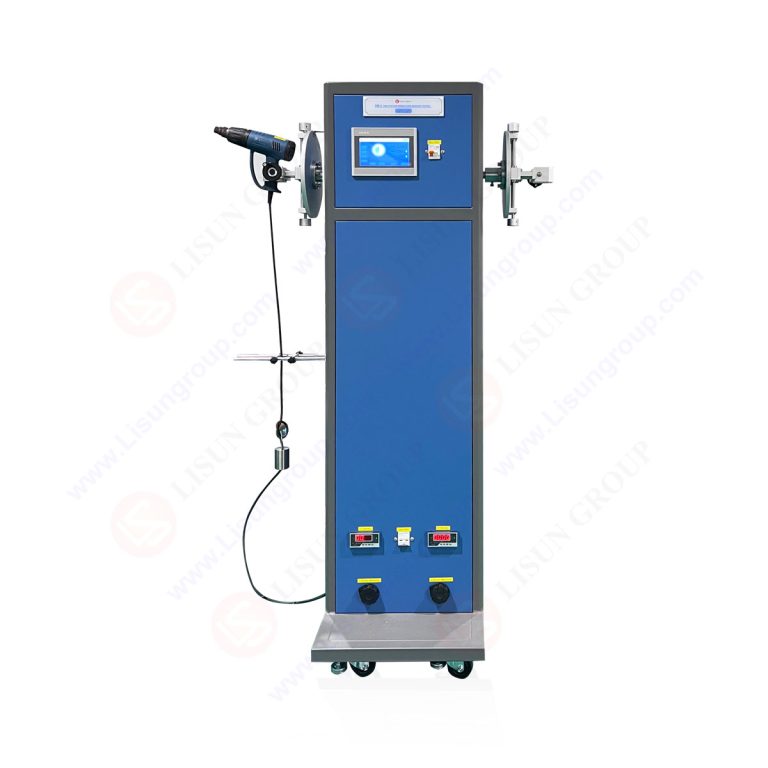
Once samples are loaded, the operator configures the test parameters on the HMI: bend angle, bending speed, target cycle count, load current, and test voltage. The PLC initiates the servo motor and the bending arm oscillates through the programmed arc. Throughout the test, the system records elapsed cycles and continuously monitors continuity. If a conductor fracture occurs, the load current drops below the threshold, triggering an automatic stop, cycle count retention in non-volatile memory, and visible fault indication. Operators can resume testing after recording data or replace failed samples, enabling uninterrupted multi-sample campaigns without supervisions.
5.1 Mapping Test Capabilities to Standard Clauses
The SW Series power cord flexibility tester is designed with compliance at its core. For IEC 60884-1, clause 23.4 bend testing, the device meets the required 90-degree bending angle and supports the specified test duration at a rate of 10 bends per minute, with an option to accelerate up to 60 bends per minute for in-house screening. For IEC 60745-1, clause 25.5, the SW Series accommodates the higher bend counts (up to 50,000 cycles) and the specific loading conditions applicable to hand-held tools. Similarly, IEC 60335-1, clause 25.14, requirements for appliances with flexible cords are fully satisfied, as the tester supports varying cord gauges and flexing radii.
5.2 Additional Standard References
Beyond the primary IEC standards, the SW Series is applicable for testing to UL 507 for electric fans, UL 1278 for portable electric heaters, and similar product-level standards that reference flexible cord endurance. The 90-degree bend testing per standards also aligns with automotive industry expectations, where cable harnesses in vehicle doors and seats undergo repeated flexing. The programmable nature of the equipment makes it a valuable asset for labs that must maintain flexibility to test against multiple regulatory frameworks with a single capital investment.
6.1 Household Appliance Manufacturing
In the production of vacuum cleaners, electric kettles, and washing machines, the power cord is a common failure point. The SW-6 six-station model is particularly well-suited for high-volume manufacturing environments, where quality control engineers can test statistically significant sample sizes within a single work shift. The ability to set different load currents between stations enables simultaneous testing of different product lines, maximizing equipment utilization. Incoming quality control departments also use the SW Series to verify that purchased power cords meet specification prior to assembly line integration.
6.2 Hand-Held Power Tools and Portable Electronics
For power tools such as drills, grinders, and circular saws, the cord flexing requirement is significantly more stringent due to the continuous handling and movement during operation. The SW-2 dual-station model provides an optimal configuration for tool manufacturers, allowing comparison testing between two cord suppliers or two design revisions under identical conditions. The high-precision servo drive ensures that the bending motion is smooth and repeatable, even at the accelerated speeds used during preliminary screening. This speed advantage accelerates the design iteration cycle without compromising data integrity.
7.1 Routine Maintenance Procedures
To maintain measurement accuracy, the power cord flexibility tester requires scheduled preventive maintenance. The servo motor and gearbox bearings should be lubricated bi-monthly, and the guide tubes inspected for wear or deformation. The load current sensors must be calibrated annually using a certified reference instrument. A diagnostic self-test function built into the PLC automates verification of sensor outputs and motor response, highlighting deviations that require attention. Operator training should cover safe cord replacement procedures and emergency stop activation to minimize downtime.
7.2 Calibration Traceability and Documentation
Calibration records form a critical part of audit trails for accredited laboratories under ISO/IEC 17025 and manufacturing facilities certified to ISO 9001. The SW Series controller logs parameter settings, cycle counts, and failure events with timestamps, providing comprehensive traceability for each test run. When recalibration is performed, the new calibration coefficients are stored in the PLC memory, and the previous calibration data is archived for reference. This documentation approach supports traceability to national standards and facilitates smooth external audits, demonstrating the laboratory’s commitment to reliable and defensible test data.
The LISUN SW Series Power Cord Flexibility Bending Tester delivers precise, repeatable, and compliant bend testing for the validation of power cord reliability. With models ranging from single to six stations, the system accommodates the throughput requirements of manufacturers and testing laboratories alike. The integration of PLC control and servo motor drives ensures accurate execution of 90-degree bend testing per standards, with real-time fault detection safeguarding the integrity of each test. By aligning with IEC 60884-1, IEC 60745-1, IEC 60335-1, and GB/T 2099.1, the SW Series provides engineers with a dependable platform for meeting domestic and international safety regulations. Adopting this power cord flexibility tester optimizes product development cycles, enhances production quality assurance, and contributes directly to reducing field failures and safety risks.
Q1: What is the maximum bending cycle rate of the LISUN SW Series power cord flexibility tester, and how does this impact accelerated testing?
A: The maximum bending speed is 60 cycles per minute for all SW Series models. This elevated rate allows rapid screening of design prototypes, where a 20,000-cycle test can be completed in approximately 5.5 hours compared to 33 hours at the standard 10 cycles per minute rate. However, accelerated testing should be interpreted cautiously; higher speeds can elevate conductor temperature due to increased mechanical friction and resistive heating, potentially introducing failure mechanisms not representative of real-world usage. Best practice involves conducting preliminary accelerated screening, followed by confirmation testing at the standard rate specified in the applicable regulation. This dual approach balances the need for fast turnaround during design iterations with the regulatory requirement for reproducible, comparable data.
Q2: Can the SW Series be used to test cords with different conductor gauges or numbers of cores without modifying the equipment?
A: Yes, the SW Series accommodates a wide range of power cord configurations, from two-core light-duty cords to five-core heavy-duty cables with conductor cross-sections up to 4 mm². The primary adjustments involve selecting the appropriate guide tube diameter and counterweight mass to match the cord’s outer diameter and flexural rigidity. Guide tubes are readily exchangeable, and each station features a rapid-release mounting system. The load current range of 0.1 to 50 A covers virtually all plug-and-socket and appliance inlet applications encountered in consumer products and light industrial equipment. For extreme cases, customized guides and tension settings can be arranged through the manufacturer’s engineering support team.
Q3: How does the current-based fault detection system differentiate between a minor conductor damage and a complete break?
A: The SW Series monitors the root-mean-square (RMS) load current flowing through the sample during each bending cycle. A catastrophic conductor failure results in an open circuit, causing the current to drop abruptly to near-zero, which triggers an immediate stop. For partial strand breakage, the effective cross-section decreases, causing a corresponding reduction in current. The PLC sets a failure threshold as a percentage of the nominal current value, typically adjustable from 5% to 20% below the setpoint. When the measured current falls below this threshold, the system flags the event and stops, enabling the operator to inspect for partial fractures. This granular sensitivity is critical for detecting early-stage conductor degradation.