









Abstract
Automotive LED lighting systems demand exceptional reliability, with lumen maintenance directly impacting vehicle safety and regulatory compliance. This article examines the critical role of accelerated aging testing for automotive LED components, focusing on the LISUN Optical Aging Test Instrument as a comprehensive solution for IES LM-80, LM-84, TM-21, and TM-28 compliance. The system supports dual testing configurations—LEDLM-80PL for LM-80/TM-21 protocols and LEDLM-84PL for LM-84/TM-28 standards—with Arrhenius Model-based software enabling accurate lifetime prediction. Automotive LED lighting aging testing requires precise thermal management, extended duration capabilities up to 6000 hours, and support for L70/L50 metrics across multiple temperature chambers. This article provides technical professionals with actionable insights into system architecture, testing methodologies, and data interpretation for automotive-grade LED validation.
1.1 The Critical Need for Accelerated Aging in Automotive Applications
Automotive LED lighting operates under extreme thermal and vibrational stress conditions, with engine bay temperatures reaching 125°C and headlamp assemblies experiencing continuous thermal cycling. Unlike general illumination LEDs, automotive-grade components must maintain lumen output above 70% of initial value (L70) for minimum 10,000 operational hours per regulatory frameworks. The LISUN Optical Aging Test Instrument addresses these demands through precise temperature-controlled environments and photometric measurement capabilities. Automotive LED lighting aging testing must account for solder joint degradation, phosphor thermal quenching, and encapsulant yellowing—failure modes that accelerate under sustained high-temperature operation. The Arrhenius Model-based software within LISUN systems calculates acceleration factors using activation energies typically ranging from 0.4 eV to 0.7 eV for common LED failure mechanisms.
1.2 Industry Standards Governing Automotive LED Aging
The automotive lighting industry relies on IES LM-80-15 for measuring lumen maintenance of LED packages, arrays, and modules, requiring testing at three case temperatures (typically 55°C, 85°C, and a third temperature selected by the manufacturer). IES LM-84-14 extends these requirements to LED lamps and luminaires, which is particularly relevant for complete automotive lighting assemblies. TM-21-19 provides the mathematical framework for projecting long-term lumen maintenance based on LM-80 test data, supporting extrapolation to L70 and L50 lifetimes. For complete automotive LED lighting systems, TM-28-14 offers projection methods using LM-84 test data with similar mathematical rigor. The LISUN LEDLM-80PL variant includes integrated TM-21 projection algorithms that automatically calculate 6x rule extrapolation limits, while the LEDLM-84PL provides TM-28 compliance for finished automotive lighting products.
2.1 Dual System Configuration Overview
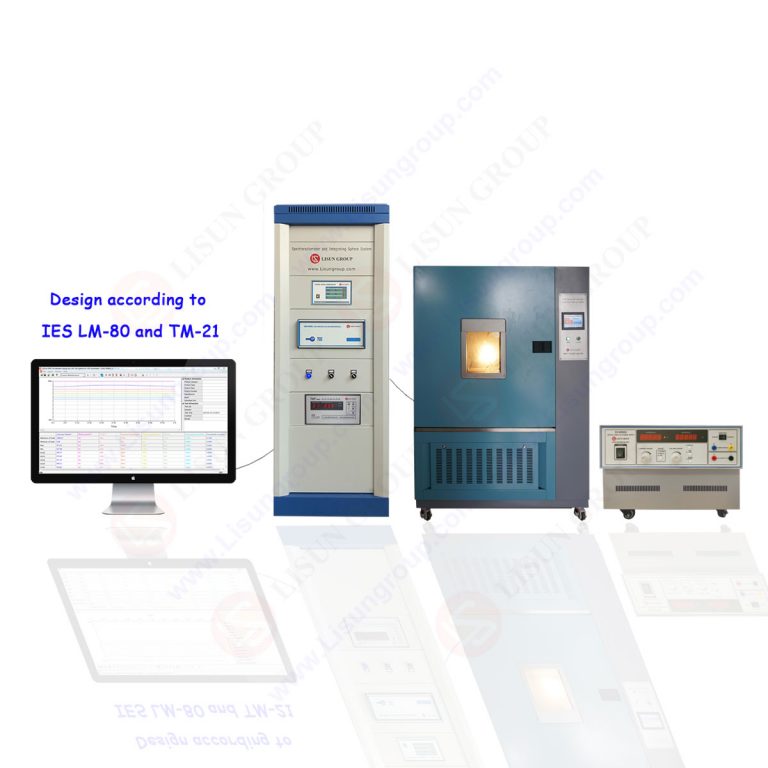
The LISUN Optical Aging Test Instrument is available in two distinct configurations tailored to specific testing requirements. The LEDLM-80PL system is optimized for component-level testing of LED packages, arrays, and modules per IES LM-80, supporting up to 3 connected temperature chambers for simultaneous multi-temperature testing. The LEDLM-84PL variant accommodates complete LED lamps and luminaires per IES LM-84, with larger chamber capacities and modified photometric measurement interfaces. Both systems share core architecture including high-precision integrating sphere photometers, programmable DC power supplies, and temperature-controlled chamber environments. The dual system approach allows automotive manufacturers to validate both individual LED components and finished lighting assemblies within a unified testing framework.
| Specification | LEDLM-80PL | LEDLM-84PL |
|---|---|---|
| Applicable Standard | IES LM-80, TM-21 | IES LM-84, TM-28 |
| Test Object | LED packages, arrays, modules | LED lamps, luminaires |
| Maximum Duration | 6000+ hours | 6000+ hours |
| Temperature Chambers | Up to 3 units | Up to 2 units |
| Temperature Range | 25°C – 125°C | 25°C – 85°C |
| Photometric Measurement | Integrating sphere (0.5m-2m) | Integrating sphere (1m-3m) |
| Lifetime Metrics | L70, L50, L90 | L70, L50, L90 |
| Data Acquisition Interval | 1 minute – 24 hours | 1 minute – 24 hours |
2.2 Temperature Chamber Integration and Thermal Management
Precise temperature control is essential for valid Arrhenius Model acceleration and accurate TM-21 extrapolation. The LISUN system supports connection of up to three independently programmable temperature chambers, each capable of maintaining setpoint temperatures within ±1°C across the operating range. Automotive LED testing typically requires chamber temperatures of 55°C, 85°C, and 105°C for accelerated aging, with the third temperature selected based on maximum rated junction temperature. Each chamber includes multi-zone heating elements and forced air circulation to eliminate thermal gradients, with temperature monitoring via calibrated thermocouples attached directly to LED test boards. The system automatically logs chamber temperature at each measurement interval, allowing engineers to correlate lumen depreciation with actual thermal exposure rather than setpoint values.
3.1 Dual Testing Modes for Comprehensive Validation
The LISUN Optical Aging Test Instrument supports two primary testing modes: constant temperature aging and thermal cycling aging. Constant temperature aging, required by IES LM-80 and LM-84, maintains specified case temperature throughout the test duration, typically 6000 hours with photometric measurements at 0, 1000, 2000, 3000, 4000, 5000, and 6000-hour intervals. Thermal cycling mode simulates automotive operational conditions, with programmable temperature profiles ranging from -40°C to 125°C at ramp rates up to 10°C/minute. This mode is particularly valuable for evaluating solder joint reliability and encapsulant stress cracking. Both modes support automated data collection with measurement intervals configurable from 1 minute to 24 hours, enabling engineers to capture transient effects during thermal transitions.
3.2 Photometric Measurement and Data Acquisition
Accurate lumen maintenance assessment requires photometric measurements traceable to national standards. The LISUN system integrates high-precision spectroradiometers and photometers with absolute accuracy of ±0.5% for luminous flux measurement and ±0.3 nm for wavelength accuracy. Measurements are conducted in compliance with IES LM-79-19 for electrical and photometric testing, ensuring consistency with regulatory reporting requirements. The system performs automated dark current correction, detector temperature stabilization, and reference lamp calibration verification before each measurement sequence. Data acquisition includes simultaneous recording of luminous flux, correlated color temperature (CCT), color rendering index (CRI), chromaticity coordinates (CIE 1931 x,y), and electrical parameters (voltage, current, power). This comprehensive dataset enables engineers to identify color shift mechanisms alongside lumen depreciation.
4.1 Mathematical Framework for Accelerated Aging
The Arrhenius Model forms the theoretical foundation for accelerated LED aging, relating reaction rate to temperature through the equation k = A × exp(-Ea/kT), where k is the reaction rate, A is the pre-exponential factor, Ea is the activation energy, k is Boltzmann’s constant, and T is absolute temperature. The LISUN software automatically calculates activation energy from multi-temperature test data using linear regression on ln(lumen maintenance) versus 1/T plots. Typical automotive LED activation energies range from 0.3 eV for phosphor degradation to 0.8 eV for solder joint intermetallic growth. The software determines acceleration factors between testing temperature and use temperature (typically 85°C junction temperature for automotive headlamps), enabling projection of 10,000-hour equivalent lifetime from 3000-6000 hours of accelerated testing.
4.2 TM-21 and TM-28 Extrapolation Algorithms
TM-21-19 specifies mathematical procedures for projecting lumen maintenance beyond test duration using exponential decay curve fitting. The standard limits extrapolation to 6× the test duration for LM-80 data with R² ≥ 0.9, enabling 36,000-hour projections from 6000-hour tests. The LISUN software implements the least-squares exponential fitting algorithm per TM-21 Annex A, including outlier detection and confidence interval calculation. For complete automotive lighting assemblies, TM-28-14 provides similar projection methods with additional considerations for system-level interactions. The software generates comprehensive reports including fitted curves, extrapolation limits, L70 and L50 projected lifetimes, and 90% confidence bands. Engineers can compare projection results across multiple temperature conditions to assess the validity of Arrhenius assumptions.
5.1 Test Board and Fixture Design Options
Automotive LED components vary significantly in package size, thermal interface requirements, and electrical configurations. The LISUN system supports customizable test boards with options for FR4, aluminum-core PCB, and ceramic substrates with thermal conductivity ratings from 1 W/mK to 30 W/mK. Test boards accommodate multiple LED packages in series-parallel configurations with individual current monitoring per channel. Each test board includes built-in thermocouple attachment points for direct case temperature measurement per IES LM-80 requirements. The system supports board dimensions up to 300mm × 300mm for the LEDLM-80PL and up to 600mm × 600mm for the LEDLM-84PL, accommodating complete automotive lighting modules including daytime running lights and taillight assemblies.
5.2 Power Supply and Driver Integration
Constant current testing is essential for accurate lumen maintenance measurement, as LED forward voltage decreases with temperature while luminous flux depends on drive current. The LISUN system integrates programmable DC power supplies with current stability of ±0.02% and ripple below 10 mA at full load. For automotive LED lighting aging testing, the system supports pulsed current operation simulating PWM dimming schemes common in modern vehicle lighting. The software synchronizes photometric measurements with current pulses to capture full dynamic range performance. Multiple power supply channels (up to 16 for LEDLM-80PL, up to 8 for LEDLM-84PL) enable simultaneous testing of different current conditions, supporting evaluation of drive current effects on lumen maintenance and color stability.
6.1 Comprehensive Data Visualization
The LISUN software suite provides real-time data visualization including lumen maintenance curves, chromaticity shift plots, and temperature profiles across the entire test duration. Engineers can overlay data from multiple temperature conditions to visualize Arrhenius model conformance and identify anomalous behavior. The system automatically generates CIE 1931 and CIE 1976 chromaticity diagrams with color binning overlays per CIE 084 and CIE 127 standards. Statistical analysis tools calculate mean lumen maintenance, standard deviation, and failure rate projections using Weibull distribution fitting. Customizable report templates include all required data tables per IES LM-80/LM-84 reporting formats, reducing documentation labor for regulatory submissions.
6.2 Export and Integration with Quality Systems
Data files are exportable in CSV, Excel, and PDF formats compatible with major quality management systems. The system supports automated notification triggers when lumen maintenance drops below predefined thresholds (e.g., L80, L70, L50), enabling real-time failure detection during extended tests. Integration with Laboratory Information Management Systems (LIMS) is supported through REST API interfaces, enabling automated data transfer to enterprise-level databases. The software maintains complete audit trails including user login logs, measurement parameter changes, and calibration history, meeting requirements for ISO 17025 accredited testing laboratories.
7.1 Component Qualification for Tier 1 Suppliers
Automotive LED manufacturers require comprehensive aging data for Advanced Product Quality Planning (APQP) submissions. The LISUN system enables qualification testing of individual LED packages from multiple suppliers, generating comparable lumen maintenance data under identical test conditions. Engineers can evaluate activation energy consistency across production batches, identify outliers indicating process drift, and establish acceptance criteria for incoming quality control. Automotive lighting aging testing data directly supports Production Part Approval Process (PPAP) submissions with quantifiable reliability metrics.
7.2 System-Level Validation for Complete Assemblies
Finished automotive lighting assemblies—including headlamps, fog lights, brake lights, and interior lighting modules—require system-level aging validation under simulated operational conditions. The LEDLM-84PL configuration accommodates complete assemblies with integrated optics, heat sinks, and drivers. Testing reveals system-level interactions such as thermal cross-talk between adjacent LEDs, driver efficiency degradation, and optical material yellowing. Engineers can validate thermal management designs by comparing junction temperatures predicted by simulation with actual measurements during aging. The system supports concurrent testing of multiple assemblies, enabling statistically significant sample sizes for reliability certification.
Automotive LED lighting aging testing demands rigorous adherence to international standards, precise thermal management, and comprehensive data analysis capabilities. The LISUN Optical Aging Test Instrument provides a complete solution for both component-level LM-80/TM-21 testing and system-level LM-84/TM-28 validation, with dual system variants optimized for each application. The Arrhenius Model-based software enables accurate lifetime prediction from accelerated test data, supporting L70/L50 projections critical for automotive reliability requirements. Key technical advantages include support for up to 3 temperature chambers, customizable test board configurations, and automated data acquisition spanning 6000+ hours. For engineering professionals responsible for LED quality validation, the system delivers the measurement accuracy and standard compliance necessary for automotive-grade certification. By integrating multiple industry standards including IES LM-79-19, CIE 084, CIE 70, and CIE 127, the LISUN platform ensures that automotive LED manufacturers can confidently validate product reliability before deployment. Automotive LED lighting aging testing represents a critical investment in vehicle safety and longevity, and the LISUN system provides the technical foundation for that validation.
Q1: What is the minimum test duration required for automotive LED aging testing, and how does the LISUN system support accelerated testing?
A: Industry standards require minimum 6000-hour testing per IES LM-80 and LM-84 for reliable lifetime projection. However, the LISUN system enables accelerated testing using elevated temperatures based on the Arrhenius Model, where increasing test temperature accelerates failure mechanisms. For example, testing at 105°C instead of 85°C can reduce required test duration by approximately 50% while maintaining projection accuracy, assuming activation energy of 0.5 eV. The system automatically calculates acceleration factors and provides TM-21 extrapolation for projections up to 36,000 hours from 6000-hour tests. Engineers should validate Arrhenius assumptions by testing at multiple temperatures and confirming linear behavior in Arrhenius plots before relying on accelerated projections.
Q2: How does the LISUN system ensure temperature measurement accuracy for automotive LED testing?
A: Temperature measurement accuracy is critical for valid Arrhenius calculations. The LISUN system uses calibrated Type T thermocouples with ±0.5°C accuracy attached directly to LED thermal pads or case surfaces per IES LM-80 requirements. Each temperature chamber includes multiple zone sensors with PID control maintaining setpoint within ±1°C. The system logs actual temperatures at each measurement interval rather than relying on setpoint values, enabling engineers to calculate actual activation energy from measured thermal exposure. For automotive-grade testing, we recommend thermocouple attachment using high thermal conductivity epoxy with verification via infrared thermal imaging before test initiation.
Q3: Can the LISUN Optical Aging Test Instrument handle complete automotive headlamp assemblies?
A: The LEDLM-84PL variant is specifically designed for complete luminaire testing including automotive headlamps, with chamber dimensions accommodating assemblies up to 600mm × 600mm × 400mm. The system includes adjustable mounting fixtures for various form factors and integrated photometric measurement through 1m to 3m integrating spheres. For headlamp testing, the system accommodates the complete optical assembly including reflector, lens, and heat sink, providing system-level aging data. The power supply supports automotive electrical system voltages (12V DC nominal, with 9V-16V range for testing under extreme conditions) and includes transient protection for reliable long-term operation during 6000-hour tests.