









Abstract
In the rigorous world of LED reliability validation, understanding and mitigating failure modes induced by high-temperature, high-humidity environments is paramount. This technical article delves into the critical role of Damp Heat Test Chambers in compliance with IEC 60068-2-78, a foundational standard for assessing the robustness of LEDs and electronic components against steady-state damp heat. We explore how integrating these chambers with advanced optical monitoring systems, such as LISUN‘s LEDLM series, creates a complete solution for accelerated aging and lumen maintenance prediction. The focus is on a data-driven methodology that bridges environmental stress testing with photometric performance analysis, enabling engineers to accurately forecast product lifetime and ensure compliance with key industry standards like IES LM-80 and TM-21.
1.1 Understanding the IEC 60068-2-78 Standard
IEC 60068-2-78, “Environmental testing – Part 2-78: Tests – Test Cab: Damp heat, steady state,” specifies a standardized method for evaluating the ability of components and equipment to withstand prolonged exposure to high relative humidity at an elevated constant temperature, typically 85°C and 85% RH. For LED packages, modules, and drivers, this test is not merely a check of ingress protection but a critical acceleration of failure mechanisms. The steady-state conditions promote chemical degradation, corrosion of metallic components, delamination of encapsulants, and other thermally-humidly activated processes that directly impact optical performance and electrical integrity. Compliance with this standard provides a benchmark for product robustness in applications ranging from outdoor lighting to automotive electronics, where environmental resilience is non-negotiable.
1.2 Failure Mechanisms Accelerated by Damp Heat
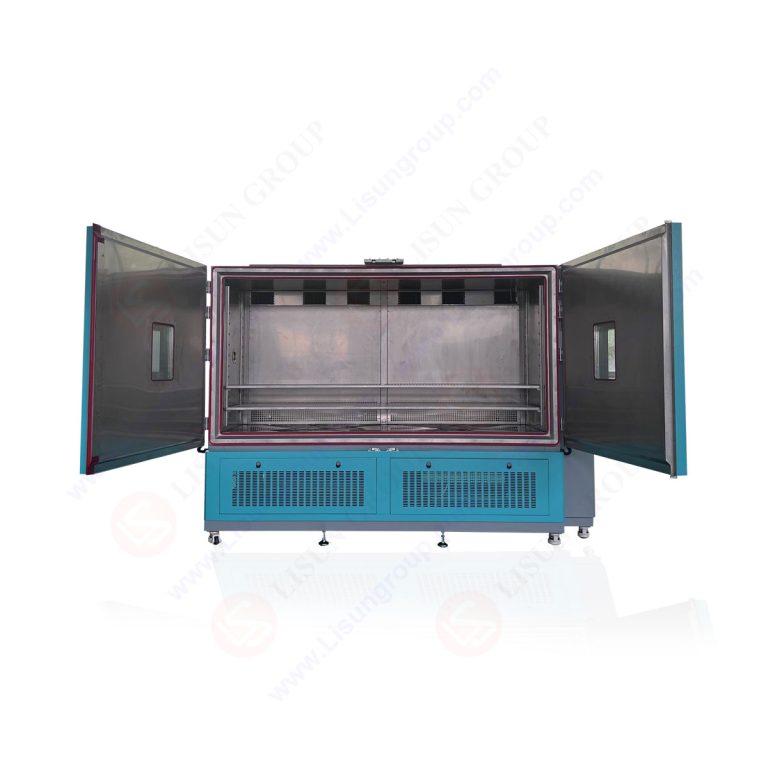
The synergistic effect of temperature and humidity accelerates specific failure modes distinct from dry heat aging. Key mechanisms include metal corrosion on lead frames and wire bonds, increasing series resistance and leading to catastrophic open-circuit failure. Hygroscopic swelling and delamination of silicone or epoxy encapsulants can create optical interfaces that scatter light, reducing light extraction efficiency and causing measurable lumen depreciation. Furthermore, moisture ingress can lead to phosphor degradation in white LEDs, causing chromaticity shifts. By subjecting LEDs to controlled Damp Heat Test Chambers per IEC 60068-2-78, engineers can identify these vulnerabilities early in the R&D cycle, informing material selection, packaging design, and manufacturing processes to enhance long-term field reliability.
2.1 The LISUN LEDLM System Architecture
A standalone damp heat chamber reveals only part of the reliability picture. The true engineering insight comes from correlating environmental stress with real-time photometric performance decay. LISUN’s LED Optical Aging Test Instruments, specifically the LEDLM-80PL and LEDLM-84PL systems, are engineered for this exact purpose. These systems integrate high-precision optical sensors, typically housed within an integrating sphere, with one or more external environmental chambers. The core architecture allows for continuous or periodic measurement of luminous flux, chromaticity coordinates, and forward voltage from LEDs under test while they are subjected to the rigorous conditions inside a connected Damp Heat Test Chamber. This closed-loop data acquisition is the foundation for predictive lifetime analysis.
2.2 Dual System Variants: LM-80/TM-21 vs. LM-84/TM-28 Compliance
LISUN offers two primary system variants to address different standard compliance pathways. The LEDLM-80PL is configured for testing LED packages and arrays in accordance with IES LM-80-20, “Measuring Luminous Flux and Color Maintenance of LED Packages, Arrays, and Modules,” facilitating subsequent lifetime extrapolation using the TM-21-11 protocol. In contrast, the LEDLM-84PL system is designed for testing integrated LED luminaires and lamps, aligning with IES LM-84-20, “Measuring Luminous Flux and Color Maintenance of LED Lamps, Light Engines, and Luminaires,” with data analysis per TM-28-20. This distinction is crucial, as LM-84 testing requires measuring the complete system, including driver and thermal management, under its operational state, which the LEDLM-84PL hardware is specifically configured to support.
3.1 Dual Testing Modes: Continuous Monitoring vs. Periodic Sampling
The LISUN LEDLM systems support two fundamental testing methodologies to balance data resolution with operational efficiency. Continuous Monitoring Mode involves near-real-time measurement, often used for critical characterization or shorter-duration tests to capture rapid initial depreciation trends. Periodic Sampling Mode is the standard for long-duration tests like the 6000-hour minimum required by IES LM-80, where samples are measured at defined intervals (e.g., every 24 or 168 hours) while maintaining constant environmental stress. This mode optimizes the use of the integrating sphere and spectrometer, enabling a single optical system, as specified, to support up to 3 connected temperature or Damp Heat Test Chambers, thereby multiplying testing throughput and capital efficiency.
3.2 Advanced Software and the Arrhenius Model
The proprietary software suite is the analytical engine of the system. It manages all data acquisition, storage, and visualization. Its most powerful feature is the integration of the Arrhenius Model, which describes the temperature dependence of reaction rates—fundamental to LED degradation. The software can use data from multiple stress temperatures (e.g., 55°C, 85°C, 105°C from connected chambers) to calculate the activation energy of the dominant degradation process. This model allows for more scientifically robust extrapolations of lumen maintenance life beyond the collected data, moving beyond simple curve-fitting to a physics-based prediction that enhances the accuracy of L70 and L50 lifetime projections reported in TM-21 or TM-28 documents.
4.1 Foundational Photometric Measurement Standards
Accurate lifetime prediction is predicated on accurate initial and ongoing photometric measurement. The LISUN systems are designed to comply with a suite of foundational standards that govern these measurements. IES LM-79-19, “Electrical and Photometric Measurements of Solid-State Lighting Products,” defines the methods for measuring total luminous flux, electrical power, and efficacy—metrics essential for establishing baseline performance. For spatial light distribution, CIE 070-1987, “Measurement of Absolute Luminous Intensity Distributions,” provides guidance. Furthermore, the use of an integrating sphere aligns with CIE 084-1989, “Measurement of Luminous Flux,” while the characterization of LED intensity refers to CIE 127-2007, “Measurement of LEDs.” Adherence to these standards ensures data integrity and global recognition of test results.
4.2 Lifetime Reporting and Extrapolation Protocols
The culmination of a long-term test is the formal lifetime projection. IES TM-21-11, “Projecting Long-Term Luminous Flux Maintenance of LED Light Sources,” provides the sanctioned method for extrapolating LM-80 data, defining the mathematical models (exponential decay) and limiting the extrapolation to no more than 6 times the total test duration. Similarly, TM-28-20 governs projections from LM-84 data for luminaires. The LISUN software automates these calculations, generating compliant reports that detail the L70 (time to 70% of initial lumen output) and L50 metrics with clear statements on the extrapolation limits. This direct pathway from raw data to standardized report is critical for manufacturers needing to provide reliability data to specifiers and certification bodies.
5.1 Key Numerical Performance Data
The systems are built to deliver precise, repeatable data over extended periods. Test durations are programmable to meet the minimum 6000-hour requirement for LM-80 and can extend far beyond for more confident datasets. The optical measurement system typically offers high-resolution spectral data, precise colorimetric measurement (Δu’v’ tolerance defined), and stable flux measurement. The capability to connect and control up to 3 external chambers, which can include dedicated Damp Heat Test Chambers for IEC 60068-2-78 compliance, allows for parallel testing at different stress conditions, dramatically accelerating the data collection needed for Arrhenius analysis and multi-factorial reliability studies.
5.2 Customization for Diverse Sample Types
Recognizing the diversity of LED products, the hardware is highly configurable. Options include various sizes of integrating spheres (e.g., 1m, 1.5m, 2m diameter) to accommodate different sample sizes and luminous intensities while maintaining measurement accuracy. Specialized fixture adapters and power supply integration modules are available for testing everything from small LED packages on metal-core PCBs to complete LED luminaires requiring active cooling or driver input. This flexibility ensures that the system can be tailored to the specific needs of an R&D lab focused on component development or a quality assurance lab validating final assembled products.
To elucidate the operational strategy, the following table compares the two primary testing modes and their optimal applications within the context of using a Damp Heat Test Chamber.
Table 1: Comparison of LISUN LEDLM System Testing Modes for Damp Heat Applications
| Feature | Periodic Sampling Mode | Continuous Monitoring Mode |
| :— | :— | :— |
| Primary Application | Long-duration compliance testing (e.g., 6000-hr LM-80) | Short-term characterization, failure analysis, rapid degradation studies |
| Chamber Utilization | Enables 1 optical system to serve up to 3 chambers sequentially | Typically dedicated to a single chamber/test point |
| Data Resolution | Lower frequency (e.g., once per 24-168 hours) | High frequency (measurements every few minutes) |
| Ideal For | Generating data for TM-21/TM-28 lifetime projections | Investigating detailed kinetic behavior of lumen decay under stress |
| Throughput Efficiency | High – Maximizes capital investment by multiplexing | Lower – Provides maximum data detail for a single condition |
7.1 Designing a Test Plan: From Damp Heat to Lifetime Prediction
A comprehensive validation program begins with a risk-based test plan. For moisture-sensitive applications, an IEC 60068-2-78 damp heat test is a mandatory first step, potentially using the LISUN system in Continuous Monitoring Mode to identify any immediate failures or large performance shifts. Surviving samples can then be transitioned into a long-term lumen maintenance test per LM-80 or LM-84 using Periodic Sampling Mode, possibly at multiple temperatures. The data from these parallel streams—damp heat robustness and luminous flux depreciation—are then synthesized. The Arrhenius-based software can model the temperature acceleration of the primary degradation mechanism observed, leading to a field-life prediction that accounts for both thermal and hygroscopic stresses.
7.2 Data Interpretation and Engineering Decision-Making
The ultimate value of the system lies in translating data into action. A successful damp heat test with minimal lumen depreciation confirms robust packaging. A steady depreciation curve allows for a confident TM-21 projection. A sudden drop in output during damp heat testing pinpoints a specific failure mode for root-cause analysis. By correlating environmental test results from the Damp Heat Test Chamber with precise photometric data, engineers can make informed decisions on supplier selection, design tolerances, and qualification criteria. This data-driven approach reduces time-to-market for reliable products and provides defensible evidence for warranty claims and performance certifications.
The integration of standardized environmental stress testing with high-fidelity photometric measurement represents the state of the art in LED reliability engineering. Damp Heat Test Chambers compliant with IEC 60068-2-78 provide the essential controlled stress environment to accelerate humidity-induced failure mechanisms. When seamlessly coupled with LISUN’s LEDLM-80PL or LEDLM-84PL optical aging systems, they form a complete analytical platform. This synergy enables technical professionals to not only verify compliance with critical standards like IES LM-80, LM-84, TM-21, and TM-28 but also to gain deeper insights into the fundamental degradation physics of their products through Arrhenius Model analysis. The practical outcome is the ability to generate accurate, standards-compliant L70 and L50 lifetime projections, de-risking product development and providing credible performance data to the market. For LED manufacturers and testing labs, adopting this integrated approach is a strategic investment in quality, reliability, and competitive advantage.
Q1: Can the LISUN LEDLM system be used exclusively for damp heat testing per IEC 60068-2-78, or is it only for dry heat LM-80 tests?
A: The LISUN LEDLM system is highly versatile and is explicitly designed to interface with external environmental chambers, which include both temperature-only and temperature-humidity (Damp Heat Test) chambers. While its software is optimized for the long-term, periodic sampling required by IES LM-80 and LM-84 (often conducted at dry heat temperatures like 55°C, 85°C), the hardware can continuously monitor samples inside a chamber running an IEC 60068-2-78 profile (e.g., 85°C/85% RH). This allows you to collect real-time luminous flux and color data during the damp heat stress, providing a direct correlation between the environmental insult and optical performance decay, which is invaluable for failure analysis and material qualification.
Q2: How does the system’s support for 3 connected chambers practically work with a 6000-hour test duration?
A: The system uses a multiplexing approach in its Periodic Sampling Mode. A single integrating sphere and optical measurement unit is connected to multiple chambers via a robotic or automated sample transfer system (configurable). The software schedules measurement cycles. For example, samples in Chamber 1 (at 55°C) are measured on Day 1, samples in Chamber 2 (at 85°C dry) on Day 2, and samples in Chamber 3 (at 85°C/85% RH, a Damp Heat Test) on Day 3, then the cycle repeats. This allows one optical system to collect compliant LM-80-style data from three independent stress conditions simultaneously, effectively tripling laboratory throughput and providing the multi-temperature dataset needed for robust Arrhenius analysis over the 6000+ hour test period.
Q3: What is the advantage of using the Arrhenius Model in the software over simply following the TM-21 curve-fitting method?
A: TM-21 provides a standardized, conservative method for extrapolating data from a single test temperature. The Arrhenius Model offers a more fundamental, physics-based advantage when data from multiple temperature stress conditions (e.g., from two temperature chambers and one Damp Heat Test Chamber) is available. By analyzing the rate of lumen depreciation at different temperatures, the software calculates an activation energy (Ea) specific to the product’s dominant degradation mechanism. This allows for lifetime predictions that are informed by the actual temperature dependence of the failure process, potentially leading to more accurate and less conservative life estimates across a wider range of use temperatures, especially when extrapolating to lower application temperatures.