









Abstract
In the demanding fields of LED manufacturing, automotive electronics, and EMC compliance testing, achieving high-accuracy AC & DC digital power meter performance is not merely an advantage—it is a fundamental requirement for product validation and quality assurance. These precision instruments serve as the cornerstone for reliable power measurement, enabling engineers to verify efficiency, analyze power quality, and ensure adherence to stringent international standards. This article provides a comprehensive technical exploration of modern digital power meters, detailing their core technologies, critical specifications, and application-specific capabilities. We will examine how features like wide-bandwidth harmonic analysis, automatic range switching, and robust communication interfaces empower testing professionals to deliver precise, repeatable, and compliant results across diverse electrical testing scenarios.
1. The Critical Role of Precision Power Measurement in Modern Industry
1.1 Beyond Basic Readings: From Validation to Compliance
Modern electrical testing transcends simple voltage and current checks. A high-accuracy AC & DC digital power meter is an essential tool for product validation, quality control, and regulatory compliance. In industries like LED manufacturing, precise measurement of input power, power factor, and harmonic distortion is mandated by standards such as LM-79 for photometric testing and EN/IEC61000-3-2 for EMC harmonic current emissions. Similarly, automotive electronics R&D relies on these meters to validate the efficiency and electromagnetic compatibility of components like DC-DC converters and onboard chargers under both AC and DC conditions. The meter’s accuracy directly impacts product certification, market access, and performance guarantees.
1.2 Core Technological Foundations: Digital Sampling and Analysis
The leap from analog to digital power measurement is driven by advanced digital sampling waveform analysis. This technology involves simultaneously sampling voltage and current signals at a high rate, digitizing them, and applying mathematical algorithms to compute a comprehensive suite of parameters. This method enables the simultaneous calculation of true RMS values, real/active power (W), apparent power (VA), reactive power (VAR), power factor, displacement factor, and frequency. Unlike older methods, digital analysis accurately captures power in non-sinusoidal waveforms—common in modern switch-mode power supplies and LED drivers—ensuring measurements reflect real-world operating conditions.
2. Decoding Key Specifications of a High-Accuracy Power Meter
2.1 Accuracy Class and Measurement Ranges
The defining characteristic of a precision instrument is its accuracy, typically expressed as a percentage of reading plus a percentage of range. For critical compliance testing, a basic accuracy of 0.1% or better for power measurements is often required. Equally important are the measurement ranges. A versatile meter must handle both low-power standby measurements and high-power operational tests. Key ranges include:
- Voltage: From millivolts to hundreds of volts (e.g., 0-600V AC/DC).
- Current: From milliamps to tens of amps, often using external current sensors for higher ranges.
- Frequency: A wide bandwidth (e.g., 0.5Hz to 100kHz) is crucial for analyzing harmonics and switch-mode power supply noise.
2.2 Advanced Functional Capabilities
Beyond fundamental parameters, advanced capabilities define a meter’s application scope. Automatic range switching enhances testing efficiency and prevents range selection errors. Harmonic analysis is paramount, with the ability to measure up to the 50th order harmonic (per IEC 61000-4-7) being essential for EN/IEC61000-3-2 compliance testing. The instrument must distinguish between total harmonic distortion (THD) and the partial harmonic currents prescribed by the standard. Furthermore, the ability to measure both power factor (PF) and displacement factor (cos φ) is critical for analyzing non-linear loads where current waveforms are distorted.
3. Model-Specific Capabilities and Technical Comparison
3.1 Choosing the Right Meter for the Application
Product lines like the LISUN LS2050 series offer tiered models to match specific application requirements, from general R&D to accredited compliance testing. Selecting the correct model ensures both technical adequacy and cost-effectiveness.
3.2 Comparative Technical Analysis
The following table provides a data-driven comparison of key models, highlighting their progression in capability.
Table 1: Comparative Analysis of LS2050 Series Digital Power Meters
| Technical Feature / Model | LS2050B (Standard Accuracy) | LS2050C (High Accuracy) | LS2050C-IEC (Harmonic Compliance) |
|---|---|---|---|
| Basic Power Accuracy | ±(0.1% of reading + 0.1% of range) | ±(0.05% of reading + 0.05% of range) | ±(0.05% of reading + 0.05% of range) |
| Harmonic Analysis | 0-50th order | 0-50th order | 0-50th order (IEC/CSA method) |
| Compliance Standard Focus | General product testing | High-precision R&D & QA | EN/IEC61000-3-2 Class A, B, C, D |
| Key Application | Factory production line checks | R&D prototype validation | EMC lab compliance certification |
| Communication Interface | RS232 | RS232 / RS485 | RS232 / RS485 (for system integration) |
4. Ensuring Safety and Compliance in Testing Environments
4.1 Adherence to Safety Standards
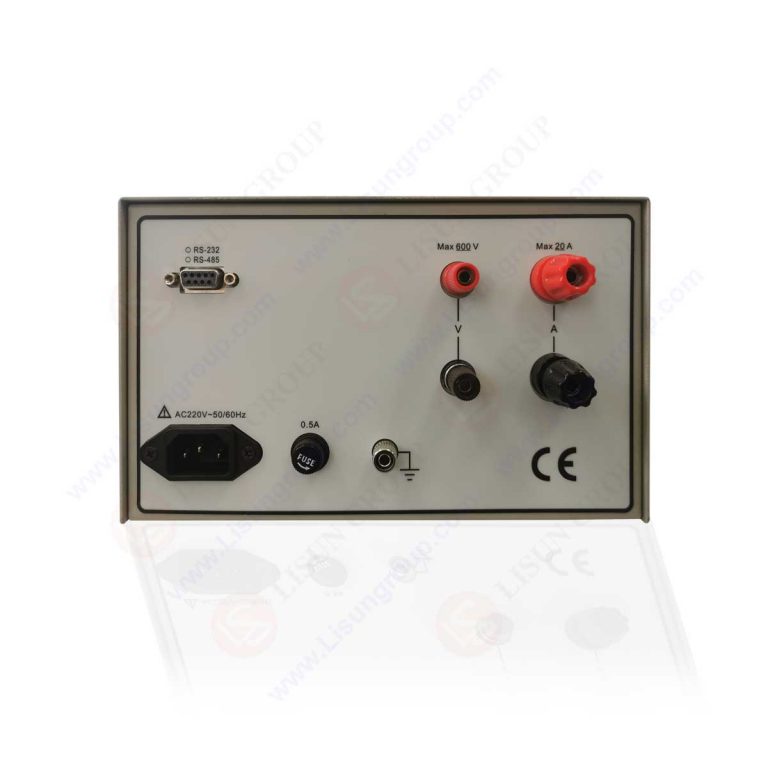
A precision measurement tool must itself be safe and reliable. Compliance with equipment safety standards like IEC 61010 (safety requirements for electrical equipment for measurement, control, and laboratory use) is non-negotiable. This ensures the meter provides adequate protection against electric shock, mechanical hazards, and excessive temperature, even under fault conditions. Features like high overload capacity (e.g., 1600V instantaneous max voltage, 50A instantaneous max current) protect the instrument from transient surges common in industrial and laboratory settings.
4.2 The Role in EMC and Performance Compliance
The high-accuracy AC & DC digital power meter is often the primary measurement device in compliance test setups. For UL 1989 (Standard for Standby Power Supplies), it accurately measures efficiency and output performance. In photometric testing per LM-79, it precisely measures the electrical input characteristics of LED luminaires, which is a required part of the total efficacy (lm/W) calculation. The LS2050C-IEC model is explicitly designed to implement the measurement methodology of EN/IEC61000-3-2, providing the necessary accuracy and analysis algorithms to determine if a device’s harmonic currents fall within permissible limits.
5. Integration and Communication in Automated Test Systems
5.1 Enabling Automated Workflows
Modern manufacturing and test laboratories rely on automated sequences for efficiency and repeatability. Digital power meters facilitate this through standard communication ports like RS232 and RS485. These interfaces allow a host computer or programmable logic controller (PLC) to remotely configure measurement parameters (range, function), trigger readings, and retrieve data in real-time. This is indispensable for endurance testing, burn-in cycles, and high-volume production line testing, where thousands of measurements must be logged without manual intervention.
5.2 Data Logging and Analysis Software
The value of measurement data is unlocked through analysis. Companion software packages enable users to visualize trends, export data to formats compatible with analysis tools (e.g., .CSV for Excel), and generate standardized test reports. For harmonic compliance testing, specialized software can automatically compare measured harmonic currents against the limits defined in EN/IEC61000-3-2, producing a clear pass/fail report and graphical representations of the harmonic spectrum, dramatically streamlining the certification process.
6. Target Industry Applications and Use Cases
6.1 LED Lighting Manufacturing and Testing
In the LED industry, power meters are used at multiple stages. R&D engineers use them to optimize driver circuitry for efficiency (as required by LM-79) and low harmonic distortion. On the production line, they are integrated into test stations for final product verification, checking input power, power factor, and ensuring harmonic emissions are within specified limits before shipment. The AC/DC capability is vital for testing both AC-input luminaires and low-voltage DC lighting systems.
6.2 Automotive Electronics Validation
The automotive sector, with its shift towards electrification, presents unique challenges. Engineers use precision power meters to characterize the efficiency of onboard chargers (OBCs), DC-DC converters, and battery management systems. Tests involve measuring power across a wide range of loads and conditions, analyzing inrush currents, and verifying performance under both DC (battery simulation) and AC (grid simulation) inputs. The wide frequency range is essential for analyzing switching noise and its potential impact on vehicle EMC.
7. Selection Criteria and Best Practices
7.1 Defining Your Measurement Requirements
Selecting the optimal meter begins with a clear specification of needs. Key questions include: What is the required accuracy class for your standard or internal specification? Do you need to perform formal harmonic compliance testing to EN/IEC61000-3-2, or is general harmonic observation sufficient? What are the minimum and maximum voltage, current, and frequency ranges of your devices under test? Will the meter be used in a benchtop or automated systems environment, dictating communication needs?
7.2 Verification and Calibration
To maintain confidence in measurement results, regular calibration against traceable standards is essential. The calibration interval should be determined based on usage frequency, environmental conditions, and the criticality of the measurements. Furthermore, performing routine verification checks using a stable reference source helps detect potential drift or issues between formal calibrations, ensuring the high-accuracy AC & DC digital power meter continues to deliver reliable data.
8. Conclusion
The high-accuracy AC & DC digital power meter represents a sophisticated fusion of measurement technology and practical engineering application. As detailed, its value extends far beyond simple meter readings, serving as a critical tool for product development, quality assurance, and regulatory compliance across advanced industries. By offering unparalleled precision in measuring power, harmonics, and power factor across wide AC/DC and frequency ranges, these instruments provide the empirical data necessary to drive innovation, ensure safety, and demonstrate conformity to global standards like EN/IEC61000-3-2 and LM-79. For electrical testing engineers, R&D professionals, and lab managers, investing in a capable digital power meter—and understanding its full spectrum of applications—is an investment in product integrity, operational efficiency, and market credibility. The choice between standard, high-accuracy, and compliance-specific models allows teams to precisely match tool capability to task requirement, ensuring both technical rigor and cost-effective testing workflows.
FAQ (Frequently Asked Questions)
Q1: What is the practical difference between power factor (PF) and displacement factor (cos φ), and why does my power meter measure both?
A: Displacement factor (cos φ) is the cosine of the phase angle between the fundamental frequency voltage and current waveforms. It reflects reactive power from inductive or capacitive loads. Power factor (PF) is the ratio of real power (W) to apparent power (VA). For perfect sinusoidal waveforms, PF = cos φ. However, with non-linear loads like switch-mode power supplies, the current waveform is distorted with harmonics. These harmonics increase apparent power but don’t contribute to real power, causing PF to be lower than cos φ. A precision power meter measures both to help engineers distinguish between issues caused by phase displacement (solved with power factor correction capacitors) and those caused by harmonic distortion (requiring filtering or improved circuit design).
Q2: For EMC compliance testing to EN/IEC61000-3-2, can I use any high-accuracy power meter, or do I need a specific model?
A: While any accurate meter can measure harmonics, formal compliance testing to EN/IEC61000-3-2 requires an instrument that implements the specific measurement methodology outlined in the standard (referenced from IEC 61000-4-7). A dedicated compliance model like the LS2050C-IEC is designed for this purpose. It uses the correct measurement bandwidth, applies the required weighting for partial harmonics, and often includes software that automatically classifies the equipment (Class A, B, C, or D) and compares results directly against the standard’s limits. Using a general-purpose meter may yield different harmonic values and would not be accepted by accredited test laboratories for certification.
Q3: How does automatic range switching work, and what are its benefits in automated testing environments?
A: Automatic range switching is an intelligent feature where the power meter’s internal processor continuously monitors the input signal magnitude. If the signal approaches the upper or lower limit of the currently selected measurement range, the instrument automatically and seamlessly switches to a more appropriate range to maintain optimal resolution and accuracy. This eliminates manual range selection errors, speeds up test sequences by avoiding pauses for operator intervention, and is crucial in automated test systems (ATE). It ensures that whether measuring a device’s low standby power or its full-load operational power, the meter is always using the most accurate range without requiring pre-programmed range commands.