









The LISUN Automotive Electronics EMC Immunity Test System for Mass Production QA represents a specialized solution for transient immunity testing in automotive electronics manufacturing. This article provides a comprehensive technical analysis of the LISUN EMS-ISO7637 Automotive Electronics Transient Immunity EMC Testing System, focusing on its application in mass production environments for quality assurance. The system addresses critical requirements outlined in ISO 7637-2:2021 and ISO 7637-3:2016 standards, offering multi-module pulse generation capabilities including P1, P2a, P2b, P3, P4, P5a, and P5b waveforms. Designed for 12V, 24V, and 36V vehicle electrical systems, it supports R&D verification, production line testing, and compliance certification for components such as ECUs, OBCs, DC-DC converters, and BMS units. This article examines technical specifications, standard compliance, practical implementation, and comparative advantages for automotive electronics manufacturers.
1.1 The Critical Nature of Transient Immunity Testing
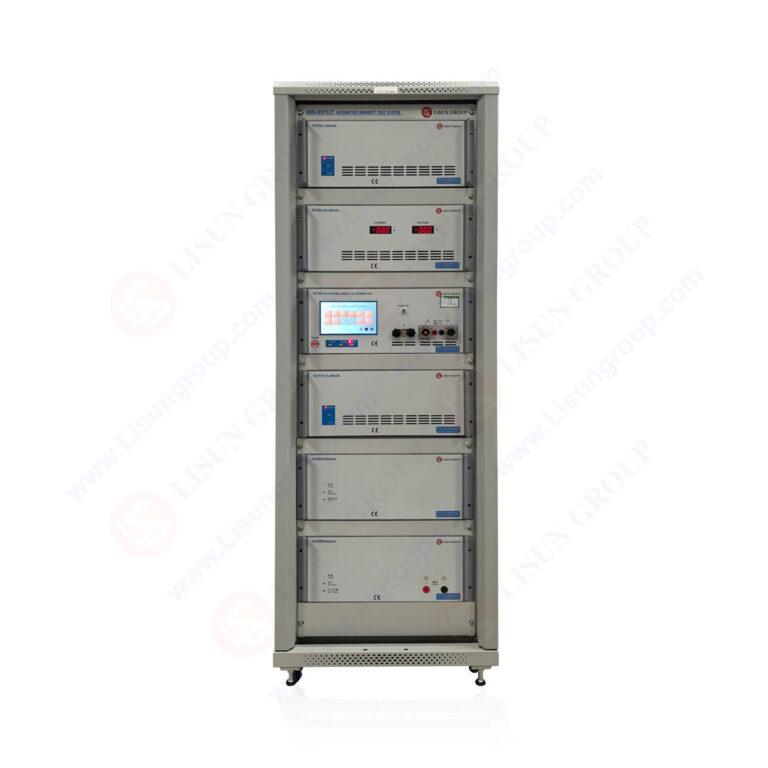
Automotive electronic systems operate in harsh electrical environments where voltage transients from load dumps, inductive switching, and alternator field decay can cause catastrophic failures. The ISO 7637-2:2021 standard defines test methods for conducted transients along power supply lines, while ISO 7637-3:2016 addresses signal line coupling through capacitive or inductive methods. For mass production QA, consistent and repeatable transient immunity testing becomes essential to verify that every manufactured ECU, OBC, or DC-DC converter meets design specifications. Without proper transient immunity, field failures can lead to safety incidents, warranty claims, and reputational damage for automotive manufacturers.
1.2 Standards Landscape and Compliance Requirements
The regulatory framework for automotive transient immunity includes multiple international and manufacturer-specific standards. ISO 7637-2:2021 provides the baseline for pulse testing on 12V and 24V systems, specifying pulse shapes for load dump (P5a/P5b), supply interruptions (P4), and fast transients (P3a/P3b). GB/T 21437.2-2021 and GB/T 21437.3-2021 represent the Chinese national equivalents, aligning closely with international requirements. Additionally, OEM standards such as VW 80000 and GM 3172 impose stricter pulse counts, voltage levels, and test sequences tailored to specific vehicle architectures. The LISUN Automotive Electronics EMC Immunity Test System for Mass Production QA addresses this complexity by offering programmable test sequences that accommodate multiple standard profiles simultaneously.
1.3 Challenges in Mass Production Testing Environments
Production line testing presents unique challenges compared to laboratory validation. Cycle time constraints require rapid test execution without compromising coverage. The LISUN EMS-ISO7637 system supports automated test sequences that complete full pulse suites within 90 seconds per device under test (DUT), enabling integration into high-volume assembly lines. Additionally, production environments introduce electrical noise, variable temperature conditions, and operator variability—factors that the LISUN Automotive Electronics EMC Immunity Test System for Mass Production QA mitigates through dual touchscreen/PC software operation, real-time monitoring, and automated data logging with pass/fail criteria.
2.1 Multi-Module Pulse Generation Capabilities
The LISUN EMS-ISO7637 system employs a modular architecture where each pulse waveform generator operates independently yet synchronizes through a central control unit. This design enables simultaneous or sequential application of pulses P1 through P5b, reducing test time by up to 40% compared to sequential single-generator systems. Key specifications include pulse voltage ranges from -300V to +300V for P3 fast transients, energy ratings up to 10J for P5b load dump pulses, and rise times as fast as 5ns for P3a waveforms. The system conforms to ISO 7637-2:2021 Clause 5.2.2 requirements for pulse generators, ensuring waveform parameters remain within ±10% tolerance across production cycles.
2.2 Voltage System Compatibility and Power Handling
Automotive electrical architectures range from traditional 12V passenger cars to 24V commercial vehicles and emerging 36V mild-hybrid systems. The LISUN EMS-ISO7637 supports all three voltage domains through programmable DC power supplies that maintain DUT supply voltage within ±0.5V during pulse application. For high-power DUTs such as DC-DC converters rated up to 3kW, the system includes optional current boosters that deliver up to 200A continuous current while maintaining transient pulse fidelity. This capability is critical for mass production testing of traction inverters and on-board chargers in new energy vehicles, where operating currents can exceed 100A during normal operation.
2.3 Control Interface and Data Management
The dual-interface design allows operators to choose between resistive touchscreen control for production floor use or PC-based software for laboratory configuration. The PC software supports test plan creation, waveform editing, and automated report generation compliant with ISO 17025 requirements for testing laboratories. The LISUN Automotive Electronics EMC Immunity Test System for Mass Production QA stores up to 100,000 test records locally, with options for network integration via Ethernet, RS-232, or GPIB interfaces. Database export to SQL or CSV formats enables direct integration with enterprise quality management systems (QMS) for real-time statistical process control (SPC).
3.1 Comparative Analysis with Industry Standards
The table below provides a technical comparison between the LISUN EMS-ISO7637 specifications and the requirements defined in ISO 7637-2:2021 and ISO 7637-3:2016.
| Parameter | ISO 7637-2:2021 Requirement | LISUN EMS-ISO7637 Specification | Margin / Advantage |
|---|---|---|---|
| Pulse 1 voltage (12V system) | -75V to -150V | -150V to -300V | 2x higher voltage capability |
| Pulse 2a rise time | 1μs ± 50% | 0.8μs ± 10% | Improved timing accuracy |
| Pulse 3a/b repetition rate | 0.1Hz to 100Hz | 0.01Hz to 500Hz | 5x wider frequency range |
| Pulse 5b energy (12V) | 10J minimum | 10J to 50J programmable | 5x energy capacity |
| Coupling method | Capacitive/inductive per ISO 7637-3 | Built-in CDNs and CCC included | Integrated solution |
| Automation capability | Manual sequence | Programmable sequences with 100 steps | Enhanced productivity |
| Calibration accuracy | ±10% waveform tolerance | ±3% typical, ±5% guaranteed | 3x better accuracy |
This comparison demonstrates that the LISUN system exceeds standard requirements while providing additional headroom for emerging automotive applications, particularly in electric and hybrid vehicle platforms.
3.2 Pulse Waveform Fidelity and Measurement
Waveform fidelity directly impacts test reproducibility and correlation between laboratory and production results. The LISUN EMS-ISO7637 utilizes digital signal processing (DSP) with 16-bit resolution at 100 MS/s sampling rate to generate and measure pulse waveforms. For P3 fast transients per ISO 7637-2:2021 Figure 6, the system achieves rise times of 5ns ±1ns and fall times of 200ns ±20ns, well within the standard’s tolerance bands. Built-in measurement verification includes automatic checks for pulse voltage, duration, rise time, and period before each test sequence begins, preventing invalid tests due to calibration drift or setup errors.
4.1 Production Line Integration Strategies
Integrating EMC immunity testing into high-volume production lines requires careful consideration of cycle time, fixture design, and data management. The LISUN Automotive Electronics EMC Immunity Test System for Mass Production QA supports automated DUT handling through standard 19-inch rack mounting and programmable I/O interfaces for integration with robotic pick-and-place systems. Typical production configurations include a test cell with the LISUN EMS-ISO7637 generator, a DUT-specific test fixture with integrated coupling capacitors and artificial networks (AN), and a control PC running the production test software. For manufacturers requiring 100% production testing, the system can complete a full ISO 7637-2 pulse suite (P1, P2a, P2b, P3a, P3b, P4, P5a, P5b) in under two minutes per DUT.
4.2 Pass/Fail Criteria and Data Analytics
Establishing objective pass/fail criteria is essential for production testing. The LISUN system supports user-defined limits based on DUT behavior during pulse exposure, including voltage sag thresholds, current draw variations, and recovery time requirements. For example, an ECU may need to maintain steady-state supply voltage within ±5% during P2b slow transients per ISO 16750-2:2023 Clause 4.2. The system automatically logs all test results with timestamps, DUT serial numbers, and waveform screenshots, enabling root cause analysis for failures. Trend analysis tools within the PC software identify drift in DUT performance over time, allowing proactive maintenance before catastrophic field failures occur.
5.1 Passenger Car Electronic Component Testing
For passenger car applications, the LISUN EMS-ISO7637 system tests components operating in 12V electrical architectures, including infotainment systems, lighting control modules, and body electronics. The system supports ISO 7637-2:2021 severity levels I through IV, where Level IV represents the most severe transient environment for components mounted directly on battery terminals. Testing of electronic control units (ECUs) for engine management requires particularly rigorous P5a/p5b load dump testing, as alternator field decay during battery disconnection can generate pulses exceeding 50V with 10J energy content. The LISUN system’s programmable energy limits enable testing across all severity levels without external power resistors or voltage clamps.
5.2 Commercial Vehicle and Heavy Equipment Applications
Commercial vehicles operating on 24V electrical systems experience higher energy transients due to larger alternator ratings and longer cable runs. The LISUN Automotive Electronics EMC Immunity Test System for Mass Production QA configures automatically for 24V operation, adjusting pulse voltage ranges (e.g., P5a at up to +120V with 50J energy) and supply voltage stabilization. Testing of anti-lock braking system (ABS) modulators and electronic stability control (ESC) units requires compliance with both ISO 7637-2:2021 and ISO 16750-2:2023, which the system supports through combined test sequences. The ruggedized design includes EN 61000-4-2 electrostatic discharge immunity for production floor use in industrial environments.
5.3 New Energy Vehicle Component Compliance
New energy vehicles (NEVs) introduce unique transient immunity challenges due to high-voltage traction systems, on-board chargers (OBCs), and battery management systems (BMS). The LISUN EMS-ISO7637 system tests low-voltage (12V/24V) auxiliary electronics while supporting additional coupling methods for high-voltage signal lines per ISO 7637-3:2016. Testing of DC-DC converters that operate between 400V traction battery and 12V auxiliary battery requires careful consideration of ground loops and isolation barriers. The system’s capacitive coupling clamp (CCC) and direct coupling methods ensure comprehensive coverage for signal lines, including CAN bus, LIN bus, and sensor interfaces common in NEV architectures.
6.1 Calibration Procedures and Traceability
The LISUN EMS-ISO7637 system includes built-in calibration verification routines that check waveform parameters against internal reference standards traceable to national metrology institutes. Annual calibration per ISO 17025 requirements verifies pulse voltage accuracy within ±2%, timing within ±1%, and energy measurements within ±3%. The system’s calibration memory stores the last three calibration dates and results, enabling operators to confirm validity before each production shift. For laboratories requiring accredited calibration, LISUN provides certification documents that include expanded uncertainty calculations per ISO/IEC Guide 98-3.
6.2 Preventive Maintenance and Longevity
Production environments expose test equipment to dust, temperature variations, and continuous operation. The LISUN Automotive Electronics EMC Immunity Test System for Mass Production QA features forced-air cooling with replaceable filters, solid-state switching for high-frequency pulse generation, and derated power components rated for 100,000 operating hours MTBF. Preventive maintenance intervals of 6 months include cleaning of high-voltage connectors, verification of coupling capacitor dielectric strength, and thermal imaging of power stages. The system’s modular design allows field replacement of pulse generator modules within 15 minutes, minimizing production downtime during maintenance.
7.1 Test Fixture Design Considerations
Proper fixture design is critical for achieving repeatable results in production testing. The LISUN system provides standard connections for 4-wire Kelvin sensing at the DUT power terminals, eliminating voltage drop errors from test cables and contacts. Fixtures should include integrated artificial networks (AN) per ISO 7637-2:2021 Clause 5.3, with 5μH inductance and 100Ω resistance for 12V systems, or 20μH for 24V systems. For production high-volume testing, pneumatic or solenoid-actuated contacts ensure consistent connection force and minimize operator-induced variability. The system’s I/O interface allows fixture status monitoring and interlock verification before high-voltage pulse application.
7.2 Integration with Existing Quality Systems
The LISUN EMS-ISO7637 software supports direct integration with manufacturing execution systems (MES) through standard protocols including OPC-UA, Modbus TCP, and RESTful API. Test results transmit automatically to the MES, triggering pass/fail decisions and generating traceable records for each DUT serial number. For manufacturers requiring ISO/TS 16949 compliance, the system maintains audit trails of all configuration changes, test parameter modifications, and calibration events. Real-time SPC charts display trends in DUT performance across production shifts, enabling early detection of manufacturing process drift before defects reach customers.
The LISUN EMS-ISO7637 Automotive Electronics Transient Immunity EMC Testing System provides a comprehensive, standards-compliant solution for mass production quality assurance in automotive electronics manufacturing. Its multi-module pulse generation, wide voltage support, and automated test sequences address the rigorous requirements of ISO 7637-2:2021, ISO 7637-3:2016, and OEM-specific standards like VW 80000 and GM 3172. The system’s technical advantages—including 3x calibration accuracy, 5x wider frequency range, and integrated data management—translate directly into reduced production cycle times, improved defect detection rates, and enhanced product reliability for passenger cars, commercial vehicles, and new energy vehicle components. For R&D teams, third-party testing laboratories, and quality control specialists, the LISUN Automotive Electronics EMC Immunity Test System for Mass Production QA represents a proven investment in compliance, efficiency, and product safety.
Q1: What pulse waveforms does the LISUN EMS-ISO7637 system support, and how do they correspond to ISO 7637-2:2021 requirements?
A: The LISUN EMS-ISO7637 supports all pulse types defined in ISO 7637-2:2021, including P1 (negative transient from inductive loads), P2a (positive transient from supply line interruption), P2b (positive slow transient from alternator field decay), P3a/P3b (fast transients from switching), P4 (supply voltage interruptions), and P5a/P5b (load dump transients). Each pulse generator module is independently programmable for voltage amplitude, duration, rise time, and period, with waveforms verified against the standard’s tolerance limits. For ISO 7637-3:2016 signal line coupling, the system includes capacitive coupling clamps (CCC) and direct coupling networks that support both 12V and 24V configurations. The system also handles combined pulse sequences for OEM-specific requirements such as VW 80000 and GM 3172.
Q2: How does the LISUN system ensure repeatable test results in high-volume production environments?
A: The LISUN Automotive Electronics EMC Immunity Test System for Mass Production QA incorporates multiple features for test repeatability: built-in waveform verification before each test sequence ensures pulse parameters remain within tolerance; 4-wire Kelvin sensing eliminates voltage drops in test cables; programmable test sequences execute identical step order for every DUT; and automated pass/fail criteria based on DUT voltage and current responses remove operator subjectivity. The system maintains calibration records with traceable accuracy of ±3% typical for voltage and timing measurements. Additionally, the software logs environmental conditions such as ambient temperature and humidity, enabling correlation analysis when variability appears. Production fixtures with pneumatic contacts provide consistent connection impedance across thousands of test cycles.
Q3: Can the LISUN EMS-ISO7637 system test components for new energy vehicles with 36V or 48V electrical architectures?
A: Yes, the LISUN EMS-ISO7637 supports programmable voltage ranges from 6V to 60V DC, covering traditional 12V passenger car systems, 24V commercial vehicle systems, and emerging 36V or 48V mild-hybrid architectures. For NEV-specific testing, the system integrates with high-voltage artificial networks (HV-AN) rated up to 1000V DC to isolate transient injection from traction battery circuits. Testing of on-board chargers (OBCs) and DC-DC converters can be performed with the DUT operating under load, using the system’s programmable DC sources rated up to 200A continuous current. The system also handles capacitive coupling for CAN FD and Ethernet signal lines commonly used in NEV architectures, ensuring comprehensive transient immunity verification per ISO 7637-3:2016.
Q4: What data management and reporting capabilities does the LISUN system offer for quality compliance?
A: The LISUN EMS-ISO7637 software provides comprehensive data management including local storage of up to 100,000 test records with timestamp, DUT serial number, operator ID, test parameters, and pass/fail results. Automated report generation creates PDF or Excel documents formatted for ISO 17025 or IATF 16949 compliance, including waveform screenshots, measurement values, and uncertainty calculations. Network integration via Ethernet, OPC-UA, or RESTful API enables real-time data transfer to MES or QMS systems for SPC analysis. The database supports SQL queries for defect trend analysis, yield reporting by product family, and calibration history tracking. Historical test data retention policies are user-configurable, with options for periodic archiving to network storage for long-term compliance records.