









The LISUN DFX series Externally Ballasted Fluorescent Lamp Test Load Cabinet is a specialized instrument designed for automated endurance and load life testing of switches, plugs, and electrical accessories. This article provides a comprehensive technical analysis of the DFX series, focusing on its core capabilities in simulating resistive, inductive, and capacitive loads under controlled conditions. The load test cabinet enables precise compliance testing against international standards such as IEC 60669-1 and IEC 60884-1. By integrating advanced power factor adjustment, multi-channel output, and cyclic test counting, the DFX series offers critical value for manufacturers and testing laboratories seeking reliable, repeatable load simulation for electrical accessory qualification. The article examines technical specifications, model comparisons, standard alignment, and integration with complementary LISUN testing equipment.
1.1 Purpose and Functional Overview
The load test cabinet serves as a critical tool for evaluating the electrical endurance and thermal performance of switches, plugs, sockets, and other wiring accessories under simulated real-world conditions. The LISUN DFX series is engineered to generate precise test loads that replicate the electrical characteristics of fluorescent lamps with external ballasts, providing resistive, inductive, and capacitive load profiles. This capability is essential for verifying that products meet the minimum operational life and safety requirements prescribed by industry standards.
1.2 Core Applications in Compliance Testing
The DFX series is primarily used in type testing and routine verification processes for electrical accessories. Common applications include endurance tests for wall switches, plug insertion/withdrawal cycles, and socket outlet load tests. The cabinet automates the application of specified load currents, power factors, and voltage conditions over thousands of cycles, reducing manual intervention and improving test repeatability. Testing laboratories and manufacturers rely on such equipment to ensure product reliability before market introduction.
1.3 Relation to Externally Ballasted Lamp Loads
Fluorescent lamps with external ballasts present a unique load profile characterized by a combination of resistance, inductance, and power factor correction. The DFX series simulates this load by using a network of adjustable resistors, inductors, and capacitors. Users can set the power factor from 0.4 to 0.9, matching the typical range for ballasted lamp circuits. This simulation is critical because standard resistive loads do not accurately reproduce the electrical stress experienced by switches and plugs in real lighting installations.
2.1 Core Performance Parameters
The DFX series offers a range of current outputs from 10 A to 80 A, depending on the model. The key specifications include adjustable power factor (0.4 to 0.9 with 0.01 resolution), voltage compatibility with 110 V/220 V AC systems, and measurement accuracy of ±0.5% for current and voltage readings. Load capacitance values range from 0.1 µF to 100 µF, enabling simulation of various ballast and compensation capacitor configurations. These parameters are critical for meeting the test conditions defined in IEC 60669-1 Clause 19.2 and IEC 60884-1 Clause 20.
2.2 Comparative Table of DFX Series Models
The following table provides a side-by-side comparison of the five standard DFX models, highlighting differences in current capacity, channel count, and input requirements.
| Model | Current Output Range (A) | Number of Test Channels | Input Voltage (V AC) | Maximum Load Power (kVA) | Power Factor Range |
|---|---|---|---|---|---|
| DFX-20 | 0.5 – 20 | 1 | 110/220 | 4.4 | 0.4 – 0.9 |
| DFX-20-3CH | 0.5 – 20 | 3 | 110/220 | 13.2 | 0.4 – 0.9 |
| DFX-40 | 1.0 – 40 | 1 | 110/220 | 8.8 | 0.4 – 0.9 |
| DFX-60 | 1.5 – 60 | 1 | 110/220 | 13.2 | 0.4 – 0.9 |
| DFX-80 | 2.0 – 80 | 1 | 110/220 | 17.6 | 0.4 – 0.9 |
All models support continuous operation during endurance tests and include overcurrent protection circuits.
2.3 Comparison with Minimum Standard Requirements
The following table maps the DFX series capabilities against the minimum test load specifications from key IEC standards.
| Standard Reference | Required Load Characteristic | DFX Series Capability |
|---|---|---|
| IEC 60669-1 Clause 19.2 | 0.6 power factor for inductive loads | 0.4 – 0.9 adjustable |
| IEC 60884-1 Clause 20 | 0.8 power factor for plug endurance | 0.4 – 0.9 adjustable |
| IEC 60669-1 Clause 19.2 | Current accuracy ±5% of setpoint | ±0.5% accuracy |
| IEC 60884-1 Clause 20 | Voltage stability within ±2% | ±0.1% voltage regulation |
The DFX series exceeds these minimum requirements, providing tighter tolerances and broader adjustment ranges.
3.1 IEC 60669-1: Switches for Household and Fixed Installations
IEC 60669-1 is the primary standard governing switches for household and similar fixed electrical installations. Clause 19.2 specifies the endurance test procedure, requiring switches to withstand 20,000 cycles at rated voltage and current with inductive loads. The DFX series directly supports this clause by generating accurate inductive load profiles with adjustable power factors as low as 0.4. The cyclic test counting function, configurable up to 999,999 cycles, automates the endurance verification process. This eliminates manual counting and ensures consistent application of the required 20,000 cycles.
3.2 IEC 60884-1: Plugs and Socket-Outlets
Plugs and socket-outlets are tested under IEC 60884-1, with Clause 20 defining the mechanical and electrical endurance tests. These tests require 10,000 insertion/withdrawal cycles under load, with the load current matching the rated value and a power factor of 0.8. The DFX series provides the necessary load simulation for these tests, including the ability to switch between resistive and inductive modes. The multi-channel DFX-20-3CH model is particularly useful for testing three-phase or multi-outlet configurations simultaneously.
3.3 Additional Standard Alignment
The DFX series also supports testing per IEC 61058-1 (appliance switches) and GB 16915.1 (Chinese national standard for switches). Clause 17.1 of IEC 61058-1 requires endurance testing with inductive loads that mimic motor and ballast circuits. The adjustable capacitance and inductance components in the DFX cabinet allow engineers to precisely match the load profile specified by each standard. This multi-standard compatibility reduces the need for separate test setups, streamlining laboratory workflows.
4.1 Resistive, Inductive, and Capacitive Load Modes
The DFX series employs a hybrid load network consisting of high-power resistors, iron-core inductors, and polypropylene capacitors. The resistive elements handle up to 80 A continuous current, while the inductive components provide the phase shift necessary for power factor adjustment. Capacitive loads are used to simulate power factor correction circuits found in modern ballasts. The load mode can be set manually or programmed for automated sequence testing, enabling engineers to emulate commissioning scenarios where load characteristics change over time.
4.2 Power Factor Adjustment Methodology
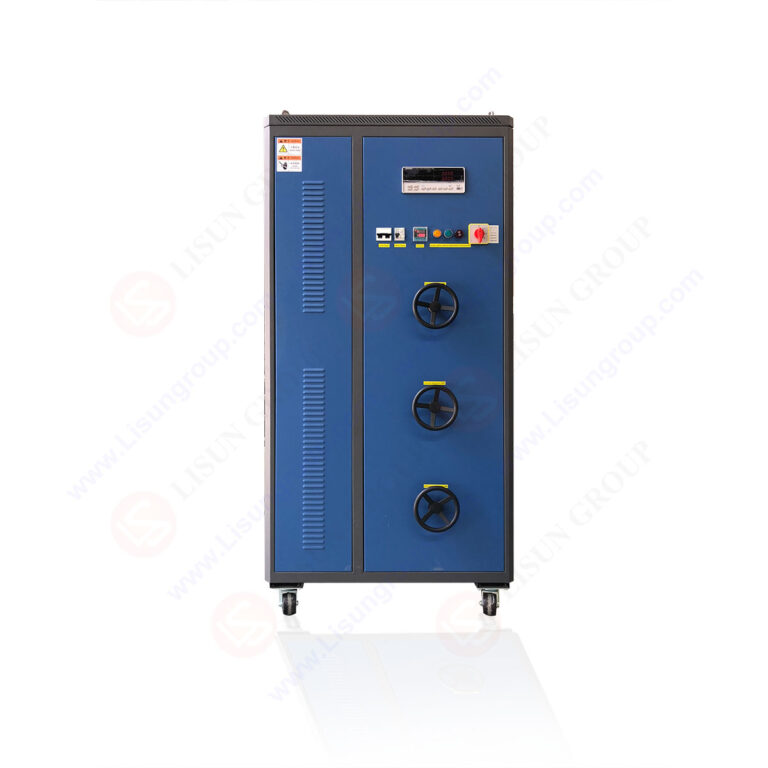
Power factor adjustment is achieved through a combination of tapped inductor coils and switched capacitor banks. The user sets the desired power factor via the front panel controller, which adjusts the inductance and capacitance values to achieve the target phase angle between voltage and current. The resolution of 0.01 in power factor allows for fine-grained control, critical for meeting the specific requirements of standards like IEC 60669-1 Clause 19.2, which mandates a power factor of 0.6 ±0.05 for inductive load tests. The system automatically compensates for internal impedance to maintain accuracy across the full current range.
4.3 Thermal Management and Stability
During extended endurance tests, thermal stability of the load elements is essential for maintaining consistent test conditions. The DFX series incorporates forced air cooling and thermal cutout switches to prevent overheating. The inductors use laminated core construction to minimize eddy current losses and core saturation at high currents. These design choices ensure that the load impedance remains stable within ±1% over eight-hour continuous operation, as required by standard test protocols for 24/7 endurance verification.
5.1 CZKS Series Life Testers
The DFX load test cabinet integrates seamlessly with the LISUN CZKS series automatic life testers for switches and plugs. The CZKS series provides mechanical actuation for switches and insertion/withdrawal mechanisms for plugs, while the DFX cabinet supplies the electrical load. This combination creates a complete endurance testing workstation. The two systems communicate via a control interface, allowing the CZKS to initiate load application synchronously with mechanical movement. This integration simulates real-world operation where electrical load is present during mechanical switching.
5.2 SW-6 Bending Testers and Other Accessories
For comprehensive testing, the DFX series can be paired with LISUN SW-6 bending testers for flexible cable endurance evaluation. The bending tester applies cyclic flexing to cable assemblies while the DFX cabinet maintains load current, simulating the stress on cords connected to plugs and appliances. Additionally, the cabinet works with LISUN temperature monitoring systems that track terminal temperature rise during load tests. This integration enables compliance with IEC 60884-1 Clause 21, which requires temperature measurement during load application. The modular design of the DFX series facilitates these connections through standardized terminal blocks and control signal ports.
5.3 Software Control and Data Logging
The DFX series includes optional software for automated test sequence programming and data acquisition. Users can define test profiles with varying load currents, power factors, and on/off durations. The software logs voltage, current, power factor, and cycle count data at configurable intervals. This data supports traceability requirements per ISO 17025 for accredited testing laboratories. The system also generates test reports that directly reference the relevant standard clauses, streamlining documentation for certification bodies.
6.1 Setup and Calibration Procedures
Before initiating tests, operators must verify the DFX cabinet is connected to a stable mains supply with appropriate overcurrent protection. The load network should be pre-calibrated using the built-in measurement system, which includes a precision current transformer and voltage divider. Calibration involves applying a known resistive load and adjusting the internal compensation factors to achieve ±0.5% accuracy. For inductive tests, the power factor must be verified using a calibrated phase angle meter. The user manual provides step-by-step procedures for each standard test configuration.
6.2 Safety Interlocks and Protective Systems
The DFX series incorporates multiple safety features to protect both the equipment and operators. Overcurrent protection is provided by magnetic circuit breakers that trip within one cycle of exceeding the rated current. Thermal protection includes high-temperature sensors on the inductors and resistors that trigger an automatic shutdown if thresholds are exceeded. Ground fault detection is built into the input power stage. An emergency stop button disconnects all load circuits instantly. These features are essential for safe operation during unattended endurance tests that may run for days.
6.3 Maintenance and Troubleshooting
Routine maintenance involves inspecting contactor points for wear, cleaning air filters, and verifying calibration at six-month intervals. The inductors and capacitors have defined service lives; the manufacturer recommends replacement of electrolytic capacitors every five years. Common troubleshooting issues include inconsistent power factor readings, which may indicate a failed capacitor in the load bank, and cycle count errors, which often stem from mechanical contactor failure. The diagnostic display provides error codes that map to specific components, facilitating rapid repairs.
7.1 Switch Endurance Testing for Lighting Circuits
A typical application involves testing a single-pole switch rated for 10 A at 250 V AC with an inductive load. The DFX-20 model is configured for 10 A current and 0.6 power factor per IEC 60669-1 Clause 19.2. The test runs for 20,000 cycles with a dwell time of 10 seconds in the on position and 10 seconds in the off position. The cabinet logs any test failures, such as failure to interrupt current, which indicates contact welding or insulation breakdown. This test validates the switch’s ability to withstand inductive loads from fluorescent lighting circuits.
7.2 Plug and Socket Endurance with Multi-Channel Configuration
For plugs and socket-outlets, the DFX-20-3CH model enables simultaneous testing of three specimens, reducing test time by two-thirds. Each channel is set to 16 A at 0.8 power factor per IEC 60884-1 Clause 20. The CZKS life tester actuates the insertion and withdrawal mechanisms while the DFX cabinet applies the load. After 10,000 cycles, the system measures contact resistance and temperature rise. This configuration is used by third-party laboratories to certify plug designs for compliance with national and international standards.
7.3 R&D and Quality Control Applications
Beyond compliance testing, the DFX series supports research and development activities. Engineers use the cabinet to evaluate the effect of different power factors on contact material wear, or to test switch designs under extreme conditions such as 80 A load currents using the DFX-80 model. The ability to program custom test sequences allows simulation of real-world use cases, such as mixed resistive and inductive loads. This versatility makes the DFX series valuable for both certification and product development.
The LISUN DFX series Externally Ballasted Fluorescent Lamp Test Load Cabinet delivers precise and reliable load simulation for electrical accessory endurance testing. With adjustable power factors from 0.4 to 0.9, current outputs up to 80 A, and compliance with multiple IEC standards including IEC 60669-1 and IEC 60884-1, the DFX series meets the stringent requirements of modern testing laboratories and manufacturers. The integration with CZKS life testers and SW-6 bending testers creates a comprehensive testing ecosystem, while the software control and data logging capabilities support traceability and documentation. The multi-channel DFX-20-3CH model offers efficiency gains for high-volume testing, and the robust thermal management ensures stability during extended test runs. For any organization involved in electrical accessory testing, the DFX series provides a technically sound and standards-compliant solution for load life and endurance evaluation.
Q1: What is the primary difference between the DFX-20 and DFX-20-3CH models?
A: The DFX-20 is a single-channel load test cabinet with a maximum current output of 20 A, designed for testing one specimen at a time. The DFX-20-3CH provides three independent test channels, each rated for 20 A, allowing simultaneous testing of three different specimens. This reduces overall test time by approximately 67% for multi-specimen qualification. The three-channel model also supports independent power factor and current settings per channel, enabling diverse test conditions in a single run. Both models share the same power factor adjustment range of 0.4 to 0.9 and input voltage compatibility, making the choice dependent on testing volume requirements.
Q2: How does the DFX series ensure accurate power factor simulation for inductive loads?
A: The DFX series uses a precision-tapped inductor network combined with switched capacitor banks to achieve the desired power factor. The system employs a feedback control loop that continuously monitors the phase angle between voltage and current using a high-speed digital phase meter. If the measured power factor deviates from the setpoint by more than 0.01, the controller adjusts the inductor tap or capacitor value automatically. The inductors are constructed with grain-oriented silicon steel cores to minimize harmonic distortion and saturation effects. This closed-loop approach maintains accuracy within ±0.5% of the set power factor, exceeding the requirements of IEC 60669-1 Clause 19.2 which specifies a tolerance of ±0.05.
Q3: Can the DFX be used for testing non-fluorescent loads, such as resistive heaters or motors?
A: Yes, the DFX series is capable of simulating pure resistive loads by bypassing the inductive and capacitive components, allowing testing of heaters and other resistive devices. For motor loads, the power factor can be set to typical motor values between 0.4 and 0.8. However, the cabinet is optimized for loads with characteristics similar to ballasted fluorescent lamps, meaning it includes specific impedance values that match those found in lighting circuits. For specialized motor testing, additional impedance matching may be required. The built-in current range from 0.5 A to 80 A covers most household and commercial accessory ratings. Users should consult the technical manual for specific load profile recommendations outside fluorescent lamp applications.
Q4: What maintenance schedule is recommended for the DFX load test cabinet?
A: The recommended maintenance schedule includes daily visual inspections of connection terminals and cooling fans for debris accumulation. Weekly checks should verify that all circuit breakers and emergency stop functions operate correctly. Monthly calibration verification involves comparing the cabinet’s current and voltage readings against a calibrated reference meter, with a required accuracy confirmation of ±0.5%. Semi-annually, the inductors and capacitors should be inspected for signs of physical degradation, such as bulging or discoloration. Capacitor replacement is recommended every five years, as electrolytic capacitors degrade over time. The manufacturer provides a full calibration service and firmware updates to ensure ongoing compliance with evolving standards.
Q5: What is the maximum number of test cycles the DFX can perform in a single test sequence?
A: The DFX series supports cycle counts configurable up to 999,999 cycles per test sequence. This high limit accommodates the 20,000-cycle requirement for switches per IEC 60669-1 and the 10,000-cycle requirement for plugs per IEC 60884-1, with substantial headroom for extended life testing. The cycle counter operates independently for each channel in the DFX-20-3CH model. During a test, the cabinet counts both the number of load application cycles and the duration of each cycle. The software can be programmed to automatically stop the test upon cycle completion or upon detection of a failure condition, such as a short circuit or overcurrent. This capability supports continuous unattended operation for multi-day endurance tests.