




Abstract
The LISUN SW Series Power Cord Flexibility Bending Tester represents a precision-engineered solution for validating power cord mechanical endurance under repeated flexing stress, addressing critical reliability requirements defined in IEC 60884-1, IEC 60745-1, and IEC 60335-1. This article examines the SW-6 Power Cord Flexibility Tester by LISUN | Certified Equipment, focusing on its six-station configuration, PLC-controlled servo drive system, and current-based failure detection methodology. Technical professionals in household appliance manufacturing, hand-held tool production, and compliance testing laboratories require equipment that delivers repeatable bending cycles, adjustable parameters, and automatic stop functions. The SW series meets these demands through configurable bending angles (10°-90°), variable test speeds (1-60 cycles/min), and load current monitoring up to 40A. This analysis provides detailed specifications, comparative benchmarking, and practical application guidance for integrating this equipment into quality assurance protocols.
1.1 Mechanical Bending Mechanism and Cycle Definition
The fundamental operating principle of the LISUN SW series involves subjecting power cords to repetitive angular displacement around a defined pivot point, simulating real-world stresses encountered during product use. Each bending cycle consists of a forward flex to the programmed angle, a return to the neutral position, and a reverse flex to the opposite angular limit. The SW-6 Power Cord Flexibility Tester by LISUN | Certified Equipment employs a servo motor-driven bending arm with positional accuracy within ±0.5°, ensuring that each of the six test stations experiences identical mechanical loading conditions. The bending frequency ranges from 1 to 60 cycles per minute, allowing engineers to accelerate testing according to standard requirements or internal validation protocols.
1.2 Current-Based Failure Detection Methodology
Unlike purely mechanical endurance testers, the SW series integrates real-time current monitoring across each test circuit. A programmable load current, typically set between 0.1A and 40A depending on the cord rating, flows through the conductor during testing. The system continuously compares measured current against preset thresholds, with a deviation of ±5% triggering automatic station shutdown. This methodology detects intermittent conductor fractures, insulation breaches, or connection degradation that would escape visual inspection alone. The technology aligns with IEC 60884-1 Clause 23.2 requirements for continuity verification during bending tests, providing quantitative evidence of cord integrity throughout the test duration.
1.3 PLC Control Architecture and Parameter Programmability
The programmable logic controller (PLC) serves as the central nervous system of the SW series, managing all test parameters through a human-machine interface (HMI) touchscreen. Operators can configure bending angle, test speed, cycle count (up to 999,999 cycles), load current values, and failure thresholds for each station independently. The PLC logs station-specific data including completed cycles, failure events with timestamps, and current deviation trends, enabling post-test analysis. This architecture supports both single-sample validation and production-line batch testing where multiple cord types require different parameter sets.
2.1 Station Configuration and Throughput Capabilities
The SW series offers three configurations designed to match testing volume requirements. The single-station SW-1 suits R&D laboratories conducting detailed failure analysis on prototype cords, while the dual-station SW-2 accommodates moderate production validation needs. The SW-6 Power Cord Flexibility Tester by LISUN | Certified Equipment provides simultaneous testing of six samples, enabling statistically significant data collection within compressed timeframes. Each station operates independently, meaning a failure in one channel does not interrupt testing on remaining stations.
2.2 Technical Specifications Comparison Table
| Parameter | SW-1 Single Station | SW-2 Dual Station | SW-6 Six Station | IEC 60884-1 Minimum Requirement |
|---|---|---|---|---|
| Number of test stations | 1 | 2 | 6 | 1 (per test) |
| Bending angle range | 10°-90° | 10°-90° | 10°-90° | 45° ± 5° (typical) |
| Bending speed | 1-60 cycles/min | 1-60 cycles/min | 1-60 cycles/min | 30 cycles/min (recommended) |
| Load current range | 0.1-40A | 0.1-40A | 0.1-40A | Rated current of cord |
| Maximum cycle count | 999,999 | 999,999 | 999,999 | 10,000 cycles (typical) |
| Failure detection sensitivity | ±5% current deviation | ±5% current deviation | ±5% current deviation | Continuity check required |
| Weight (approx.) | 45 kg | 65 kg | 120 kg | N/A |
2.3 Application-Specific Model Selection Guidance
For manufacturers of portable household appliances such as vacuum cleaners, food processors, or electric kettles producing fewer than 500 units per day, the SW-2 provides adequate throughput for sample-based quality audits. High-volume producers of hand-held power tools, where daily output exceeds 2,000 units, benefit from the SW-6’s capacity to test multiple cord configurations simultaneously. Third-party testing laboratories processing certification requests for multiple clients find the SW-6’s independent station operation advantageous, as different cord types can be tested concurrently without cross-contamination of test parameters.
3.1 IEC 60884-1 Clause 23.2: Mechanical Strength of Flexible Cords
The primary standard governing power cord flexibility testing is IEC 60884-1 for plugs and socket-outlets. Clause 23.2 specifies that flexible cords must withstand 10,000 bending cycles at a 45° return angle without conductor breakage or insulation damage. The SW-6 Power Cord Flexibility Tester by LISUN | Certified Equipment exceeds this requirement through adjustable bending angles from 10° to 90°, enabling manufacturers to apply more stringent internal standards where product reliability demands exceed minimum regulatory thresholds. The current monitoring system provides quantitative pass/fail criteria beyond the standard’s qualitative visual inspection requirements.
3.2 IEC 60745-1 Clause 25.8: Hand-Held Motor-Operated Tools
For hand-held electric tools, IEC 60745-1 Clause 25.8 requires flexible cords to withstand bending tests under load conditions representative of actual tool operation. The standard mandates 20,000 cycles for tools with cord lengths exceeding 2 meters and 10,000 cycles for shorter cords. The SW series’ load current capability up to 40A accommodates testing for high-power tools such as angle grinders, circular saws, and heavy-duty drills. The programmable cycle counter allows exact matching to standard requirements while permitting accelerated testing for internal quality validation.
3.3 IEC 60335-1 Clause 25.14: Household Appliances
IEC 60335-1 for household electrical appliances specifies bending tests for cords subjected to flexing during normal use. Clause 25.14 requires 10,000 cycles at a bending angle that depends on the cord entry point design. The SW-6’s adjustable bending angle and speed parameters enable compliance testing for diverse appliance categories, including portable heating devices, kitchen machines, and personal care appliances. The independent station operation allows simultaneous testing of cords for different appliance types, improving laboratory efficiency.
3.4 GB/T 2099.1 National Standard Compliance
For manufacturers targeting the Chinese market, GB/T 2099.1 mirrors IEC 60884-1 requirements while adding supplementary clauses relevant to domestic production conditions. The SW series’ current monitoring capability satisfies GB/T 2099.1 Clause 23.2 which requires continuity verification throughout the bending test. The PLC-based data logging provides documented evidence for certification bodies, reducing compliance audit preparation time.
4.1 Real-Time Conductor Integrity Monitoring
The SW-6 Power Cord Flexibility Tester by LISUN | Certified Equipment employs a four-wire Kelvin measurement technique for load current verification, eliminating errors from contact resistance variations. Each station’s current sensor samples at 100 Hz, providing sub-cycle detection of intermittent failures that may last only milliseconds. When a current deviation exceeds the programmed threshold, the system records the exact cycle number and failure duration, producing a detailed fault log. This data enables failure mode analysis—differentiating between complete conductor fracture, partial strand breakage, and insulation degradation causing leakage current.
4.2 Automatic Stop and Isolation Functions
Upon detecting a failure condition, the affected station automatically stops its bending mechanism and disconnects the load current circuit, preventing further damage to the sample that could obscure root cause analysis. The remaining stations continue testing uninterrupted, maximizing throughput. The HMI displays a visual alert indicating the failed station, failure type (current interruption, current deviation, or cycle count completion), and the cumulative cycle count at failure. Operators can clear the fault after sample removal and reset the station for subsequent tests without affecting other active stations.
4.3 Data Logging and Export for Quality Documentation
The PLC maintains non-volatile memory for test parameters and results, supporting up to 1,000 test records. Each record includes station identification, test date and time, programmed parameters, actual completed cycles, failure details, and pass/fail status. Data export via USB port generates CSV-formatted reports compatible with statistical process control software. This documentation capability satisfies quality management system requirements under ISO 9001 for traceable test records and supports root cause analysis in continuous improvement programs.
5.1 Clamping Mechanism and Sample Alignment
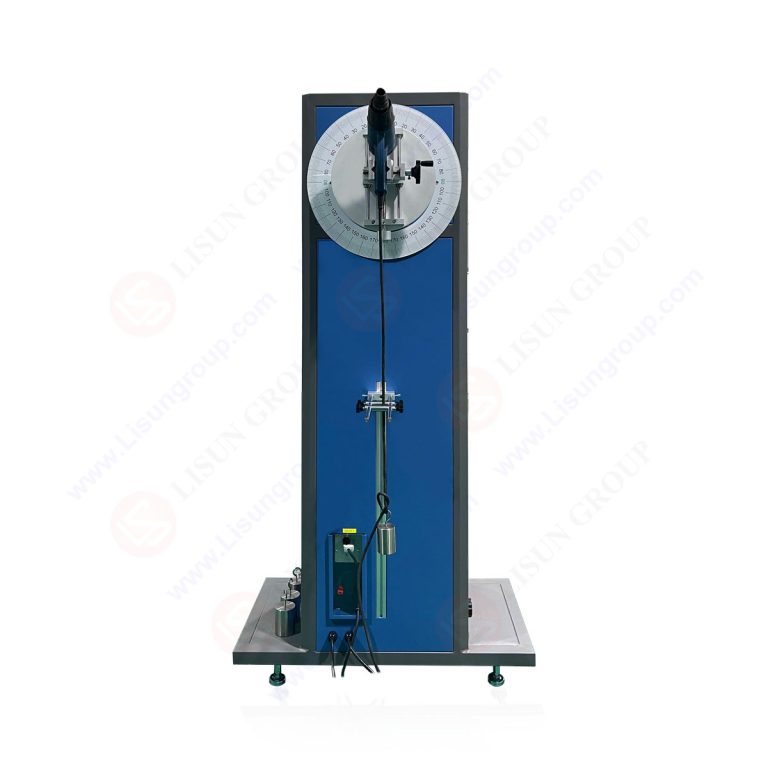
Each test station features adjustable cord clamps that accommodate cord diameters from 5mm to 20mm, covering the majority of power cord specifications used in household appliances and hand-held tools. The clamps employ a quick-release lever system reducing sample changeover time to under 30 seconds per station. The bending axis aligns with the cord exit point from the appliance or connector, ensuring that mechanical stress replicates real-world conditions. Vernier scales on the clamping assembly enable precise positioning repeatability within 0.5mm across successive tests.
5.2 Frame Construction and Vibration Damping
The SW-6 chassis utilizes welded steel construction with a minimum wall thickness of 3mm, providing the mass necessary to dampen vibrational forces generated during high-speed bending cycles. Rubber isolation feet reduce transmitted vibration to the work surface, maintaining positional accuracy of the bending mechanisms. The servo motor drive incorporates electromagnetic braking for instantaneous stop capability, preventing coasting that could introduce stress beyond programmed parameters. This mechanical stability ensures that test results reflect cord durability rather than equipment variability.
5.3 Environmental and Safety Provisions
The control cabinet includes IP54 splash protection for operation in humid laboratory environments. Emergency stop buttons mounted on both the control panel and test frame provide rapid power disconnection. Overcurrent protection on each station’s load circuit prevents damage from sample short circuits or insulation failure. The PLC monitors enclosure temperature and motor drive current, initiating shutdown if thermal limits are exceeded. These safety features comply with IEC 61010-1 for electrical test equipment, reducing operator risk during extended testing periods.
6.1 Incoming Material Inspection Protocols
Component suppliers delivering pre-assembled power cords to appliance manufacturers must demonstrate consistent bending durability across production lots. The SW-6 enables statistical sampling plans where 5-10 samples per lot are tested to internal specification limits exceeding regulatory minimums. Manufacturers can establish acceptable quality levels (AQL) based on cycle count to failure distribution, rejecting lots where median failure occurs below the specification limit. This proactive approach prevents defective cords from entering production, reducing warranty claims and field failures.
6.2 Production Line Process Validation
For manufacturers producing cords in-house, the SW series supports process capability studies during equipment qualification and periodic revalidation. Testing 30-50 samples from a production run provides data for calculating Cpk values, indicating whether the extrusion, stripping, and termination processes produce cords with consistent bending durability. When Cpk falls below 1.33, corrective actions on wire stranding, insulation thickness, or connector molding can be implemented before defective products reach customers.
6.3 Product Certification and Type Testing
Third-party testing laboratories use the SW-6 to perform certification testing for manufacturers seeking IECEE CB Scheme certification or national marks such as CCC, UL, or VDE. The six-station configuration allows simultaneous testing of different cord lengths, connector types, or insulation materials for a single product family, reducing certification timelines by up to 80% compared to sequential testing. The data logging capability generates test reports in the format required by certification bodies, minimizing administrative overhead.
7.1 Routine Maintenance Schedule and Procedures
The SW-6 Power Cord Flexibility Tester by LISUN | Certified Equipment requires minimal routine maintenance to ensure consistent performance. Daily checks include verifying load current accuracy using a calibrated ammeter at each station, inspecting cord clamps for wear, and confirming that bending angle settings match programmed values. Weekly maintenance involves lubricating the bending arm pivot points with silicone-based grease, cleaning the current monitoring contacts with isopropyl alcohol, and verifying emergency stop functionality. The manufacturer recommends annual calibration of load current sensors and positional sensors using traceable reference standards.
7.2 Calibration Intervals and Traceability
Load current measurement accuracy of ±2% is verified using a calibrated reference resistor with traceability to national standards. Bending angle accuracy of ±0.5° is confirmed using a digital protractor with resolution better than 0.1°. The cycle counter accuracy is verified against an external timer over a 1,000-cycle test at nominal speed. Calibration certificates should document as-found and as-left values for each parameter, with corrective actions taken if deviations exceed manufacturer specifications.
7.3 Spare Parts and Support Considerations
LISUN provides spare parts kits including replacement cord clamps, current sensors, and control boards for the SW series. The modular design allows field replacement of station-specific components without affecting adjacent stations. Firmware updates for the PLC are available from the manufacturer to address standard revisions or add new testing protocols. Technical support response time is typically within 24 hours for critical failures affecting production testing schedules.
The LISUN SW Series Power Cord Flexibility Bending Tester, particularly the SW-6 six-station configuration, delivers a technically robust solution for validating power cord mechanical endurance under repeated flexing stress. The integration of PLC control, servo motor drive, and real-time current monitoring provides quantitative failure detection capabilities that surpass the qualitative inspection methods specified in foundational standards such as IEC 60884-1, IEC 60745-1, and IEC 60335-1. The adjustable bending angle range of 10°-90°, variable test speeds from 1-60 cycles per minute, and load current capability up to 40A enable testing across diverse product categories including household appliances, hand-held power tools, and portable electronics.
For technical professionals in manufacturing quality control and compliance testing laboratories, the SW-6 offers measurable throughput advantages through independent station operation, reducing test cycle times by up to 80% compared to sequential testing on single-station equipment. The comprehensive data logging and export capabilities support ISO 9001-aligned quality documentation requirements, while the mechanical durability and safety provisions ensure reliable long-term operation in demanding industrial environments. By enabling early detection of conductor degradation and insulation failure, this equipment directly contributes to reducing warranty claims, improving product reliability, and streamlining certification processes. The SW series represents a targeted investment for organizations committed to power cord reliability validation at scale.
Q1: What distinguishes the SW-6 Power Cord Flexibility Tester from conventional mechanical bending testers that lack current monitoring?
A: Conventional mechanical bending testers rely solely on visual inspection or cycle count completion to determine pass/fail status, which cannot detect partial conductor fractures that maintain mechanical continuity while increasing resistance. The SW-6 Power Cord Flexibility Tester by LISUN | Certified Equipment incorporates continuous current monitoring across each of six independent stations, detecting resistance increases exceeding ±5% of programmed load current. This methodology identifies intermittent failures such as strand breakage within multi-strand conductors, connection degradation at crimp points, and insulation breaches causing leakage current. The current-based approach provides quantitative pass/fail criteria aligned with IEC 60884-1 Clause 23.2 continuity requirements, enabling objective failure analysis rather than subjective visual assessment.
Q2: How does the SW-6 accommodate testing of different cord diameters and connector types within a single test run?
A: Each of the six test stations includes adjustable cord clamps with a diameter range of 5mm to 20mm, accommodating standard power cords from lightweight appliance cords (H03VV-F, 0.75mm²) to heavy-duty tool cords (H07RN-F, 2.5mm²). The clamping mechanism uses a quick-release lever for rapid changeover between cord sizes, with Vernier scale positioning ensuring repeatable alignment of the bending axis relative to the cord exit point. Operators can program station-specific parameters including bending angle, speed, cycle count, and load current through the PLC interface, allowing simultaneous testing of different cord types on adjacent stations. For connector types that require specialized fixturing, optional adapter plates are available for common plug and socket configurations.
Q3: What standards compliance is verified through the bending angle range of 10° to 90° beyond the typical 45° specified in IEC 60884-1?
A: While IEC 60884-1 Clause 23.2 specifies a 90° bending angle (45° deflection in each direction from neutral), the SW-6’s 10°-90° range supports compliance testing for additional standards including IEC 60745-1 Clause 25.8 for hand-held tools which may require 30° deflection angles for specific cord entry configurations, and IEC 60335-1 Clause 25.14 for household appliances where the bending angle depends on the appliance design. The adjustable range also enables manufacturers to apply accelerated stress testing at higher angles for reliability qualification beyond regulatory minimums, and to match bending angles specified in internal standards for specific product categories such as vacuum cleaners or power tools where actual usage involves more extreme flexing.
Q4: How does the independent station operation of the SW-6 improve laboratory efficiency compared to multi-station testers with linked operation?
A: Independent station operation means that when a sample fails on one station, the system isolates only that station by stopping its bending mechanism and disconnecting its load circuit, while the remaining five stations continue testing uninterrupted. This architecture eliminates the inefficiency of multi-station testers with linked operation where a single failure stops all stations, wasting testing time on samples that have not yet reached their failure point. For laboratories managing multiple test requests, independent stations allow simultaneous testing of samples with different specifications (e.g., different cord types, bending angles, or cycle counts) without cross-contamination of test parameters. The PLC also supports staggered start times, enabling operators to begin testing on available stations without waiting for all stations to be loaded.
Q5: What data logging and reporting capabilities does the SW-6 provide for quality management system compliance?
A: The PLC maintains non-volatile memory storing up to 1,000 test records, each including station identification, test date and time, programmed parameters (bending angle, speed, cycle count, load current), actual completed cycles, failure details with cycle count at failure, failure mode (current interruption or deviation), and pass/fail status. Data export via USB port generates CSV-formatted reports compatible with spreadsheet software for statistical analysis. This documentation supports ISO 9001 requirements for traceable test records, enabling quality engineers to calculate process capability indices (Cpk), generate failure distribution histograms, and identify trends in cord durability across production lots. Test records also serve as evidence for certification body audits under IECEE CB Scheme or national certification programs.