




The LISUN SW Series Power Cord Flexibility Bending Tester represents a critical advancement in cable reliability validation for manufacturers seeking compliance with international safety standards. This article examines the SW-6 six-station configuration, designed to simulate repetitive bending stresses on power cords under controlled load conditions. Certified equipment for IEC 60884-1, IEC 60745-1, and IEC 60335-1 compliance testing, the SW-6 Power Cord Flexibility Tester enables simultaneous evaluation of six samples with programmable bending angles, frequencies, and load currents. Technical professionals in appliance manufacturing, power tool production, and component testing laboratories will find this analysis relevant for selecting appropriate cable flexibility testing equipment. The system’s PLC-controlled servo drive mechanism ensures precise angular displacement and consistent test parameters across all stations, delivering reproducible results for certification-grade validation.
1.1 Industry Standards Governing Flexibility Testing
Power cord flexibility testing is mandated by multiple international standards that define minimum performance criteria for cable assemblies subjected to repeated mechanical stress. IEC 60884-1, clause 23, specifies bending test requirements for plugs and socket-outlets, requiring 10,000 bending cycles at a rate of 60 cycles per minute with a specified load current. IEC 60745-1, clause 25, addresses hand-held electric tools, mandating 20,000 bending cycles for cord guards and cable entry points. IEC 60335-1, clause 25.14, establishes testing protocols for household appliances, requiring power cords to withstand 10,000 to 30,000 bending cycles depending on appliance category. The GB/T 2099.1 Chinese national standard mirrors IEC 60884-1 requirements while adding specific adjustments for local market conditions. These standards collectively define bending angles of 90 degrees in both directions, with back-and-forth motion constituting a single cycle.
1.2 Failure Modes Detected by Flexibility Testing
Bending fatigue testing identifies critical failure modes in power cord assemblies including conductor strand breakage, insulation cracking, and connector termination failure. Conductor breakage typically manifests as intermittent open circuits or increased resistance values exceeding the standard threshold of 0.1 ohms. Insulation degradation from repetitive bending creates dielectric strength reduction, potentially leading to short circuits or ground faults. Connector termination failures occur at the strain relief interface where the cable enters the plug or appliance enclosure. The SW-6 Power Cord Flexibility Tester incorporates continuous current monitoring through each test sample, automatically detecting open-circuit conditions exceeding predefined thresholds. This real-time failure detection capability eliminates subjective visual inspection and provides quantitative pass/fail determination aligned with standard requirements.
2.1 PLC-Controlled Servo Drive System
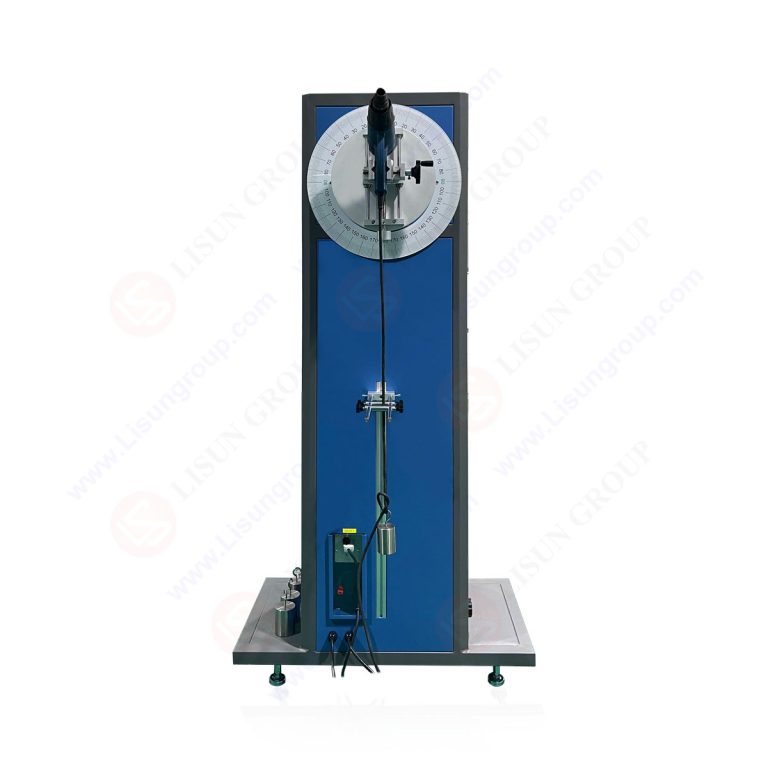
The LISUN SW-6 Power Cord Flexibility Bending Tester utilizes a programmable logic controller (PLC) coupled with a servo motor drive system to achieve precise angular displacement control. The servo motor provides closed-loop position feedback, maintaining angular accuracy within ±0.5 degrees across the full 0 to 180 degree adjustable range. Bending frequency is programmable from 10 to 60 cycles per minute, accommodating requirements for accelerated testing protocols. The PLC controller stores up to 50 test programs, each configurable with parameters for bending angle, frequency, cycle count, load current, and automatic stop conditions. This architecture enables unattended operation for extended test durations exceeding 24 hours while maintaining consistent test conditions across all six test stations.
2.2 Multi-Station Testing Configuration
The six-station configuration allows simultaneous testing of multiple samples under identical or differentiated test parameters. Each station operates independently with its own sample clamping mechanism, current monitoring circuit, and bending arm assembly. Stations can be programmed with identical parameters for production lot validation or with different parameters for comparative material evaluation. The independent station design prevents single sample failure from interrupting testing on remaining samples, maximizing throughput for quality control applications. Typical throughput for the SW-6 Power Cord Flexibility Tester reaches 360 test cycles per minute across all stations when operating at 60 cycles per minute frequency, delivering productivity improvements over single-station alternatives.
3.1 Bending Mechanics and Load Control
The SW Series Power Cord Flexibility Bending Tester supports adjustable bending angles from 0 to 180 degrees with resolution settings of 1 degree increments. The bending arm design accommodates cable diameters from 5 mm to 15 mm, covering the majority of power cord configurations for household appliances and power tools. Load current capability ranges from 0.1 A to 20 A per station, with current monitoring resolution of 0.01 A. The system applies resistive or inductive loads through external load banks connected to each test station. Back-and-forth bending motion follows a controlled velocity profile that minimizes inertia effects at reversing points, ensuring consistent stress application throughout the test duration.
3.2 Model Comparison and Selection Criteria
The LISUN SW Series offers three configurations to address varying throughput requirements and budget constraints.
| Parameter | SW-1 Single Station | SW-2 Dual Station | SW-6 Six Station | IEC 60884-1 Minimum Requirement |
|---|---|---|---|---|
| Test Stations | 1 | 2 | 6 | Not specified |
| Bending Angle Range | 0-180° | 0-180° | 0-180° | ±90° each direction |
| Bending Frequency | 10-60 cpm | 10-60 cpm | 10-60 cpm | 60 cpm maximum |
| Load Current per Station | 0.1-20 A | 0.1-20 A | 0.1-20 A | 0.1-20 A per sample |
| Cycle Counter Capacity | 0-999,999 | 0-999,999 | 0-999,999 | 10,000 minimum |
| Independent Station Control | No | No | Yes | Not specified |
| Automatic Failure Detection | Yes | Yes | Yes | Required for certification |
| External Dimensions (mm) | 600x500x400 | 900x500x400 | 1500x600x500 | Not specified |
The six-station configuration provides optimal throughput for production quality control laboratories requiring high sample volumes. Independent station control enables simultaneous testing of different cable types, reducing setup time between test batches.
4.1 Sample Preparation and Mounting Protocol
Proper sample preparation ensures test results accurately represent cable assembly performance. Test samples must be conditioned at 23±2°C and 45-55% relative humidity for a minimum of 4 hours prior to testing. Each power cord sample is mounted with the cable axis oriented horizontally at the bending fulcrum point, with the connector or appliance end secured in the fixed clamp. The free end passes through the bending arm guide and connects to the load current circuit. Sample installation tension should be adjusted to eliminate slack while avoiding pre-stress that would influence bending fatigue results. The bending radius at the fulcrum point must correspond to the cable diameter per standard requirements, typically 5 times the cable outer diameter for round cords.
4.2 Cycle Counting and Failure Detection Algorithms
The PLC controller implements a counter algorithm that increments one cycle upon completion of a full bending excursion from starting position to maximum angle and back. Cycle counting continues independently for each station, with automatic termination upon reaching the programmed cycle target or detecting a failure condition. Failure detection employs continuous resistance monitoring with a threshold setting of 0.1 ohms above baseline, corresponding to the standard requirement for conductor continuity verification. Current interruption exceeding 0.5 seconds triggers an automatic stop for the affected station, logging the failure cycle count and timestamp. The system maintains test history records including cycle count at failure, maximum resistance value, and test program parameters for subsequent analysis and reporting.
5.1 Household Appliance Power Cord Validation
Refrigerators, washing machines, and kitchen appliances require power cord flexibility testing per IEC 60335-1 clause 25.14 with specific adjustments for appliance mobility and cord exposure conditions. Testing configurations for these applications typically utilize 10,000 to 15,000 cycles at 45 cycles per minute frequency with 90 degree bending angle. Load current is set to 80% of the cord rated current for three-core cables carrying nominal operational loads. The SW-6 Power Cord Flexibility Tester’s six-station configuration enables simultaneous testing of multiple appliance cord types, reducing qualification time for product families sharing common cable specifications. Comparative testing between different cable suppliers using identical test parameters identifies performance variations critical for supplier qualification decisions.
5.2 Power Tool Cord Reliability Assessment
Hand-held electric tools per IEC 60745-1 clause 25 require more demanding testing due to higher operational stress levels and frequent cord flexing during use. The standard mandates 20,000 bending cycles for cord guards with the tool oriented in the position of maximum cord strain. Test parameters for power tool applications include 60 cycles per minute frequency with 180 degree total bending angle (90 degrees each direction). Load current corresponds to the tool rated current plus 10% safety margin. The SW-6 Power Cord Flexibility Tester’s independent station control allows testing of different power tool models simultaneously, each with unique load current settings matching their respective ratings. This capability streamlines certification testing for manufacturers producing multiple power tool models sharing common cable components.
6.1 Real-Time Monitoring and Data Logging
The PLC controller captures resistance data at 10-millisecond intervals for each test station, creating a continuous resistance profile throughout the test duration. This high-resolution data enables detection of transient conductor separations that would reset permanently under open-circuit conditions. The system logs bending cycle count, elapsed test time, instantaneous load current, and sample temperature for each station at configurable logging intervals. Graphical display on the integrated touch screen interface shows resistance trending over time, enabling operators to identify degradation patterns before complete failure occurs. Data export functionality supports CSV format for subsequent analysis in statistical process control software or laboratory information management systems.
6.2 Qualification Report Generation
Automated report generation compiles test parameters, results, and failure analysis data into standardized formats compatible with certification body requirements. Reports include the test program identification, operator information, sample description, and environmental conditions recorded during testing. Each report presents cycle count results for all stations with pass/fail status clearly indicated against the applicable standard requirements. Failure analysis sections document the cycle count at failure, failure mode classification (conductor break, insulation failure, or connector separation), and associated resistance or current measurements. The report generation feature reduces laboratory documentation time while ensuring complete traceability for audit purposes.
7.1 Preventive Maintenance Schedule
Regular maintenance ensures consistent test results and extends equipment service life. Daily inspection includes verification of bending arm alignment, sample clamp integrity, and load circuit continuity. Weekly maintenance tasks involve cleaning the guide tracks and applying lubricant to the linear bearing assemblies. Monthly calibration verification checks angular displacement accuracy using a digital protractor, with acceptable deviation not exceeding ±0.5 degrees. Quarterly calibration includes load current measurement verification using a calibrated ammeter and resistance measurement verification using a precision milliohm meter. The maintenance schedule documentation system records all activities with date, technician identification, and measured values for traceability.
7.2 Calibration Procedures and Standards Traceability
Calibration procedures follow documented protocols referencing national measurement standards through accredited calibration laboratories. Angular displacement calibration uses a calibrated digital inclinometer with measurement uncertainty of ±0.1 degrees to verify the servo motor position feedback accuracy. Load current calibration employs a precision current shunt and calibrated multimeter traceable to national standards with measurement uncertainty of ±0.05% of reading. Resistance measurement verification uses a calibrated milliohm standard with values spanning 0.01 ohms to 1.0 ohms to validate the failure detection circuit accuracy. Calibration intervals of 12 months are recommended for normal laboratory usage, with more frequent intervals for high-throughput production environments.
The LISUN SW-6 Power Cord Flexibility Tester delivers precision cable bending fatigue testing with six independently controlled stations, PLC-driven servo motor actuation, and real-time failure detection. Compliance with IEC 60884-1, IEC 60745-1, IEC 60335-1, and GB/T 2099.1 standards positions this equipment as a validation tool for manufacturers requiring certification-grade test results. The adjustable bending angle range of 0-180 degrees, frequency capability from 10-60 cycles per minute, and load current capacity up to 20 amperes per station provide flexibility across diverse application requirements from household appliances to hand-held power tools. Independent station control enables simultaneous testing of different cable configurations, maximizing laboratory throughput while maintaining test integrity. The continuous resistance monitoring system automatically detects conductor failures, eliminating operator-dependent visual inspection variability. For quality control engineers and compliance testing laboratories, the SW-6 Power Cord Flexibility Bending Tester represents a reliable solution for power cord reliability validation, delivering reproducible results essential for product certification and quality assurance programs.
Q1: What is the difference between the SW-2 and SW-6 Power Cord Flexibility Tester models for production quality control applications?
A: The primary difference lies in testing throughput and operational flexibility. The SW-2 dual station model supports simultaneous testing of two samples with shared test parameters, suitable for low-volume validation or research applications. The SW-6 six-station model features independent station control, allowing each station to run different test programs with unique bending angles, frequencies, and load currents. For production quality control testing 50 samples per day from multiple product lines, the SW-6 reduces total test time by 60% compared to the SW-2 while providing separate failure logging for each sample. The six-station configuration also enables accelerated testing of multiple cable suppliers simultaneously, supporting comparative material evaluation within a single test run. The SW-6 external dimensions of 1500x600x500 mm require larger laboratory floor space but deliver proportional throughput advantages.
Q2: How does the automatic failure detection system work with capacitive or inductive loads during flexibility testing?
A: The failure detection system employs a four-wire resistance measurement method that remains accurate regardless of load type. For inductive loads such as motors or transformers, the system measures resistance during the zero-current portion of each bending cycle to eliminate inductive reactance effects. Capacitive loads require a 100-millisecond settling time after load application before resistance measurement begins, ensuring that transient charging currents do not trigger false failure indications. The resistance threshold is programmable from 0.01 to 1.0 ohms above the baseline measurement, accommodating different cable gauges and conductor materials. The detection algorithm applies a 3-cycle confirmation filter, requiring three consecutive resistance measurements above threshold before declaring a failure condition. This filtering eliminates false trips from momentary contact resistance variations while maintaining detection sensitivity for genuine conductor failures.
Q3: Can the SW-6 Power Cord Flexibility Tester perform testing according to both IEC 60884-1 and IEC 60745-1 standards without hardware modifications?
A: Yes, the SW-6 accommodates both standards through software parameter adjustments without hardware changes. IEC 60884-1 clause 23 testing requires 10,000 cycles at 60 cycles per minute with 90-degree bending angle and load current of 0.2 amperes for plugs. IEC 60745-1 clause 25 requires 20,000 cycles at 60 cycles per minute with the same bending angle but higher load currents corresponding to tool ratings. The PLC controller stores pre-configured test programs for each standard, enabling operator selection through the touch screen interface. The sample mounting hardware accommodates both plug configurations per IEC 60884-1 and tool cord guard configurations per IEC 60745-1 through adjustable clamps and bending arm positions. The automatic stop conditions are pre-set to match each standard’s pass/fail criteria, including the 0.1 ohm resistance increase threshold common to both standards.
Q4: What data export formats are available for integration with laboratory information management systems (LIMS)?
A: The SW-6 Power Cord Flexibility Tester supports data export in CSV, XML, and PDF formats through USB port or Ethernet network connection. The CSV format includes column headers for station identification, cycle count, elapsed time, resistance measurement, load current, temperature, and failure status at user-configurable logging intervals from 1 second to 60 seconds. XML format provides structured data suitable for automated LIMS ingestion, including metadata tags for test program parameters, standard reference, operator identification, and calibration information. The PDF report generation creates formatted documents with test summary, failure analysis graphs, and pass/fail designation ready for submission to certification bodies. The system also supports direct database connectivity via ODBC protocol for real-time data streaming to LIMS platforms, enabling live monitoring of test progress and immediate notification of failure events through laboratory notification systems.