









Here is a comprehensive technical article generated according to your specifications.
Abstract
Accurate Solid-State Lighting Electrical Testing with LMS6000 Digital Power Meter represents a critical evolution in photometric and electrical validation. This article examines the LMS6000 series, a precision power meter family engineered for the rigorous demands of LED manufacturing, automotive electronics, and EMC compliance. The core value lies in its dual AC/DC capability, wide 0.5Hz-100kHz frequency range, and advanced digital sampling for harmonic analysis up to the 50th order. It provides engineers with the necessary tools to measure voltage, current, power, and power factor with high accuracy, ensuring products meet stringent international standards. This piece analyzes the technological foundations, model variations, and practical applications, offering a technical roadmap for integrating these instruments into modern test protocols for solid-state lighting and power quality assessment.
1. The Evolution of Power Measurement in Solid-State Lighting
1.1 The Shift from Analog to Digital Sampling
Early power meters relied on analog multipliers, which introduced significant phase errors at high frequencies and with non-sinusoidal waveforms. The LMS6000 series, however, employs advanced digital sampling waveform analysis. This technology captures the instantaneous voltage and current signals and computes power parameters mathematically. This approach eliminates drift and ensures accuracy even when measuring the highly distorted currents typical of LED drivers. By converting analog signals to digital data at high sampling rates, the meter provides a true RMS representation of the waveform, which is fundamental for Accurate Solid-State Lighting Electrical Testing with LMS6000 Digital Power Meter.
1.2 The Challenge of Non-Linear Loads
LED drivers and ballasts are inherently non-linear loads, drawing current in short pulses rather than smooth sine waves. This results in a low power factor and high harmonic content, which can distort the mains supply. Measuring this accurately requires a bandwidth far beyond the 50/60Hz fundamental. The LMS6000’s 100kHz bandwidth captures the energy contained in the high-frequency harmonic components, which is vital for calculating true power. Without this capability, engineers would significantly under-report the power consumption and misjudge the input characteristics of the lighting product.
1.3 Automatic Range Switching for Dynamic Testing
During compliance testing, devices undergo transient states, such as inrush current at startup or sudden load changes. The LMS6000 features automatic range switching, which allows the meter to adapt instantly to changing voltage and current levels without compromising data integrity. This function is crucial for protecting the device under test (DUT) and the meter itself while maintaining continuous measurement accuracy. For R&D laboratories characterizing prototypes, this dynamic response ensures that the performance data collected is representative of real-world operating conditions, not just steady-state behavior.
2. Core Measurement Capabilities and Technologies
2.1 AC/DC Compatibility and Wide Frequency Range
The LMS6000 is not merely an AC power meter; it is a true AC/DC energy analyzer. This dual capability is essential for testing battery-powered LED emergency lighting or DC-driven automotive lighting modules. The instrument measures DC voltage and current with the same precision class as AC, simplifying test setups. The specified frequency range of 0.5Hz to 100kHz covers not only standard mains (50/60Hz) but also high-frequency electronic ballasts and variable-frequency drives, making it a versatile tool for cross-industry power analysis and a cornerstone for Accurate Solid-State Lighting Electrical Testing.
2.2 Power Factor and Displacement Factor Analysis
The meter distinguishes between power factor (PF) and displacement factor (Dpf).
- Power Factor (PF): The ratio of real power to apparent power, representing overall efficiency.
- Displacement Factor (Dpf): The cosine of the phase angle between the fundamental voltage and current.
This distinction is critical for diagnosing whether low efficiency is due to phase shifts (reactive loads) or harmonic distortion (non-linear loads). By analyzing both, engineers can design better power factor correction circuits. The meter provides real-time readouts, enabling iterative design adjustments in the laboratory to optimize the driver topology for maximum energy efficiency and compliance with utility regulations.
2.3 Total Harmonic Distortion Analysis (IEC/CSA Method)
Harmonic analysis is a mandatory requirement for international compliance. The LMS6000 performs 0-50 order harmonic analysis using the methods defined by IEC and CSA standards. This feature quantifies the Total Harmonic Distortion (THD) and provides a breakdown of each harmonic component’s magnitude and phase. For solid-state lighting, this data directly corresponds to the limits set by EN/IEC61000-3-2. The integration of this analysis into the power meter allows for a single-instrument test station, reducing the complexity and cost associated with using separate power analyzers and spectrum analyzers.
3. Model Variations and Technical Specifications
3.1 Comparison of LMS6000 Series Models
The LMS6000 family is available in several configurations to align with different budget and accuracy requirements. The primary models are the LS2050B, LS2050C, and LS2050C-IEC. The choice between these models hinges on the required precision and specific compliance needs of the laboratory.
| Feature | LS2050B (Standard) | LS2050C (High Accuracy) | LS2050C-IEC (Compliance) |
|---|---|---|---|
| Accuracy Class | 0.5% | 0.1% | 0.1% |
| Harmonic Analysis | Up to 50th | Up to 50th | Up to 50th (Pre-certified) |
| Frequency Range | 0.5Hz – 100kHz | 0.5Hz – 100kHz | 0.5Hz – 100kHz |
| Primary Certification | General R&D | Calibration & High-End R&D | EN/IEC61000-3-2 Pre-compliance |
| Data Interfaces | RS232 | RS232/RS485 | RS232/RS485 |
| Parameter Measurement | V, A, W, PF, Dpf, Hz | V, A, W, PF, Dpf, Hz | V, A, W, PF, Dpf, Hz, THD |
3.2 Overload Capacity and Input Protection
In testing environments, unexpected spikes can damage sensitive instruments. The LMS6000 series is engineered with a high overload capacity to withstand instantaneous maximum voltage of 1600V and instantaneous maximum current of 50A. This robust design ensures that a misconnection or a device fault does not result in costly repairs and downtime. This protective specification is essential for manufacturing floors where operators may connect a device incorrectly or where DUTs fail catastrophically during life testing, ensuring the longevity and reliability of the capital equipment.
4. Ensuring EMC Compliance and Standard Adherence
4.1 Harmonic Current Emission Limits (EN/IEC61000-3-2)
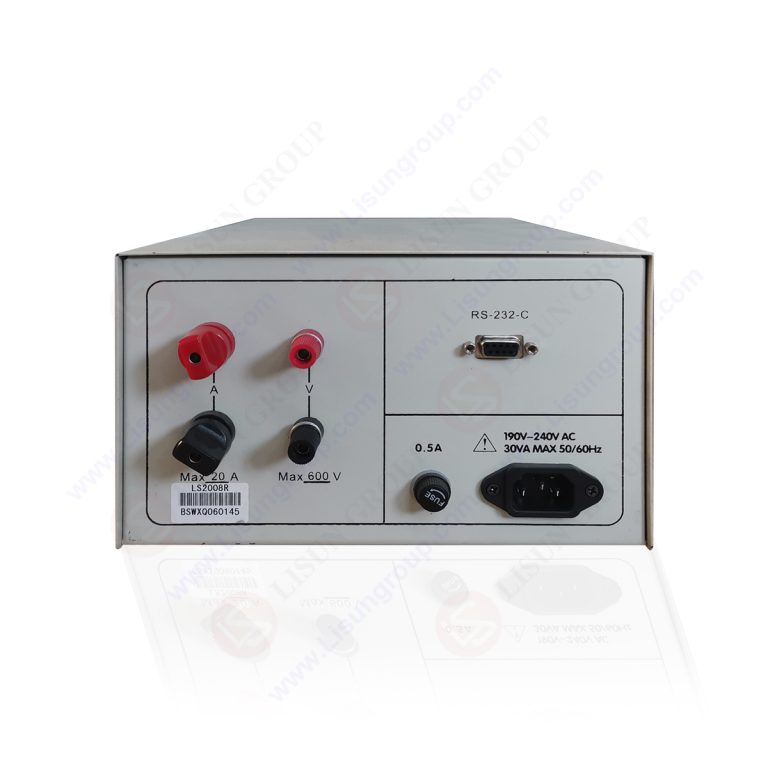
The primary regulatory hurdle for LED lighting is the harmonic current emission standard EN/IEC61000-3-2. The LS2050C-IEC model is specifically tailored for this assessment. It provides a dedicated analysis mode that classifies the DUT (Class C for lighting is automatic) and compares the measured harmonics against the standard’s limits. This pre-compliance testing capability allows manufacturers to identify and rectify design flaws in-house before submitting products to third-party laboratories for costly and time-consuming certification, making Accurate Solid-State Lighting Electrical Testing with LMS6000 Digital Power Meter essential.
4.2 Safety and Performance Validation Standards
Beyond EMC, the physical safety of test equipment and the DUT is governed by IEC 61010, which the LMS6000 series complies with. This standard ensures the meter is safe for operators when used with high-energy electrical circuits. Furthermore, the data provided by the meter contributes to validating performance under standards like LM-79 (for LED luminaire photometric and electrical testing). Accurate electrical measurement is a prerequisite for calculating luminous efficacy (lumens per watt), a key performance metric. The meter’s precision directly influences the integrity of the efficacy calculation.
4.3 Certifications for the US Market (UL 1989)
For manufacturers targeting the North American market, compliance with UL standards is non-negotiable. The LMS6000 supports testing protocols aligned with UL 1989, which covers LED drivers and power supplies. The meter’s ability to accurately measure inrush current and steady-state power under varying input voltages is critical for validating the safety and performance requirements of UL standards. This allows a single test bench to serve global markets, simplifying the quality assurance matrix for international companies.
5. Integration into Industrial Test Benches
5.1 Communication and Automated Testing (RS232/RS485)
Modern manufacturing requires automation. The LMS6000 integrates seamlessly into automated test equipment (ATE) via built-in RS232 and RS485 communication ports. These interfaces allow for remote control of the instrument, data logging, and integration with supervisory control and data acquisition (SCADA) systems. A centralized computer can program test sequences, record pass/fail results, and store traceability data for each unit. This automation eliminates human error, increases throughput, and ensures that every product leaving the assembly line has been electrically verified.
5.2 Longevity Testing in LED Manufacturing
Solid-state lighting is prized for longevity, often rated for 50,000 hours or more. During lifetime testing, the electrical parameters (power, current, and efficiency) must be monitored continuously to detect degradation. The LMS6000’s communication capabilities enable long-term data logging for these aging tests. Engineers can analyze trends in power consumption over time to predict the useful life of the product. By identifying catastrophic failure points or gradual performance shifts, the meter provides the quantitative data required to substantiate lifetime claims and improve the reliability of future designs.
6. Advanced Applications in R&D and Quality Control
6.1 Analyzing Power Quality in Automotive Electronics
The automotive industry is moving towards electric and hybrid vehicles, creating a need for high-precision DC testing. The LMS6000’s AC/DC capability is vital for testing onboard chargers (AC input) and DC-DC converters (DC input/output). For modern headlights using LED matrices, the instantaneous power drawn during dynamic dimming can be analyzed. The wide frequency range allows engineers to study the switching noise and its potential interference with other vehicle systems, supporting compliance with automotive EMC standards in the R&D phase.
6.2 Cross-Industry Validation for Quality Managers
For quality control (QC) managers, the LMS6000 offers a means to standardize electrical testing protocols across different product lines. Whether it is a household LED bulb or an industrial control panel, the fundamental parameters are the same. The high accuracy of the LS2050C model allows it to serve as a reference standard in a metrology lab for calibrating lower-tier instruments. This provides a traceable chain of measurement, ensuring that all production testing is aligned with the national or international standards that define measurement uncertainty.
7. Practical Guidance for Test Setup Optimization
7.1 Wiring Configuration for Accurate Readings
To achieve the highest measurement accuracy, the wiring configuration of the power meter is paramount. For lighting products drawing low current, the meter should be connected in the “2-wire” configuration to minimize lead resistance errors. However, when measuring high-current industrial equipment, a “4-wire” (Kelvin) connection may be necessary. The LMS6000’s user manual provides clear diagrams, and its firmware allows for calibration of the test leads’ impedance. Making the correct connection ensures that the accuracy class of the meter is fully realized during testing with the LMS6000.
7.2 Selecting the Right Model for the Test Objective
Choosing between standard and high-accuracy models depends on the application’s criticality.
- For production line pass/fail: The LS2050B offers sufficient speed and accuracy at an optimal cost.
- For product certification: The LS2050C-IEC provides the compliance-focused features required for regulatory validation.
Selecting the correct model prevents over-spending on excessive accuracy for simple tests, while ensuring that critical compliance and research data are captured with the fidelity they require.
8. Conclusion
The LMS6000 Digital Power Meter stands as a versatile and robust platform for electrical testing in the solid-state lighting and automotive electronics sectors. Its combination of digital sampling technology, wide frequency range, and inherent safety features addresses the complex challenges of modern power analysis. By integrating harmonic analysis up to the 50th order and supporting critical safety and EMC standards like EN/IEC61000-3-2 and IEC 61010, the instrument empowers engineers to ensure their products are efficient, reliable, and compliant with international regulations. The inclusion of communication ports and automatic range switching transitions it from a simple measurement tool to an integral component of automated quality assurance systems, delivering high ROI and data integrity.
FAQ (Frequently Asked Questions)
Q1: What is the primary difference between the LS2050B and LS2050C models of the LMS6000 series?
A: The fundamental distinction lies in their measurement accuracy. The LS2050B is designated as a standard accuracy model with a 0.5% accuracy class, making it suitable for general production testing and basic R&D validation. The LS2050C offers a high accuracy class of 0.1%. This higher precision is critical for calibration tasks, metrology labs, and detailed research where true power consumption must be assessed with near-zero error. The LS2050C is the better investment when the cost of measurement error outweighs the initial capital expenditure.
Q2: How does the LMS6000 facilitate compliance with the EN/IEC61000-3-2 standard for LED lighting?
A: The LS2050C-IEC variant is specifically equipped with a harmonic analysis function that pre-validates products against EN/IEC61000-3-2 limits. It utilizes the IEC/CSA calculation method to measure harmonics up to the 50th order. The instrument automatically classifies the device under test (e.g., Class C for lighting) and provides a clear pass/fail indication on the display or via software. This allows manufacturers to conduct pre-compliance screening in-house, significantly reducing the risk of failure and costs associated with formal third-party certification.
Q3: Can this meter be used for DC testing applications, such as automotive LED modules?
A: Yes, absolutely. Unlike many power meters that are limited to standard AC mains, the LMS6000 is a true AC/DC power meter. It can measure DC voltage, DC current, and DC power with the same high fidelity as AC signals. This dual functionality is essential in the automotive sector, where components like LED headlights and battery systems operate on DC. It eliminates the need for separate instruments, simplifying the test setup and ensuring consistent measurement methodology across AC and DC platforms.
Q4: What is the purpose of the automatic range switching feature and the high overload capacity?
A: Automatic range switching allows the meter to dynamically adjust its internal sensing range to match the input signal. This is critical during inrush current testing or when a device’s power consumption fluctuates, as it ensures the meter is always operating within its optimal accuracy band. The high overload capacity (1600V/50A instantaneous maximum) is a safety feature that prevents the meter from being damaged by accidental spikes or short-circuits, thereby protecting the user’s capital investment in the test equipment.