









Here is the comprehensive technical article generated based on your detailed instructions.
Abstract
This article provides an in-depth technical analysis of the Advanced Multi-Chamber LED Aging Testing System for Lumen Maintenance, focusing on the LISUN LEDLM-80PL and LEDLM-84PL series. As a Senior LED Testing Engineer at LISUN, I detail how these systems address critical challenges in predicting long-term LED reliability through accelerated aging and precise photometric measurement. The article explores adherence to IES LM-80, TM-21, and LM-84 standards, the application of the Arrhenius Model for lifespan extrapolation, and the engineering of dual testing modes (integrating sphere vs. goniophotometry). By integrating technical specifications such as support for up to three temperature chambers and L70/L50 metrics, this guide serves as a resource for R&D and quality assurance professionals seeking to validate lumen maintenance with high-confidence, repeatable results.
1.1 The Critical Need for Standardized Aging
Lumen depreciation remains the primary failure mechanism for solid-state lighting (SSL) products, making accelerated aging testing a non-negotiable part of product qualification. Traditional single-chamber systems introduce speed and throughput bottlenecks, as engineers must run sequential tests at different temperatures to model junction temperature (Tj) effects. An Advanced Multi-Chamber LED Aging Testing System for Lumen Maintenance solves this by allowing simultaneous testing at three distinct thermal nodes, directly supporting the statistical rigor required by IES LM-80-15 and LM-84-19.
1.2 Core Architecture of the LISUN System
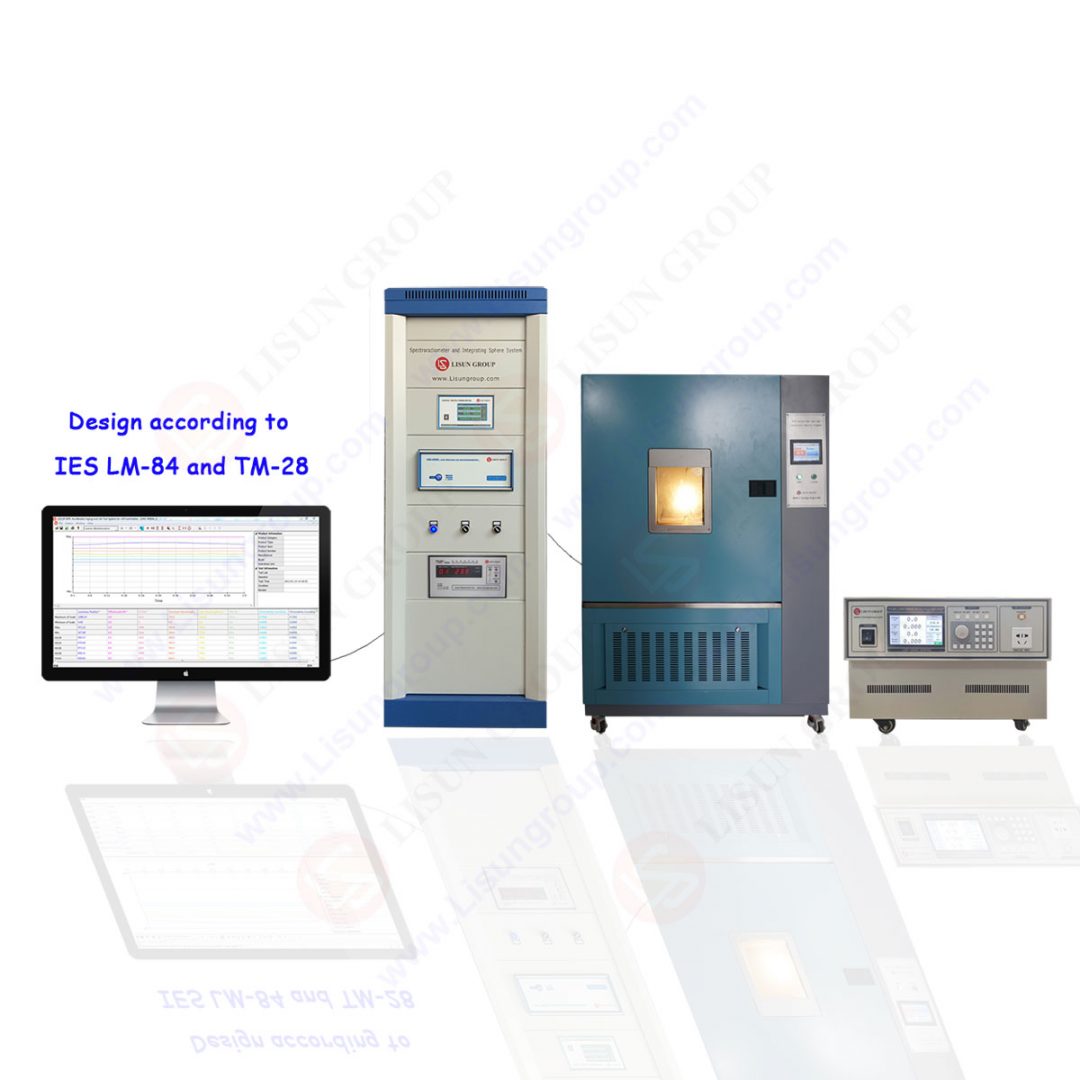
The LISUN system is designed around a modular hardware platform that prioritizes photometric stability. It features a precision DC power supply with ultra-low ripple (<1% to maintain constant current) and a thermally isolated enclosure that minimizes ambient light ingress. The core differentiator is the ability to connect up to three independent temperature chambers (e.g., 55°C, 85°C, and a user-defined point like 105°C). This architecture allows a single control unit to orchestrate the entire 6000-hour test duration without operator intervention, a significant labor cost reduction for third-party testing labs.
2.1 LEDLM-80PL: The LM-80/TM-21 Workhorse
The LEDLM-80PL is engineered specifically for the IES LM-80-15 standard, which mandates testing LEDs, arrays, or modules. This variant includes a built-in integrating sphere (typically 0.3m or 1.0m options) and a high-speed spectroradiometer for real-time measurement of total luminous flux, CCT, and CRI. The proprietary software automatically calculates TM-21 extrapolation, projecting L70 (time to 70% lumen maintenance) and L50 (50% maintenance) values based on the collected 6000-hour data set. This eliminates manual spreadsheet handling, a common source of error in compliance reporting.
2.2 LEDLM-84PL: Precision for Lamps and Luminaires
Designed for finished products per IES LM-84 and data extrapolation per TM-28, the LEDLM-84PL system is optimized for larger form factors. It offers increased internal chamber dimensions and supports a goniophotometer for full spatial luminance distribution testing. A key specification is its ability to maintain a high degree of uniformity across the chamber, with a temperature deviation of < ±1.0°C at 85°C, crucial for minimizing test variance. The software allows for a blend of LM-84 testing with TM-28 statistical modeling to predict long-term performance of integrated SSL luminaires.
3.1 Constant Current (CC) vs. Constant Voltage (CV) Mode
The LISUN system supports dual driver testing modes, a feature essential for comprehensive reliability analysis.
- Constant Current (CC) Mode: Used for testing discrete LED packages or modules. The system maintains a current deviation of < ±0.5% to ensure temperature rise and photon flux are solely driven by environmental factors.
- Constant Voltage (CV) Mode: Designed for testing complete luminaires with integrated drivers (per LM-84). The system simulates real-world electrical stress, allowing engineers to observe how driver failures (e.g., capacitor aging) contribute to overall lumen depreciation.
3.2 Realistic Modeling and Control
The software utilizes a PID (Proportional-Integral-Derivative) control loop to manage the chamber’s thermal profile. It minimizes overshoot during ramp-up to prevent thermal shock to the DUTs (Devices Under Test). For an Advanced Multi-Chamber LED Aging Testing System for Lumen Maintenance, this is critical. The system can log up to 3,000 data points per channel over the 6000-hour period, creating a high-resolution S-curve (performance curve) that is mathematically robust for TM-21 extrapolation.
Table 1: Technical Comparison of LISUN Multi-Chamber System Variants
| Feature | LEDLM-80PL (LM-80 Focus) | LEDLM-84PL (LM-84 Focus) |
|---|---|---|
| Primary Standard | IES LM-80, TM-21 | IES LM-84, TM-28 |
| Target Device | LED Packages, Modules, Arrays | LED Lamps, Luminaires |
| Measurement Method | Integrating Sphere (Total Flux) | Goniophotometer / Sphere |
| Max Connected Chambers | 3 | 3 |
| Lumen Maintenance Metrics | L70, L50, L90 | L70, L50, L70/L50 (TM-28) |
| Operating Mode | CC (Constant Current) | CC & CV (Constant Voltage) |
| Standard Test Duration | 6000 Hours (minimum per LM-80) | 6000 Hours (minimum per LM-84) |
4.1 Application of the Arrhenius Equation
The system’s software intelligently applies the Arrhenius Model to accelerate failure mechanisms. By testing at elevated temperatures (e.g., 85°C and 105°C) and comparing them against a lower reference (e.g., 55°C), the software calculates the Activation Energy (Ea) specific to the device chemistry. This Ea value is critical for predicting lifetime at the nominal operating temperature (Tnom). A lower Ea (e.g., 0.4 eV) indicates robust phosphor technology, while a higher Ea (e.g., >0.7 eV) flags potential material degradation risks.
4.2 Standard Compliance for TM-21 and TM-28
Compliance is not simply a checkbox. The LISUN software strictly adheres to TM-21-19 rules:
- Minimum Data Requirement: The software checks that at least 6000 hours of data are collected before allowing extrapolation to 6x the test duration.
- Goodness of Fit: It calculates the R² value for the exponential decay curve fit. A system warning is issued if R² < 0.90, signaling potential data corruption or anomalous failure.
- Report Generation: The output is a standardized PDF report that meets the formatting requirements of NIST and IESNA, ensuring seamless submission to regulatory bodies like Energy Star or DLC.
5.1 High-Density DUT Fixturing
A practical pain point for LED aging is the physical layout of devices. The LISUN Advanced Multi-Chamber LED Aging Testing System for Lumen Maintenance offers customizable trays that can hold up to 32 single-chip modules per chamber. These trays feature gold-plated sockets to minimize contact resistance and a quick-release mechanism for efficient sample loading during intermittent photometric measurements.
5.2 Thermal Isolation and Airflow Architecture
To achieve the required temperature uniformity of ±1.5°C across the working volume, the system uses a forced-air circulation system with honeycomb diffusers. This design prevents hot spots that could skew the life test results. The chambers also include a thermal safety cut-off and a redundant PT100 sensor system. For R&D engineers, this reliability in hardware directly translates to higher confidence in the resulting L70 data.
6.1 Real-Time Graphing and Historical Logging
The software provides a live display of flux degradation over time. Users can view overlays of different temperatures and current settings on a single Cartesian plot. The system automatically marks key milestones (e.g., 1000h, 3000h, 6000h) and generates a performance curve based on the normalized reading. This feature is invaluable for detecting early catastrophic failures (sudden drop in flux) versus gradual lumen depreciation.
6.2 Remote Monitoring and Alarms
The system is network-enabled, allowing engineers to monitor the progress of an Advanced Multi-Chamber LED Aging Testing System for Lumen Maintenance from a remote workstation. The software includes configurable alarm triggers:
- Critical Failure: * >20% flux drop in a single measurement cycle.
- Temperature Deviation: * Chamber temperature variance > ±2.5°C.
- Power Loss: * Data recovery upon unscheduled shutdown.
7.1 Phosphor and Package Qualification
For LED manufacturers, the system is used to certify new phosphor formulations. Running a 6000-hour test at three temperatures allows engineers to characterize the Stokes shift drift and chromaticity shift (Δu’v’). The built-in spectroradiometer provides correlated color temperature (CCT) stability data, which is critical for high-end architectural lighting applications per CIE 127 guidelines.
7.2 Automotive Electronics Component Validation
Automotive specifications (e.g., AEC-Q102) require rigorous environmental stress testing. The multi-chamber architecture allows simultaneous testing of headlight LEDs under different drive currents (e.g., 350mA for signaling vs. 1A for main beam). The system’s ability to log L70 within defined cycles supports the validation of life targets for automotive applications, where a failure rate of <10 ppm is expected.
The LISUN LEDLM-80PL and LEDLM-84PL series represent a significant engineering advancement for the field of photometric reliability testing. By providing an Advanced Multi-Chamber LED Aging Testing System for Lumen Maintenance, LISUN empowers engineers to move beyond simple pass/fail criteria into deep statistical analysis of failure mechanisms. The system’s strict adherence to IES LM-80, TM-21, LM-84, and TM-28 standards ensures that the generated L70 and L50 data are legally defensible and scientifically valid for lifetime warranty claims.
The ability to run three simultaneous temperature profiles, combined with dual CC/CV modes and an Arrhenius-based software platform, drastically reduces the time-to-market for new LED products while ensuring a high degree of reliability. For testing labs and R&D facilities, this means lower operational costs and higher throughput of validated units. Choosing a LISUN solution is an investment in precision, compliance, and the long-term integrity of your lighting products.
Q1: What is the minimum data length required for the TM-21 extrapolation using the LISUN system?
A: According to IES TM-21-19, the minimum test duration is 6000 hours. The LISUN system’s software is hard-coded to prevent extrapolation to 6x (36,000 hours) before this time threshold is met. However, for highly stable LEDs, users can optionally view interim reports at 3000 hours, but these are marked as “preliminary” and not valid for formal Energy Star or DLC submissions. The system uses the exponential decay curve fit (A+B*exp(-Ct)) and requires a minimum of 5 measurement intervals post-initial burn-in (typically 48 hours) to calculate the decay rate parameters mathematically. This ensures statistical confidence in the reported L70 value.
Q2: How does the system handle thermal runaway or a sudden power failure during the 6000-hour test?
A: The system is equipped with a non-volatile memory logging system and an Uninterruptible Power Supply (UPS) interface. If a power failure occurs, the heating and photometric measurement systems shut down gracefully, but the data recorded up to the last stable interval is saved to a solid-state drive. Upon power restoration, the system checks the chamber temperature. If the DUTs have cooled below the set point, the system initiates a controlled re-ramp cycle (e.g., 5°C/min) to avoid thermal shock. The software logs this “power cycle event” in the final report. For thermal runaway, the system has a redundant over-temperature relay that cuts main power independently of the control board.
Q3: Can the system test both SMD (Surface Mount) LEDs and High-Power Cobs (Chip-on-Board) in the same run?
A: Yes, but with specific configuration limitations. The LISUN system uses individual current-controlled channels. If you are testing SMD LEDs running at 100mA and COBs running at 1.5A, they must be placed in separate groups on the test tray. The software allows you to assign different “Test Programs” to different physical sockets. However, the chamber’s ambient temperature (Ta) is uniform for that specific chamber. You cannot run a 55°C test and an 85°C test in the same chamber. For optimal results, we recommend dedicating one chamber to die-level components (SMD) and a second chamber to high-power COBs to manage the different thermal loads and junction temperatures accurately.
Q4: What is the difference between L70 and L50, and which one is more important for automotive standards?
A: L70 is defined as the time (in hours) when the LED’s lumen output drops to 70% of its initial value. L50 is the time to 50%. For general lighting, L70 is the standard metric (e.g., >50,000 hours). For automotive and aviation applications, L70 is also the primary metric for forward-lighting (headlights). However, for interior signaling (reading lights), L50 might be used. The LISUN LEDLM-84PL system automatically calculates both according to the TM-28 standard. The TM-21/TM-28 model in the software will provide confidence bounds for both metrics, allowing automotive engineers to select the appropriate one for their specific performance target sheet.
Q5: How often should the photometric measurement be taken during the aging test to ensure accurate extrapolation?
A: Per IES LM-80, measurements must be taken at least every 1000 hours. However, for high-precision data analysis, the LISUN system allows for intermittent measurements (e.g., at 0, 1, 48, 500, 1000 hours) during the initial “burn-in” phase. For the stable aging phase (1000-6000 hours), a measurement every 500 hours is recommended to capture subtle degradation slopes. The high-speed spectroradiometer allows for fast measurement sweeps (less than 5 seconds per DUT) to avoid thermal drop. The software uses all data points (not just the 1000-hour intervals) for the exponential curve fit, providing a higher R² value and better confidence in the projected L70 lifespan.