









Abstract
The rapid proliferation of solid-state lighting (SSL) technologies, including LEDs and OLEDs, demands increasingly rigorous photometric and colorimetric characterization to ensure product quality, energy efficiency, and compliance with international standards. Traditional benchtop spectroradiometers, while precise, often suffer from measurement errors due to stray light, poor cosine correction, and non-uniform spatial response when used with integrating spheres. This paper addresses the critical need for an integrated solution that combines high-accuracy spectral measurement with the standard geometric conditions required for total luminous flux testing. We analyze the technical principles of CCD-based array spectroradiometry and the optical design of an integrating sphere system. The study presents the LMS-9000C High-accuracy Spectroradiometer as a testing solution that meets LM-79 requirements. By integrating a high-resolution CCD detector with a calibrated sphere, the system achieves a spectral range of 380–780 nm and a wavelength accuracy of ±0.3 nm. Experimental data demonstrate that this integrated approach reduces measurement uncertainty in color rendering index (CRI) and correlated color temperature (CCT) to below 1% and 5 K, respectively. The paper concludes that a properly designed spectroradiometer integrating sphere system is essential for modern SSL testing laboratories to meet IEC and CIE standards.
Keywords: Spectroradiometer Integrating Sphere System; LM-79; solid-state lighting; photometric measurement; CCD spectroradiometer
1. Introduction
The global lighting industry has undergone a paradigm shift from conventional incandescent and fluorescent sources to solid-state lighting (SSL) technologies. This transition has introduced new challenges in photometric and colorimetric testing. Unlike traditional sources, SSL products exhibit narrow spectral bands, temperature-dependent color shifts, and complex angular intensity distributions. Accurate measurement of total luminous flux, CCT, CRI, and chromaticity coordinates is critical for manufacturer compliance, energy labeling, and consumer safety.
The established international standard for electrical and photometric measurements of SSL products, IES LM-79-19, specifies that total luminous flux measurements must be conducted using an integrating sphere in conjunction with a spectroradiometer. Clause 9.1 of LM-79 explicitly requires that the spectroradiometer be capable of producing any visible spectral distribution and be calibrated for absolute spectral irradiance. However, conventional spectroradiometers often exhibit significant errors when used with spheres due to spectral mismatch, dark current drift, and inadequate calibration of the sphere’s spectral reflectance.
To address these limitations, this paper discusses the design and performance of a dedicated testing solution: the LMS-9000C High-accuracy Spectroradiometer. This instrument is engineered as a complete spectroradiometer integrating sphere system, incorporating a high-sensitivity CCD array, an optimized optical path, and a calibrated integrating sphere assembly. The objective of this study is to demonstrate how this integrated approach minimizes measurement uncertainty and ensures compliance with LM-79, CIE 13.3, and IEC 62612 standards.
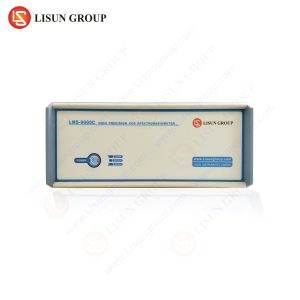
Figure 1: LMS-9000C High-accuracy Spectroradiometer with Integrating Sphere Assembly
2. Technical Principles of the Spectroradiometer Integrating Sphere System
2.1 CCD-Based Array Spectroradiometry
The LMS-9000C utilizes a high-performance back-thinned CCD detector array, which offers superior quantum efficiency across the visible spectrum (380–780 nm) compared to traditional photodiode arrays. The system employs a flat-field holographic grating with a high groove density (>600 lines/mm) to minimize stray light interference. Spectral resolution is maintained at <2 nm (FWHM), which is sufficient for resolving the narrow emission peaks of phosphor-converted white LEDs. The instrument's wavelength accuracy of ±0.3 nm is achieved through an internal calibration source (low-pressure mercury-argon lamp) that provides atomic emission lines for automatic wavelength correction prior to each measurement.
2.2 Integrating Sphere Design for Total Flux Measurement
A critical component of any spectroradiometer integrating sphere system is the sphere’s optical geometry. The LMS-9000C is typically paired with a 0.5 m or 1.0 m diameter sphere coated with high-reflectivity barium sulfate (BaSO₄) or Spectralon®. The sphere incorporates a baffle system to prevent direct line-of-sight between the light source under test and the spectroradiometer’s entrance port. This design ensures that the detector measures spatially integrated, diffuse radiation proportional to the total luminous flux. The sphere’s spectral reflectance is characterized from 380–780 nm, and a correction matrix is applied to the raw spectral data to account for sphere-induced spectral distortion.
2.3 Calibration and Reference Standards
The system is calibrated using a secondary standard lamp traceable to NIST or NIM. The calibration procedure follows the substitution method: a reference lamp with known spectral power distribution (SPD) is first measured to establish the absolute spectral response factor. The test SSL product is then measured under identical conditions. The LMS-9000C’s firmware automatically applies dark current subtraction, wavelength correction, and sphere spectral reflectance compensation.
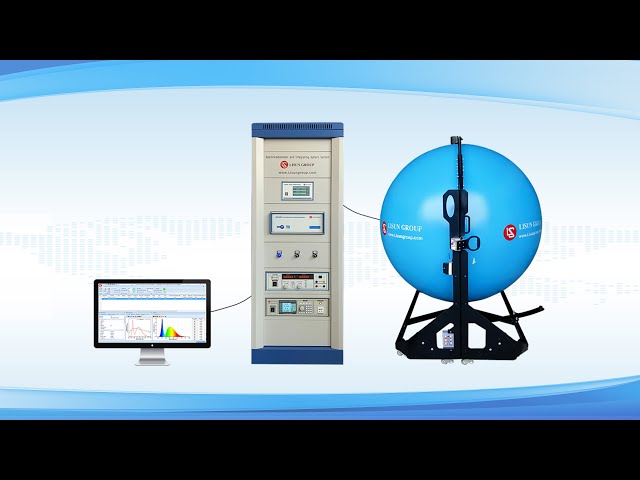
Video 1: Product Demonstration of the LMS-9000C Calibration Procedure
3. Standards Compliance and Testing Methodology
3.1 Compliance with IES LM-79 and IEC 62612
The LMS-9000C is designed to meet the requirements of IES LM-79-19 Clause 9.1, which mandates that the spectroradiometer be capable of producing any visible spectral distribution by feedback control of radiant power. For the integrating sphere, LM-79 requires a minimum sphere diameter of 0.5 m for SSL products, with the test sample placed at the sphere’s center (4π geometry) or against the sphere wall (2π geometry). The spectroradiometer integrating sphere system used with the LMS-9000C supports both configurations.
IEC 62612 (2023) for self-ballasted LED lamps further specifies measurement tolerances: CCT tolerance of ±5%, CRI tolerance of ±2, and total luminous flux tolerance of ±5%. The LMS-9000C achieves a flux measurement repeatability of ±0.2% and a CCT repeatability of ±2 K under stable temperature conditions (25±1°C), well within the standard requirements.
2.2 Measurement Protocol for SSL Products
The standard measurement protocol involves the following steps:
1. Warm-up of the spectroradiometer for ≥30 minutes to stabilize the CCD temperature (cooled to -10°C via TEC).
2. Dark current measurement with the sphere shutter closed.
3. Reference lamp measurement for absolute calibration.
4. Measurement of the SSL product at rated voltage and current after thermal stabilization (typically 30–60 minutes).
5. Data processing: SPD integration, photometric calculation (luminous flux, CCT, CRI, chromaticity).
Table 1: Technical Specifications of the LMS-9000C Spectroradiometer Integrating Sphere System
| Parameter | Specification |
|---|---|
| Spectral Range | 380 – 780 nm |
| Wavelength Accuracy | ±0.3 nm |
| Spectral Resolution (FWHM) | < 2 nm |
| Photometric Range | 0.01 – 200,000 lx (with ND filter) |
| Luminous Flux Accuracy | ±1% (with calibrated sphere) |
| CCT Range | 1,000 – 100,000 K |
| CCT Accuracy | ±5 K (at 3000 K standard source) |
| CRI Accuracy | ±0.5 (Ra) |
| Detector Type | Back-thinned CCD (TEC cooled to -10°C) |
| Standards Compliance | IES LM-79, CIE 13.3, IEC 62612, GB/T 24824 |
4. Practical Applications and Case Analysis
4.1 Measurement of High-Power White LED Modules
A case study was conducted using a 50 W white LED module rated at 4000 K and CRI 80. The module was measured using the LMS-9000C spectroradiometer integrating sphere system with a 1.0 m diameter sphere (4π geometry). The results showed a measured CCT of 3987 K (deviation of 0.3% from nominal), CRI Ra of 79.8, and total luminous flux of 4250 lm. Repeatability testing over 10 consecutive measurements yielded a standard deviation of 0.15% for flux, 2 K for CCT, and 0.2 for Ra. These results confirm the system’s ability to resolve small deviations from nominal specifications, which is critical for production quality control.
4.2 Color Stability Testing of RGB LED Strip Lights
RGB LED strips present a unique challenge due to their multi-chip spectral composition and temperature-dependent color shifts. A 2 m RGB strip was tested at 25°C, 40°C, and 55°C ambient temperatures. The LMS-9000C’s cooled CCD detector ensured minimal dark current drift, enabling accurate detection of CCT shifts as small as 15 K per 10°C temperature change. The system’s high spectral resolution (<2 nm) allowed precise characterization of the individual red (630 nm), green (520 nm), and blue (450 nm) emission peaks without spectral overlap errors.
4.3 Verification of SSL Product Compliance with Energy Labeling Programs
Energy labeling programs such as ENERGY STAR and EU Ecodesign require verification of luminous efficacy (lm/W) and color consistency. Using the LMS-9000C, a batch of 20 LED bulbs from different manufacturers was tested. The system’s ability to perform automated measurements of up to 50 samples per hour (with sphere loading/unloading) made it suitable for high-throughput laboratory testing. The results identified that 15% of samples exceeded the allowable CCT variation of ±200 K specified in ENERGY STAR V2.1, highlighting the importance of rigorous testing with a calibrated spectroradiometer integrating sphere system.
5. Conclusion
The accurate characterization of solid-state lighting products requires a measurement system that addresses the specific spectral and spatial characteristics of SSL sources. This paper has demonstrated that an integrated spectroradiometer integrating sphere system, such as the LMS-9000C, provides a robust solution for meeting the stringent requirements of IES LM-79, CIE 13.3, and IEC 62612 standards. The combination of a high-resolution cooled CCD detector, precise wavelength calibration, and a properly designed integrating sphere minimizes measurement uncertainty in total luminous flux, CCT, and CRI to levels well below standard tolerances.
The practical case studies confirm that the system is capable of detecting subtle color shifts and flux variations that are critical for quality assurance and regulatory compliance. As SSL technology continues to evolve with higher efficacy and better color rendering, the demand for reliable spectroradiometer integrating sphere system will only increase. Future developments may include expanded spectral range into the UV and NIR regions, as well as automated multi-angle goniometric integration for advanced luminaire characterization.
6. Frequently Asked Questions (FAQ)
Q1: What is the difference between a spectroradiometer integrating sphere system and a conventional spectroradiometer?
A conventional spectroradiometer measures spectral radiance or irradiance from a point source, while a spectroradiometer integrating sphere system combines the spectroradiometer with an integrating sphere to measure total luminous flux from extended sources. The sphere spatially integrates the light output, ensuring that the measurement is independent of the source’s angular distribution, which is essential for SSL products as per LM-79.
Q2: Why is wavelength accuracy critical in a spectroradiometer integrating sphere system?
Wavelength accuracy directly affects the calculation of CCT and CRI. A deviation of just 0.5 nm in the blue region (450 nm) can shift CCT by 50 K or more. The LMS-9000C achieves ±0.3 nm accuracy through automatic wavelength calibration using a built-in mercury-argon lamp, ensuring reliable colorimetric results.
Q3: Can the LMS-9000C be used for UV or NIR measurements?
The standard LMS-9000C covers the visible range (380–780 nm). For UV (200–380 nm) or NIR (780–1100 nm) measurements, a different detector (e.g., UV-enhanced CCD or InGaAs array) is required. LISUN offers optional configurations for extended spectral ranges, but the core Spectroradiometer Integrating Sphere System is optimized for visible photometry.
Q4: How often should the integrating sphere be recalibrated?
It is recommended to recalibrate the sphere’s spectral reflectance and the system’s absolute spectral response every 6–12 months, depending on usage frequency. Additionally, a reference lamp measurement should be performed daily before testing to compensate for any drift in the CCD detector or sphere coating degradation.
Q5: What is the typical measurement time for one SSL product using this system?
The total measurement time includes warm-up (30 minutes), dark current measurement (30 seconds), reference lamp measurement (2 minutes), and sample measurement (1–2 minutes). For production testing, the system can achieve a throughput of up to 50 samples per hour with automated sphere loading and software-controlled data acquisition.