









This article provides a comprehensive technical analysis of the LISUN DFX series Externally Ballasted Fluorescent Lamp Test Load Cabinet, a precision instrument designed for compliance testing of electrical accessories under international standards. The DFX series simulates the electrical characteristics of externally ballasted fluorescent lamps, enabling accurate evaluation of switches, relays, and connectors under inductive-resistive load conditions. Targeting electrical product manufacturers, third-party testing laboratories, and quality control engineers, this article examines the product’s core capabilities, technical specifications, and integration within broader testing workflows. By aligning with IEC 60669-1, IEC 60884-1, and GB 16915.1 standards, the DFX series ensures reproducible test results for endurance and temperature rise assessments. Key features include adjustable power factor, multi-channel output, and precise load simulation, making it an essential tool for standards-compliant electrical accessory testing.
1.1 Purpose and Application Scope
The LISUN DFX series is a specialized load test cabinet engineered to replicate the electrical behavior of externally ballasted fluorescent lamps. This load simulation is critical for testing the durability and safety of electrical accessories such as switches, sockets, and connectors under controlled conditions. The equipment addresses the need for standardized testing environments that mimic real-world inductive loads, ensuring that products meet international compliance requirements.
1.2 Core Functional Principle
The DFX series operates by generating a combined resistive and inductive load with a defined power factor. It utilizes an external ballast inductor in series with a resistive load bank, allowing precise adjustment of the current and power factor to match fluorescent lamp characteristics. This mechanism enables testing laboratories to perform cyclic endurance tests and temperature rise evaluations without relying on actual lamps, which are variable and non-reproducible.
1.3 Target User Groups
Primary users include quality control engineers at electrical accessory manufacturing facilities, compliance officers at third-party testing laboratories, and research engineers developing new switch or socket designs. The DFX series provides a reliable, repeatable load source that eliminates discrepancies caused by lamp aging or batch variations, thereby improving test consistency and audit readiness.
2.1 Model Variants Overview
The LISUN DFX series comprises five models: DFX-20, DFX-20-3CH, DFX-40, DFX-60, and DFX-80. Each model is designed to accommodate different current output requirements and testing capacities, enabling laboratories to select the appropriate configuration based on their testing workload and standards compliance needs.
2.2 Comparative Specifications Table
The following table summarizes the core specifications for each model in the DFX series:
| Model | DFX-20 | DFX-20-3CH | DFX-40 | DFX-60 | DFX-80 |
|---|---|---|---|---|---|
| Rated Current | 20A | 20A per channel | 40A | 60A | 80A |
| Channel Count | 1 | 3 | 1 | 1 | 1 |
| Input Voltage | 220V AC | 220V AC | 220V AC | 220V AC | 220V AC |
| Power Factor Range | 0.3~0.9 | 0.3~0.9 | 0.3~0.9 | 0.3~0.9 | 0.3~0.9 |
| Load Type | Resistive + Inductive | Resistive + Inductive | Resistive + Inductive | Resistive + Inductive | Resistive + Inductive |
| Measurement Accuracy | ±2% | ±2% | ±2% | ±2% | ±2% |
| Capacitance Load | Optional | Optional | Optional | Optional | Optional |
2.3 Power Factor Adjustment and Resolution
All DFX models allow power factor adjustment from 0.3 to 0.9 in steps of 0.01, providing fine-grained control over load characteristics. This resolution is essential for replicating the exact load conditions specified in standards such as IEC 60669-1 Clause 19.2, which defines the required power factor for inductive load testing of switches. The resistive component is adjustable via a multi-tap transformer, while the inductive component relies on external ballast inductors.
3.1 IEC 60669-1 Clause 19.2 Compliance
IEC 60669-1 specifies the testing requirements for switches for household and similar fixed-electrical installations. Clause 19.2 mandates that switches undergo endurance testing under an inductive load with a power factor of 0.6 ± 0.05 at rated current. The DFX series can precisely achieve this power factor value, ensuring that test results are valid for certification bodies. The load cabinet’s current output stability within ±2% meets the standard’s tolerance requirements.
3.2 IEC 60884-1 Clause 20 Compliance
IEC 60884-1 covers plugs and socket-outlets for household and similar purposes. Clause 20 requires temperature rise tests under rated current conditions with a defined load. The DFX series supports these tests by providing a stable inductive-resistive load that simulates connected appliances. The ability to set current levels up to 80A (DFX-80) accommodates high-power socket testing as per the standard.
3.3 GB 16915.1 and Additional Standards
For the Chinese market, GB 16915.1 aligns with IEC 60669-1, requiring similar load simulation for switch endurance testing. The DFX series is fully compatible with this national standard. Additionally, it can be configured to meet requirements of IEC 61058-1 for switches and IEC 60947-1 for low-voltage switchgear, demonstrating broad compliance utility.
4.1 Resistive-Inductive Load Modeling
The DFX series generates a combined load using a resistive wire-wound resistor bank and an external inductor. The inductor, typically a coreless or air-gapped type, provides the necessary inductive reactance to achieve the target power factor. The resistive load is adjustable in discrete steps, while the inductor remains fixed for a given test setup, allowing the operator to tune the overall impedance.
4.2 Capacitive Load Option
For testing scenarios requiring capacitive loads, such as those simulating electronic ballasts or LED drivers, the DFX series offers an optional capacitive load module. This module adds a capacitor bank in parallel with the resistive-inductive circuit, enabling testing under power factor leading conditions. This capability is critical for evaluating accessories intended for modern lighting systems.
4.3 Current Stability and Measurement Accuracy
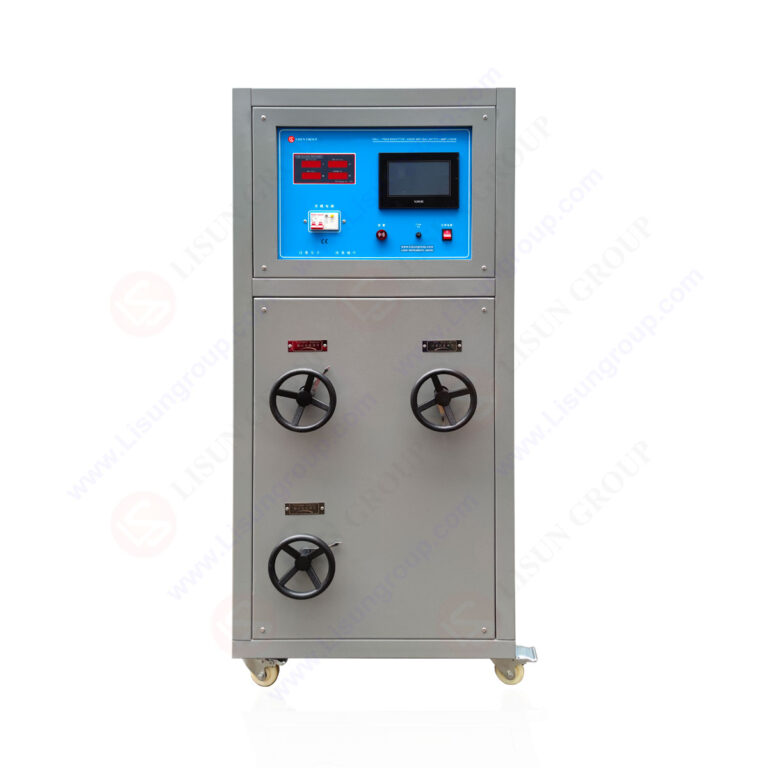
The load cabinet incorporates a current monitoring system with an accuracy of ±2% of the set value. This accuracy is maintained across the full operating range from 10% to 100% of rated current. The system uses a precision current transformer and digital display, providing real-time feedback to the operator. This level of precision ensures reproducible test conditions across multiple test cycles.
5.1 Compatibility with LISUN CZKS Series Life Testers
The DFX series can be seamlessly integrated with LISUN CZKS series electrical accessory life testers. The life tester provides cyclic switching control, while the DFX supplies the standardized load. This combination automates endurance tests as per IEC 60669-1, reducing operator intervention and improving test throughput. For example, a CZKS-2A life tester can drive a mechanical switch under DFX load for 10,000 cycles with data logging.
5.2 Synchronization with SW-6 Bending Testers
For testing cord switches or flexible cable assemblies, the DFX series can be paired with the LISUN SW-6 bending tester. The bending tester applies mechanical stress to the cable while the DFX maintains the electrical load, allowing simultaneous mechanical and electrical endurance evaluation. This integrated approach is particularly valuable for compliance testing under IEC 60884-1 Clause 21.
5.3 End-to-End Test Workflow Architecture
A typical testing laboratory setup includes a DFX load cabinet connected to a LISUN CZKS life tester, which in turn interfaces with a data acquisition system (e.g., LISUN DS series). The load cabinet provides the electrical stress, the life tester controls the switching sequence, and the data system records parameters such as contact voltage drop, current, and temperature. This workflow ensures full traceability and audit readiness.
6.1 Input Requirements and Installation Conditions
The DFX series requires a single-phase 220V AC power supply with a tolerance of ±10% at 50/60Hz. The maximum input current depends on the model, ranging from 25A for the DFX-20 to 100A for the DFX-80. Adequate ventilation is required due to heat dissipation from the resistive load banks; the cabinet includes forced air cooling fans for continuous operation.
6.2 Protection Mechanisms
Each DFX model includes overcurrent protection via a magnetic circuit breaker, overtemperature protection with thermal cutoff switches, and emergency stop functionality. These features protect both the load cabinet and the device under test from damage during abnormal conditions. The enclosure is rated IP20 for indoor laboratory use.
6.3 User Interface and Control
The front panel includes digital displays for current, voltage, and power factor, along with rotary switches for load selection. The DFX-20-3CH model allows independent control of three channels, enabling simultaneous testing of three devices under identical or different load conditions. Remote control via RS-232 interface is available for automated test sequences.
7.1 Switch Endurance Testing
In switch endurance tests per IEC 60669-1 Clause 19.2, the DFX series provides the required inductive load at 100% rated current with power factor 0.6. The test typically involves 10,000 cycles of operation at a rate of 15-30 cycles per minute. The load cabinet maintains consistent impedance throughout the test, ensuring that any observed failure is due to the switch mechanism rather than load variations.
7.2 Socket-Outlet Temperature Rise Testing
For socket-outlet temperature rise tests under IEC 60884-1 Clause 20, the DFX supplies a continuous current for a specified duration (typically 1-4 hours). The load cabinet’s current stability ensures that temperature rise measurements at contact points are accurate. The optional capacitive load module can simulate electronic loads for modern socket applications.
7.3 Connector and Relay Testing
The DFX series is also suitable for testing industrial connectors and relays under IEC 61984 and IEC 61810 standards. The wide current range (up to 80A) and adjustable power factor allow simulation of motor start-up loads or lighting circuits. This versatility reduces the need for multiple dedicated load simulators in a testing facility.
The LISUN DFX series Externally Ballasted Fluorescent Lamp Test Load Cabinet represents a robust, standard-compliant solution for electrical accessory testing. Its precise resistive-inductive load simulation, adjustable power factor from 0.3 to 0.9, and ±2% measurement accuracy ensure reproducibility and reliability in endurance and temperature rise tests. With models ranging from 20A to 80A, including a three-channel variant, the series accommodates diverse testing workloads across switches, sockets, and connectors. Compliance with IEC 60669-1, IEC 60884-1, GB 16915.1, and other international standards positions the DFX series as a trusted tool for certification bodies and manufacturers alike. Integration with LISUN CZKS life testers and SW-6 bending testers enables end-to-end automated workflows, reducing testing time and operator error. For quality control engineers and testing laboratories seeking to enhance their compliance testing capabilities, the DFX series offers a scalable, accurate, and standards-aligned solution that addresses the complexities of modern electrical accessory evaluation.
Q1: What is the difference between the DFX-20 and DFX-20-3CH models?
A: The DFX-20 is a single-channel load cabinet rated for 20A output, suitable for testing one device at a time. The DFX-20-3CH offers three independent channels, each capable of delivering 20A simultaneously, enabling concurrent testing of up to three devices. This multi-channel configuration is advantageous for high-throughput laboratories that need to perform parallel endurance tests. Both models share the same power factor range (0.3 to 0.9) and measurement accuracy (±2%), but the DFX-20-3CH requires a higher input capacity due to simultaneous channel operation. Additionally, the three-channel model allows independent load settings per channel, enabling different test conditions for each device under test. This flexibility is particularly useful for comparative studies or when testing products with varying current ratings.
Q2: How does the DFX series achieve a specific power factor for IEC 60669-1 compliance?
A: The DFX series uses a combination of adjustable resistive load banks and external fixed inductors to achieve the target power factor. For IEC 60669-1 Clause 19.2, which requires a power factor of 0.6 ± 0.05, the operator selects an inductor with appropriate reactance and adjusts the resistive load until the measured power factor reaches 0.6. The cabinet’s digital power factor display provides real-time feedback with 0.01 resolution, allowing precise tuning. The resistive load is varied in discrete steps (typically 1A increments), while the inductor remains unchanged for a given test setup. This method ensures that the load impedance remains stable throughout the test duration, which is critical for reproducible endurance testing. The ±2% accuracy of the current measurement further ensures that the load conditions meet standard tolerances.
Q3: Can the DFX series be used for testing electronic switches or dimmers?
A: Yes, the DFX series can be used for testing electronic switches and dimmers, but with considerations. For resistive-inductive loads typical of magnetic ballasts, the DFX operates as standard. However, for electronic loads such as LED drivers or capacitive loads, the optional capacitive module should be installed to simulate the leading power factor characteristics. Electronic dimmers often require specific load types (e.g., resistive for incandescent, inductive for magnetic, or capacitive for electronic). The DFX series’ adjustable power factor and optional capacitive module allow simulation of these conditions. Additionally, the DFX’s current range up to 80A accommodates high-power dimmer testing. For devices with complex control algorithms, the load cabinet’s stable impedance ensures that the dimmer under test experiences consistent electrical conditions, enabling accurate evaluation of performance and endurance.
Q4: What is the recommended calibration interval for the DFX series load cabinets?
A: For optimal accuracy and compliance with ISO/IEC 17025 laboratory accreditation requirements, LISUN recommends a calibration interval of 12 months for the DFX series. Calibration should verify current output accuracy, power factor measurement precision, and load impedance stability across the full operating range. The calibration process typically involves comparing the DFX’s current display against a traceable reference current transformer and verifying power factor using a precision power analyzer. Laboratories conducting tests for certification bodies may require more frequent calibration (e.g., every 6 months) if the equipment is used extensively. The DFX series includes self-diagnostic routines that can alert operators to drift, but formal calibration remains essential for audit compliance. LISUN offers calibration services and can provide test certificates traceable to national metrology institutes.
Q5: How does the DFX-80 handle high current testing without overheating?
A: The DFX-80 is designed for continuous operation at 80A with forced air cooling using multiple high-CFM fans arranged in a push-pull configuration. The resistive load banks are constructed from wire-wound elements mounted on ceramic cores to withstand high temperatures, with thermal cutoff switches set at 85°C for safety. The unit includes a thermal management system that monitors internal temperature and adjusts fan speed accordingly. For extended duration tests (e.g., temperature rise tests lasting 4 hours), the cabinet maintains load current within ±2% without derating. Users should ensure adequate clearance around the cabinet for airflow and avoid obstructing ventilation grills. The DFX-80 also features an overtemperature alarm that triggers at 75°C, allowing operators to take corrective action before shutdown. Regular cleaning of air filters is recommended to maintain cooling efficiency.