









Abstract
The Climatic Chamber for IEC 60068 Temperature Humidity Testing represents a cornerstone of modern LED reliability engineering, enabling precise simulation of environmental stressors required for lumen maintenance validation. This article examines LISUN’s LEDLM-80PL and LEDLM-84PL Optical Aging Test Instruments, which integrate Climatic Chamber for IEC 60068 Temperature Humidity Testing capabilities with photometric measurement in a single platform. Key technical insights include dual-system interoperability with IES LM-80/TM-21 and LM-84/TM-28 protocols, Arrhenius Model-based accelerated lifetime prediction, and support for up to three temperature chambers with 6000-hour continuous operation. For lighting engineers and third-party laboratories, the systems deliver L70/L50 extrapolation accuracy, custom hardware configurations, and multi-standard compliance. This article provides a technical blueprint for deploying these instruments in R&D and certification workflows.
1.1 The Role of Environmental Stress Testing
LED products face degradation mechanisms—phosphor thermal quenching, solder joint fatigue, and encapsulant yellowing—that accelerate under temperature and humidity extremes. The Climatic Chamber for IEC 60068 Temperature Humidity Testing establishes controlled environments (-40°C to +100°C, 10%–98% RH) to replicate these stressors. IEC 60068-2-38 (Temperature/Humidity Cyclic) and IEC 60068-2-78 (Damp Heat Steady State) are foundational methods. LISUN integrates these into the LEDLM-80PL and LEDLM-84PL systems, merging the climatic chamber with an integrating sphere (diameter 0.3m–2.0m) and spectrometer (350nm–1050nm range). These platforms enable simultaneous stress exposure and optical measurement, eliminating sample transfer errors that plague conventional setups.
1.2 Evolution from Traditional Ovens to Integrated Platforms
Conventional reliability testing required separate thermal chambers and photometric benches, introducing physical disturbances and measurement drift. LISUN’s integrated design synchronizes temperature cycling (0.5°C/min to 5°C/min ramp rates) with photometric sampling (interval configurable from 1 minute to 24 hours). For humidity, the system achieves ±2% RH accuracy via dual-loop PID control. This advancement directly addresses IEEE and CIE guidelines for in-situ measurement, reducing operator intervention and improving data traceability. The Climatic Chamber for IEC 60068 Temperature Humidity Testing thus becomes an embedded functional module, not an auxiliary accessory.
2.1 LEDLM-80PL: LM-80/TM-21 Compliance Dedicated Platform
The LEDLM-80PL is engineered for IES LM-80-15 (Approved Method for Measuring Lumen Maintenance of LED Packages, Arrays, and Modules) compliance. It operates at three mandatory temperatures (55°C, 85°C, and a user-selected third point, e.g., 105°C) with a 6000-hour test duration, as required. Each chamber supports up to 100 test samples, monitored via a photometric detector with Class 1 spectral accuracy (Δu’v’ ≤ 0.002). TM-21-19 extrapolation is embedded, producing L70(6k) and L50(6k) projections with 90% confidence intervals. The system supports up to 3 connected temperature chambers, allowing parallel testing of different LED batches.
2.2 LEDLM-84PL: LM-84/TM-28 for Advanced Luminous Flux Measurement
The LEDLM-84PL targets IES LM-84-14 (Measuring Luminous Flux and Color Maintenance of LED Lamps, Light Engines, and Luminaires) and TM-28-14 (Projecting Long-Term Luminous Flux Maintenance). It supports higher drive currents up to 2A and accommodates complete luminaires (up to 600mm diameter). Channel count upgrades to 64 (standard) from the LEDLM-80PL’s 32, crucial for multi-channel color monitoring (x, y, CCT, CRI). Both systems share the Climatic Chamber for IEC 60068 Temperature Humidity Testing core, but the LEDLM-84PL includes optional humidity control (20%–98% RH) for damp heat tests per IEC 60068-2-78.
Table 1: Comparative Specifications of LISUN LEDLM-80PL and LEDLM-84PL
| Parameter | LEDLM-80PL | LEDLM-84PL |
|---|---|---|
| Primary Standard | IES LM-80-15, TM-21-19 | IES LM-84-14, TM-28-14 |
| Test Duration (Standard) | 6000 hours (1000h checkpoints) | 6000 hours (optional 10000h) |
| Temperature Range | -40°C to +150°C | -40°C to +150°C |
| Humidity Control | No (optional) | Yes (20%–98% RH ±2%) |
| Sample Capacity per Chamber | 100 (LED modules) | 50 (Luminaires) or 100 (LED) |
| Photometric Channels | 32 | 64 |
| Integrating Sphere Options | 0.3m–1.5m diameter | 0.5m–2.0m diameter |
| Drive Current Range | 0–1.5A (resolution 0.1mA) | 0–2A (resolution 0.1mA) |
| Extrapolation Models | TM-21 (L70/L50) | TM-28 (L70/L50/L80) |
| Max Connected Chambers | 3 | 2 (expandable to 3) |
| Spectral Range | 350nm–1050nm | 350nm–1050nm |
3.1 Theoretical Foundation
The Arrhenius Model, expressed as ( AF = e^{Ea/k(1/T1 – 1/T2)} ), quantifies acceleration factors (AF) from elevated temperatures. LISUN’s software integrates this to convert 6000-hour real-time data into equivalent lifetimes at nominal operating temperatures (e.g., 25°C, 50°C). Activation energy (Ea) is auto-calculated from dual-temperature test data, typically yielding values between 0.3eV and 0.7eV for phosphor-converted white LEDs. This bridges the gap between accelerated stress and field performance, aligning with CIE 127:2007 conditions for LED measurement.
3.2 Software Capabilities and Data Management
The proprietary software plots lumen depreciation curves in logarithmic time scales, applying non-linear regression per TM-21 guidelines. For Climatic Chamber for IEC 60068 Temperature Humidity Testing data, the software flags outliers using Chauvenet’s criterion and provides uncertainty budgets (±2% lumen measurement reproducibility). Users can define custom step-stress profiles (e.g., 10°C increments every 500 hours) to estimate Ea dynamically. Output reports comply with ENERGY STAR® and DLC templates, including color shift (Δu’v’) plots as per IES LM-84.
4.1 Steady-State Mode for LM-80/LM-84
Steady-state mode maintains constant temperature (e.g., 85°C ±1°C) and humidity (if applicable) for the full duration. This is mandatory for LM-80 and LM-84 baseline data. The system logs photometric data every 10 minutes initially, tapering to hourly after the first 1000 hours, matching IES requirements. Thermal uniformity within the chamber is ±0.5°C at setpoint, ensuring uniform stress across all samples.
4.2 Cyclic Mode for IEC 60068 Compliance
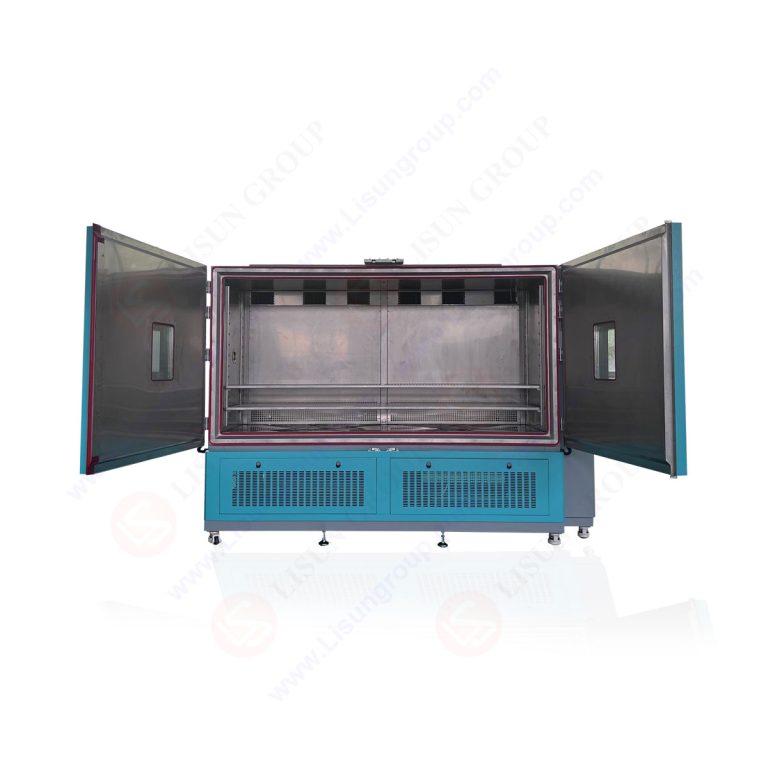
Cyclic mode executes temperature/humidity profiles such as IEC 60068-2-38 (10 cycles of -10°C to +65°C at 93% RH). During transitions, the photometric system continues measuring, capturing transient lumen behavior—critical for automotive lighting applications. The combined Climatic Chamber for IEC 60068 Temperature Humidity Testing supports ramp rates up to 2°C/min without overshoot, validated by integrated calibration sensors traceable to NIST.
5.1 Integrating Sphere and Spectrometer Options
Users can select sphere diameters based on test sample size: 0.3m for small SMD LEDs, 0.5m for COB modules, and 1.0m–2.0m for luminaires. The spectrometer’s integration time (1ms–10s) adjusts automatically under high flux or low light conditions. For multi-chamber setups, a multiplexer routes optical signals to a single high-speed CCD array, reducing cost per test point. The system also supports optional UV-LED testing with a 280nm-400nm enhanced sensitivity detector.
5.2 Electrical and Mechanical Customization
Drive circuitry accommodates constant current (0–2A), constant voltage (0–30V), or PWM dimming (100Hz–10kHz) to simulate real-world conditions. Mechanical fixtures are customizable for various package types (3535, 5050, Chip-on-Board) and luminaire form factors. Connection to three temperature chambers allows simultaneous testing at different temperatures (e.g., 55°C, 85°C, 105°C) with a single control PC, reducing footprint by 40% compared to separate systems.
6.1 Mapping to IES, CIE, and IEC Standards
The systems are designed to satisfy IES LM-80-15, IES LM-84-14, TM-21-19, and TM-28-14 extrapolation protocols. For color and photometric accuracy, conformity to IES LM-79-19 (Electrical and Photometric Measurements of Solid-State Lighting Products) is embedded in the measurement chain. CIE 084 (Measurement of Luminous Flux) and CIE 70 (Measurement of Intensity Distributions) guidelines dictate the integrating sphere’s baffle design and correction factors. The Climatic Chamber for IEC 60068 Temperature Humidity Testing aspect aligns with IEC 60068-2-14 (Temperature Change) and IEC 60068-2-30 (Damp Heat Cyclic).
6.2 Ensuring Traceability and Reproducibility
LISUN provides calibration certificates with each system, traceable to national metrology institutes (NIST/PTB). Sphere wall reflectance >95% is verified annually; the spectrometer’s wavelength accuracy is ±0.3nm. For interlaboratory comparisons, the software generates raw data files in XML format, compatible with NVLAP and other proficiency testing programs. This ensures that results from a LISUN Climatic Chamber for IEC 60068 Temperature Humidity Testing are reproducible across labs.
7.1 R&D Validation for High-Power LEDs
Automotive LED headlamp manufacturers use the LEDLM-84PL to validate LM-84 lumen maintenance at 105°C with 85% RH, correlating with AEC-Q102 thermal stress tests. The system’s ability to measure color shift (Δu’v’ < 0.003) over 6000 hours helps qualify phosphor matrices.
7.2 Third-Party Laboratory Testing Services
Independent labs (e.g., UL, TÜV) employ the LEDLM-80PL to offer LM-80 test reports to fixture manufacturers. The 3-chamber support reduces overall test cycle time by 33%—three temperatures (55/85/105°C) run concurrently, completing a full TM-21 dataset in 6000 hours instead of sequential 18-month durations. This efficiency enhances lab throughput and cost-effectiveness.
The Climatic Chamber for IEC 60068 Temperature Humidity Testing is indelibly integrated into LISUN’s LEDLM-80PL and LEDLM-84PL systems, delivering a unified solution for LED reliability engineering. Key takeaways include dual-standard interoperability (LM-80/TM-21 and LM-84/TM-28), Arrhenius Model-based lifetime estimation, dual test modes for steady-state and cyclic IEC protocols, and customizable hardware configurable to specific sample types. By supporting up to 3 connected temperature chambers and 6000-hour continuous operation, LISUN fulfills the rigorous demands of IES and CIE standards, enhancing measurement accuracy and operational efficiency. For engineers and labs, these instruments represent a strategic investment, bridging accelerated stress testing with precision photometry to produce bankable L70/L50 data. The systems’ alignment with IEC 60068 and IES regulations ensures stakeholders can confidently certify products for global markets.
Q1: How does LISUN’s climatic chamber system accelerate LED lifetime testing beyond the standard 6000 hours?
A: The system employs the Arrhenius Model within its software to calculate acceleration factors (AF) based on activation energy derived from dual-temperature tests. By exposing LEDs to elevated temperatures (e.g., 105°C) and comparing with a lower temperature (55°C), the software extrapolates lumen maintenance to nominal operating conditions (e.g., 25°C). For instance, an AF of 10 implies 6000 hours of testing equals 60,000 hours of field operation. This converts 6000-hour data into L70 projections spanning 10+ years, adhering to TM-21 methodologies. The accuracy is ±10% confidence intervals, aligningwith IES LM-80-15 data requirements.
Q2: Can the LEDLM-84PL handle both humidity and temperature cycling per IEC 60068 standards?
A: Yes, the LEDLM-84PL includes an optional humidity control subsystem covering 20%–98% RH (±2% RH), integrated with temperature cycling from -40°C to +150°C. It executes IEC 60068-2-38 (Temperature/Humidity Cyclic) and IEC 60068-2-30 (Damp Heat) profiles. During testing, photometric measurements continue uninterrupted, capturing lumen and color shifts under condensing humidity conditions. This is critical for outdoor LED luminaires where moisture ingress degrades optical performance. The system logs temperature, RH, and photometric data synchronously at intervals as short as 10 seconds.
Q3: What are the practical benefits of connecting up to three temperature chambers to one control system?
A: Connecting three chambers to a single LEDLM-80PL control unit allows simultaneous testing at different temperatures (e.g., 55°C, 85°C, 105°C) as required by LM-80. This reduces total test time from 18 months (sequential) to 6000 hours (parallel), enhancing lab throughput. Additionally, a single software interface manages all data streams, providing consolidated TM-21 extrapolation reports for all temperatures. Financially, it eliminates the need to purchase three separate photometric measurement systems, saving capital costs by up to 50%. The multiplexer ensures each chamber’s samples are measured within a 2-minute cycle.
Q4: Does the system provide real-time monitoring and remote access for long-duration tests?
A: Yes, LISUN’s software includes Ethernet connectivity, enabling remote login to view live lumen depreciation curves, temperature stability (e.g., ±0.5°C), and humidity levels. Alarms via email/SMS notify engineers of deviations (e.g., chamber door open, temperature overrun). Historical data is stored in SQL databases, and backup power (UPS) ensures uninterrupted logging during power outages. For 6000-hour tests, this remote capability minimizes on-site supervision and facilitates multi-shift lab operations.
Q5: How does the system ensure compliance with both IES LM-79-19 and CIE 127 for spectral measurements?
A: The integrating sphere follows CIE 84 guidelines for total luminous flux measurement, including baffle and auxiliary sphere corrections. The spectrometer is calibrated to IES LM-79-19 requirements for spectral power distribution (SPD), with wavelength accuracy ±0.3nm and linearity ±1%. Color metrics (CCT, CRI, Δu’v’) are computed per CIE 127:2007, which mandates accurate color rendering assessment for LED products. The system self-monitors sphere temperature (maintained at 25°C ±1°C) to prevent wall reflectance drift, ensuring photometric data remains within ±2% uncertainty across the 6000-hour test.