









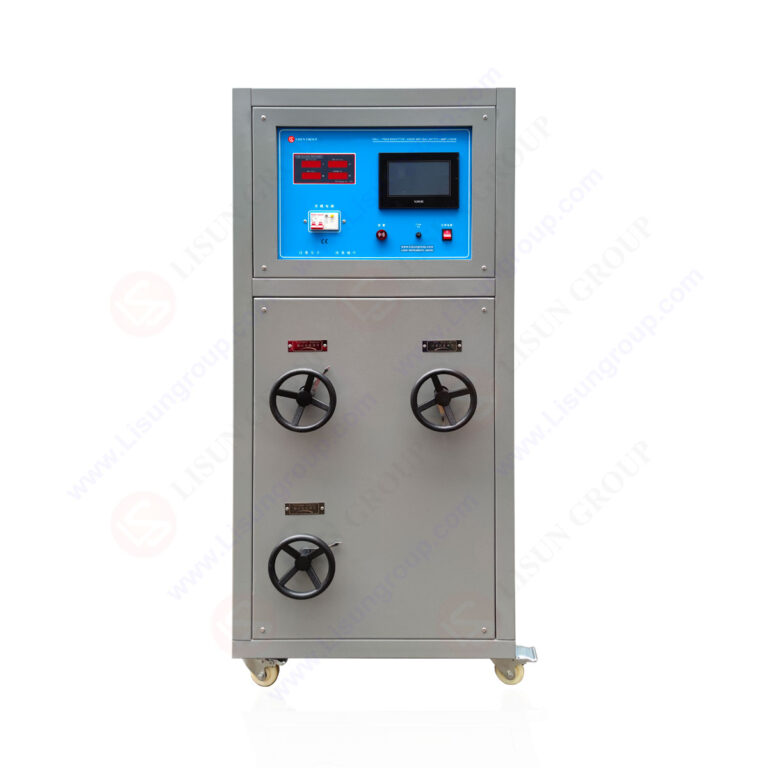
The LISUN DFX series Externally Ballasted Fluorescent Lamp Test Load Cabinet represents a critical advancement in combined life and load testing for power cords, enabling precise simulation of ballasted lamp loads under controlled conditions. This comprehensive guide examines the DFX series’ technical architecture, compliance capabilities, and integration within end-to-end testing workflows. Designed for electrical product manufacturers, third-party testing laboratories, and quality control engineers, the load test cabinet delivers adjustable resistive, inductive, and capacitive load profiles essential for validating power cord durability per IEC and GB standards. The DFX series addresses the growing demand for reliable, repeatable load simulation across multiple test channels, supporting compliance with IEC 60884-1 Clause 20 and IEC 60669-1 Clause 19.2. This article provides detailed technical specifications, comparative model analysis, and practical implementation guidance to empower professionals in achieving accurate, standard-compliant testing outcomes.
1.1 Core Functional Principles
The LISUN DFX series operates on the principle of externally ballasted fluorescent lamp load simulation, replicating the electrical characteristics of real-world lighting circuits. Each model incorporates precision resistors, inductors, and capacitors arranged in configurable networks to generate accurate power factor values ranging from 0.3 to 1.0. The load test cabinet supports both resistive and reactive load combinations, enabling engineers to test power cords under worst-case scenario conditions as specified in international standards. The internal switching architecture ensures rapid load transitions without introducing transient artifacts that could compromise test validity.
1.2 Modular Design for Scalability
The DFX series employs a modular chassis design accommodating varying channel counts and current capacities. Model DFX-20 provides single-channel output up to 20A, while DFX-20-3CH offers three independent channels for parallel testing applications. Higher-capacity models DFX-40, DFX-60, and DFX-80 support increased current demands up to 80A for industrial-grade power cord evaluation. Each module contains independent load banks with dedicated cooling systems to maintain thermal stability during extended test cycles. This modularity allows laboratories to scale testing capabilities incrementally without replacing entire infrastructure.
2.1 Current and Power Factor Ranges
The load test cabinet delivers precise current regulation across its operating range with ±1% accuracy for resistive loads and ±3% for inductive and capacitive combinations. Power factor adjustment resolution reaches 0.01 increments, enabling fine-grained simulation of diverse load conditions. The table below compares core specifications across DFX series models:
| Model | Current Range | Channels | Input Voltage | Power Factor Range | Max Capacitive Load |
|---|---|---|---|---|---|
| DFX-20 | 0.1–20A | 1 | AC 220V/50Hz | 0.3–1.0 | 100µF |
| DFX-20-3CH | 0.1–20A per channel | 3 | AC 220V/50Hz | 0.3–1.0 | 100µF per channel |
| DFX-40 | 0.1–40A | 1 | AC 220V/50Hz | 0.3–1.0 | 200µF |
| DFX-60 | 0.1–60A | 1 | AC 380V/50Hz | 0.3–1.0 | 300µF |
| DFX-80 | 0.1–80A | 1 | AC 380V/50Hz | 0.3–1.0 | 400µF |
2.2 Measurement and Monitoring Capabilities
Integrated digital instrumentation provides real-time display of voltage, current, power, and power factor values with update rates of 10 samples per second. The load test cabinet includes overcurrent protection circuits with adjustable thresholds and automatic shutdown features for test specimen safety. Data logging interfaces via RS-232 and USB ports allow continuous recording of test parameters throughout life testing cycles exceeding 10,000 hours. Accuracy specifications include ±0.5% for voltage measurement and ±0.8% for power measurement across the full frequency range of 45–65Hz.
3.1 IEC 60884-1 Clause 20 Implementation
IEC 60884-1 Clause 20 specifies testing requirements for plugs and socket-outlets under load conditions simulating inductive loads from ballasted lighting equipment. The DFX series directly addresses these requirements by providing adjustable power factor settings between 0.4 and 0.6 for inductive loads, coupled with specified current values up to 80A. The load test cabinet maintains stable load characteristics throughout the required 100-cycle testing sequence, with automatic cycle counting and interruption detection. Compliance verification includes validation against reference load curves published in the standard.
3.2 IEC 60669-1 Clause 19.2 Compliance
For switches controlling fluorescent lighting circuits, IEC 60669-1 Clause 19.2 demands testing with ballasted loads exhibiting defined inrush current characteristics. The DFX series replicates these conditions through programmable load sequences that incorporate initial capacitive charging currents followed by steady-state inductive operation. The load test cabinet supports the required 10,000 operating cycles at rated current values, with integrated monitoring to detect contact welding or excessive arcing. Additional standards compliance includes IEC 60269-1 for fuse testing and GB 1002 for domestic Chinese market requirements.
4.1 Resistive Load Characterization
Resistive load simulation within the load test cabinet utilizes high-precision wire-wound resistors with tolerance better than ±1% and temperature coefficients below 50ppm/°C. These resistors handle continuous power dissipation up to 10 times the rated current without significant drift, ensuring test repeatability across extended durations. The resistive load bank supports power factor values of 1.0 and can be combined with reactive elements for composite load profiles. This capability is essential for testing power cords under rated current conditions as specified in IEC 60884-1 Clause 19.3.
4.2 Inductive and Capacitive Load Simulation
The inductive load section employs iron-core reactors with air gaps to prevent saturation at peak currents, providing linear inductance values from 1mH to 100mH. Capacitive loads utilize metallized polypropylene capacitors rated for continuous AC operation with dielectric strength exceeding 2000V. The load test cabinet allows independent adjustment of inductive and capacitive components to achieve target power factor values, enabling simulation of ballasted fluorescent lamps with power factors as low as 0.3. This capability is critical for evaluating power cord performance under reactive load conditions that generate increased contact stress and thermal cycling.
5.1 LISUN CZKS Series Life Testers
The DFX series integrates seamlessly with LISUN CZKS automated life testers through standardized control interfaces and communication protocols. The load test cabinet serves as the load source while CZKS series units manage mechanical cycling, specimen monitoring, and failure detection. This combination enables fully automated life testing according to IEC standards, with the load test cabinet providing synchronized load switching synchronized with mechanical operations. Integration reduces manual intervention and improves test consistency through centralized control software that logs all test parameters.
5.2 LISUN SW-6 Bending Testers
For comprehensive power cord durability evaluation, the load test cabinet connects to LISUN SW-6 bending testers to simulate mechanical stress during load application. The combined system applies specified current loads while the bending tester flexes the cord through defined arc angles at prescribed frequencies. This configuration supports compliance with IEC 60884-1 Clause 22 for flexible cord bending endurance tests under load. Synchronization ensures load application occurs at the peak bending angle to maximize stress on conductor strands and insulation materials.
6.1 Test Configuration and Parameter Setup
Operators begin by configuring the load test cabinet parameters through the front-panel interface or software control. Key settings include target current value, power factor selection, and test duration with cycle count limits. The system performs a self-calibration routine verifying internal load bank integrity before test initiation. For complex sequences, engineers can program multi-step profiles with varying load conditions representing different operating phases. The load test cabinet stores up to 50 custom test profiles for rapid recall and consistency across repeated evaluations.
6.2 Real-Time Monitoring and Data Acquisition
During testing, the load test cabinet displays instantaneous voltage, current, power factor, and cumulative cycle count on the digital panel. Built-in alarm thresholds trigger warnings or automatic shutdown if parameters deviate from specified ranges by more than 5%. Data acquisition systems record values at programmable intervals from 0.1 seconds to 1 minute, generating comprehensive test reports. The integrated event log captures any anomalies such as load interruptions, overcurrent trips, or power factor fluctuations for post-test analysis.
7.1 Application-Specific Model Recommendations
Selection of the appropriate load test cabinet model depends on maximum current requirements, channel count needs, and available input power infrastructure. The table below compares DFX series models against minimum standard requirements for common testing scenarios:
| Standard Requirement | Test Parameter | Minimum Specification | DFX-20 | DFX-20-3CH | DFX-40 | DFX-60 | DFX-80 |
|---|---|---|---|---|---|---|---|
| IEC 60884-1 Clause 20 | Inductive load 10A | 10A @ PF 0.6 | Yes | Yes | Yes | Yes | Yes |
| IEC 60669-1 Clause 19.2 | Ballasted load 16A | 16A @ PF 0.5 | Yes | Yes | Yes | Yes | Yes |
| GB 1002-2008 | Rated current 25A | 25A resistive | No | No | Yes | Yes | Yes |
| IEC 60269-1 | Fuse testing 32A | 32A continuous | No | No | Yes | Yes | Yes |
| High-power industrial cords | 63A rated | 63A inductive | No | No | No | Yes | Yes |
7.2 Future-Proofing Considerations
Laboratories anticipating expanded testing requirements should consider higher-capacity models with upgrade paths. The DFX-80 offers maximum flexibility for evolving standards while maintaining backward compatibility with existing test fixtures. All models support firmware updates for new standard compliance as regulations develop. Multi-channel configurations like the DFX-20-3CH improve throughput for high-volume testing without sacrificing accuracy.
The LISUN DFX series Externally Ballasted Fluorescent Lamp Test Load Cabinet provides a comprehensive solution for combined life and load testing of power cords, meeting rigorous IEC and GB compliance requirements. With adjustable resistive, inductive, and capacitive load simulation across power factors from 0.3 to 1.0, these load test cabinets enable accurate reproduction of ballasted lamp operating conditions. The modular design accommodates single-channel high-current applications or multi-channel parallel testing configurations, supporting laboratories of varying scales. Integration with CZKS life testers and SW-6 bending testers creates an end-to-end testing workflow that automates complex sequences while maintaining measurement accuracy of ±1%. Technical specifications including 0.01 power factor resolution and data logging capabilities provide engineers with the precision needed for certification testing and quality assurance programs. The DFX series represents a reliable investment for organizations committed to standard-compliant power cord evaluation, offering scalability to meet emerging regulatory demands.
Q1: What is the difference between DFX-20 and DFX-20-3CH in terms of test capability?
A: The primary distinction lies in channel configuration and parallel testing efficiency. DFX-20 provides a single channel supporting up to 20A, suitable for sequential testing of individual specimens. DFX-20-3CH offers three independent channels, each capable of delivering 0.1–20A simultaneously, enabling concurrent testing of up to three power cord samples. This multi-channel design significantly improves throughput for laboratories conducting high-volume compliance testing. Both models maintain identical accuracy specifications of ±1% for resistive loads and ±3% for reactive combinations, with independent power factor adjustment per channel on the DFX-20-3CH. The multi-channel version also features isolated load banks preventing interference between simultaneously tested specimens.
Q2: Can the load test cabinet simulate starting inrush currents for fluorescent lighting circuits?
A: Yes, the DFX series incorporates programmable transient response capabilities to replicate inrush current characteristics typical of ballasted fluorescent lamps. The load test cabinet generates initial current peaks up to 10 times the steady-state rated current for durations of 10–50 milliseconds, as required by IEC 60669-1 Clause 19.2. This is achieved through controlled capacitor charging sequences combined with inductive load switching, producing current waveforms matching real-world ballast behavior. Operators can adjust inrush amplitude and duration parameters through the software interface. The system logs inrush event data including peak current values and duration for compliance documentation.
Q3: How does the load test cabinet integrate with existing laboratory automation systems?
A: Integration is accomplished through multiple communication interfaces including RS-232, USB, and optional Ethernet connectivity. The DFX series supports standard SCPI commands for remote control and data acquisition from centralized software platforms. LISUN provides LabVIEW drivers and Python libraries for custom automation development. The load test cabinet can synchronize with external test equipment through DC voltage trigger signals for coordinated start/stop operations. Data logging outputs CSV and XML formatted files compatible with laboratory information management systems (LIMS). The modular architecture allows connection of up to five DFX units in parallel for expanded channel count or current capacity without additional interface hardware.
Q4: What maintenance procedures are required for the load test cabinet to maintain accuracy?
A: Recommended maintenance includes quarterly calibration verification using reference resistor and inductor standards traceable to national metrology institutes. The load test cabinet’s internal cooling fans require annual cleaning to prevent dust accumulation affecting thermal performance. Capacitor banks should undergo dielectric absorption testing every 5000 operating hours to detect degradation. The self-calibration routine should be executed before each critical test series to compensate for ambient temperature variations. LISUN provides a calibration kit and documented procedures for on-site verification. Annual factory recalibration is recommended for laboratories seeking ISO 17025 accreditation, with typical calibration cycles requiring 5–7 working days.
Q5: Can the DFX series test power cords rated for DC applications?
A: While primarily designed for AC load simulation per IEC standards for mains-connected equipment, the DFX series can perform certain DC tests with limitations. The resistive load bank supports DC operation up to rated current values, but the inductive components are optimized for AC frequencies of 45–65Hz and may exhibit different behavior under DC conditions due to core saturation. Capacitive loads provide accurate DC simulation with appropriate surge protection. For comprehensive DC testing meeting standards such as IEC 60065 for electronic equipment, LISUN recommends dedicated DC load banks or combination testing with separate DC power supplies. The load test cabinet’s measurement system can accurately monitor DC parameters with ±1.5% accuracy when operated in resistive-only mode.