









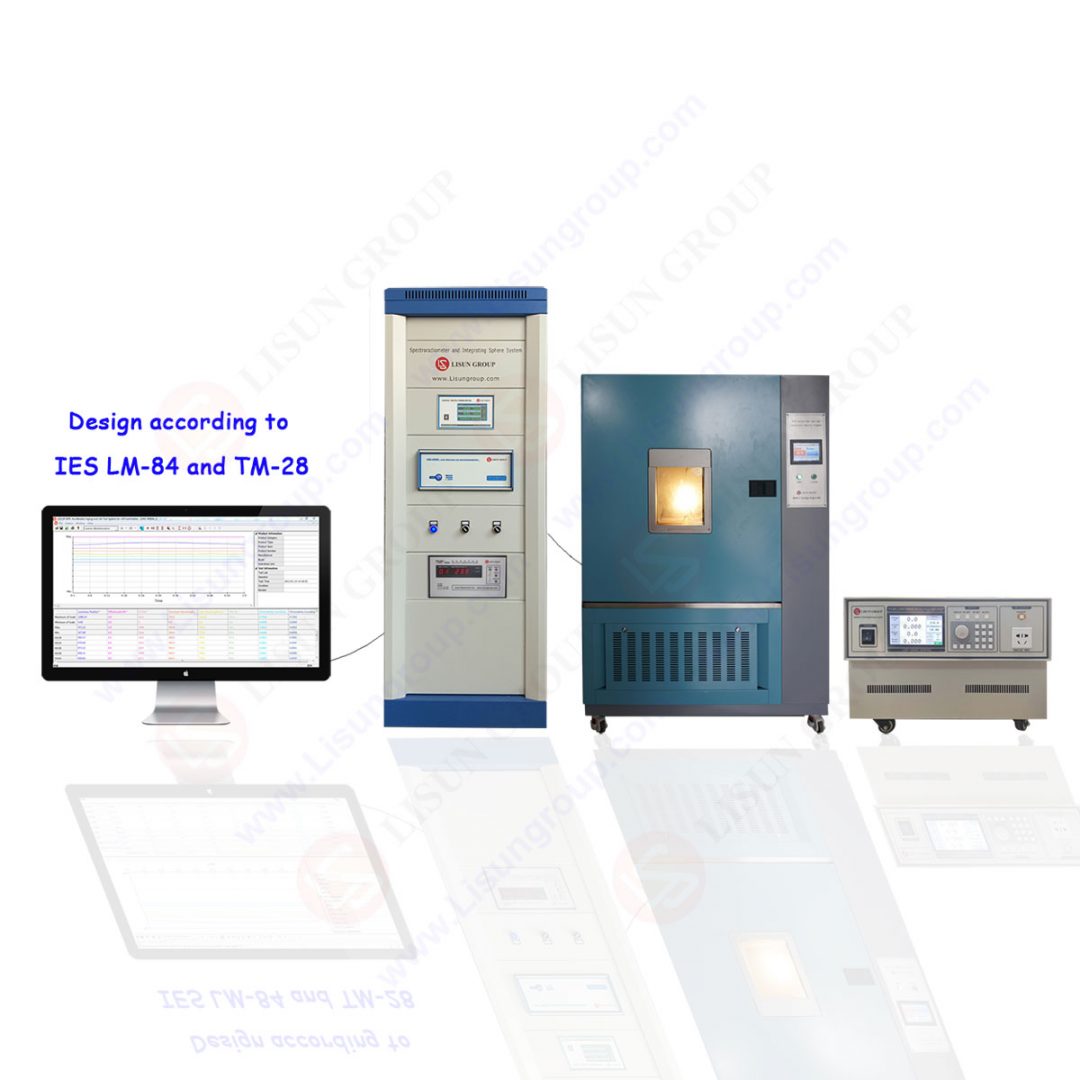
This technical article presents a comprehensive analysis of the Compliant IES LM-84 LED Aging Life Test Chamber – 6000-Hour Automated Testing Solution developed by LISUN. Designed to meet rigorous industry standards including IES LM-80, IES LM-84, TM-21, and TM-28, this system integrates dual testing variants—LEDLM-80PL for LM-80/TM-21 compliance and LEDLM-84PL for LM-84/TM-28 protocols. The chamber enables automated 6000-hour lumen maintenance testing with real-time data acquisition, Arrhenius Model-based lifetime projection, and support for up to three connected temperature chambers. This article provides technical professionals with detailed insights into system architecture, testing methodologies, standard compliance, and practical applications for accelerated LED aging validation.
1.1 Evolution of IES LM-80 and IES LM-84 Standards
The Illuminating Engineering Society (IES) has established critical standards for LED lumen maintenance testing. IES LM-80-15 specifies the approved method for measuring lumen depreciation of solid-state lighting (SSL) components, requiring minimum test durations of 6,000 hours at specified case temperatures (55°C, 85°C, and optionally a third temperature). IES LM-84-19 extends this framework to complete LED luminaires, engines, and integrated lamps, mandating similar 6,000-hour testing protocols with data collection intervals not exceeding 1,000 hours.
1.2 TM-21 and TM-28 Projection Methodologies
TM-21-19 provides the mathematical framework for projecting long-term lumen maintenance from LM-80 test data, utilizing nonlinear regression analysis to estimate L70 (time to 70% lumen output) and L50 (time to 50% lumen output) values. TM-28-19 offers analogous projection methods for LM-84 data, incorporating Arrhenius Model calculations for temperature-accelerated life testing. These projections enable manufacturers to estimate LED lifespan up to 60,000 hours from empirical 6,000-hour data, significantly reducing validation timelines.
1.3 Complementary Standards: IES LM-79-19, CIE 084, CIE 70, and CIE 127
IES LM-79-19 governs electrical and photometric measurements of SSL products. CIE 084 provides measurement standards for luminous flux, while CIE 70 details measurement methods for absolute luminous intensity. CIE 127 specifies temperature measurement techniques for LEDs. Integrating these standards ensures comprehensive characterization of LED performance under thermal and electrical stress conditions.
2.1 Dual System Variants: LEDLM-80PL and LEDLM-84PL
The LISUN LED Optical Aging Test Instrument comprises two specialized configurations. The LEDLM-80PL system is engineered for component-level testing per IES LM-80 and TM-21, supporting up to 2 channels with individual temperature control. The LEDLM-84PL variant addresses luminaire and integrated lamp testing per IES LM-84 and TM-28, featuring expanded channel capacity and higher current handling (up to 10A per channel). Both systems share a common software platform for unified data management.
2.2 Hardware Configuration and Customization Options
The instrument supports up to 3 connected temperature chambers, enabling simultaneous testing at multiple test points (typically 55°C, 85°C, and 60°C or 75°C for intermediate conditions). Each chamber accommodates 20 to 60 test positions depending on component size. Customizable test jigs allow for varied LED package types (SMD, COB, through-hole) and mounting configurations. The system includes integrated integrating sphere or goniophotometer interfaces for periodic photometric measurements.
2.3 Automated Data Acquisition and Control Systems
Automated power cycling systems manage ON/OFF schedules per IES standards (typically 2-hour ON, 1-hour OFF cycles for LM-80). Real-time monitoring of case temperature (Tc), ambient temperature, drive current, and forward voltage occurs at user-defined intervals (minimum 15 seconds). Data logging captures lumen output measurements at each data collection point, with automatic flagging of anomalous readings exceeding ±5% from projected decay curves.
3.1 Test Duration and Data Collection Frequency
The standard 6,000-hour test protocol requires lumen output measurements at 0, 1,000, 2,000, 3,000, 4,000, 5,000, and 6,000 hours. However, LISUN’s system enables user-configurable intervals (e.g., 500-hour increments for accelerated validation). For TM-21 compliance, at least 4 data points beyond 1,000 hours are mandatory. The system automatically inserts additional measurement points if lumen depreciation accelerates beyond predicted thresholds (>2% per 1,000 hours).
3.2 Temperature and Humidity Control Parameters
Temperature chambers maintain set-point accuracy of ±2°C across the operating range (20°C to 100°C). Relative humidity control is optional per chamber, with ±5% RH accuracy for high-humidity testing. The Arrhenius Model integration allows extrapolation of test results from three temperature conditions to predict room-temperature performance. For example, testing at 85°C for 6,000 hours can project 30,000+ hours at 55°C using activation energy values derived from standard LED failure mechanisms.
3.3 Automated Failure Detection and Reporting
The system monitors for sudden failures (catastrophic opens/shorts) and gradual degradation. When lumen output drops below 10% of initial measurement within a single 1,000-hour interval, the system triggers a detailed failure analysis protocol. TM-21 extrapolation automatically pauses if R-squared values from regression analysis fall below 0.98, alerting operators to potential test anomalies.
4.1 Theoretical Framework and Activation Energy Calculation
The Arrhenius Model equation: L(t) = L0 exp(-t/τ(T)), where τ(T) = A exp(Ea/(k*T)). The software calculates activation energy (Ea) from experimental data across multiple temperatures. Typical Ea values for LED packages range from 0.3 to 0.7 eV depending on phosphor composition. The system automatically performs Arrhenius plot construction (ln(τ) vs. 1/T) and validates linearity with Pearson correlation coefficients >0.95 for reliable projections.
4.2 Integration with TM-21 and TM-28 Extrapolation Methods
The software implements TM-21’s nonlinear exponential decay model: Φ(t) = α exp(-βt) + γ, with parameters optimized via Levenberg-Marquardt algorithm. For TM-28, the system utilizes a combined model incorporating both temperature and current acceleration factors. The Arrhenius window—typically 55°C to 85°C for LM-80—is automatically verified to ensure at least one test temperature falls within 10°C of the intended use temperature. Projections beyond 6× the test duration are flagged as provisional.
4.3 Data Visualization and Export Capabilities
The software generates automated reports including L70/L50 extrapolation curves with confidence intervals (95%), temperature life plots, and failure distribution histograms. Export formats include CSV, PDF (with embedded calibration certificates), and XML for third-party database integration. Parameter sensitivity analysis allows engineers to assess projection accuracy based on sample size (minimum 20 units per temperature per TM-21 requirements).
| Parameter | LEDLM-80PL (LM-80/TM-21) | LEDLM-84PL (LM-84/TM-28) |
|---|---|---|
| Test Target | LED packages, arrays, modules | LED luminaires, engines, integrated lamps |
| Maximum Channels | 2 independent channels | 4 independent channels |
| Current Range | 0-2A per channel (0.1% accuracy) | 0-10A per channel (0.1% accuracy) |
| Voltage Range | 0-50V per channel | 0-300V per channel |
| Temperature Points | 3 (55°C, 85°C, optional 60-75°C) | 3 (user-defined, typically 25-85°C) |
| Sample Quantity | 20-60 units per temperature | 10-30 units per temperature |
| Test Duration | 6,000 hours (minimum) | 6,000 hours (minimum) |
| Projection Standard | TM-21-19 (up to 60,000 hours) | TM-28-19 (up to 36,000 hours) |
| Measurement Frequency | Every 1,000 hours | Every 1,000 hours (luminaire level) |
| Humidity Control | Optional | Standard (20-80% RH) |
Table 1: Technical comparison between LEDLM-80PL and LEDLM-84PL configurations for IES LM-80 and IES LM-84 compliance.
6.1 Accelerated Aging Validation for New LED Products
Manufacturers use the 6,000-hour automated solution to validate new LED product lifetimes within 8-10 months versus 5-7 years for real-time testing. The Arrhenius Model allows projection of L70 values from 85°C tests to standard operating conditions (25-40°C). For example, an LED showing L70 at 8,000 hours under 85°C testing can project L70 values exceeding 50,000 hours at 55°C junction temperature.
6.2 Third-Party Testing Laboratory Compliance
Independent testing labs utilize dual-channel configurations to run multiple customer projects simultaneously. The system’s ability to connect up to 3 temperature chambers enables concurrent testing at 55°C, 85°C, and 75°C—exceeding the IES LM-80 minimum requirement of two temperatures. Automated reporting with embedded calibration data ensures ISO 17025-ready documentation.
6.3 Automotive Electronics and High-Reliability Applications
For automotive LED components (headlights, daytime running lights), the system supports extended humidity testing per AEC-Q101 requirements. The LEDLM-84PL variant can test complete headlamp assemblies with integrated heat sinks. Custom test profiles mimic thermal cycling conditions (e.g., -40°C to 85°C in 30-minute cycles) to evaluate solder joint reliability alongside lumen maintenance.
7.1 Photometric Measurement Traceability
The system utilizes integrating sphere or goniophotometer interfaces calibrated annually against NIST-traceable standard lamps. Measurement uncertainty for lumen output is ±2% for LM-80 (color measurement) and ±3% for LM-84 (complete luminaire testing). Chromaticity coordinates (x,y) maintain ±0.002 accuracy per CIE 084 guidelines.
7.2 Temperature Sensor Verification
Thermocouple sensors (Type K or T) are calibrated at three key temperature points (25°C, 55°C, 85°C) with ±0.5°C accuracy. The system automatically logs sensor drift over time, generating calibration reminders every 13 months per ISO 17025 requirements. Active temperature control ensures chamber stability within ±0.5°C during lumen measurement periods.
7.3 Electrical Parameter Monitoring Precision
Current measurement accuracy of ±0.1% of reading ensures precise drive current control critical for TM-21 extrapolation. Forward voltage monitoring with ±0.05% accuracy enables detection of early-stage phosphor degradation (voltage shifts >2% indicate potential failure). Power supply ripple ≤50mV peak-to-peak prevents measurement artifacts.
The Compliant IES LM-84 LED Aging Life Test Chamber – 6000-Hour Automated Testing Solution represents a significant advancement in LED reliability validation. By integrating dual testing variants for both LM-80/TM-21 component testing and LM-84/TM-28 luminaire evaluation, LISUN provides a unified platform for comprehensive LED aging analysis. The system’s Arrhenius Model-based software enables accurate lifetime projection up to 60,000 hours from empirical 6,000-hour data, while automated data acquisition and failure detection reduce operator intervention requirements. Support for up to three temperature chambers, customizable test schedules, and comprehensive standard compliance (IES LM-79-19, CIE 084, CIE 70, CIE 127) ensures applicability across LED manufacturing, third-party testing, and high-reliability automotive applications. This solution delivers measurable value through accelerated validation timelines, reduced testing costs, and robust regulatory compliance, making it an essential tool for engineers committed to LED quality assurance.
Q1: What is the minimum test duration required for IES LM-84 compliance, and does the LISUN system exceed this requirement?
A: IES LM-84 mandates a minimum test duration of 6,000 hours, with lumen output measurements taken every 1,000 hours. The LISUN system fully complies with this requirement, supporting automated 6,000-hour test protocols with user-configurable measurement intervals as short as 500 hours. Additionally, the system can extend testing beyond 6,000 hours (up to 10,000 hours) for enhanced projection accuracy. For LM-84 luminaire testing, the LEDLM-84PL configuration includes humidity control and higher current handling (10A per channel) to accommodate larger test samples. The integrated Arrhenius Model software automatically validates that at least four data points beyond 1,000 hours are available for TM-28 extrapolation, ensuring compliance with projection requirements. Engineers should note that TM-28 prohibits extrapolation beyond 6× the test duration, so a 6,000-hour test supports projections up to 36,000 hours.
Q2: How does the LISUN system manage temperature testing for multiple LED samples simultaneously?
A: The system supports up to three connected temperature chambers, each independently controllable within a range of 20°C to 100°C with ±2°C accuracy. For IES LM-80 compliance, three test temperatures are required: 55°C, 85°C, and an intermediate temperature selected by the user (typically 60°C for low-power LEDs or 75°C for high-power devices). Each chamber can accommodate 20-60 LED test positions depending on component size, with individual case temperature monitoring via attached thermocouples. The software automatically assigns samples to channels and temperature conditions, ensuring equal distribution across test points. Real-time temperature logging occurs every 15 seconds, with automatic power adjustment if any sample exceeds its specified temperature by ±3°C. This multisite testing capability enables simultaneous validation at all required temperatures, reducing overall test cycle time by up to 66% compared to sequential testing.
Q3: What are the L70 and L50 metrics, and how does the system calculate them from test data?
A: L70 represents the projected time at which an LED’s lumen output degrades to 70% of its initial value, while L50 indicates degradation to 50% initial output. The system calculates these metrics using TM-21 nonlinear exponential decay modeling: Φ(t) = α exp(-βt) + γ, where parameters (α, β, γ) are optimized via Levenberg-Marquardt algorithm. For LM-80 data, projections require at least 6,000 hours of test data from three temperatures. The Arrhenius Model incorporates activation energy (Ea) values derived from temperature sensitivity analysis—typical values range from 0.3eV for standard phosphors to 0.7eV for high-efficiency variants. The software automatically calculates L70 and L50 at the use temperature (typically 25-55°C), with 95% confidence intervals. Sample size significantly affects projection accuracy; TM-21 recommends at least 20 units per temperature condition. The system flags projections where R-squared values fall below 0.98 or sample sizes are insufficient, ensuring reliable lifetime estimates.
Q4: Can the LISUN system be customized for non-standard testing protocols or specific LED types?
A: Yes, the system offers extensive customization options. Custom test jigs accommodate SMD, COB, through-hole, chip-on-board, and high-power LED packages, as well as complete automotive headlamp assemblies. Programming features allow user-defined test profiles, including variable temperature cycling (e.g., -40°C to 85°C thermal shock), humidity ramps (20-80% RH), and power cycling schedules. The software supports plug-in modules for specialized calculations, such as LM-83 for color shift, or CIE 13.3 for color rendering index maintenance. Project-specific reporting templates can be integrated with custom failure definition criteria (e.g., lumen output drop >15% within 500 hours). For research applications, the system allows manual override of Arrhenius activation energy values when known material properties exist. Calibration verification can be scheduled at user-defined intervals rather than default 13-month cycles. Non-standard test durations (e.g., 3,000 hours for accelerated screening) are supported with appropriate caveats in generated reports.
Q5: What data export capabilities does the software provide for regulatory submission?
A: The software exports test data and reports in multiple formats optimized for regulatory submissions. Standard export includes PDF reports with embedded calibration certificates, measurement uncertainty budgets, and TM-21/TM-28 projection curves. CSV files include raw lumen output data, temperature logs, electrical parameter measurements, and Arrhenius plot data points. XML exports follow IEC 62962 format for compatibility with third-party database systems. For US Department of Energy (DOE) submissions, the system generates CALiPER-compatible data packages. For Energy Star qualifications, reports automatically include mandated L70/L50 projections with 6,000-hour minimum test durations. The system also supports ISO 17025-accredited laboratory formats, including test method descriptions, equipment calibration traceability, and uncertainty analysis per EA-4/02 guidelines. All exported files include metadata tags for standard version numbers (e.g., IES LM-80-15), test dates, operator identification, and chamber calibration validity periods.