









Here is the comprehensive technical article generated based on your detailed instructions.
Abstract
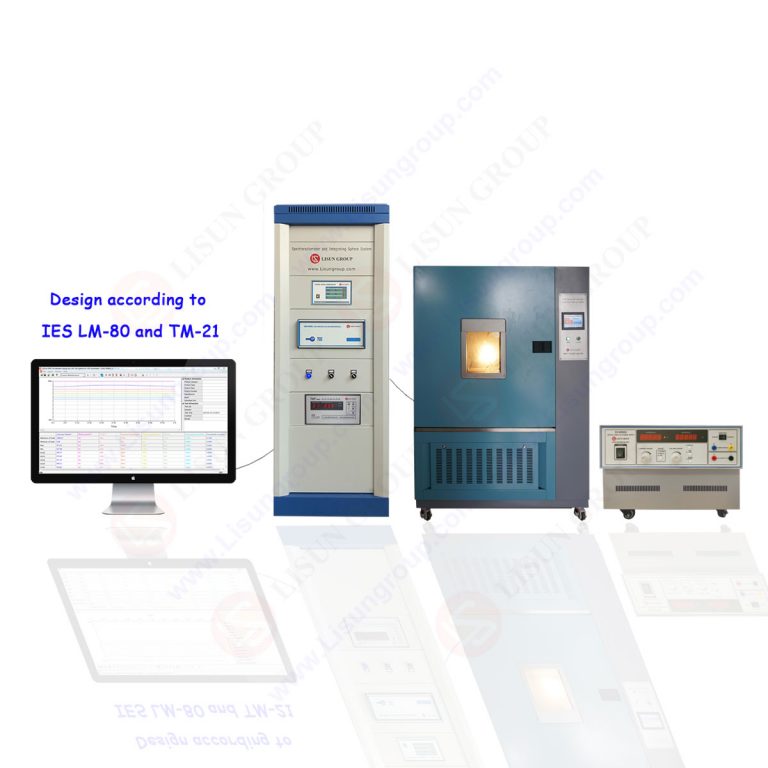
This article provides an in-depth technical analysis of Custom LED Aging Test Fixtures for Lumen Maintenance & L70/L50 Prediction, focusing on the rigorous methodologies required for reliable LED lifetime estimation. As an essential tool for R&D and quality control, these fixtures enable precise accelerated aging tests. By integrating the Arrhenius Model and supporting IES standards like LM-80 and TM-21, engineers can accurately predict L70/L50 failure points. The discussion centers on the LISUN LEDLM-80PL and LEDLM-84PL systems, highlighting their dual-mode operation, data acquisition at specified case temperatures, and support for up to three connected temperature chambers for multi-stress testing.
Modern LED system reliability is defined by lumen maintenance, not sudden catastrophic failure. To predict when a system will reach 70% (L70) or 50% (L50) of its initial light output, engineers rely on standardized, accelerated aging processes. Custom LED Aging Test Fixtures for Lumen Maintenance & L70/L50 Prediction bridge the gap between generic test equipment and specific application requirements.
1.1 Moving Beyond Standard Testing Protocols
While standards like IES LM-80 provide a baseline, they often require customization for specific form factors (e.g., COBs, automotive LEDs, or chip-on-board modules). A custom fixture integrates specific thermal management, allowing for precise control of case temperature (Tsp) and drive current, which are the primary accelerators of lumen depreciation.
1.2 The Necessity of High-Temperature Forcing
To generate L70 data within a practical timeframe (e.g., 6,000 hours), fixtures must provide isothermal control at multiple test points (e.g., 55°C, 85°C, and 105°C). The LISUN system allows for the connection of up to 3 temperature chambers simultaneously, enabling the parallel testing required for the Arrhenius extrapolation mandated by TM-21.
The LISUN LEDLM-80PL and LEDLM-84PL platforms are engineered for high-accuracy, long-duration testing. They incorporate modular hardware and dual operational modes to cater to both LM-80 (discrete LEDs) and LM-84 (light engines/lamps) standards.
2.1 Dual System Variants: LEDLM-80PL vs. LEDLM-84PL
These systems share a common software backbone but differ in their hardware configuration to meet specific standard requirements.
| Feature | LEDLM-80PL (LM-80/TM-21 Focus) | LEDLM-84PL (LM-84/TM-28 Focus) |
|---|---|---|
| Primary Standard | IES LM-80 | IES LM-84 |
| Output Metric | TM-21 (L70/L50) | TM-28 (L70/L50) |
| Test Object | Discrete LED packages, arrays | LED light engines, modules |
| Typical Channels | High-density (50-100+ slots) | Lower density, higher power (20-40 slots) |
| Drive Current | 0-1.5A (Typical) | 0-3.0A+ |
2.2 Data Acquisition and Photometric Integration
A critical feature is the integration of a photometric measurement system (e.g., integrating sphere) at specific intervals. The fixture automates the transfer of the DUT (Device Under Test) from the aging chamber to the measurement sphere without operator intervention, ensuring data integrity for lumen maintenance curves.
Predicting L70/L50 lifetimes requires understanding how heat accelerates failure mechanisms. The fixture enables engineers to gather data at multiple stress levels and apply the Arrhenius equation to extrapolate lifetimes at rated conditions.
3.1 Junction Temperature vs. Case Temperature Control
The fixture is designed to stabilize the case temperature (Tsp) rather than just the ambient air. This is critical because junction temperature (Tj) determines lumen depreciation. The system monitors Tsp with T-type thermocouples with an accuracy of ±1°C, ensuring the activation energy (Ea) calculation in the Arrhenius Model is valid.
3.2 Defining the Test Duration and Data Points
For a valid TM-21 extrapolation, a minimum of 6,000 hours of data is recommended (with 10,000 hours being ideal). The LISUN fixture logs photometric and colorimetric data (CCT, CRI, chromaticity shift) at intervals defined by the user, typically every 1,000 hours. This raw data is then processed by the built-in software to predict the L70 point, which may be 50,000 to 100,000 hours into the future.
The software suite is not merely a data logger; it is a predictive analytics engine. It features two distinct testing modes to suit different development stages, from R&D validation to final qualification.
4.1 Constant Stress Mode (Standard Compliance)
This mode maintains a fixed ambient temperature and drive current for the entire test duration. It is the default mode for generating LM-80 ready data. The software automatically calculates the L70 (Iq) and L50 (Iq) metrics based on the IES TM-21 or IES TM-28 algorithms, applying the 6x extrapolation limit rule.
4.2 Step-Stress and HALT Mode (R&D Optimization)
For rapid failure analysis, the fixture supports Step-Stress Accelerated Life Testing (SSALT). The algorithm increases stress (temperature or current) in discrete steps until failure occurs. This mode is invaluable for identifying the “wear-out” mechanisms that dictate the L50 endpoint, allowing engineers to redesign for higher reliability before committing to a 6,000-hour LM-80 test.
Compliance with global standards ensures that the generated L70/L50 predictions are accepted by regulatory bodies and clients. The fixture is designed to operate within the tolerances defined by IES LM-79-19, CIE 084, and CIE 127.
5.1 Electrical and Photometric Measurement Precision
The system uses a Class A spectroradiometer integrated with the fixture. It measures total luminous flux with an uncertainty of less than 1.5% and provides correlated color temperature (CCT) with a precision of ±2K. The drive current is regulated to ensure ripple is less than 1% RMS, preventing false aging acceleration from electrical stress.
5.2 Chromaticity Shift and Color Maintenance
Beyond lumen maintenance, the fixture tracks chromaticity shift (Δu’v’). While standard CIE 70 or LM-80 often focus on lumen decay, the LISUN software automatically plots the Δu’v’ vector, which is critical for predicting color consistency over the lifespan of the LED.
The term “Custom ” is key. The LISUN fixture is modular, allowing R&D teams to adapt the hardware layout for specific thermal masses, mechanical footprints, or electrical driving schemes (e.g., PWM dimming).
6.1 Modular Sockets and Thermal Interfaces
Customization begins with the interface plate. Engineers can design specific sockets for SMD packages or holders for COB modules. The fixture provides a low thermal resistance path from the DUT to the chamber’s heat sink, which is essential for maintaining the specified Tsp (e.g., 85°C ± 2°C) as defined by CIE 127.
6.2 Multi-Chamber Synchronization
For high-throughput labs, up to three temperature chambers (e.g., one at 55°C, one at 85°C, one at 105°C) can be connected to a single control unit. This allows for simultaneous testing of multiple variants, drastically reducing the time to generate a complete Arrhenius model for L70/L50 prediction.
The final value of the fixture lies in its output. The software automates the complex calculations of the Arrhenius Model and generates reports that are compliant with TM-21 or TM-28.
7.1 Raw Data to TM-21 Extrapolation
The workflow involves:
- Importing lumen maintenance data (e.g., 0, 1,000, 2,000, … 6,000 hours).
- Applying the exponential decay model: ( Phi(t) = beta e^{-alpha t} ).
- Calculating the activation energy (Ea) from the multi-temperature data.
- Extrapolating to L70 (1 – 0.3 = 0.7) and L50 (0.5).
- The software automatically flags data that violates the ( t{extrapolated} leq 6 times t{tested} ) limit.
7.2 Predictive Analysis for L70 Lifetime
The software visualizes the confidence intervals of the L70 prediction. Engineers can immediately see if the DUT meets the specification of, for example, L70 > 50,000 hours at 85°C. This predictive capability is the core deliverable of Custom LED Aging Test Fixtures for Lumen Maintenance & L70/L50 Prediction.
The precision required for calculating L70 and L50 lifetimes demands more than a standard oven; it requires an integrated system capable of Custom LED Aging Test Fixtures for Lumen Maintenance & L70/L50 Prediction. The LISUN LEDLM-80PL and LEDLM-84PL platforms fulfill this demand by providing hardware flexibility to match IES LM-80 or LM-84 standards, robust data acquisition, and Arrhenius Model-based software for accurate extrapolation. By managing up to three thermal chambers simultaneously and ensuring high-precision photometric measurements, these fixtures empower engineers to transition from simple data logging to predictive analytics. This ensures that the final LED product meets its stated lifetime claims, reducing warranty risk and enhancing market credibility. For any laboratory or manufacturer serious about LED reliability, investment in such dedicated, compliant aging fixtures is not a luxury—it is a mandatory requirement for quality assurance.
Q1: What is the difference between using the LEDLM-80PL for TM-21 and the LEDLM-84PL for TM-28?
A: The primary difference lies in the test subject. IES TM-21 is used to predict the lifetime of LED components (packages or arrays) based on data gathered per IES LM-80. The LEDLM-80PL is optimized for high-density layouts and lower drive currents typical of discrete LEDs. Conversely, IES TM-28 is used for LED light engines or modules, and its data is sourced per IES LM-84. The LEDLM-84PL is designed to handle high-power modules (e.g., 50W+) with more robust cooling and higher current drivers. While both predict L70 and L50, the TM-28 algorithm is specifically calibrated for the thermal characteristics of integrated modules. Selecting the correct fixture ensures your raw data is compliant with the extrapolation model you intend to use.
Q2: How does the fixture ensure accuracy of the L70 prediction if the test is only 6,000 hours?
A: The accuracy is governed by the Arrhenius Model and the TM-21 extrapolation limits. The fixture tests the LEDs at multiple elevated case temperatures (e.g., 85°C and 105°C) to accelerate failure. The software calculates the activation energy (Ea) of the failure mechanism. TM-21 allows extrapolation up to 6 times the test duration (e.g., 36,000 hours from a 6,000-hour test). The fixture’s high-accuracy temperature control (±1°C) and photometric precision (<1.5% uncertainty) are critical. If the measured data has high noise, the confidence interval of the L70 prediction widens. The system’s software automatically calculates this 90% confidence bound, letting the user know the true reliability of the L70 claim.
Q3: Can I customize the fixture for testing chip-on-board (COB) LEDs with specific thermal pad requirements?
A: Yes. The “Custom ” aspect of the fixture is designed for exactly this scenario. The socket mounting mechanism is modular. For COBs with specific thermal pads (e.g., 20mm x 24mm), we design a custom aluminum or copper interface plate that matches the exact size and mounting hole pattern of the DUT. This plate includes a pocket for a thermocouple to be placed within 1mm of the thermal pad for accurate Tsp measurement. The plate then mounts to the standard cooling block of the chamber. This ensures the thermal resistance path is consistent across all samples, which is essential for repeatable L70/L50 predictions.