









Abstract
The digital power meter for EMC labs represents a critical instrument for high-accuracy AC/DC measurement and data integration in compliance testing environments. These precision instruments combine digital sampling waveform analysis with automatic range switching to deliver reliable power parameter measurements across a frequency range of 0.5Hz to 100kHz. For electrical testing engineers and EMC lab technicians, the ability to simultaneously measure voltage, current, power, power factor, and harmonic distortion up to the 50th order is essential for validating product compliance with international standards. This article examines the technical architecture, measurement capabilities, and practical applications of digital power meters designed specifically for EMC testing laboratories, with particular focus on models such as the LS2050B, LS2050C, and LS2050C-IEC that offer varying accuracy levels and compliance features for LED manufacturing and automotive electronics validation.
1. Technical Architecture of Digital Power Meters for EMC Compliance Testing
1.1 Digital Sampling Waveform Analysis Technology
Modern digital power meters employ high-speed analog-to-digital conversion to capture voltage and current waveforms with exceptional fidelity. The sampling rate directly determines the accuracy of power calculations and harmonic analysis. In EMC testing environments, where non-sinusoidal waveforms are common, the digital sampling approach provides superior measurement accuracy compared to traditional analog meters. The waveform analysis engine reconstructs the fundamental frequency components and identifies harmonic distortions that may cause electromagnetic interference. For compliance testing against EN/IEC61000-3-2, the meter must accurately capture harmonics up to the 50th order, requiring a sampling rate that satisfies the Nyquist criterion for the maximum harmonic frequency while maintaining phase coherence between voltage and current channels.
1.2 Automatic Range Switching and Overload Protection
Automatic range switching is a fundamental feature that enhances both measurement accuracy and equipment safety in EMC labs. The meter continuously monitors input signals and selects the optimal measurement range without operator intervention, reducing the risk of measurement errors caused by manual range selection. High overload capacity is engineered into the input circuitry, with instantaneous maximum ratings of 1600V for voltage and 50A for current. This robust design protects the instrument during transient events common in EMC testing, such as surge testing and electrical fast transient simulations. The range switching algorithm incorporates hysteresis to prevent rapid toggling when signals are near range boundaries, ensuring stable measurement readings during dynamic test conditions.
1.3 Communication Interfaces for Data Integration
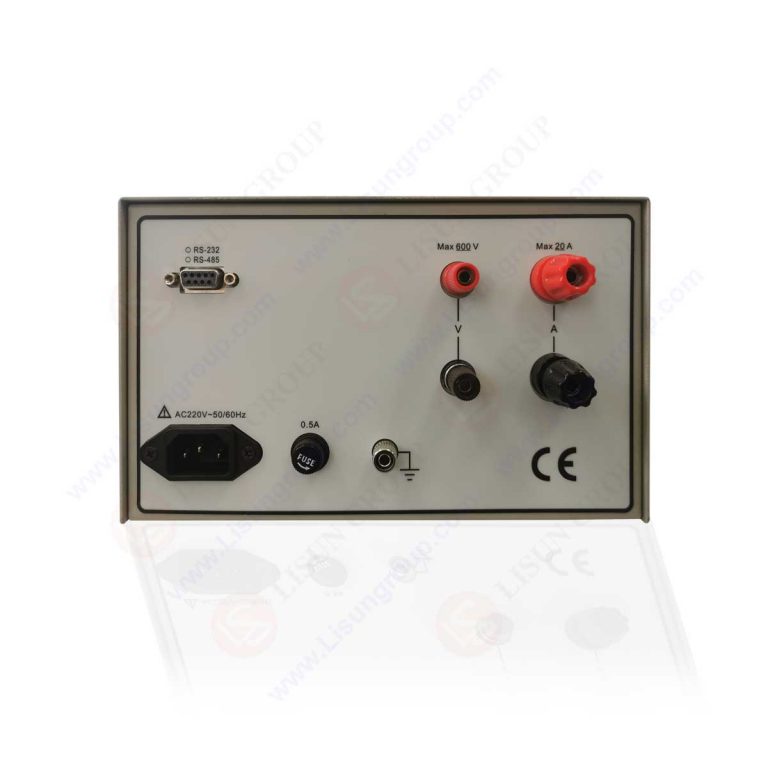
Digital power meters designed for EMC laboratories incorporate standard communication interfaces that enable seamless data integration with automated test systems. RS232 and RS485 ports provide reliable serial communication for transferring measurement data to host computers, PLCs, or data acquisition systems. The RS485 interface supports multi-drop configurations, allowing multiple meters to be networked for simultaneous monitoring of multiple test points. This connectivity is essential for EMC labs that require automated reporting of harmonic measurements in accordance with EN/IEC61000-3-2, where continuous monitoring and data logging are necessary to document compliance across the full test duration.
2. High-Accuracy AC/DC Measurement Capabilities
2.1 AC and DC Measurement Modes
The ability to measure both AC and DC parameters with high accuracy distinguishes these instruments from conventional power analyzers. In AC mode, the meter calculates true RMS values for voltage and current, accommodating waveforms with significant harmonic content. The DC measurement mode provides accurate readings for power electronics applications, including rectifiers, inverters, and switched-mode power supplies commonly found in LED drivers and automotive electronics. The transition between AC and DC modes is automatic or user-selectable depending on the measurement configuration. For EMC testing, the DC measurement capability is critical when evaluating conducted emissions from power converters, where DC bus ripple and switching noise contribute to the overall emission profile.
2.2 Wide Frequency Range Performance
The frequency range of 0.5Hz to 100kHz covers the fundamental frequency and harmonics required for comprehensive power quality analysis. At the lower frequency end, the meter can analyze power systems operating at 50Hz or 60Hz fundamentals, while the high-frequency capability captures harmonics up to the 200th order for a 50Hz system. This wide bandwidth is essential for EMC compliance testing where conducted emissions must be measured from 150kHz to 30MHz according to CISPR standards, and radiated emissions extend to higher frequencies. The phase accuracy across this frequency range is maintained through careful calibration of the current and voltage measurement channels, ensuring that power factor and displacement factor calculations remain accurate at higher harmonic orders.
2.3 High Overload Capacity and Measurement Accuracy
The overload capacity of 1600V instantaneous maximum voltage and 50A instantaneous maximum current provides a safety margin for transient events without compromising measurement integrity. During EMC testing, equipment under test may generate voltage spikes or current surges that exceed normal operating levels. The meter’s input protection circuitry prevents damage while capturing these events for analysis. Accuracy specifications vary by model, with the LS2050B offering standard accuracy suitable for manufacturing quality control, while the LS2050C provides enhanced accuracy for R&D and certification testing. The LS2050C-IEC model includes additional calibration for harmonic measurements to meet the stringent requirements of EN/IEC61000-3-2 compliance testing.
3. Harmonic Analysis for EMC Compliance
3.1 Total Harmonic Analysis Methods
Harmonic analysis in digital power meters employs either the IEC method or the CSA method, depending on the applicable standard. The IEC method, specified in EN/IEC61000-3-2, defines measurement bandwidth and grouping requirements for harmonic currents up to the 50th order. The meter performs a Fast Fourier Transform (FFT) on the sampled waveform data, extracting the magnitude and phase angle of each harmonic component. Total Harmonic Distortion (THD) is calculated as the ratio of the RMS value of all harmonic components to the fundamental component. The CSA (Canadian Standards Association) method may differ in grouping and smoothing criteria, requiring the meter to support multiple calculation algorithms for global compliance testing. For LED manufacturers exporting to European markets, the IEC method is mandatory for CE marking compliance.
3.2 Power Factor and Displacement Factor Analysis
Power factor measurement in the presence of harmonic distortion requires separation of the displacement factor (cos φ) from the distortion factor. The displacement factor represents the phase angle between the fundamental voltage and current waveforms, while the distortion factor accounts for the RMS contribution of harmonic components. Digital power meters calculate both parameters independently, providing engineers with a complete picture of power quality. For inductive loads common in automotive electronics, such as DC motors and solenoids, the displacement factor indicates the reactive power component. The distortion factor reveals the impact of non-linear loads from switched-mode power supplies. This combined analysis is essential for EMC pre-compliance testing, where power factor correction circuits may introduce harmonics that require mitigation.
| Parameter | LS2050B | LS2050C | LS2050C-IEC |
|---|---|---|---|
| Voltage Accuracy (AC) | ±0.2% reading + 0.1% range | ±0.1% reading + 0.05% range | ±0.1% reading + 0.05% range |
| Current Accuracy (AC) | ±0.3% reading + 0.1% range | ±0.15% reading + 0.05% range | ±0.15% reading + 0.05% range |
| Harmonic Analysis | Up to 40th order | Up to 50th order | Up to 50th order (IEC method) |
| Frequency Range | 0.5Hz – 50kHz | 0.5Hz – 100kHz | 0.5Hz – 100kHz |
| Communication Ports | RS232 | RS232, RS485 | RS232, RS485 |
| EMC Compliance | General measurements | R&D, pre-compliance | Full EN/IEC61000-3-2 |
| Overload Voltage | 1000V peak | 1600V peak | 1600V peak |
| Overload Current | 30A peak | 50A peak | 50A peak |
4. Compliance Standards and Certification
4.1 EN/IEC61000-3-2 Harmonic Current Emissions
The EN/IEC61000-3-2 standard specifies limits for harmonic current emissions from equipment with input current up to 16A per phase. Digital power meters configured for this standard must measure each harmonic order individually and compare the results against the applicable limits for Class A, B, C, or D equipment. The LS2050C-IEC model is specifically designed with the measurement bandwidth, grouping algorithm, and smoothing time constants required by this standard. For LED lighting products classified as Class C equipment, the harmonic limits are more stringent than for general Class A equipment. The meter must differentiate between equipment classes and apply the correct limits during the compliance assessment. Real-time indication of pass/fail status accelerates the testing process for EMC labs processing multiple product certifications daily.
4.2 LM-79 and IESNA Standards for Solid-State Lighting
LM-79, published by the Illuminating Engineering Society (IES), specifies the electrical and photometric measurement of solid-state lighting products. For LED luminaires and lamps, the standard requires measurement of total luminous flux, electrical power, and efficacy. The digital power meter provides the electrical measurement portion of LM-79 compliance, including AC/DC voltage, current, power, power factor, and harmonic distortion. The accuracy requirements for LM-79 testing demand precision better than ±0.5% for power measurements. The LS2050C model meets these requirements with its enhanced accuracy specifications. Integration with photometric measurement systems via RS232 communication allows simultaneous data collection during goniophotometer testing, streamlining the LM-79 certification process for LED manufacturers.
5. Applications in LED Manufacturing
5.1 Production Line Power Testing
In LED manufacturing environments, digital power meters serve as quality control instruments for verifying electrical parameters of each production batch. The automatic range switching feature enables rapid testing without manual adjustment, increasing throughput on automated test lines. Measurements of power factor and efficiency are critical for LED drivers, where regulatory requirements mandate minimum power factor levels for commercial lighting products. The harmonic analysis capability identifies drivers with excessive current distortion that may fail EN/IEC61000-3-2 compliance testing. Manufacturers use the LS2050B model for routine production testing, while R&D departments employ the LS2050C for design validation and pre-compliance assessment before submitting products to external testing laboratories.
5.2 R&D Validation and Power Quality Analysis
Research and development teams in LED manufacturing rely on the high-accuracy measurement capabilities of digital power meters for characterizing new driver designs. The wide frequency range captures switching frequency components from power factor correction circuits, enabling engineers to optimize the trade-off between power quality and efficiency. The displacement factor measurement reveals the effectiveness of active PFC circuits in maintaining near-unity power factor across varying load conditions. R&D testing often requires continuous data logging for thermal characterization, where power measurements must be stable over extended periods. The communication interfaces facilitate automated data acquisition, allowing engineers to correlate electrical parameters with thermal measurements from IR cameras and thermocouples.
6. Applications in Automotive Electronics
6.1 Power Electronics Validation
Automotive electronics present unique measurement challenges due to the combination of high-voltage DC systems, inverters, and switched-mode power supplies. The AC/DC measurement capability of digital power meters is essential for testing DC-DC converters, battery chargers, and motor controllers. In electric vehicle applications, power measurements must be accurate across a wide load range, from standby modes consuming milliwatts to full-load operation consuming kilowatts. The automatic range switching ensures accuracy across this dynamic range without manual intervention. Harmonic analysis is critical for evaluating the impact of power electronics on vehicle electrical systems, where conducted emissions must comply with CISPR 25 standards for automotive components.
6.2 Reliability and Endurance Testing
Long-duration reliability testing of automotive electronics requires stable measurement instruments that maintain accuracy over extended periods. Digital power meters with RS232 or RS485 communication can be integrated into automated test stands that run endurance tests lasting weeks or months. The meters provide continuous monitoring of power consumption, efficiency, and power factor, alerting engineers to any degradation in performance. The high overload capacity protects the meter during fault conditions that may occur during reliability testing, such as short circuits or load dumps. For automotive suppliers seeking IATF 16949 certification, the traceability of measurement data from certified instruments is mandatory for quality documentation.
7. Integration with EMC Test Systems
7.1 Automated Compliance Testing Workflows
EMC testing laboratories benefit from the data integration capabilities of digital power meters when implementing automated test sequences. The communication protocols allow the meter to be controlled by test management software that sequences through measurement points, captures harmonic data, and generates compliance reports. For EN/IEC61000-3-2 testing, the software configures the meter for the appropriate equipment class, sets measurement durations, and evaluates limits automatically. The RS485 multi-drop capability enables synchronization of multiple meters when testing three-phase equipment or monitoring multiple test points simultaneously. This automation reduces test time and eliminates manual data entry errors that could compromise certification results.
7.2 Data Logging and Reporting
Comprehensive data logging features in digital power meters support the documentation requirements of EMC compliance testing. The meters can log measurement values at user-defined intervals, capturing voltage, current, power, power factor, and individual harmonic components for the full test duration. This data is essential for demonstrating compliance with standards that require statistical analysis, such as EN/IEC61000-3-2 where measurements must be stable and reproducible. The reported data can be exported in common formats compatible with laboratory information management systems. For UL 1989 certification of uninterruptible power supplies, the power meter data provides the electrical performance documentation required for safety and performance evaluation.
8. Conclusion
Digital power meters designed for EMC laboratories combine high-accuracy AC/DC measurement, digital sampling waveform analysis, and comprehensive harmonic analysis capabilities that are essential for compliance testing and product validation. The LS2050B, LS2050C, and LS2050C-IEC models offer scalable accuracy levels and feature sets that serve different testing requirements, from production line quality control to full certification testing. The integration of RS232 and RS485 communication ports enables automated data collection and reporting, reducing test cycle times and eliminating manual documentation errors. For electrical testing engineers and quality control managers in LED manufacturing and automotive electronics industries, these instruments provide the measurement certainty needed to ensure compliance with EN/IEC61000-3-2, LM-79, IEC 61010, and UL 1989 standards. The combination of wide frequency range, automatic range switching, and high overload capacity makes them suitable for the demanding environments of EMC testing laboratories and R&D facilities. By adopting these precision instruments, testing laboratories can enhance their testing throughput while maintaining the confidence that their measurements meet the rigorous requirements of international compliance standards.
FAQ
Q1: How does a digital power meter achieve harmonic analysis for EN/IEC61000-3-2 compliance testing?
A: A digital power meter achieves harmonic analysis through high-speed digital sampling of voltage and current waveforms, followed by Fast Fourier Transform (FFT) processing to extract individual harmonic components. For EN/IEC61000-3-2 compliance testing, the meter must measure harmonics up to the 50th order using the IEC method, which specifies specific grouping and smoothing criteria. The LS2050C-IEC model incorporates these requirements directly, applying the correct measurement bandwidth of approximately 1.5 times the maximum harmonic frequency to prevent aliasing. The meter measures each harmonic order magnitude, compares it against the applicable limits for the equipment class (A, B, C, or D), and provides a pass/fail indication. For Class C LED lighting equipment, the limits are more stringent, particularly for the third, fifth, and seventh harmonics. The meter’s internal calibration ensures that harmonic measurements are traceable to national standards, supporting certification body audits.
Q2: What is the difference between power factor and displacement factor in ACM power measurements?
A: Power factor is the ratio of real power (watts) to apparent power (volt-amperes), representing the overall efficiency of power transfer in the presence of both reactive components and harmonic distortion. Displacement factor, also known as cos φ, represents only the phase angle between the fundamental voltage and current waveforms, excluding the effects of harmonics. In a purely sinusoidal system without harmonics, power factor equals displacement factor. However, in power electronics applications such as LED drivers and motor controllers, non-linear loads generate harmonic currents that increase the RMS current without contributing to useful power, reducing the power factor below the displacement factor. Digital power meters calculate both parameters independently, allowing engineers to separate the effects of phase displacement from harmonic distortion. For EMC pre-compliance testing, understanding both factors helps identify whether power factor correction, harmonic filtering, or both are needed to meet standards.
Q3: Which communication interface is preferred for integrating a digital power meter into an automated EMC test system?
A: RS485 is generally preferred for integrating a digital power meter into automated EMC test systems due to its multi-drop capability and longer cable length support compared to RS232. RS485 allows up to 32 devices to be connected on a single bus, enabling simultaneous monitoring of multiple test points or three-phase power measurements with a single communication interface. The differential signaling provides better noise immunity in the electrically noisy environment of an EMC laboratory, where high-frequency emissions and radiated fields are present. However, RS232 remains a reliable choice for single-meter applications and is commonly available on all models including the LS2050B. For the highest integration flexibility, the LS2050C and LS2050C-IEC models include both RS232 and RS485 ports, allowing connection to existing lab infrastructure while providing upgrade path to network-based systems. The communication protocols typically support Modbus RTU, enabling compatibility with a wide range of industrial automation software and data acquisition platforms.