









Abstract
The LISUN HSCD series dual-beam portable spectrophotometer represents a significant advancement in high-accuracy color measurement technology for quality control and R&D applications. Engineered with a dual-beam optical design and grating spectroscopy, the HSCD series (including models HSCD-780, HSCD-800, and HSCD-860) delivers exceptional inter-instrument agreement and repeatability, ensuring reliable color data across production batches and supply chains. This article examines the core optical architecture, calibration methodologies involving zirconium whiteboards, and compliance with international standards such as CIE No.15, ISO 7724-1, and ASTM E1164. The dual-beam portable spectrophotometer ensures precise color evaluation across plastics, coatings, textiles, and automotive interiors, empowering professionals with actionable spectral data for rigorous quality assurance.
1.1 Dual-Beam Design Principles
The LISUN HSCD series employs a dual-beam optical configuration, a design traditionally reserved for high-end benchtop instruments. In a dual-beam portable spectrophotometer, light from the pulsed xenon lamp is split into a sample beam and a reference beam. The sample beam illuminates the test surface, while the reference beam monitors the light source’s intensity in real-time. This simultaneous measurement compensates for any temporal fluctuations in lamp output, directly enhancing photometric accuracy. The system achieves a photometric range of 0 to 200% with a resolution of 0.01%, ensuring that even subtle color differences are detected with certainty.
1.2 Grating Spectroscopy and Wavelength Precision
At the core of the HSCD series is a high-resolution grating spectroscopy module. Unlike filter-based colorimeters, a grating spectrophotometer disperses light across a spectral array, capturing detailed reflectance data across the visible spectrum (400-700nm). The HSCD-860 model features a wavelength interval of 10nm, while the HSCD-800 and HSCD-780 offer 10nm steps as well, with a half-bandwidth of 10nm. This optical configuration ensures compliance with the geometric requirements of CIE No.15 and ISO 7724-1, providing spectral data sufficient for calculating colorimetric values under multiple illuminants and observer angles.
1.3 Nano-Integrated Optical Devices
The HSCD series integrates nano-level precision optical components, including a concave holographic grating and a silicon photodiode array (SPD). This integration minimizes stray light and enhances signal-to-noise ratio. The stray light level is kept below 0.1%, which is critical for measuring dark or highly saturated colors accurately. The combination of these components allows the dual-beam portable spectrophotometer to maintain a measurement repeatability of within ΔE*ab ≤ 0.03, a specification that underscores its suitability for stringent laboratory environments.
2.1 Zirconium Calibration Whiteboard Technology
A cornerstone of the HSCD series’ accuracy is its use of a zirconium calibration whiteboard. Zirconium dioxide (ZrO2) ceramics exhibit high, stable reflectance across the visible spectrum with excellent resistance to UV degradation and physical wear. Unlike traditional barium sulfate or PTFE white standards, the zirconium whiteboard maintains its calibrated reflectance values over extended periods, reducing the need for frequent recalibration. This ensures that the dual-beam portable spectrophotometer generates consistent baseline data, directly contributing to long-term inter-instrument agreement (typically within ΔE*ab < 0.2).
2.2 Compliance with Key Measurement Standards
The HSCD series aligns with regulatory and industry frameworks essential for international trade and quality assurance:
- CIE No.15 (Colorimetry): Mandates standard illuminants (D65, A, F2) and observer functions (2°/10°) which the HSCD-860 supports fully.
- ISO 7724-1 (Paints and Varnishes – Color Measurement): Requires specific geometric conditions (d/8° integrating sphere). The HSCD series operates with a d/8° geometry, compliant with both ISO 7724-1 and ASTM E1164.
- GB/T 3978 (Standard Illuminants and Observers): Ensures alignment with Chinese national standards for colorimetry, crucial for manufacturers in the region.
- ASTM E313 / D1925 (Yellowness Index): These indices are calculated directly within the instrument software, allowing for immediate pass/fail decisions in plastic and polymer processing.
3.1 The Science Behind SCI/SCE Switching
A critical feature of the HSCD series is the ability to measure color in both Specular Component Included (SCI) and Specular Component Excluded (SCE) modes. The integrating sphere (d/8° geometry) is equipped with a mechanically controlled gloss trap.
- SCI Mode: Measures total color, including the specular reflection. This mode correlates well with visual assessment of color appearance and is insensitive to surface texture.
- SCE Mode: Excludes the specular component, focusing only on diffuse reflectance. This is vital for evaluating color consistency on textured or matte surfaces where gloss variations confound the measurement.
3.2 Practical Application in Quality Control
For a quality control manager inspecting injection-molded plastic parts, the dual-beam portable spectrophotometer allows toggling between SCI and SCE without additional hardware. If a batch shows a color shift in SCE mode but not in SCI, the issue is likely a surface finish anomaly, not a pigment dispersion error. This diagnostic capability saves significant troubleshooting time on the production floor. The HSCD-780 model offers fully automatic SCI/SCE switching, enabling high-throughput testing protocols.
4.1 Comparative Analysis of HSCD Series Models
The HSCD series comprises three primary models engineered for different application depths and budget constraints. The table below provides a detailed comparison:
| Feature/Model | HSCD-780 | HSCD-800 | HSCD-860 |
|---|---|---|---|
| Optical Geometry | d/8°, Dual-Beam | d/8°, Dual-Beam | d/8°, Dual-Beam |
| Light Source | Pulsed Xenon (Xe) | Pulsed Xenon (Xe) | Pulsed Xenon (Xe) |
| Measurement Aperture | 8mm (SAV) / 4mm (MAV) | 8mm (SAV) / 4mm (MAV) | 8mm (SAV) / 4mm (MAV) / 1x3mm (USAV) |
| Wavelength Range | 400-700nm | 400-700nm | 400-700nm |
| Wavelength Interval | 10nm | 10nm | 10nm |
| Photometric Range | 0-200% | 0-200% | 0-200% |
| Repeatability (White Board) | ΔE*ab ≤ 0.05 | ΔE*ab ≤ 0.04 | ΔE*ab ≤ 0.03 |
| Inter-Instrument Agreement | ΔE*ab ≤ 0.25 | ΔE*ab ≤ 0.20 | ΔE*ab ≤ 0.15 |
| SCI/SCE Switching | Manual | Automatic | Automatic |
| Connectivity | USB, RS-232 | USB, RS-232, Bluetooth | USB, RS-232, Bluetooth, Wi-Fi |
| Measurement Time | 1.5 seconds | 1.2 seconds | 1.0 seconds |
4.2 Selecting the Right Model for Your Lab
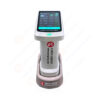
For a third-party testing laboratory processing high volumes of diverse samples, the HSCD-860 presents the most compelling case. Its increased aperture options (including a 1x3mm ultra-small aperture for measuring thin stripes or printed dots) and superior inter-instrument agreement (ΔE*ab ≤ 0.15) make it ideal for multi-site manufacturing networks. The HSCD-800 offers automatic SCI/SCE and Bluetooth connectivity, suitable for dynamic production environments where portability and data logging are key. The HSCD-780 remains a robust entry-level dual-beam portable spectrophotometer, providing high accuracy at a more accessible price point for smaller workshops.
5.1 Index Calculation and Metamerism Evaluation
The HSCD series is not just a hardware solution; its integrated software suite calculates a comprehensive range of color indices essential for modern QC. Besides standard CIE Lab, LCh, and ΔE*ab, the instrument computes Whiteness Index (WI) per ISO 2470, Yellowness Index (YI) per ASTM E313 and D1925, and Metamerism Index (MI). The Metamerism Index is particularly valuable for textile manufacturers comparing dyed fabrics under D65 and A illuminants. The software allows users to set tolerances for each index, triggering instant PASS/FAIL alerts.
5.2 Data Management and Connectivity
Portability in the HSCD series is matched by connectivity. All models feature USB and RS-232 ports for direct PC connection. The HSCD-860’s Wi-Fi capabilities allow seamless integration into a factory’s IIoT network, enabling real-time statistical process control (SPC). For instance, in automotive interior manufacturing, color data from a dual-beam portable spectrophotometer can be streamed directly to a central database to monitor the color consistency of leather or dashboard plastics across different supplier batches, ensuring compliance with stringent OEM specifications.
6.1 Coatings and Paints
In paint manufacturing, the opacity and hiding power of coatings are critical. The HSCD series measures reflectance over a black and white substrate to calculate contrast ratio. Its dual-beam design ensures accurate readings on wet or dry films, allowing formulators to adjust pigment concentration efficiently. Compliance with GB/T 3978 ensures the instruments align with standard illuminants used in the local auto OEM industry.
6.2 Plastics and Polymers
Plastics often contain UV stabilizers and flame retardants that can cause yellowing over time. The HSCD-860, with its superior repeatability (ΔE*ab ≤ 0.03), provides the precision needed to track YI changes during accelerated aging tests. The ability to measure small color chips (with the 4mm MAV or 1x3mm USAV aperture) means that material verification can occur on small molded parts without destructive sampling.
6.3 Printing and Packaging
For the printing industry, matching spot colors (e.g., Pantone) is essential for brand consistency. The grating spectroscopy technology allows for exact spectral matching, not just colorimetric approximation. This reduces wasted substrate and ink. The dual-beam portable spectrophotometer verifies color density and dot gain on various paper stocks, ensuring the final product meets the brand owner’s strict visual requirements.
7.1 Ergonomic Design and Ease of Use
The HSCD series is ergonomically designed with a lightweight housing and a high-resolution capacitive touch screen. The intuitive UI allows operators to switch between color spaces, illuminants, and indices with minimal training. The instrument features a lithium-ion battery offering a continuous operating time of over 8 hours, suitable for round-the-clock factory shifts.
7.2 Environmental Resilience
Built to withstand harsh factory environments, the instrument operates effectively in ambient temperatures from 0°C to 40°C and humidity levels up to 85% (non-condensing). The optical bench is sealed against dust ingress, a critical factor for paper mills or textile spinning plants where airborne particulates are prevalent. This robustness guarantees that the high-accuracy color measurement capability remains stable, regardless of the production floor environment.
The LISUN HSCD series of dual-beam portable spectrophotometers offers a synthesis of benchtop-grade accuracy and field-portable convenience. Through its grating spectroscopy, dual-beam optical design, and zirconium calibration whiteboard, the HSCD-780, HSCD-800, and HSCD-860 provide quantifiable improvements in measurement repeatability and inter-instrument agreement. By supporting SCI/SCE modes and complying with international standards like CIE No.15, ASTM E1164, ISO 7724-1, and GB/T 18833, these instruments deliver trustworthy spectral data that is critical for controlling the quality of paints, plastics, textiles, and automotive interiors. For any professional seeking a reliable method for high-accuracy color measurement, the HSCD series represents a technologically superior solution that bridges the gap between laboratory precision and industrial practicality. The integration of advanced connectivity ensures that data flows seamlessly into modern digital quality ecosystems, driving efficiency and reducing waste.
Q1: How does the dual-beam design in the LISUN HSCD-860 improve measurement accuracy compared to single-beam spectrophotometers?
A: In a single-beam spectrophotometer, the light source intensity can fluctuate due to temperature changes or aging of the xenon lamp, leading to measurement drift. The dual-beam portable spectrophotometer measures a reference beam and a sample beam simultaneously. The HSCD-860 continuously monitors the lamp output via the reference channel, electronically compensating for any variation within nanoseconds. This ensures that the photometric accuracy remains stable even when the lamp is warming up or nearing the end of its life cycle. Consequently, the repeatability is maintained at ΔE*ab ≤ 0.03, a specification that is critical for long-term color consistency in multi-site manufacturing, far exceeding the capabilities of standard single-beam portable devices.
Q2: What is the practical advantage of having both SCI and SCE modes in a portable spectrophotometer?
A: SCI (Specular Component Included) measurement captures the total reflected light, including the gloss. This mode provides data that mimics the human eye’s perception of color density and is recommended for pigment formulation and color matching. SCE (Specular Component Excluded) measurement excludes gloss, capturing only the diffuse color. This is crucial for quality control on textured surfaces like anodized aluminum or matte plastic. With the HSCD-800 and HSCD-860, you can switch between modes automatically. This feature is invaluable for troubleshooting: if a product fails in SCE but passes in SCI, it indicates a surface finish issue, not a colorant problem, allowing you to direct your resources to the correct process.
Q3: How does the zirconium calibration whiteboard enhance the long-term reliability of the HSCD series?
A: Conventional white standards, such as pressed PTFE, are porous and can absorb contaminants, oils, or moisture, causing their reflectance values to drift over time. The zirconium whiteboard used in the HSCD series is a dense ceramic with a closed surface structure. It is non-absorbent, highly resistant to solvents and UV radiation, and mechanically robust. This stability ensures that the baseline calibration remains valid for a significantly longer period. For a testing laboratory, this translates to less frequent calibration cycles, lower cost of ownership for reference standards, and higher confidence in the absolute reflectance values produced by the dual-beam portable spectrophotometer, leading to reliable yellowness and whiteness index calculations.
Q4: Can the HSCD-780 handle measurements on transparent or translucent materials?
A: Yes, the HSCD-780 is capable of measuring transparent, translucent, and opaque materials. The integrating sphere geometry (d/8°) is designed to capture both reflected and transmitted light paths, though reflectance is the primary mode. For transparent films, users can place the sample over a standard white background or a black trap to measure haze and transmittance via software calculations. The 8mm SAV and 4mm MAV apertures allow for adaptability to different sample sizes. However, for optimal measurements on high-clarity films, using the SCE mode is recommended to eliminate the dominant specular reflection, thereby providing accurate color data for the material’s intrinsic tint.