









Here is a comprehensive technical article generated according to your specifications.
Abstract
Accurate safety verification of electrical accessories, such as switches and sockets, demands precise simulation of real-world loads, specifically externally ballasted fluorescent lamps. The LISUN DFX series Externally Ballasted Fluorescent Lamp Test Load Cabinet provides a dedicated solution for this critical testing requirement. Designed to meet stringent IEC and GB standards, the DFX series enables manufacturers and testing laboratories to simulate resistive, inductive, and capacitive loads with high resolution. This article details the series’ technical capabilities, compliance alignment, and integration into an end-to-end testing workflow, offering a data-driven analysis of its value for quality control engineers seeking reliable and repeatable test results.
1.1 The Necessity of Specific Load Simulation
Electrical accessories like dimmers and switches are required to withstand specific types of loads, not just simple resistive ones. An externally ballasted fluorescent lamp presents a complex, nonlinear load profile involving a high inrush current and a specific operational power factor (PF). Standard resistive test loads cannot replicate this, leading to potential overestimation of a product’s endurance. The LISUN DFX series directly addresses this gap by providing dedicated load cabinets that emulate these specific electrical characteristics for compliance testing.
1.2 Core Components and Operational Principle
The DFX series cabinet integrates a combination of high-precision resistor, inductor, and capacitor banks. By switching these components in defined configurations, the unit can simulate the impedance and phase angle of a real ballasted lamp. The core operational principle is based on creating a controlled, adjustable reactive circuit that matches the specified test current and power factor required by standards, ensuring the device under test (DUT) experiences electrical stress equivalent to a real-world installation.
2.1 Comparative Analysis of DFX Models
The series offers a range of models tailored to different testing volumes and current requirements. Selection depends on the maximum test current and the number of simultaneous test channels required. The following table provides a direct comparison of core specifications:
| Model | Max Current Output (A) | Power (VA) | Channel Count | Input Voltage | Key Application |
|---|---|---|---|---|---|
| DFX-20 | 20 | 4400 | 1 | 220VAC | Single-point life testing |
| DFX-20-3CH | 20 per Channel | 13,200 | 3 | 220VAC | Multi-sample parallel testing |
| DFX-40 | 40 | 8800 | 1 | 220VAC | High-current component testing |
| DFX-60 | 60 | 13,200 | 1 | 380VAC | Industrial switchgear testing |
| DFX-80 | 80 | 17,600 | 1 | 380VAC | High-power accessory endurance |
This range allows a lab to start with a single-channel unit for R&D qualification and scale to a multi-channel system for production line verification.
2.2 Technical Specification Details
Beyond current, precise power factor (PF) adjustment is critical for accurate testing. The DFX series offers a PF adjustment range from 0.3 (highly inductive) to 0.9 (resistive-dominant), with a resolution of 0.01. Measurement accuracy for both voltage and current is within ±0.5% of reading + 0.1% of range. The load capacitance values are stepped, typically from 20 µF to 100 µF, selectable via relay switching to simulate different ballast types and cable lengths.
3.1 Alignment with IEC and GB Clauses
The DFX series is engineered to meet the specific load definitions in pivotal safety standards. For example, to test a switch for fluorescent lamp loads, the test setup must comply with IEC 60669-1 Clause 19.2, which specifies the use of a resistive and inductive load to create a circuit with a specific PF and inrush current. The DFX series provides the exact impedance required to meet these test conditions.
3.2 Verification for Socket-Outlets and Plugs
For testing plugs and socket-outlets, IEC 60884-1 Clause 20 defines the conditions for normal and abnormal operation tests. The DFX series can be programmed to cycle through loads that simulate a resistive-inductive circuit often required for motor or lamp loads. Furthermore, IEC 60947-1 Clause 8.3.3.3 for low-voltage switchgear and GB 16915.1 (Chinese equivalent of IEC 60669) are directly addressed by the cabinet’s ability to maintain stable current and voltage during prolonged endurance tests.
4.1 Power Factor and Inrush Current Accuracy
The quality of a load cabinet is defined by its ability to maintain a stable power factor across the entire test cycle. The DFX series uses high-grade, low-inductance resistors to minimize parasitic reactance. The inductive load is built with a low DC resistance (DCR) air-core reactor to ensure consistent performance. This design ensures that the electrical accessory load tester maintains the power factor within ±0.02 of the set value, a crucial requirement for repeatable Pass/Fail decisions.
4.2 User Interface and Programmability
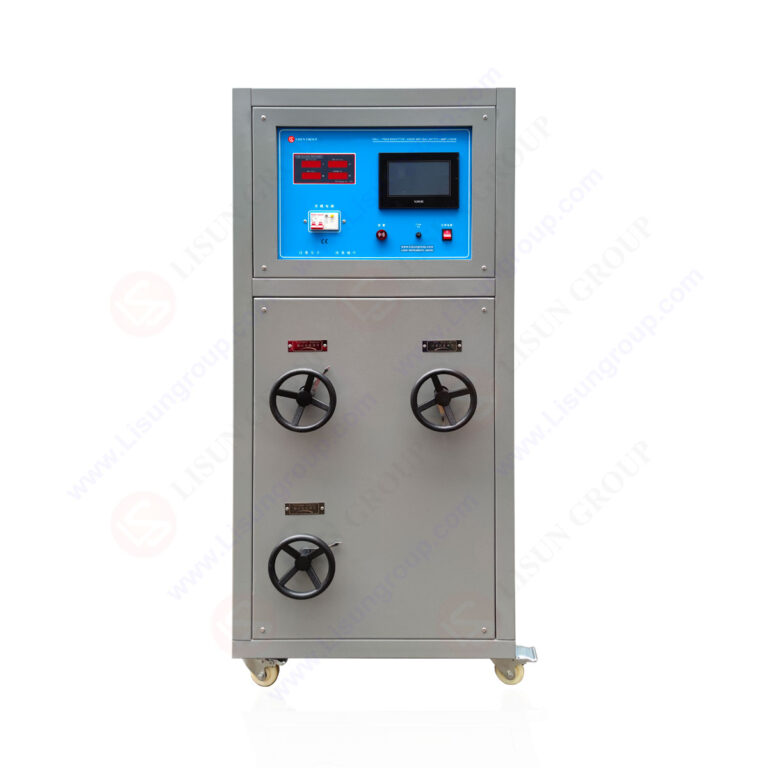
The front panel features a high-definition touch screen for manual parameter entry, including cycle count, ON/OFF time (ranging from 1 to 999 seconds), and load type selection. For automated testing, the DFX-20-3CH and higher models include an RS-232 or RS-485 interface, allowing integration with a PLC or PC for automated life test sequences. This programmability is essential for running long-duration tests (e.g., 10,000 cycles) without operator intervention.
5.1 Synergy with the LISUN CZKS Life Testers
A complete solution for switch testing involves integrating the load cabinet with a mechanical actuator. The LISUN CZKS series life testers provide the mechanical motion (e.g., pushing a button or toggling a switch) while the DFX cabinet provides the electrical load. This integration allows for simultaneous execution of a mechanical endurance test under electrical stress, as required by IEC 60669-1 Clause 19.2. The synchronization is achieved via a common trigger signal from the CZKS controller.
5.2 Combining with SW-6 Bending Testers for Comprehensive Compliance
For cord-connected accessories, the mechanical strength of the connection point is tested alongside electrical load. The LISUN SW-6 bending tester applies a specific number of flexing cycles to a cable. In a comprehensive compliance workflow, an accessory could first be tested for electrical endurance on a DFX + CZKS system, and then the same accessory’s cord anchor could be tested on the SW-6 system while still under load, providing a holistic view of product durability.
6.1 Production Line Verification vs. Type Testing
In a production environment, the DFX series can be used for 100% go/no-go testing of critical safety components. For example, a QC engineer can set the DFX-20-3CH to apply a 16A inductive load to three dimmers simultaneously. A significant deviation in the measured current or voltage drop across the DUT indicates a fault, allowing immediate rejection. This is faster and more accurate than using individual lamp ballasts and dimmers.
6.2 Troubleshooting and Failure Analysis
When a sample fails a test, the DFX series provides valuable diagnostic data. By measuring the load voltage and current during the fault, an engineer can determine if the failure was due to contact welding (caused by inrush current at PF 0.6) or due to over-temperature (caused by prolonged resistive load at PF 0.9). This granular data helps in redesigning products for better arcing or heat dissipation performance.
7.1 Stability Under Prolonged Operation
Standard variable transformers (variacs) are not designed for long-term, high-current inductive loads. The DFX series uses discrete tapped inductors and resistors, which are more robust and thermally stable. This design prevents the load profile from drifting as the cabinet heats up during a 1,000-hour life test, ensuring the test remains within the standard’s tolerance limits for the entire duration.
7.2 Safety and Protection Features
The cabinet is equipped with over-current protection, over-temperature shutdown, and an emergency stop button. Each channel has an independent circuit breaker. This is critical because a short circuit in the DUT could damage a less sophisticated load unit. The DFX’s protection circuitry isolates the power source immediately upon detecting a fault, protecting both the expensive load cabinet and the test operator.
The LISUN DFX series Externally Ballasted Fluorescent Lamp Test Load Cabinet is a fundamental tool for any organization involved in the safety verification of electrical accessories. Its precise power factor adjustment, compliance with key IEC and GB clauses, and robust integration capabilities with complementary test equipment (such as the CZKS life testers and SW-6 bending testers) make it a versatile and reliable solution. The series offers a clear path from single-channel R&D testing to multi-channel production line verification, with technical specifications that meet the most demanding test protocols. For quality control engineers, the data accuracy and repeatability of the DFX series directly translate into reduced product risk and higher confidence in safety certifications.
Q1: How do I select the right DFX model for testing single-pole and double-pole switches?
A: The number of poles determines the number of load channels required. A single-pole switch can be tested on any single-channel model (DFX-20, DFX-40, DFX-60, DFX-80). However, for a double-pole switch, you must either test one pole sequentially, or use the DFX-20-3CH model which provides three independent, simultaneous load channels. For example, testing a 10A double-pole switch for 10,000 cycles under load is done efficiently by connecting each pole to a dedicated channel on the DFX-20-3CH, ensuring both contacts are stressed simultaneously as per IEC 60669-1.
Q2: Can the DFX series simulate capacitive loads for electronic ballasts?
A: Yes, specifically the inductive and capacitive load banks are designed to emulate the complex impedance of electronic ballasts. For fluorescent lamps with external electronic ballasts, the load is often more capacitive or has a leading power factor. The DFX series allows you to select a capacitive load bank (typically in the range of 20-100 µF) in parallel or series with the resistive bank. This simulates the input filter of an electronic ballast, which is critical for testing dimmers designed for LED or CFL loads, as per the guidance in IEC 60669-2-1.
Q3: What is the maximum ambient temperature the DFX cabinet can operate in during a long-duration life test?
A: The LISUN DFX series is designed for an operating ambient temperature range of 5°C to 40°C. However, for sustained life tests exceeding 100 hours at maximum rated current (e.g., running the DFX-40 at 40A for a week), it is recommended to keep the ambient temperature below 30°C and ensure adequate airflow around the cabinet’s ventilation grilles. The internal over-temperature protection is set to trip at 65°C to prevent damage to the internal load resistors and inductors.
Q4: How do I calibrate the power factor setting on the DFX-20-3CH to maintain accuracy?
A: Calibration is performed using an external high-precision power analyzer (e.g., a Yokogawa WT series). Connect the analyzer between the DFX output and the DUT. Set the DFX to a specific current and PF (e.g., 10A at PF 0.6). Then, using the internal control system’s calibration menu, you can adjust the tap selection of the inductor or resistor banks until the power analyzer reads the exact target values. LISUN recommends performing this calibration annually or after any major service to ensure the ±0.5% measurement accuracy is maintained.