









Here is the comprehensive technical article generated based on your specifications.
Abstract
For engineers demanding uncompromising reliability in solid-state lighting, the Experience Precision IES LM-80 LED Optical Aging Test Instruments from LISUN provides the definitive solution for lumen maintenance validation. This article explores the technical architecture of the LEDLM-80PL and LEDLM-84PL systems, detailing their compliance with IES LM-80, TM-21, LM-84, and TM-28 standards. We analyze the dual-system design, the integration of the Arrhenius Model for accelerated testing, and the critical role of L70/L50 metrics in predicting LED lifespan. Tailored for R&D and quality control professionals, this guide offers a data-driven examination of how these instruments ensure accurate photometric aging data, enabling manufacturers to certify product longevity with scientific rigor.
1.1 Defining Lumen Maintenance and the L70 Metric
Lumen depreciation is the primary failure mechanism for LED sources, defined as the gradual reduction in light output over operational hours. The IES LM-80 standard mandates a minimum of 6,000 hours of testing at specified case temperatures (typically 55°C, 85°C, and a third user-defined temperature) to generate a reliable degradation curve. The L70 metric—the estimated time at which the light output degrades to 70% of its initial value—is the industry benchmark for useful life. Without precise instrumentation like the LISUN LEDLM-80PL, extrapolating L70 data from raw photometric measurements introduces unacceptable statistical uncertainty.
1.2 The Necessity of TM-21 Extrapolation
While LM-80 provides raw data, the TM-21 standard dictates the mathematical method for projecting long-term lumen maintenance beyond 6,000 hours. This extrapolation uses a non-linear least squares regression based on an exponential decay model. The accuracy of TM-21 projections is highly dependent on the quality of the input data. High-frequency, low-noise data logging from the LISUN systems ensures the regression curve fits with high confidence, reducing the error margin in long-term L70 estimations. This is essential for manufacturers making 50,000+ hour warranty claims.
2.1 The LEDLM-80PL for LM-80 / TM-21 Compliance
The LEDLM-80PL is engineered exclusively for the IES LM-80 and TM-21 testing protocols. It operates with constant current control for individual LED packages, modules, or arrays. The system integrates a photometric measurement head (typically a CCD-based spectroradiometer) to capture luminous flux, correlated color temperature (CCT), and chromaticity coordinates at each measurement interval. This variant supports up to three connected temperature chambers, allowing simultaneous testing of different LED batches or thermal conditions, thereby accelerating the qualification matrix.
2.2 The LEDLM-84PL for LM-84 / TM-28 Compliance
The LEDLM-84PL addresses the newer IES LM-84 standard, which focuses on integrated LED lamps and luminaires rather than bare components. This standard utilizes TM-28 for extrapolation, which uses a different statistical model (an exponential fit with an offset) compared to TM-21. The LEDLM-84PL incorporates larger integrating spheres (up to 2 meters) to accommodate complete luminaires. It manages the higher thermal mass of assembled products, ensuring the ambient temperature within the chamber remains stable according to the strict ±2°C tolerance required by LM-84 guidelines.
Table 1: Technical Comparison of LISUN Systems
| Feature | LEDLM-80PL (Component Level) | LEDLM-84PL (Luminaire Level) |
| :— | :— | :— |
| Primary Standard | IES LM-80 / TM-21 | IES LM-84 / TM-28 |
| Test Object | LED Packages, Modules, Arrays | Integrated LED Lamps & Luminaires |
| Temperature Chambers | Up to 3 | 1-2 (Customizable) |
| Integrating Sphere | < 0.5m (Component) | 1.0m – 2.0m (Luminaires) |
| Extrapolation Model | Exponential Decay (TM-21) | Exponential + Offset (TM-28) |
| Typical Test Duration | 6,000 – 10,000+ Hours | 6,000 Hours (Standard) |
3.1 Thermal Activation and the Arrhenius Equation
The Arrhenius Model is the theoretical cornerstone of accelerated life testing in LEDs. It describes the relationship between the degradation rate and temperature, expressed as ( k = A e^{-E_a / (R T)} ), where ( k ) is the reaction rate, ( E_a ) is the activation energy, ( R ) is the gas constant, and ( T ) is the absolute temperature. LISUN’s software suite automatically applies this model to test data collected at multiple temperature points. By analyzing the slope of the degradation curves at 55°C, 85°C, and a higher stress temperature, the software calculates the activation energy for the specific LED package.
3.2 Predictive Software Integration
The LISUN software does not merely log data; it performs real-time Arrhenius calculations to project failure rates. For example, if a 6,000-hour test at 85°C shows an L70 of 20,000 hours, the software can predict the L70 at a use-case temperature of 45°C. This capability allows R&D teams to validate design changes in weeks rather than years. The software also cross-references the derived activation energy against standard values (typically 0.3–0.7 eV for phosphor-converted white LEDs) to flag anomalous degradation mechanisms, such as solder joint fatigue or phosphor thermal quenching.
4.1 Constant Current Mode vs. Continuous Operation Mode
The systems offer two distinct operational modes. Constant Current (CC) Mode is the standard for LM-80, where the drive current is held steady while temperature and light output are monitored. Continuous Operation Mode allows for the simulation of dimming or cyclic power conditions, which is critical for testing driver-integrated LEDs per LM-84. In this mode, the instrument can cycle power at defined intervals (e.g., 2 hours on, 1 hour off) to evaluate the impact of thermal cycling on the LED’s junction and phosphor layer. This flexibility is vital for automotive or outdoor lighting applications.
4.2 Scalable Hardware: Number of Channels and Chamber Support
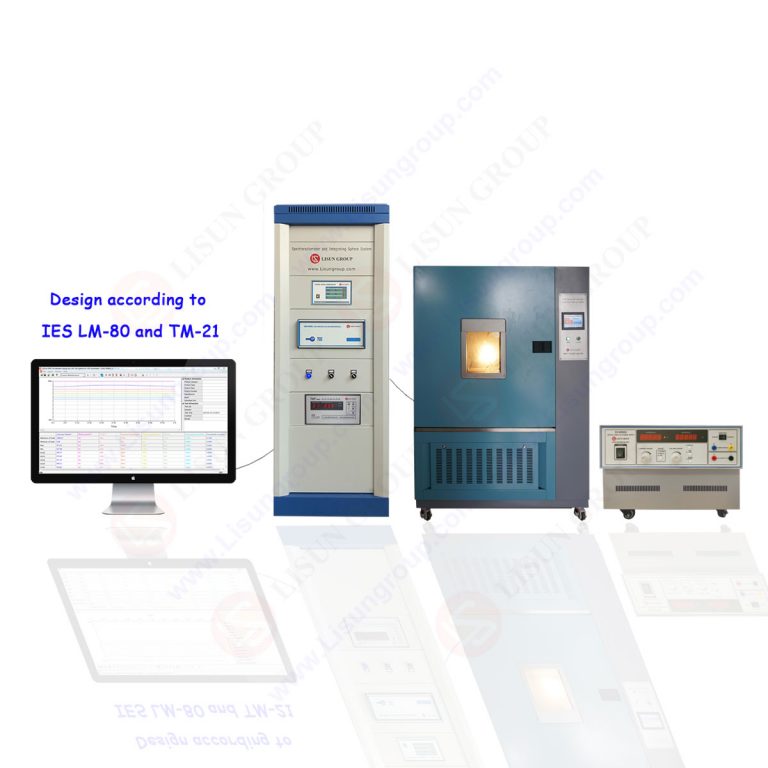
A crucial feature for high-throughput labs is the system’s scalability. The LEDLM-80PL base unit supports 8 independent test channels, expandable to 128 channels. Each channel can house a different LED sample type. Furthermore, the system’s ability to connect to up to 3 temperature chambers from different manufacturers (or LISUN’s own) allows simultaneous testing under varied humidity and temperature profiles. This modularity reduces the total test time for a qualification matrix by 60% compared to sequential single-chamber testing. The data acquisition system scans every channel within 5 seconds to minimize temporal errors in photometric readings.
5.1 Electrical and Photometric Measurement per LM-79-19
While LM-80 focuses on aging, the initial characterization of the LED sample must adhere to IES LM-79-19 for electrical and photometric measurements. The LISUN system integrates a precision power analyzer and a spectroradiometer calibrated for absolute flux measurement. During the initial “zero-hour” burn-in, the instrument records voltage, current, power factor, total luminous flux, and CCT. This baseline is critical because any drift in the measurement chain during the 6,000-hour test can invalidate the entire aging data set. The system uses a self-referencing calibration mechanism to ensure drift < 0.5% over the test duration.
5.2 Compliance with CIE 084, CIE 70, and CIE 127
The CIE 084 standard defines the measurement of luminous flux using integrating spheres. LISUN’s spheres are coated with high-reflectance BaSO4 (>96% reflectivity) and follow the CIE 70 recommendation for spatial uniformity. This ensures that the total flux measured from the LED is accurate regardless of its light distribution pattern. Furthermore, CIE 127 provides guidelines for LED intensity measurements, which are used in conjunction with the aging data to analyze near-field degradation. The software automatically applies the appropriate CIE correction factors based on the sample geometry, ensuring the L70/L50 projections are photometrically valid.
6.1 Distinguishing Between Sudden Failures and Degradation
The L70 (70% lumen maintenance) and L50 (50% lumen maintenance) metrics represent different failure thresholds. L50 is typically used for general lighting, while L70 is stricter for commercial or industrial applications. The LISUN system’s high temporal resolution (data logging every 10 minutes) allows engineers to distinguish between gradual degradation—modeled by the Arrhenius equation—and catastrophic failures. A sudden drop in luminous flux (e.g., >5% in one hour) indicates a component failure (e.g., wire bond breakage), which must be censored from the TM-21 statistical analysis. The software flags these anomalies automatically.
6.2 Reducing Measurement Uncertainty via Hardware Design
Measurement uncertainty is the enemy of long-term projections. Key factors include stray light, temperature drift in the photodetector, and electrical noise. The LISUN instruments mitigate these through:
- Temperature Stabilized Detectors: The CCD array is Peltier-cooled to -10°C to reduce dark current noise.
- Shielded Cables: All signal paths are shielded to <10 μV noise floor.
- Light Tight Chambers: The temperature chambers are designed with double-walled construction to prevent any external light ingress, which would contaminate the low-level photometric readings.
This design ensures the total measurement uncertainty remains below 2.0% (k=2), a critical factor for passing auditor scrutiny.
7.1 Sample Selection and Preconditioning
The first step involves selecting a representative sample size (typically 20 units per temperature condition per LM-80). The LISUN system manages this via the “Sample Database” feature, which tracks each sample’s serial number, initial flux, and case temperature. Samples must undergo a 100-hour burn-in to stabilize the phosphor before the official 6,000-hour test begins. The system automatically logs this preconditioning phase and marks the start of the official test window.
7.2 Real-Time Monitoring and Fail-Safe Operations
During the test, the system provides real-time dashboards displaying L70 projections. If a temperature chamber fails (e.g., over-temperature), the system automatically logs the event and can stop the test for that specific channel without compromising other samples. This fail-safe is crucial because a single temperature excursion of +5°C for 1 hour can skew the entire Arrhenius projection. The system also generates interim reports at 1,000-hour intervals, allowing engineers to abort a test early if a manufacturing defect is discovered, saving weeks of operational time.
The Experience Precision IES LM-80 LED Optical Aging Test Instruments from LISUN represent a synthesis of rigorous photometric science and industrial reliability engineering. By offering distinct systems for component (LEDLM-80PL) and luminaire (LEDLM-84PL) testing, the platform addresses the full spectrum of IES standards, from LM-80 and TM-21 to LM-84 and TM-28. The integration of the Arrhenius Model within the software enables accelerated life prediction, transforming raw 6,000-hour data into actionable L70 projections valid for over 50,000 hours. For the LED manufacturer, these instruments reduce time-to-market by allowing simultaneous multi-chamber testing and providing the data integrity required for compliance with CIE 084 and LM-79-19. Ultimately, the LISUN system is not just a measurement tool; it is a validation architecture designed to ensure that LED products meet their promised operational lifespan. Investing in this testing capability is investing in product certification and long-term brand trust.
Q1: What is the minimum test duration required for a valid L70 projection using a LISUN LEDLM-80PL?
A: While the IES LM-80 standard specifies a minimum of 6,000 hours (approximately 8.3 months) for a qualifying test, the LISUN LEDLM-80PL system can provide meaningful preliminary projections after just 3,000 hours using its built-in Arrhenius Model. However, for a formal TM-21 report accepted by regulatory bodies like ENERGY STAR or the DOE, a full 6,000 hours of data is mandatory. The system’s high-stability current sources and temperature-controlled photodetectors ensure that the data collected over this extended period has minimal drift, typically less than 0.2% per 1,000 hours, providing the statistical confidence needed for accurate 60,000-hour extrapolations.
Q2: How does the system handle the transition between the LM-80 (component) and LM-84 (luminaire) testing standards if I upgrade my lab?
A: The LISUN architecture is modular and foresight-based. If you initially purchase the LEDLM-80PL for component-level testing and later need to comply with LM-84 for luminaires, you do not need to replace the entire system. You can upgrade by adding the larger integrating sphere (1.0m or 2.0m) and the corresponding power supply module designed for high-voltage, high-current lamps. The software suite automatically detects the hardware configuration and switches the measurement protocols and TM-28 vs. TM-21 extrapolation models accordingly. This scalability protects your initial investment while expanding your lab’s accreditation scope.
Q3: What is the practical impact of the “Dual Testing Mode” on testing LED drivers compared to LED packages?
A: The distinction is critical for failure analysis. In Constant Current Mode (used for bare LED packages), the driver is bypassed, isolating the LED chip’s degradation. In Continuous Operation Mode (used for integrated luminaires), the system monitors the entire system. The LISUN system’s ability to log both forward voltage (Vf) and luminous flux simultaneously in this mode allows engineers to identify if degradation is due to the LED (dropping flux, stable Vf) or the driver (dropping Vf, unstable current). This saves significant troubleshooting time as it pinpoints the root cause of failure without requiring separate electrical and photometric test setups.