









Here is the comprehensive technical article on the LISUN HSCD Spectrophotometer, structured to your specifications.
Abstract
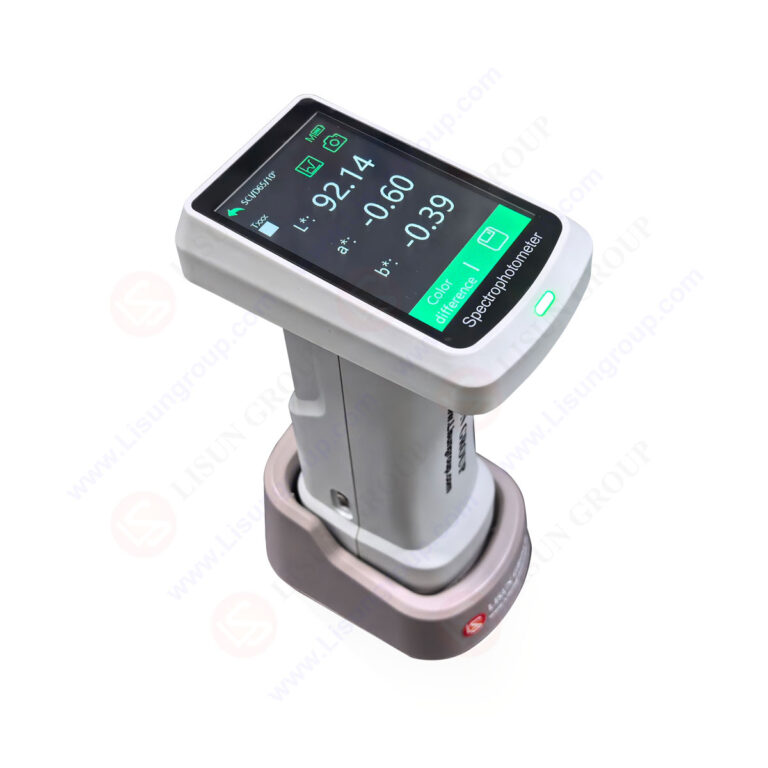
Accurate color management is critical for quality control in high-volume manufacturing. The LISUN HSCD series portable spectrophotometer serves as a precision handheld color meter for accurate color difference analysis, providing lab-grade performance in a field-ready device. Utilizing advanced grating spectroscopy and a dual-beam optical system, this instrument enables users to quantify color deviations (dE*ab) with high repeatability. This article details the core technologies, model specifications, standards compliance, and industry-specific applications of the HSCD series, offering quality managers a technical reference for implementing robust color quality assurance protocols.
1.1 Grating Spectroscopy and Spectral Resolution
The HSCD series employs a high-resolution diffraction grating to disperse reflected light across a silicon photodiode array. This design captures the full spectral reflectance curve from 400nm to 700nm, with a wavelength interval of 10nm. Unlike filter-based colorimeters, this method provides continuous spectral data, which is essential for accurately calculating color difference under various illuminants and observer angles.
1.2 Dual-Beam Optical Design and Nano-Integrated Components
A dual-beam optical system splits the light from the pulsed xenon lamp into a measurement beam and a reference beam. The reference beam continuously monitors lamp intensity fluctuations, ensuring stable readings over thousands of measurements. The integration of nano-scale optical devices within the light path minimizes stray light (<0.1%), enabling detection of subtle color shifts that are invisible to the human eye.
1.3 Zirconium Calibration Whiteboard Technology
The HSCD spectrophotometer uses a ceramic zirconium dioxide whiteboard for absolute reflectance calibration. Zirconium offers superior durability and spectral flatness compared to traditional barium sulfate or PTFE standards. This ensures long-term stability of the white reference, reducing the frequency of recalibration and maintaining traceability to national standards.
2.1 Simultaneous SCI/SCE Measurement
The instrument integrates both Specular Component Included (SCI) and Specular Component Excluded (SCE) measurement modes. SCI mode captures total color including gloss, correlating with visual evaluation of glossy surfaces. SCE mode excludes gloss, matching how the human eye perceives texture and pigment. The HSCD series measures both conditions in a single trigger, providing comprehensive data for formulation correction.
2.2 Multi-Aperture Options and UV Control
Different model configurations support variable aperture sizes (Φ8mm/Φ4mm and Φ11mm/Φ6mm), allowing measurement of small targets such as printed dots or textured grains. A dedicated UV calibration mode adjusts the UV content of the light source to match D65 illuminant conditions, critical for evaluating fluorescent whitening agents in textiles and paper per ISO 2470.
3.1 Performance Parameters
All models in the HSCD series maintain a measurement repeatability of within dEab ≤ 0.03 (standard deviation on white board, 30 measurements). Inter-instrument agreement (dEab) is rated at ≤ 0.15 for average values, ensuring consistency across multiple units on a production line.
3.2 LISUN HSCD Series Model Comparison
| Parameter | HSCD-780 | HSCD-800 | HSCD-860 |
|---|---|---|---|
| Light Source | Pulsed Xenon Lamp | Pulsed Xenon Lamp | Enhanced Pulsed Xenon (UV Calibrated) |
| Wavelength Range | 400-700nm | 400-700nm | 360-780nm (Extended UV) |
| Aperture Options | Φ8mm / Φ4mm | Φ11mm / Φ6mm | Φ11mm / Φ6mm; Φ8mm (Optional) |
| Measurement Repeatability | dE*ab ≤ 0.03 | dE*ab ≤ 0.03 | dE*ab ≤ 0.02 |
| Inter-Instrument Agreement | dE*ab ≤ 0.2 | dE*ab ≤ 0.15 | dE*ab ≤ 0.12 |
| Connectivity | USB, Bluetooth | USB, Bluetooth, Wi-Fi | USB, Bluetooth, Wi-Fi, RS-232 |
| Measurement Modes | SCI/SCE (Single Click) | SCI/SCE (Single Click) | SCI/SCE (Single Click), Fluorescence |
| Standard Support | CIE No.15, ASTM E1164 | CIE No.15, ASTM E1164, ISO 2470 | CIE No.15, ASTM E1164, ISO 2470, DIN5033 |
| Battery Life | 5000+ measurements | 5000+ measurements | 8000+ measurements |
4.1 CIE No.15 and ISO 7724-1 Colorimetry
The HSCD series calculates color indices strictly according to CIE No.15 (Colorimetry), defining standard illuminants (D65, A, F2) and observer functions (2°/10°). Compliance with ISO 7724-1 ensures that the instrument’s geometry (d/8° diffuse illumination, 8° viewing) adheres to the international standard for color measurement of paints and varnishes.
4.2 ASTM E1164 and DIN5033 Teil7 for Industrial Use
For industrial color acceptance, the instrument follows ASTM E1164 (Standard Practice for Obtaining Spectrometric Data for Object-Color Evaluation). This practice defines how to measure opaque materials. Additionally, the HSCD-860 conforms to DIN5033 Teil7, which specifies procedures for color measurement in the German automotive and plastics industries.
4.3 Standards for Whiteness and Yellowness
The instrument calculates whiteness indices per GB/T 3978 and ISO 2470, and yellowness indices per ASTM E313 and ASTM D1925. This allows users in the paper, textile, and polymer industries to monitor aging and bleaching processes with traceable data.
5.1 dEab, dECMC, and dE*00 Calculation
The HSCD spectrophotometer supports multiple color difference formulas. The CIELAB dEab is the standard for pass/fail assessment. For visual correlation on textured surfaces, the dECMC (l:c) formula is available. The more advanced CIEDE2000 (dE*00) formula, which accounts for lightness, chroma, and hue weighting, is also supported for demanding automotive and appliance applications.
5.2 Spectral Reflectance Data and Metamerism Index
Users can export full spectral reflectance curves (400nm-700nm at 10nm intervals) for deep analysis of pigment formulation. The metamerism index (MI) under different illuminant pairs (e.g., D65/A) quantifies how two samples shift color under different light sources, a critical feature for matching production batches to master standards.
6.1 Plastics and Polymer Processing
Injection molders use the HSCD-800 for in-line quality checks of masterbatch dispersion. The small aperture option allows measurement of small molded parts like caps or connectors. The high repeatability ensures that color shift during regrind blending is detected before large batches are produced.
6.2 Coatings and Automotive Interiors
Paint manufacturers use the spectrophotometer to evaluate metallic and pearlescent pigmentation. The SCI/SCE capability isolates the effect of surface gloss on perceived color. For automotive interiors, where materials range from leather to textured plastic, the instrument’s ability to measure curved surfaces with consistent geometry is essential for meeting OEM color specifications.
6.3 Textiles, Printing, and Testing Laboratories
Textile labs rely on the HSCD series for shade sorting and assessing the effect of laundering. In printing, the handheld meter verifies Pantone matching on various substrates. Third-party testing laboratories use the extended UV range of the HSCD-860 to certify optical brighteners in paper (per ISO 2470) and evaluate food packaging compliance with GB 2893 (color safety standards).
7.1 Multi-Platform Data Management
The HSCD spectrophotometer connects via USB, Bluetooth, and optional Wi-Fi to the LISUN Color QC software and LISUN Mobile App. Data transmission is real-time, with the capability to store over 50,000 measurement records on the device. The software supports batch statistics, trend charts, and generate PDF inspection reports.
7.2 API and LIMS Integration
For automated production lines, the HSCD-860 offers RS-232 interface support, enabling direct integration with Laboratory Information Management Systems (LIMS). The open API allows for custom pass/fail logic and automatic data logging, reducing operator error in high-throughput environments.
The LISUN HSCD series portable spectrophotometer provides a robust solution for handheld color meter for accurate color difference analysis. By integrating grating spectroscopy, dual-beam optics, and a stable zirconium whiteboard, it delivers repeatability of dE*ab ≤ 0.03 across multiple models. Compliance with CIE No.15, ISO 7724-1, ASTM E1164, and DIN5033 ensures global acceptance. From plastics and coatings to textiles and testing labs, the HSCD series offers the spectral data and connectivity needed to maintain strict color quality control. The combination of multi-aperture flexibility, simultaneous SCI/SCE measurement, and comprehensive software tools makes it a reliable investment for any quality-focused manufacturing operation.
Q1: How does the HSCD spectrophotometer ensure traceability to national standards?
A: The HSCD series is calibrated against a ceramic zirconium dioxide whiteboard that is itself certified traceable to the National Institute of Metrology (NIM). Before each measurement session, the instrument performs a white calibration using this board, which has a known absolute reflectance value across the entire spectrum. This chain of calibration ensures that the color difference values reported by the instrument are directly traceable to primary photometric standards, enabling consistent results between different manufacturing sites or between a supplier and a customer.
Q2: What is the technical advantage of simultaneous SCI/SCE measurement?
A: Simultaneous SCI/SCE measurement provides two critical data sets from a single trigger. SCI mode measures the total color of the sample, including the specular reflection (gloss), which is relevant when evaluating the inherent color of the pigment ignoring surface quality. SCE mode excludes the specular component, measuring only the diffuse reflection, which is how the human eye perceives color on matte or textured surfaces. Analyzing both simultaneously allows quality engineers to distinguish between a true pigment color shift and a simple change in surface gloss, saving significant rework time.
Q3: Can the HSCD spectrophotometer measure transparent liquids or films?
A: Yes, but the primary design of the HSCD series is for reflection (opaque and translucent solids). For transparent liquids or films, measurement requires placing the sample over a standard white backing, such as the provided zirconium whiteboard or a specific white tile. The instrument will then calculate the color of the liquid based on the reflected light passing through the sample. For transmission-only measurements of clear liquids, a dedicated transmission accessory (available separately) is required to measure spectral transmittance directly.
Q4: Why is the UV calibration feature important for my quality control process?
A: UV calibration is critical if your materials contain fluorescent whitening agents (FWAs), commonly found in paper, textiles, and detergents. Standard light sources may have inconsistent UV output, causing the FWA to emit varying amounts of blue light, leading to unstable readings. The HSCD-860’s UV control mode adjusts the UV excitation to match the D65 illuminant precisely. This ensures that measured whiteness (per ISO 2470) and brightness values are repeatable and correlate to visual perception under daylight conditions, preventing false failures or acceptances.