









Here is the comprehensive technical article on the High-Accuracy Digital Power Meter for AC/DC, formatted to your exact specifications.
Abstract
The demand for precision in electrical measurement has never been higher, particularly for evaluating modern AC/DC power systems that feature non-linear loads and complex switching topologies. This article presents a detailed technical overview of the High-Accuracy Digital Power Meter for AC/DC, specifically the LISUN LS2050 series, which integrates harmonic analysis and EMC compliance capabilities. Designed for R&D validation, production line testing, and EMC qualification labs, these instruments enable engineers to verify adherence to standards such as EN/IEC61000-3-2 and LM-79. By combining digital sampling waveform analysis, automatic range switching, and a wide frequency bandwidth (0.5Hz-100kHz), this class of power meter provides the measurement fidelity required for LED manufacturing and automotive electronics, ensuring product reliability and regulatory success.
1. Core Architecture and Measurement Principles of AC/DC Power Meters
1.1 Digital Sampling Waveform Analysis for Non-Sinusoidal Signals
Modern power systems rarely present pure sinusoidal waveforms. The High-Accuracy Digital Power Meter for AC/DC relies on high-speed digital sampling to capture voltage and current signals in real-time. Unlike analog meters that average out transients, digital sampling allows for point-by-point multiplication of voltage and current vectors. This process yields true RMS values, active power (W), apparent power (VA), and reactive power (VAR) with high fidelity, even when the crest factor exceeds 3:1. The sampling rate is typically synchronized to the fundamental frequency, with over-sampling techniques used to minimize aliasing errors on higher-order harmonics up to the 100th order.
1.2 Automatic Range Switching and Overload Protection
To maintain accuracy across variable loads, these instruments employ automatic range switching for both voltage (up to 1000Vrms) and current (up to 50Arms). The architecture uses a combination of resistive dividers and precision shunt resistors, coupled with solid-state relays. When a sudden surge occurs—such as during an inrush current test—the meter’s microcontroller initiates a range change within milliseconds to prevent saturation. The hardware is designed for high overload capacity, with a maximum instantaneous voltage of 1600V and current of 50A, protecting internal circuits during abnormal conditions while maintaining the integrity of the measurement data.
1.3 AC/DC Compatibility and Wide Frequency Bandwidth
A defining feature of these devices is the ability to measure both DC and AC signals seamlessly. For DC measurements, the meter filters out ripple components to provide a stable reading. For AC measurements, the bandwidth extends from 0.5Hz to 100kHz. This wide bandwidth is critical for analyzing variable frequency drives (VFDs), switching power supplies, and ballasts used in automotive electronics. The meter automatically detects the zero-crossing points for DC signals or the fundamental frequency for AC signals, allowing it to function as a universal power analyzer without manual mode switching.
2. Harmonic Analysis Capabilities and Methodology
2.1 IEC/CSA Method for Total Harmonic Distortion (THD)
Compliance with international standards requires precise harmonic analysis. These meters utilize the IEC/CSA method for calculating Total Harmonic Distortion (THD), which considers harmonics up to the 50th order (0-50 harmonic analysis). The algorithm separates the fundamental component from the residual distortion, calculating THD-F (relative to fundamental) or THD-R (relative to RMS). This capability is essential for evaluating power quality issues caused by LED drivers and switching converters, where low-order harmonics (3rd, 5th, 7th) are most prevalent and often exceed regulatory limits.
2.2 Vector Analysis and Phase Angle Accuracy
Harmonic analysis extends beyond magnitude; phase angle is critical for power factor and displacement factor calculations. The instrument measures the phase displacement between the fundamental voltage and current to determine the Displacement Power Factor (DPF). For harmonic content, it measures the phase of each harmonic component relative to the fundamental. This vector data allows engineers to identify the source of distortion—whether it is from capacitive input filters or inductive motor windings. Accurate phase measurement, typically with an accuracy of ±0.1 degrees, is necessary for designing effective passive or active harmonic filters.
2.3 Interpreting Harmonic Spectra for EMC Pre-Compliance
For EMC engineers, the harmonic spectrum acts as a diagnostic tool. The meter displays a graphical representation of the harmonic current envelope, highlighting frequencies that may contribute to radiated or conducted emissions. By comparing the measured harmonic current to the limits specified in EN/IEC61000-3-2, engineers can perform pre-compliance checks before formal testing. This proactive approach reduces the risk of failure during certification, saving both time and cost. The ability to export harmonic data via RS232/RS485 communication ports facilitates detailed analysis in external software applications.
3. EMC Compliance Testing and Standard Adherence
3.1 EN/IEC61000-3-2: Limits for Harmonic Current Emissions
The High-Accuracy Digital Power Meter for AC/DC is specifically designed to support testing against EN/IEC61000-3-2, which governs harmonic current emissions for equipment with input current up to 16A per phase. The LS2050C-IEC model integrates this capability natively. It classifies equipment into Classes A, B, C, and D based on waveform shape and power level. For Class C lighting equipment, strict limits are placed on the 2nd, 3rd, and 5th harmonics. The meter automatically compares measured values against these limits, providing a pass/fail indication and compliance margin analysis, which is invaluable for LED luminaire manufacturers.
3.2 Safety Standards: IEC 61010 and UL 1989 Certification
Measurement integrity must be matched by operator safety. These instruments are designed to meet IEC 61010, the safety standard for electrical measurement and test equipment. This includes protection against electric shock, arc flash, and insulation failure. The input terminals feature reinforced isolation with a minimum clearance of 8mm between live parts and enclosure. Additionally, adherence to UL 1989 ensures the surge suppression components are rated for repeated transient events. For automotive electronics testing, where high-voltage DC buses (400V-800V) are common, this safety certification is non-negotiable for lab personnel.
3.3 LM-79 Compliance for Solid-State Lighting
In the LED industry, LM-79 outlines the method for measuring total luminous flux and electrical characteristics. The power meter plays a critical role in the electrical portion of this standard. It must measure with an accuracy of ±0.1% for power to ensure the calculated efficacy (lumens per watt) is reliable. The meter’s ability to measure low power factors (Down to 0.01) and low currents (starting at 0.5mA) with high resolution makes it suitable for testing small LED modules and high-brightness individual LEDs. Table 1 below compares key models and their compliance scope.
Table 1: Technical Specification and Compliance Comparison
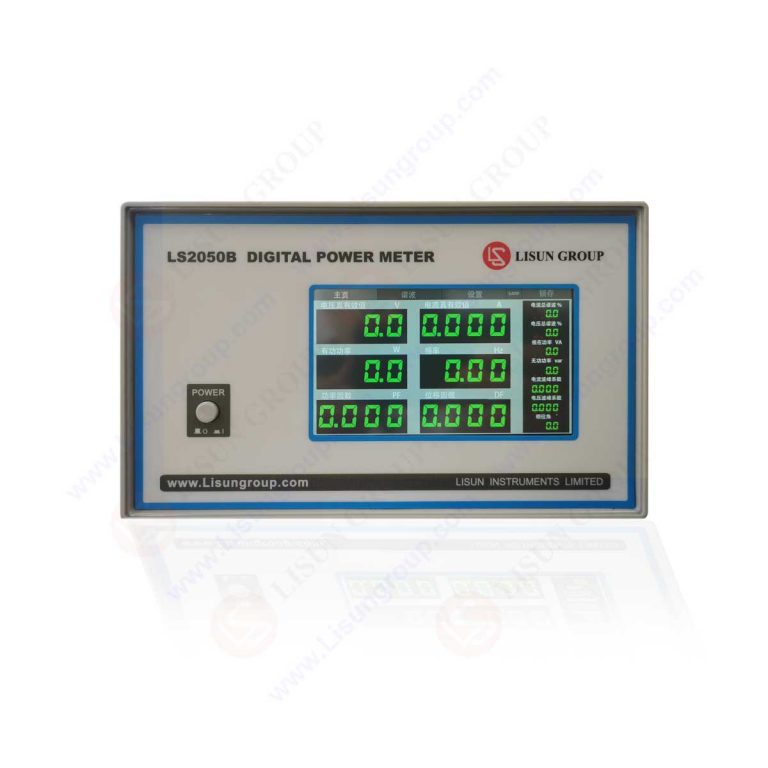
| Feature / Model | LS2050B (Standard) | LS2050C (High Accuracy) | LS2050C-IEC (EMC Compliant) |
|---|---|---|---|
| Voltage Accuracy | ±0.2% / ±0.3% of range | ±0.1% / ±0.2% of range | ±0.1% / ±0.2% of range |
| Current Accuracy | ±0.2% / ±0.3% of range | ±0.1% / ±0.2% of range | ±0.1% / ±0.2% of range |
| Harmonic Analysis | Up to 50th order | Up to 50th order | Up to 50th order (IEC/CSA) |
| EN/IEC61000-3-2 | No (Data only) | No (Data only) | Yes (Auto Pass/Fail) |
| Frequency Range | 45Hz – 65Hz (AC) | 0.5Hz – 100kHz | 0.5Hz – 100kHz |
| Key Application | General R&D / Production | High-precision R&D | EMC Pre-Certification |
4. Hardware Design: Communication, Interface & Overload Protection
4.1 RS232/RS485 Communication for Automated Testing
Integration into automated test systems is facilitated by standard communication ports. The RS232 (point-to-point) and RS485 (multi-drop network) interfaces allow the power meter to act as a slave device in a larger test system. Commands are sent via a simple ASCII protocol, enabling other instruments (like goniophotometers or temperature chambers) to trigger the meter and retrieve data. The RS485 interface supports ranges up to 1200 meters, making it suitable for remote monitoring of high-voltage test cells. This connectivity is vital for quality control managers who require real-time statistical process control (SPC) data.
4.2 Front Panel Controls and Data Logging
The user interface typically includes a numeric keypad and a high-contrast LCD display that can show multiple parameters simultaneously (e.g., V, A, W, PF, Hz). Engineers can select between numeric data and graphical harmonic bar charts. Internal memory allows for storing up to 100 measurement setups and 1000 data records. A dedicated USB port (optional) allows for direct data transfer to a USB flash drive without needing a PC. This feature is useful for field technicians performing on-site power quality audits.
4.3 Protecting Equipment from Transient Overloads
The high overload capacity of the input stages is a critical hardware advantage. The design includes metal oxide varistors (MOVs) and gas discharge tubes (GDTs) on both voltage and current inputs. In the event of a transient spike (e.g., from a nearby lightning strike or inductive kickback), these components clamp the voltage to safe levels before it reaches the precision analog-to-digital converter. This robust design ensures that the instrument meets the reliability demands of continuous production environments where faults are common, and downtime must be minimized.
5. Application in LED Manufacturing and Testing
5.1 Power Factor and Efficacy Verification
In LED manufacturing, testing involves verifying that the driver’s power factor meets design specifications (often >0.9 for commercial products). The power meter measures both the total power factor (PF) and the displacement factor (DPF) separately. A low PF often indicates high harmonic content from the input filter capacitors, while a low DPF indicates capacitive behavior. By analyzing these two values, R&D engineers can determine whether the need for power factor correction is due to distortion or phase shift. The measured input power is then used to calculate system efficacy (lm/W) in conjunction with an integrating sphere.
5.2 Standby Power and Low Current Measurement
LED lighting often runs on standby power for smart controls. Standards like IEC 62301 (standby power) require measurements down to 1.0W or less. The High-Accuracy Digital Power Meter for AC/DC achieves this through selectable low-current ranges (e.g., 5mA or 50mA). The resolution at these ranges is typically 0.1mA, allowing accurate measurement of very small loads. The meter’s crest factor capability remains high even at these low ranges, ensuring that the peak current of intermittent standby pulses is not lost in averaging, which would lead to inaccurate power calculations.
6. Automotive Electronics and Power Quality Analysis
6.1 Testing High-Voltage DC Traction Systems
Automotive electronics, particularly for electric vehicles (EVs), require testing of high-voltage DC systems. The LS2050 series can measure DC voltage up to 1000V and current up to 50A, making it suitable for analyzing the efficiency of DC-DC converters and onboard chargers. During regenerative braking, the current flows in reverse; the meter can accurately display negative power values to show energy being returned to the battery. The wide bandwidth (100kHz) is essential for capturing the switching noise from GaN or SiC MOSFETs operating at frequencies above 100kHz.
6.2 Analyzing Power Quality on 12V/48V Automotive Networks
For low-voltage automotive networks (12V/48V), power quality analysis is crucial for infotainment, ECU, and sensor validation. The meter measures ripple voltage and current, as well as harmonics caused by non-linear loads. For example, a PWM-controlled fan motor will generate significant harmonic current at the switching frequency and its multiples. The meter’s FFT analysis allows engineers to identify these spectral components. By comparing these results with CISPR 25 limits (conducted emissions), engineers can validate their EMC filter designs before final testing.
7. Verification and Calibration Procedures
7.1 Internal Self-Calibration and Zero Drift Correction
To maintain long-term stability, these meters feature an internal self-calibration routine. Before each measurement series, the instrument can be set to auto-zero, which measures the offset voltage and current with the inputs shorted and subtracts it from subsequent readings. This eliminates thermal drift caused by temperature changes in the lab. Additionally, a built-in voltage reference allows the user to perform a field check of the instrument’s fundamental accuracy without needing external calibrators, ensuring confidence between annual calibration cycles.
7.2 External Traceable Calibration and Standards
For certified results, external calibration by an accredited laboratory is recommended. The meter is designed with calibration parameters stored in firmware, meaning no internal potentiometers require adjustment. Calibration is performed by applying traceable voltage and current at critical power factors (1.0, 0.5 leading, and 0.5 lagging). The instrument can store multiple calibration coefficients for different frequencies to maintain accuracy across the 0.5Hz to 100kHz bandwidth. This traceability is mandatory for labs seeking ISO 17025 accreditation for electrical testing.
8. Conclusion
The High-Accuracy Digital Power Meter for AC/DC from LISUN represents a necessary tool for modern electrical testing, combining high-fidelity measurement with compliance-focused analysis. Its core capabilities—digital waveform sampling, 50th-order harmonic analysis, and automatic range switching—provide the accuracy required for rigorous applications in LED manufacturing, automotive electronics validation, and EMC pre-compliance testing. Adherence to standards such as EN/IEC61000-3-2, IEC 61010, and LM-79 ensures that products tested with these instruments meet global regulatory demands. For engineers moving beyond basic RMS measurements, this technology offers deep diagnostic insight into power quality, enabling faster design iterations and more reliable product launches.
FAQ (Frequently Asked Questions)
Q1: What is the difference between Total Power Factor (PF) and Displacement Power Factor (DPF) measured by a High-Accuracy Digital Power Meter?
A: Total Power Factor (PF) is the ratio of real power (Watts) to apparent power (VA). It accounts for both the phase shift between voltage and current (Displacement Factor) and the distortion caused by harmonics. Displacement Power Factor (DPF), often called Cos φ, is the cosine of the angle between the fundamental voltage and fundamental current only. A high-efficiency LED driver might show a PF of 0.90 but a DPF of 0.99, indicating the low PF is due to harmonic distortion (non-linear current draw), not a large phase shift. The LS2050 series displays both values, allowing engineers to target the specific cause of low efficiency.
Q2: How does the LS2050C-IEC model support EN/IEC61000-3-2 testing for LED luminaires?
A: The LS2050C-IEC is optimized for pre-compliance testing against EN/IEC61000-3-2 Class C limits (lighting equipment). It automatically measures the harmonic currents up to the 50th order and compares them to the absolute limits defined by the standard. The user simply connects the device under test, selects ‘Class C’ on the instrument, and the meter performs a pass/fail analysis, displaying the worst-case margin. This eliminates the need for manual data calculation in a spreadsheet. While it cannot replace a formal certified EMC test, it provides high-confidence pre-compliance data, reducing the risk of failure during final certification.
Q3: Can I use this power meter to test a 48V automotive battery charger with high switching frequency ripple?
A: Yes, this is a prime application for the LS2050C or LS2050C-IEC model. The meter’s wide frequency range (0.5Hz to 100kHz) is specifically designed to capture the energy of high-frequency switching ripples from GaN or SiC transistors. The digital sampling method ensures that the true RMS value includes the energy from the switching components, not just the DC and 50/60Hz components. Additionally, the high overload capacity protects the meter from the inrush current common in capacitive input chargers. The AC/DC capability allows you to measure both the DC output of the charger and the AC input power simultaneously.
Q4: What is the recommended calibration interval for maintaining high accuracy in these meters?
A: To guarantee the specified accuracy (e.g., ±0.1% for the LS2050C), LISUN recommends a recalibration interval of 12 months. This standard industry practice accounts for drift in the precision voltage reference and shunt resistors over time. The instrument features a ‘calibration due’ reminder that can be set. When performing external calibration, it is critical to calibrate at the specific power factors relevant to your testing (e.g., 0.5 lag for inductive loads, 1.0 for resistors). The meter’s firmware stores multiple calibration sets, allowing it to maintain accuracy across the full current range (from 5mA to 50A).