









Here is the comprehensive technical article on the LISUN HSCD series, generated according to your specifications.
Abstract
Color quality control demands precision instruments that adhere to global photometric standards. The LISUN HSCD series is a family of high accuracy portable spectrophotometer with CIE & ISO compliance, designed for rigorous color measurement in manufacturing and laboratory environments. These devices integrate advanced grating spectroscopy, dual-beam optical architecture, and nano-integrated optical devices to deliver superior inter-instrument agreement and measurement repeatability. For quality control managers and R&D engineers, the HSCD series offers a robust solution for quantifying color differences (dE*ab), evaluating metamerism, and ensuring compliance with standards such as ASTM E1164 and ISO 7724-1. This article details the technological architecture, model specifications, and practical applications that make these instruments essential for modern color quality assurance.
1.1 Dual-Beam Grating Spectroscopy
The HSCD series utilizes a precision diffraction grating spectrophotometer system, which separates polychromatic light into its constituent wavelengths for spectral analysis. This method provides superior wavelength accuracy compared to filter-based systems. The dual-beam optical design simultaneously measures the sample and a reference beam from the internal light source. This architecture compensates for fluctuations in lamp intensity and temperature drift, ensuring that the high accuracy portable spectrophotometer with CIE & ISO compliance maintains a measurement repeatability of within dE*ab ≤ 0.02 for white tiles.
1.2 Nano-Integrated Optical Devices
The series employs nano-integrated optical components, including high-efficiency photodiode arrays and ultra-precision diffractive gratings. These miniaturized elements enhance the signal-to-noise ratio while reducing the instrument’s physical footprint. The integration of these devices allows for a spectral range of 400nm to 700nm (standard models) or extended ranges up to 780nm, with a resolution of 10nm. This ensures accurate capture of spectral reflectance data required for complex color matching calculations.
1.3 Zirconium Calibration Whiteboard
A critical component for long-term stability is the zirconium dioxide (ZrO2) calibration whiteboard. Unlike standard ceramic tiles that degrade over time, the ZrO2 board offers exceptional chemical resistance and photostability. It provides a highly stable reflectance baseline (R% > 95%) across the visible spectrum. This technology eliminates the need for frequent factory recalibrations, as the onboard automatic calibration routine uses this standard to maintain the instrument’s traceability to national metrology institutes, a key requirement for ISO 7724-1 compliance.
2.1 Key Performance Metrics
The LISUN HSCD series includes three primary models—the HSCD-780, HSCD-800, and HSCD-860—each optimized for different budget and application needs. All models are designed to act as a high accuracy portable spectrophotometer with CIE & ISO compliance, but differ in sampling capability and velocity.
| Parameter | HSCD-780 | HSCD-800 | HSCD-860 |
|---|---|---|---|
| Measurement Repeatability (White Tile) | dE*ab ≤ 0.04 | dE*ab ≤ 0.03 | dE*ab ≤ 0.02 |
| Inter-Instrument Agreement (Avg. dE*ab) | ≤ 0.25 | ≤ 0.20 | ≤ 0.15 |
| Aperture Options | 8mm (Fixed) | 8mm / 4mm (Dual) | 8mm / 4mm / 2x5mm (Triple) |
| Light Source Type | LED + UV | LED + Xenon | Full Spectrum Xenon |
| Measurement Modes | SCI/SCE | SCI/SCE + Specular | SCI/SCE + UV Control |
| Connectivity | USB, Bluetooth | USB, Wi-Fi, Bluetooth | USB, Wi-Fi, Ethernet |
2.2 Spectral Analysis Capabilities
The HSCD-800 and HSCD-860 offer SCI (Specular Component Included) and SCE (Specular Component Excluded) modes simultaneously. This dual-mode capability is critical for evaluating gloss effects in coated surfaces. The HSCD-860 further includes an adjustable UV component, making it suitable for measuring fluorescent whitening agents in textiles and paper, in accordance with ISO 2470. The standard-compliant D65 illuminant simulation, combined with a UV calibration function, ensures accurate whiteness indices.
3.1 CIE and ASTM Standards
The optical geometry of the HSCD series is designed to conform to CIE No.15 for colorimetry and ASTM E1164 for standard practice for obtaining spectrometric data for object-color evaluation. The instruments utilize a d/8° (diffuse illumination, 8° viewing) geometry, which is the industry standard for minimizing measurement errors caused by surface texture. This compliance guarantees that data obtained from the LISUN device is comparable with data from other laboratory-grade spectrophotometers.
3.2 ISO and DIN Standards
For industrial quality control, the HSCD series supports calculations under ISO 7724-1 (General Test Methods) and DIN5033 Teil7 (Metamerism Index). The software suite pre-installed on the instruments enables users to calculate color differences under multiple illuminants and observers, identifying potential metameric failures. For safety and regulatory standards, the instrument provides direct pass/fail analysis for color requirements in GB 2893 (Safety Colors) and GB/T 18833 (Retroreflective Materials), essential for coating and signage manufacturers.
4.1 Plastics and Coatings Industry
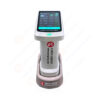
In the plastics sector, controlling color batch-to-batch consistency is paramount. The high accuracy portable spectrophotometer with CIE & ISO compliance allows QC managers to measure resin pellets or molded parts directly. The instrument’s ability to store thousands of color standards enables rapid comparison against historical data. For coatings, the dual-beam system accurately measures wet paint drawdowns and dry film panels, calculating opacity and tinting strength with precision. The instrument identifies subtle shifts in dE*ab that human vision cannot detect, preventing costly rework.
4.2 Textile and Food Industry
In textiles, the HSCD series evaluates color fastness and dye uptake. The SCE mode is crucial here, as it eliminates the gloss factor that distorts the perceived color of dull fabrics. For the food industry, the spectrophotometer can be equipped with a specialized measurement stand for liquids or semi-solids. It measures the color of sauces, fruit juices, or baked goods, correlating color indices (e.g., Hunter L, a, b) with process parameters such as roasting time or freshness, thus fulfilling internal quality and HACCP documentation requirements.
5.1 Intelligent Color Quality Control Software
The accompanying PC software provides a comprehensive suite for color analysis. It includes functions for creating color libraries, generating tolerance reports, and performing spectral analysis. The software calculates various color difference formulas (CIE Lab, CIE LCh, CMC(l:c), CIE94, CIEDE2000) to match specific industry requirements. Users can set dynamic tolerances, allowing the system to automatically flag out-of-specification batches.
5.2 Data Connectivity and Reporting
All HSCD models feature robust connectivity. The HSCD-860, with its Ethernet and Wi-Fi capabilities, can be integrated into a factory’s MES (Manufacturing Execution System). Measurements are uploaded in real-time, creating a digital trail for ISO 9000 compliance. The instrument’s internal memory can store over 50,000 samples. Reports can be exported as PDF or Excel files, including spectral reflectance curves, color density values, and pass/fail metrics, streamlining communication between QA labs and production lines.
6.1 Factors Affecting Repeatability
Repeatability in a portable spectrophotometer is influenced by optical stability, electronic noise, and physical alignment. The LISUN HSCD series mitigates these issues through its precision-engineered optical baseplate and temperature-stabilized light source. The automatic gloss compensation (SCI/SCE) ensures that the same physical sample yields consistent results regardless of minor variations in surface sheen. With a dE*ab repeatability of 0.02 (HSCD-860), the instrument provides the precision required for Gauge R&R studies.
6.2 Inter-Instrument Agreement
For multi-site manufacturers, inter-instrument agreement is critical. The HSCD series is calibrated against a master standard to achieve an agreement of dE*ab ≤ 0.15 (for HSCD-860). This means that a color measured in a supplier’s lab in Asia will match the measurement taken at an assembly plant in Europe. This consistency is achieved through rigorous factory calibration procedures and the stable, non-yellowing zirconium whiteboard, ensuring that the high accuracy portable spectrophotometer with CIE & ISO compliance delivers trustworthy data across the supply chain.
7.1 Metamerism and Color Matching
R&D engineers utilize the HSCD series to solve metamerism issues—where two samples match under one light source but differ under another. The software allows engineers to evaluate samples under multiple illuminants (A, D50, D65, F2, F11) simultaneously. The instrument calculates a Metamerism Index (MI) according to CIE specifications. This feature allows formulators to adjust pigment recipes to achieve a stable color match across retail (LED), office (Fluorescent), and outdoor (Daylight) lighting conditions.
7.2 Spectral Curve Analysis for Formula Prediction
Beyond simple color values, the HSCD series provides full spectral reflectance data (400nm to 700nm). This data is the foundation for computer color matching (CCM) systems. By analyzing the shape of the spectral curve, chemists can identify the specific chemical structure causing an absorption band. The high wavelength repeatability ensures that the spectral data is stable enough to be used for database building for colorant formulation, significantly reducing the number of physical corrections required during the color matching process.
The LISUN HSCD series represents a significant advancement in portable color measurement technology. By integrating dual-beam grating spectroscopy with nano-optical components and a stable zirconium calibration standard, these instruments deliver laboratory-grade accuracy in a handheld form factor. Compliance with key standards—including CIE No.15, ISO 7724-1, ASTM E1164, and GB/T 3978—guarantees global applicability and data integrity for industries ranging from automotive interiors and appliances to printing and food processing. The varying configurations of the HSCD-780, HSCD-800, and HSCD-860 allow users to select the precise balance of speed, aperture flexibility, and UV control needed for their specific workflow. For quality control managers and R&D engineers demanding a high accuracy portable spectrophotometer with CIE & ISO compliance, the LISUN HSCD series offers the reliability, data management, and inter-instrument consistency necessary to maintain rigorous color quality standards in production and research environments.
Q1: What is the practical difference between the SCI and SCE measurement modes on the LISUN HSCD-860, and when should I use each?
A: The SCI (Specular Component Included) mode measures all reflected light, including the gloss component. This provides a measurement of the true, physical color of the pigment regardless of the surface finish. It is recommended for color matching and formulation databases. The SCE (Specular Component Excluded) mode excludes the glossy reflection, simulating how the human eye perceives color on a textured or matte surface. SCE is essential for quality control of textile fabrics, printed materials, and powder coatings where gloss varies, as it isolates the color perception from the surface gloss.
Q2: How does the LISUN HSCD series ensure conformity with ASTM E1164 for obtaining spectrometric data?
A: ASTM E1164 specifies the use of a hemispherical optical measurement system, typically integrating sphere geometry, and requires data collection at specific wavelength intervals. The HSCD series uses a d/8° (diffuse/8 degree) integrating sphere, which is the standard geometry mandated by ASTM E1164. Furthermore, the instrument records spectral reflectance data at 10nm intervals across the visible spectrum (400-700nm), which meets the resolution requirements of the standard. The automatic UV calibration feature on advanced models also ensures the accurate simulation of the D65 illuminant, which is a key requirement for standard practice.
Q3: Can the HSCD-780 be used to evaluate the yellowness index (YI) according to ASTM E313?
A: Yes, the HSCD-780 is fully capable of calculating the Yellowness Index (YI) as defined by ASTM E313. Although it has a fixed aperture and does not include UV control, it uses the standard D65/10° observer for the calculation. The instrument measures the full spectral data required to compute the CIE Tristimulus values (X, Y, Z), from which the YI (D1925/ASTM E313) value is derived. It is therefore suitable for monitoring yellowing in clear plastics, films, and white paints where UV radiation is not the primary aging factor. For UV-sensitive materials like optical brighteners, the HSCD-860 is recommended due to its UV adjustment capability.
*Q4: Why is the inter-instrument agreement (dEab) critical for a portable spectrophotometer, and what value does the HSCD-800 offer?*
A: Inter-instrument agreement ensures that the same color standard measured by different units of the same model yields the same numerical result. This is critical for global supply chains where material is produced at one facility and qualified at another. The HSCD-800 offers an average inter-instrument agreement of dEab ≤ 0.20. This high level of agreement allows users to confidently transfer color standards digitally between production sites and their suppliers, reducing physical sample shipping and accelerating the approval cycle for new color batches.