









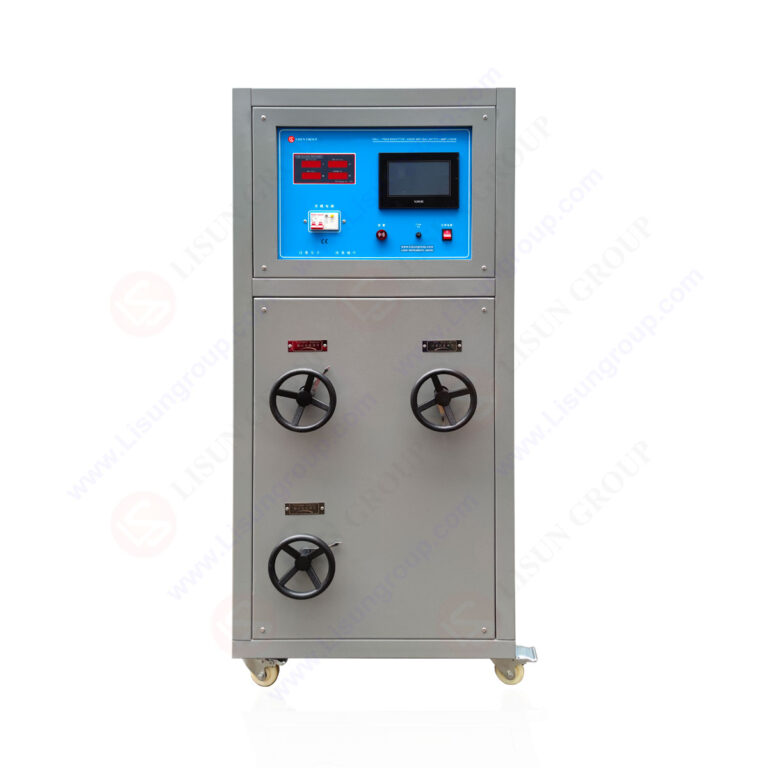
The LISUN DFX series Externally Ballasted Fluorescent Lamp Test Load Cabinet is a precision instrument designed for simulating resistive, inductive, and capacitive (R-L-C) loads in electrical accessory compliance testing. This article provides a comprehensive technical analysis of the DFX series, focusing on its role in validating switches, sockets, and circuit breakers under international standards such as IEC 60669-1 and IEC 60884-1. Core capabilities include adjustable power factor from 0.3 to 0.98, multiple output channels for simultaneous testing, and high-current support up to 80 A. For manufacturers and testing laboratories, the DFX series ensures accurate load simulation, repeatable test conditions, and full alignment with IEC/GB compliance requirements. This article examines the technical specifications, operational advantages, and integration possibilities with auxiliary test equipment, offering a data-driven guide for quality control engineers.
1.1 Purpose and Application Scope
The LISUN DFX series serves as a dedicated load cabinet for simulating ballasted fluorescent lamp circuits. It is specifically engineered for electrical accessory testing, including endurance tests for switches, plugs, and socket-outlets under IEC 60669-1 Clause 19.2 and IEC 60884-1 Clause 20. The equipment replicates real-world electrical loads by combining resistive, inductive, and capacitive elements. This allows engineers to evaluate contact performance, thermal behavior, and mechanical durability under controlled conditions.
1.2 Key Design Features
The DFX series integrates precision resistors, inductors, and capacitor banks with selectable combinations. Power factor adjustment ranges from 0.3 (highly inductive) to 0.98 (nearly resistive) in fine increments. Each model includes an LCD display for real-time monitoring of voltage, current, power factor, and test cycle count. The enclosure is constructed with forced-air cooling to maintain thermal stability during prolonged high-current operation up to 80 A.
2.1 Comparison of DFX Series Models
The DFX series includes five primary models differentiated by current capacity and channel configuration. The table below summarizes core specifications:
| Model | Output Current Range (A) | Number of Channels | Input Voltage (V AC) | Power Factor Range | Measurement Accuracy |
|---|---|---|---|---|---|
| DFX-20 | 0.1 – 20 | 1 | 220V ±10%, 50/60Hz | 0.3 – 0.98 | ±2% of reading |
| DFX-20-3CH | 0.1 – 20 (per channel) | 3 | 220V ±10%, 50/60Hz | 0.3 – 0.98 | ±2% of reading |
| DFX-40 | 0.1 – 40 | 1 | 220V ±10%, 50/60Hz | 0.3 – 0.98 | ±2% of reading |
| DFX-60 | 0.1 – 60 | 1 | 220V ±10%, 50/60Hz | 0.3 – 0.98 | ±2% of reading |
| DFX-80 | 0.1 – 80 | 1 | 220V ±10%, 50/60Hz | 0.3 – 0.98 | ±2% of reading |
2.2 Load Capacitance and Power Factor Resolution
The capacitive load branch in DFX models includes selectable values of 7.3 µF, 14.6 µF, and 21.9 µF, allowing fine-tuning of the reactive component. Power factor resolution is 0.01 across the entire range, enabling precise simulation of ballasted lamp circuits. The resistance bank uses wire-wound elements rated for continuous duty at maximum current, ensuring drift-free operation over extended test durations.
3.1 Alignment with IEC 60669-1 for Switches
IEC 60669-1 Clause 19.2 specifies endurance testing for switches controlling fluorescent lamp loads. The DFX series directly addresses these requirements by providing an AC-3a load profile with defined power factors. For a 10 A rated switch at 250 V, the standard requires a test current of 10 A with a power factor of 0.6 ±0.05 for inductive loads. The DFX-20 model delivers this with ±2% accuracy, well within tolerance. The built-in cycle counter automates the required 10,000 mechanical operations, and the integrated timer records contact duration for failure analysis.
3.2 Compliance with IEC 60884-1 for Sockets
IEC 60884-1 Clause 20 outlines heating and endurance tests for socket-outlets. For a 16 A socket at 250 V, the standard mandates a test current of 16 A with a resistive-inductive characteristic. The DFX-40 model provides the necessary load combination with a power factor of 0.6. Additionally, the cabinet supports cyclic testing—1 second on, 5 seconds off—as specified in the standard. The DFX series includes a programmable sequencer that replicates this pattern without external controllers.
3.3 Additional Standard Compliance
The DFX series also aligns with IEC 61058-1 for appliance switches and IEC 60947-1 for low-voltage switchgear. Clause 7.2.5 of IEC 61058-1 requires load simulation for inductive circuits, which the DFX series achieves through its adjustable inductance bank. For manufacturers exporting to global markets, the equipment supports 50 Hz and 60 Hz operation without recalibration.
4.1 AC Load Simulation for Fluorescent Lamps
AC load simulation is the primary function of the DFX series. The equipment replicates the electrical characteristics of externally ballasted fluorescent lamps, which present a resistive-inductive load due to the ballast winding. The inductive component causes a phase shift between voltage and current, measured as power factor. The DFX series allows engineers to set the power factor to 0.5, 0.6, or 0.85, matching common ballast types. The resistance and inductance values are calibrated to produce stable waveforms with total harmonic distortion below 3%.
4.2 DC Load Simulation and Limitations
While the DFX series is optimized for AC testing, selected models support DC load simulation for specific applications. The equipment includes a DC mode that bypasses the inductive elements, providing pure resistive or capacitive loads. However, the maximum DC current is typically 70% of the AC rating due to thermal constraints. For DC endurance tests per IEC 60669-1 Clause 20, the DFX-20-3CH model can simulate DC loads up to 14 A per channel. Engineers should consult the technical manual for derating curves.
5.1 Compatibility with LISUN CZKS Series Life Testers
The LISUN CZKS series of switch and socket life testers integrates seamlessly with the DFX series. The CZKS-5L mechanical life tester provides the actuation mechanism for switches, while the DFX cabinet supplies the electrical load. A control cable connects the two units, synchronizing the mechanical operation with the load timing. For a typical endurance test, the CZKS-5L cycles a switch at 15 operations per minute, and the DFX-20 applies a 10 A load with a 0.6 power factor for 1 second per cycle. This integration reduces setup time and ensures repeatable test conditions.
5.2 Integration with SW-6 Bending Testers
The LISUN SW-6 cord bending tester evaluates the durability of flexible cables and terminations. When paired with the DFX series, the bending tester applies mechanical stress while the load cabinet maintains current flow at rated values. This combined test replicates real-world conditions where cables are flexed under load. For example, a test per IEC 60884-1 Clause 23 requires 10,000 bending cycles with a 10 A load. The DFX-20 provides the load, and the SW-6 drives the bending motion, with the DFX series recording any interruptions in continuity.
5.3 End-to-End Workflow Capabilities
The DFX series can form part of a comprehensive test bench, including the LISUN LK series temperature rise testers and the LS series dielectric strength testers. A typical workflow involves: 1) connecting the device under test, 2) setting load parameters on the DFX series, 3) initiating the life tester or bending tester, and 4) analyzing results using the DFX series data logging function. This integrated approach streamlines compliance testing for GOST, CE, and UL certifications.
6.1 Thermal Management and Duty Cycles
High-current operation generates significant heat in the resistive and inductive elements. The DFX series employs forced-air cooling with dual fans and thermal sensors that automatically adjust fan speed. For continuous operation at maximum current (e.g., DFX-80 at 80 A), the duty cycle is limited to 50% (30 minutes on, 30 minutes off). At 50% of rated current, continuous operation is permissible. The front panel displays internal temperature, and an over-temperature alarm triggers shutdown if the threshold exceeds 85°C.
6.2 Safety Interlocks and Protection Circuits
The DFX series includes multiple safety features for laboratory environments. An emergency stop button immediately disconnects all loads. Overcurrent protection is provided by magnetic circuit breakers on each channel, rated at 125% of maximum current. Ground fault detection monitors leakage current; if it exceeds 30 mA, the cabinet disconnects within 100 ms. Additionally, the enclosure is grounded through a dedicated terminal, complying with IEC 61010-1 safety requirements.
7.1 Endurance Testing of Rocker Switches
A manufacturer of rocker switches used the DFX-20-3CH to validate compliance with IEC 60669-1. Three switch samples were tested simultaneously at 10 A and 250 V with a 0.6 power factor. The DFX series completed 10,000 cycles for each sample, recording contact resistance every 100 cycles. Results showed contact degradation at 7,500 cycles, prompting a redesign of the contact material. The three-channel capability reduced testing time by 66% compared to single-channel systems.
7.2 Verification of Socket-Outlet Heating Limits
A third-party laboratory tested a 16 A socket-outlet per IEC 60884-1 Clause 19. Using the DFX-40, they applied a 16 A load with a 0.6 power factor for 1 hour. Temperature rise was measured at 45 K on the live pin, within the 52 K limit specified in the standard. The DFX series data logging feature provided time-stamped temperature readings, which were accepted by a certification body for IECEE CB scheme reporting.
7.3 Capacitive Load Testing for Electronic Switches
An electronic switch manufacturer required testing with capacitive loads for IEC 61058-1 compliance. The DFX-60 allowed them to select a 14.6 µF capacitance in parallel with a resistive load, achieving a power factor of 0.85 leading. During 5,000 cycles at 20 A, no switch failure occurred, validating the semiconductor design. The DFX series capability to combine capacitive and resistive loads was critical for this application.
The LISUN DFX series Externally Ballasted Fluorescent Lamp Test Load Cabinet provides a precise, compliant solution for electrical accessory testing. With models ranging from 20 A to 80 A and single or three-channel configurations, the series addresses the needs of switch, socket, and circuit breaker manufacturers. Key technical capabilities include adjustable power factor from 0.3 to 0.98, load capacitance values up to 21.9 µF, and measurement accuracy of ±2%. Compliance with IEC 60669-1 Clause 19.2, IEC 60884-1 Clause 20, IEC 61058-1, and IEC 60947-1 is verified through direct parameter matching. Integration with LISUN CZKS life testers, SW-6 bending testers, and other auxiliary equipment enables a streamlined end-to-end testing workflow. For quality control engineers and testing laboratories, the DFX series delivers the repeatability, data logging, and safety features essential for certification testing. Its modular design allows future upgrades, ensuring long-term relevance as international standards evolve. By selecting the appropriate DFX model and configuring loads per standard requirements, users can achieve efficient compliance testing while minimizing test time and operator error.
Q1: How does the LISUN DFX series simulate an externally ballasted fluorescent lamp load?
A: The DFX series combines resistors, inductors, and capacitors in parallel to replicate the electrical characteristics of a fluorescent lamp circuit. The inductive component simulates the ballast winding’s reactive impedance, while the resistive component represents the lamp’s arc resistance during operation. The power factor is adjusted by varying the inductive and capacitive contributions through selector switches. For a typical 40 W fluorescent lamp, the DFX-20 model provides a 0.38 A load at 0.5 power factor, matching the ballast’s impedance. The equipment also simulates inrush current characteristics during lamp ignition, which is critical for switch endurance testing. Capacitor banks with 7.3 µF, 14.6 µF, and 21.9 µF values allow fine-tuning of leading or lagging power factors as required by specific standards.
Q2: Can the DFX series be used for DC load testing of switches?
A: Yes, the DFX series supports DC load simulation, though with current derating. In DC mode, the inductive elements are bypassed to provide purely resistive or resistive-capacitive loads. The maximum DC current is typically 70% of the AC rating due to increased resistive heating in the absence of inductive back EMF. For the DFX-20 model, this equates to 14 A DC. The power factor adjustment is disabled in DC mode, and the load remains resistive with a unity power factor. Engineers can use DC mode for tests per IEC 60669-1 Clause 20, which requires 30,000 mechanical operations with a resistive load for DC-rated switches. The built-in cycle counter and data logging functions remain fully operational in DC mode.
Q3: What maintenance procedures are required for the DFX series load cabinet?
A: Regular maintenance ensures accuracy and longevity of the DFX series. Weekly checks include verifying the calibration of current and voltage readings using an external reference meter, with a tolerance of ±2%. The cooling fans should be inspected for airflow obstruction, and the air filters cleaned monthly. The resistive elements require periodic measurement of resistance values; if any element deviates by more than 5% from nominal, it should be replaced. Inductor windings should be checked for insulation resistance using a 500 V megger, with a minimum value of 1 MΩ. Capacitor banks must be discharged via the built-in bleed resistors before handling. All calibration and maintenance records should be logged for audit purposes, as certification bodies require evidence of equipment traceability.
Q4: How does the three-channel DFX-20-3CH improve testing efficiency?
A: The DFX-20-3CH model features three independent output channels, each capable of delivering up to 20 A with individual power factor adjustment. This allows simultaneous testing of three identical switch samples, reducing total test time by up to 66% compared to single-channel models. Each channel includes its own cycle counter, timer, and data logging capability. For a 10,000-cycle endurance test at 10 A per sample, the DFX-20-3CH completes all three samples in the same timeframe required for one sample on a single-channel unit. The channels are electrically isolated, preventing cross-talk or interference. This configuration is particularly beneficial for laboratories performing routine certification tests, where throughput directly impacts project deadlines.
Q5: What are the input power requirements for the DFX-80 model?
A: The DFX-80 model requires a 220 V AC ±10% power supply at 50/60 Hz. The maximum input current is 120 A due to losses in the load elements and control electronics. A dedicated circuit with a 125 A rated breaker is recommended, using 35 mm² copper conductors for a distance under 10 meters. The unit draws 1.5 kVA in standby and up to 22 kVA at full 80 A output with a 0.5 power factor. A stable grid connection is critical because voltage fluctuations above ±5% can affect load accuracy. A line conditioning unit or voltage stabilizer is advised if the facility experiences power quality issues. The DFX-80 includes a three-phase input option (380 V/400 V) with phase balancing for high-power applications.