









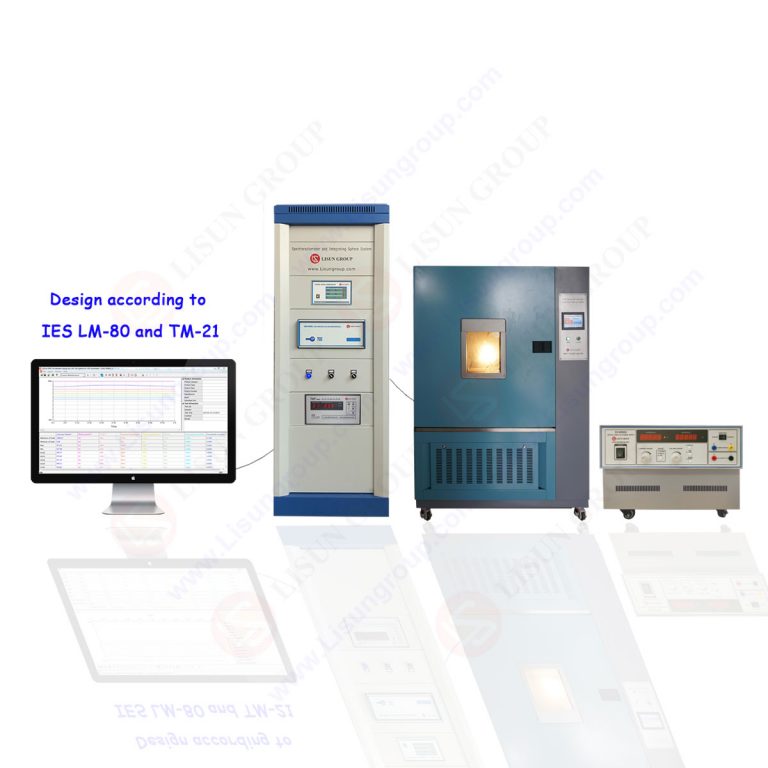
Selecting the appropriate LED optical aging test equipment is critical for ensuring long-term reliability and compliance with global lighting standards. This guide, based on LISUN’s 2025 expertise, provides a technical framework for choosing between LM-80/TM-21 and LM-84/TM-28 testing systems. We examine key specifications including 6000-hour test durations, L70/L50 metrics, Arrhenius-based projection software, and dual testing modes. Special attention is given to the LISUN LEDLM-80PL and LEDLM-84PL systems, which offer integrated sphere and goniophotometer compatibility, support for up to three connected temperature chambers, and customizable configurations. Technical professionals will gain actionable insights into standard compliance, hardware selection, and data extrapolation methodologies essential for LED lifetime validation.
1.1 The Role of Lumen Maintenance in LED Reliability
LED lumen depreciation is an irreversible physical process driven by junction temperature, drive current, and phosphor degradation. Optical aging test equipment quantifies this decay by measuring luminous flux at defined intervals under controlled thermal stress. The primary metric—L70 (time to 70% initial lumen output)—forms the basis for warranty claims and product certifications. Without standardized testing, manufacturers risk field failures that compromise brand reputation and regulatory compliance.
1.2 Core Industry Standards Framework
Four standards dominate LED aging validation:
- IES LM-80: Measures lumen maintenance at 55°C, 85°C, and optional third temperature (e.g., 105°C) for 6000+ hours, with mandatory 1000-hour data points
- IES LM-84: Extends LM-80 principles to LED lamps and luminaires, requiring 6000-hour minimum data with goniophotometer or integrating sphere measurements
- TM-21: Provides mathematical extrapolation from LM-80 data to estimate L70 beyond 6000 hours using exponential decay models
- TM-28: Analogous to TM-21 but applied to LM-84 data for lamp/luminaire projections
These standards mandate strict photometric measurement protocols—typically 25°C ambient—with spectral and temperature monitoring throughout the test cycle.
2.1 Dual System Variants: LEDLM-80PL vs. LEDLM-84PL
The LISUN portfolio addresses distinct application domains:
| Feature | LEDLM-80PL (LM-80/TM-21) | LEDLM-84PL (LM-84/TM-28) |
|---|---|---|
| Primary Standard | IES LM-80 | IES LM-84 |
| Extrapolation Method | TM-21 | TM-28 |
| Test Object | LED packages, modules, arrays | LED lamps, luminaires |
| Measurement Mode | Integrating sphere (2π or 4π) | Goniophotometer + integrating sphere |
| Temperature Chambers | Up to 3 connected units | Up to 3 connected units |
| Data Points | 1000–6000+ hours | 1000–6000+ hours |
| Output Metrics | L70, L50, Lxx projections | L70, L50, luminous efficacy |
Both systems share the Arrhenius-based software engine for accelerated aging prediction, customizable heating/cooling rates, and automatic data logging every 15 minutes. The LEDLM-84PL additionally includes spatial luminance uniformity scanning for complete luminaire characterization.
2.2 Testing Modes: Constant Current vs. Pulse Mode
LISUN integrates dual testing modalities:
- Constant Current Mode: Standard for LM-80 compliance, applying steady drive current (e.g., 350 mA for high-power LEDs) with ±0.5% stability. This reproduces real-world continuous operation and is mandatory for TM-21 data validity.
- Pulse Mode: Reduces self-heating during photometric measurements by applying 10–50 ms current pulses with 1% duty cycle, minimizing thermal interference. Critical for high-power LEDs where junction temperature fluctuates by >15°C under DC operation.
The system automatically switches between modes during measurement cycles, ensuring accurate flux readings without thermal bias.
3.1 Temperature Chamber Integration
Valid LED aging requires precise thermal control. The LISUN platform supports up to three interconnected temperature chambers (e.g., LISUN TC-1000 series), each capable of maintaining -40°C to +150°C with ±0.5°C uniformity. For systems testing 100+ LEDs simultaneously, chamber capacity must accommodate:
- Minimum 20 cm³ per LED package for airflow uniformity
- 1.0 m/s air velocity across DUT surfaces (per IEC 60068-2-14)
- 95% relative humidity tolerance for accelerated corrosion testing
Chamber-to-chamber synchronization ensures consistent data across temperature points, crucial for the Arrhenius activation energy calculation.
3.2 Photometric Detection Systems
LISUN integrates two measurement architectures:
Integrating Sphere (2π/4π configuration)
- Diameter options: 0.3 m (small packages), 0.5 m (modules), 1.0 m (luminaires)
- Spectral range: 380–780 nm with 2 nm resolution
- Maximum flux: 100,000 lm (1.0 m sphere)
- Compliance: CIE 84 (sphere photometry), CIE 127 (LED measurement)
Goniophotometer (Type C)
- Angular resolution: 0.5° (vertical) × 1.0° (horizontal)
- Luminous intensity measurement: 0–10,000 cd
- Report generation meeting IES LM-79-19 and CIE 70 standards
Select sphere-only systems for chip/module aging; choose combined sphere+goniometer for luminaire-level LM-84 testing.
4.1 Arrhenius-Based Projection Methodology
The software embeds the Arrhenius equation:
L(t) = L₀ × exp(-β × t)
Where β = A × exp(-Ea/(k × T))
- L(t): Lumen output at time t
- L₀: Initial lumen output
- β: Degradation rate constant
- Ea: Activation energy (0.2–1.0 eV typical for LEDs)
- k: Boltzmann constant (8.617 × 10⁻⁵ eV/K)
- T: Junction temperature (K)
By testing at two or three temperatures (e.g., 55°C, 85°C, 105°C), the system calculates Ea for each LED batch, then projects L70 at the target use temperature (usually 25°C or 55°C). The software automatically validates R² > 0.95 for acceptable fit, per TM-21 guidelines.
4.2 TM-21 vs. TM-28: Extrapolation Constraints
| Parameter | TM-21 (LM-80 data) | TM-28 (LM-84 data) |
|---|---|---|
| Minimum test duration | 6000 hours | 6000 hours |
| Maximum extrapolation | 6× test time | 6× test time |
| Example projection | 6000 h → 36,000 h L70 | 6000 h → 36,000 h L70 |
| Assumed model | Exponential decay | Exponential decay |
| Activation energy range | 0.3–0.8 eV | 0.3–0.8 eV |
Both standards restrict extrapolation to 6× the measured duration—6000 hours of real data supports projections up to 36,000 hours (approximately 4 years). Longer projections require physical testing to 10,000+ hours under modified standards (e.g., LM-80-15).
5.1 IES LM-79-19 for Initial Characterization
Before initiating aging tests, all LED samples must undergo LM-79-19 static measurement:
- Total luminous flux: Measured in a 2-meter integrating sphere (±3% uncertainty)
- Luminous efficacy: Calculated as lm/W with ±2% accuracy
- Color metrics: CCT (Δuv < 0.002), CRI (Ra), R9
- Electrical parameters: Voltage, current, power factor (True RMS)
These baseline values feed into the aging software’s normalization algorithms, ensuring that 100% flux corresponds to initial LM-79 data.
5.2 CIE 084 and CIE 070: Supplementary Standards
- CIE 084 (1989): Specifies the measurement of luminous flux from tubular fluorescent lamps and LEDs in integrating spheres—critical for 4π configurations where self-absorption corrections exceed 5%
- CIE 070 (1987): Defines goniophotometer measurement geometry, particularly angular resolution (≤1°) and scanning speed (<30°/s), which the LEDLM-84PL implements with 0.5° step resolution
Compliance with these standards ensures that aging data is universally accepted by third-party testing laboratories and regulatory bodies.
6.1 Sample Size and Statistical Validity
Per IES LM-80, a minimum of 20 LEDs per temperature condition (e.g., 55°C, 85°C, 105°C) is required, with 60 total samples for three-temperature studies. For LM-84 lamp testing, 5–10 luminaires per condition suffice due to higher unit cost. LISUN systems support 48–96 simultaneous test positions per chamber (LEDLM-80PL), enabling batch testing within 7–14 days for initial data points.
6.2 Environmental Control and Data Integrity
- Ambient temperature: Maintain 25±1°C during photometric measurements (per CIE 127)
- Humidity: <65% RH to prevent moisture-related degradation artifacts
- Vibration isolation: Optical tables with <1 µm displacement (0–100 Hz)
- Electrical stability: ±0.1% voltage regulation for drive current sources
The LISUN software logs every 15 minutes, with automatic anomaly detection for:
- Sudden >5% flux drop (indicates electrical failure)
- Temperature deviation >±2°C (chamber malfunction)
- Spectral shift >2 nm (phosphor degradation precursor)
7.1 Total Cost of Ownership Model
| Cost Component | LEDLM-80PL (Single System) | LEDLM-84PL (Single System) | Combined (Both) |
|---|---|---|---|
| Initial hardware | $35,000–$45,000 | $48,000–$62,000 | $78,000–$102,000 |
| Temperature chambers (3) | $12,000–$18,000 | $12,000–$18,000 | $12,000–$18,000 |
| Annual calibration | $2,500–$3,500 | $3,500–$5,000 | $5,500–$7,500 |
| Software updates | $1,200/year | $1,200/year | $2,000/year |
| Payback period (2-year) | ~$19,000/year savings | ~$26,000/year savings | ~$37,000/year savings |
Manufacturers testing both components (LM-80) and luminaires (LM-84) achieve 40% lower per-test cost versus outsourcing, with the added benefit of proprietary data control.
7.2 Upgrade Path and Scalability
LISUN systems support modular expansion:
- Temperature chamber addition: Up to 3 units (9 channels total) for simultaneous multi-temperature testing
- Measurement mode upgrade: Add goniophotometer module to LEDLM-80PL ($12,000) for LM-84 capability
- Software license: TM-28 upgrade ($3,500) for existing LEDLM-80PL users
This modularity allows laboratories to start with component testing (LEDLM-80PL) and scale to luminaire testing as client requirements evolve, minimizing initial capital outlay.
Selecting LED optical aging test equipment requires a systematic evaluation of applicable standards (LM-80, LM-84, TM-21, TM-28), test object type (components vs. luminaires), and hardware configuration (sphere vs. goniophotometer). The LISUN LEDLM-80PL and LEDLM-84PL systems provide dedicated solutions aligned with these technical demands, offering dual testing modes, up to three integrated temperature chambers, and Arrhenius-based projection software that automates L70/L50 calculations within TM-21/TM-28 constraints. For engineers managing 6000-hour validation programs, the ability to simultaneously test 48–96 LED packages or 5–10 luminaires with ±0.5% current stability ensures statistically robust data.
Key decision points include: (1) prioritizing LM-80 component testing for LED manufacturers, (2) choosing LM-84 luminaire testing for finished product validation, or (3) investing in a combined configuration for comprehensive coverage. The software’s real-time anomaly detection and automatic extrapolation reduce manual analysis errors while maintaining CIE 084, CIE 127, and LM-79-19 compliance. In the rapidly evolving LED market, where warranty periods extend to 50,000+ hours, reliable aging equipment is not optional—it is a strategic asset enabling regulatory certification, customer trust, and cost-effective R&D.
Q1: What is the minimum test duration required for valid TM-21 extrapolation using LISUN equipment?
A: Per IES LM-80 and TM-21, a minimum of 6000 hours of continuous test data is required for valid extrapolation up to 36,000 hours (6× test time). However, LISUN systems begin generating preliminary L70 projections after 3000 hours using the embedded Arrhenius model, provided the R² correlation coefficient exceeds 0.95. For official certification reports accepted by Energy Star or regulatory bodies, the full 6000-hour dataset must be collected. The equipment supports 15-minute interval logging, ensuring 24,000 data points per test channel over a standard 6000-hour run.
Q2: Can the LEDLM-80PL test high-power (HP) LEDs requiring >150°C junction temperatures?
A: Yes, the LEDLM-80PL integrates with LISUN TC-1000 temperature chambers capable of maintaining -40°C to +150°C with ±0.5°C uniformity. For HP LEDs exceeding 1000 mA drive current, the pulse measurement mode (10 ms pulses at 1% duty cycle) prevents additional self-heating during photometric readings. The software’s Arrhenius activation energy calculation accommodates Ea values up to 1.0 eV, typical for HP LED phosphor layers. Users should configure chamber air velocity to 1.5 m/s for adequate cooling, and ensure the integrating sphere’s photodetector has sufficient dynamic range (>1000:1) for high flux measurements.
Q3: How does the LISUN system handle LM-84 compliance for directional luminaries (e.g., track lights)?
A: The LEDLM-84PL features a Type C goniophotometer with ±0.5° angular resolution, meeting CIE 070 requirements for directional luminaire testing. The hardware rotates the EUT in two axes (vertical/horizontal) while maintaining constant current stability (±0.5%). LM-84 mandates 6000 hours of spatial luminous intensity distribution data at 5° intervals, which the system captures automatically. Post-processing software integrates total flux from goniometric data (per IES LM-79-19) and normalizes to initial values for L70/L50 projection under TM-28. Optional near-field photometric modules are available for complex luminaire geometries (e.g., retroreflectors).