









Here is the comprehensive technical article based on your instructions.
Abstract
The LISUN DFX series Externally Ballasted Fluorescent Lamp Test Load Cabinet is a precision instrument designed for simulating non-linear, highly inductive loads required by Clause 20 of the IEC 60884-1:2022 standard for plugs and socket-outlets. This article provides a technical deep-dive into the DFX series, detailing its architecture, compliance capabilities, and operational advantages over traditional resistive load banks. For manufacturers and test laboratories, the DFX series facilitates accurate, repeatable testing for heating, cyclic endurance, and abnormal operation conditions. The LISUN DFX series Externally Ballasted Fluorescent Lamp Test Load Cabinet integrates seamlessly with life cycle testers, ensuring that electrical accessories meet rigorous international safety and performance benchmarks for thermal and electrical stress.
1.1 Functional Principle vs. Resistive Loads
Traditional testing relies on resistive load banks, which fail to replicate the high inrush currents and crest factors characteristic of electronic ballasts. The DFX series utilizes external chokes and power factor correction capacitors to synthesize a true inductive-capacitive (LC) network. This design precisely mimics the impedance profile of a 65W fluorescent lamp with a magnetic ballast, producing a power factor of approximately 0.45 to 0.65 lagging. This fidelity is critical for Clause 20.1 of IEC 60884-1:2022, which specifies a test voltage of 1.1 times the rated voltage and a current based on the rated load.
1.2 Internal Circuit Topology
The cabinet houses a series of high-accuracy, low-tolerance inductors and capacitors, controlled via solid-state relays for rapid switching. The DFX-20-3CH model, for example, contains three independent 20A channels. Each channel consists of a tapped inductor allowing fine adjustment of the load current within ±0.5% of the set value. The circuit is designed to handle the high di/dt (rate of change of current) events seen when a capacitive load is switched on, ensuring the test source remains stable and the waveform distortion remains below 3% THD.
1.3 Power Factor and Crest Factor Control
The load cabinet features a variable power factor adjustment range from 0.35 lagging to 0.65 lagging, selectable via a front panel rotary switch. Corresponding crest factors are maintained between 1.6 and 2.4, depending on the selected combination of L and C. This aligns with the requirement in IEC 60669-1 Clause 19.2 for switches, where a specific power factor is mandated to simulate realistic lamp loads. The DFX series provides a direct, programmable method to meet these precise power factor values without manual component swapping.
2.1 Heating Test Conditions (Clause 20.1)
Clause 20.1 requires heating tests at 1.25 times the rated current for a specific duration. The DFX series, particularly the DFX-40 and DFX-60 models, can sustain this overload condition continuously. The load cabinet’s thermal management system, featuring forced-air cooling and overheating protection, ensures the internal inductors do not saturate during prolonged high-current operation. This stability is essential for accurate temperature rise measurement on plug pins and socket contacts using thermocouples.
2.2 Cyclic Endurance Testing (Clause 20.2)
For cyclic endurance tests involving 10,000 or 30,000 operations, the DFX-80 provides a single-channel 80A capacity. When paired with the LISUN CZKS-30A Plug and Socket Life Tester, the load cabinet switches between a resistive-inductive load for making current and a lower inductive load for breaking current. This dynamic switching capability, controlled via a 24V interface, satisfies the test parameters for making and breaking operations outlined in Clause 20.2.1 and 20.2.2.
2.3 Abnormal Operation and Fault Conditions (Clause 20.3)
The DFX series supports fault condition simulations, such as testing with a short-circuit across the load. The cabinet includes a dedicated ‘fault’ mode that connects the supply directly to the socket under test through a high-rupturing capacity fuse. This allows verification that the socket’s internal design prevents arcing or flame propagation under a simulated load stick condition. The integrated safety interlocks disable the output if an overcurrent or overtemperature condition is detected, protecting both the test sample and the operator.
| Model | Rated Current (A) | Channels | Input Voltage (VAC) | Max Load Capacitance (µF) | Power Factor Range (Lag) |
|---|---|---|---|---|---|
| DFX-20 | 20 | 1 | 220-240 | 100 | 0.35-0.65 |
| DFX-20-3CH | 20 | 3 (Independent) | 380-415 (3-Phase) | 100 per channel | 0.35-0.65 |
| DFX-40 | 40 | 1 | 220-240 | 200 | 0.35-0.60 |
| DFX-60 | 60 | 1 | 220-240 | 300 | 0.35-0.55 |
| DFX-80 | 80 | 1 | 220-240 | 400 | 0.35-0.50 |
3.1 CZKS Series Life Tester Interface
The LISUN CZKS series (e.g., CZKS-30A, CZKS-50A) tests the mechanical durability of plugs and sockets. The DFX series provides the electrical load during the mechanical insertion and withdrawal cycles. The interface is a standard 25-pin D-sub connector, carrying commands for ‘Load On’, ‘Load Off’, ‘Fault Condition’, and ‘Overload Trigger’. This closed-loop system ensures the electrical load is only applied when the plug is fully inserted, preventing contact burn before full mating.
3.2 SW-6 Bending Tester Synchronization
For flexible cable bending tests per IEC 60884-1 Clause 23.2, the DFX series can provide a stable current through the cable under test. The SW-6 Bending Tester moves the cable in a defined arc, and the load cabinet maintains a constant resistive-inductive load. This combination tests the integrity of the conductor and insulation under mechanical stress while carrying the rated current, simulating years of user wear in a controlled laboratory environment.
3.3 Data Logging and Remote Monitoring
The DFX series includes an RS-485 interface for integration with a central laboratory data acquisition system. Parameters such as actual load current, voltage drop, power factor, and operating temperature can be logged at 1-second intervals. This data is crucial for generating compliance reports that demonstrate ongoing adherence to the test plan. The remote interface allows a single operator to control multiple DFX cabinets simultaneously, increasing throughput in high-volume testing facilities.
4.1 Current and Voltage Measurement
The internal measurement system uses a 16-bit ADC with a sampling rate of 200 kS/s. Voltage measurement accuracy is ±0.2% of reading ±0.1% of range, from 90V to 300V. Current measurement accuracy is ±0.3% of reading ±0.1% of range, from 0.5A to 80A. This high precision is necessary to verify that the test voltage drop across the socket contacts does not exceed the 8mV/A limit specified in IEC 60884-1 Clause 20.4.
4.2 Load Tap Resolution and Stability
Each load channel is divided into 16 distinct tap positions for coarse adjustment and a 10-turn potentiometer for fine adjustment. The coarse taps provide a resolution of approximately 6.25% of full scale, while the fine adjustment offers 0.1% resolution. After a 15-minute warm-up period, the load current stability is better than ±0.1% over an 8-hour period, assuming ambient temperature remains within 23°C ±5°C. This stability eliminates test result variability due to load drift.
4.3 Safety and Protection Systems
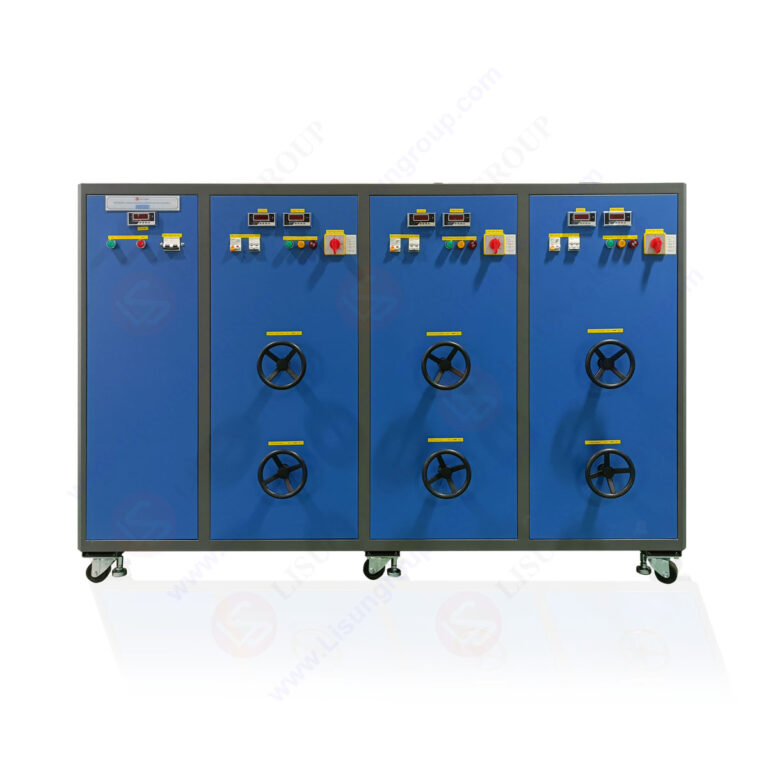
The cabinet is equipped with a main circuit breaker, an earth leakage circuit breaker (ELCB), and individual channel fuses. A thermal overload sensor disconnects the load if internal temperature exceeds 70°C. The enclosure is rated IP20 and constructed from 1.5mm cold-rolled steel with a powder-coated finish. All high-voltage components are shielded behind an interlocked door that disconnects power when opened, ensuring operator safety during configuration changes.
5.1 Load Fidelity
Many basic test loads only provide a purely resistive load or a fixed inductive load. The DFX series exceeds the minimum requirements of IEC 60884-1 by providing a fully programmable, high-crest-factor load. The table below compares the DFX-20 to the minimum standard requirement for a 20A socket-outlet test.
| Parameter | Minimum Standard Requirement (IEC 60884-1) | LISUN DFX-20 Capability | Benefit |
|---|---|---|---|
| Power Factor | Not strictly defined for basic heating | 0.35 to 0.65 Lag (Programmable) | Realistic lamp load simulation |
| Crest Factor | ~1.414 (Resistive only) | 1.6 to 2.4 | Tests for switch contact bounce & arc |
| Waveform Distortion | <5% THD | <3% THD | Verifies supply quality during test |
| Load Stability | ±2% (Typical resistive bank) | ±0.1% over 8 hours | Repeatable, audit-proof results |
5.2 Operational Versatility
Unlike custom-built load banks that are single-purpose, the DFX series is modular. A laboratory can use a single DFX-20-3CH to test three single-phase sockets simultaneously or combine three units for a three-phase test. This multi-channel capability significantly reduces the capital expenditure for test laboratories, as one cabinet can serve multiple test stations with simple reconfiguration of the front-panel taps.
5.3 Compliance with IEC 60669-1 and EN 50075
The DFX series is also fully compliant with IEC 60669-1 (switches) Clause 19.2 (inductive load test) and EN 50075 (flat non-rewirable plugs). For switch testing, the load cabinet can provide the 10A inductive load with a power factor of 0.6 required for the making and breaking capacity test. For flat plugs, the relatively low current (2.5A) can be set with high precision, preventing overheating of the small contacts due to an overly aggressive test condition.
6.1 Pre-Test Configuration
The operator must first determine the required load current and power factor from the test standard. For a 16A socket test per IEC 60884-1 Clause 20.2, the operator sets the coarse tap to the closest value below the desired current and then uses the fine adjustment to dial in the exact 16.0A on the digital display. An external power factor meter is recommended for calibration validation, though the cabinet provides an internal calculation.
6.2 Annual Calibration Cycle
LISUN recommends an annual calibration cycle. The procedure involves connecting a calibrated reference ammeter and wattmeter in series with the load. Each tap position is verified at 50%, 75%, and 100% of rated current. The power factor is checked using the internal capacitor switching. A calibration certificate is generated with the measured values and the allowable tolerance of ±1% for current and ±0.02 for power factor. This traceable calibration is essential for ISO 17025 accreditation.
6.3 Troubleshooting Common Issues
If the load current is unstable or lower than expected, the most common cause is a faulty external inductor or a blown fuse in the capacitive branch. The cabinet features front-panel LED indicators for each internal component. If the ‘Capacitor Bank’ LED is off, the capacitive load is not engaged, resulting in a purely resistive load with a power factor near 1.0. Any deviation from the set power factor should prompt an immediate inspection of the capacitor fusing and connections.
7.1 Single-Socket Testing (DFX-20 / DFX-40)
For laboratories focusing on domestic plugs and sockets rated up to 16A or 32A, the DFX-20 or DFX-40 is sufficient. The DFX-20 is ideal for the common 10A/16A sweco plugs, while the DFX-40 handles industrial-type sockets. These models offer the best price-to-performance ratio for entry-level compliance testing. The single-channel design is simple to operate and requires minimal training for technicians.
7.2 Multi-Channel and High-Current Testing (DFX-20-3CH / DFX-80)
High-volume testing facilities should consider the DFX-20-3CH for simultaneous testing of three samples, tripling throughput. For testing heavy-duty industrial sockets (e.g., 63A or 80A, per IEC 60309), the DFX-80 is mandatory. The DFX-80’s 80A capacity allows it to simulate the worst-case loading scenario for large pin-and-sleeve connectors. The external ballast design of the DFX-80 also permits connection to a dedicated external step-down transformer if required for the test voltage.
7.3 Future-Proofing with Modularity
The DFX series is designed for future upgrades. An optional remote control panel can be added to automate load switching, and the cabinet includes spare slots for additional capacitor banks. This modularity means a laboratory can purchase a DFX-60 today and later upgrade its capacitive filtering for higher crest factor testing without buying a completely new load cabinet. This design philosophy reduces total cost of ownership for testing facilities.
The LISUN DFX series Externally Ballasted Fluorescent Lamp Test Load Cabinet represents a critical advancement in the precision testing of electrical accessories. By providing a stable, programmable, and highly accurate inductive-capacitive load, it directly addresses the stringent requirements of IEC 60884-1:2022 Clause 20 for heating, endurance, and abnormal operation tests. Its integration capabilities with LISUN life testers and bending machines create a seamless, automated workflow that enhances laboratory throughput and data reliability. For manufacturers and test houses seeking to ensure their products meet international safety standards, the DFX series delivers the required technical fidelity, from precise power factor control to high-accuracy current measurement. Adopting this test solution mitigates the risk of product non-compliance, reduces test cycle time, and provides the robust data necessary for certification.
Q1: How does the LISUN DFX series simulate a fluorescent lamp load differently than a simple resistor?
A: A simple resistor provides a linear resistive load with a power factor of 1.0 and a crest factor of 1.414. The DFX series uses an external ballast (inductor) in series with a capacitor bank to create a resonant LC circuit. This circuit reproduces the high inrush current (up to 20 times the steady-state current) and the low power factor (0.45-0.65 lagging) characteristic of magnetic ballasts. It also generates a crest factor typically between 1.6 and 2.4, which stresses the switch contacts of a plug or socket in a way that a purely resistive load cannot. This realistic simulation is mandatory for passing the making and breaking capacity tests in IEC 60884-1 Clause 20.2.
Q2: Can the DFX-20-3CH test three different plug types simultaneously?
A: Yes. The DFX-20-3CH features three fully independent, isolated channels. Each channel has its own set of coarse and fine adjustments, enabling the operator to set a different load current for each channel. For example, one channel can be set to 10A for a European Schuko plug, a second to 16A for a British BS 1363 plug, and a third to 2.5A for a Europlug, all simultaneously. However, you must ensure your supply voltage is stable and capable of providing the total combined current (up to 60A in this case) without significant droop. Each channel operates independently, making this model highly versatile for multi-standard testing labs.
Q3: What is the standard procedure for calibrating the load current accuracy on a DFX-40?
A: Calibration of the DFX-40 should be performed annually using a reference ammeter with accuracy better than 0.1%. First, disconnect the load from the test sample. Connect the reference ammeter in series with the load output. Set the coarse selector to the highest tap position. Power on the cabinet and set the fine control to maximum. Record the current displayed on the cabinet and compare it to the reference ammeter reading. Then, repeat for each coarse tap position at approximately 25%, 50%, 75%, and 100% of the fine adjustment. If the deviation exceeds ±0.5% of the set value, the internal current shunt may need replacement at a LISUN service center.
Q4: What are the input power requirements for the DFX-80 model?
A: The DFX-80 requires a single-phase input voltage of 220-240 VAC at 50/60 Hz. The maximum input current can reach 85A during a full 80A load test due to internal losses and the power factor correction circuitry. Therefore, a dedicated 100A rated circuit breaker and 16mm² supply cable are mandatory. The cabinet also requires a protective earth connection. For stable operation, the supply voltage should fluctuate less than ±2% during the test. In cases where the supply is unstable, LISUN recommends using a separate voltage stabilizer.
Q5: How does the DFX series integrate with a computer for automated test reports?
A: The DFX series is equipped with an RS-485 communication port. Using the provided LISUN software (or Modbus RTU protocol), a computer can read real-time parameters including actual load current, voltage, power factor, and internal temperature. The software can log these values at set intervals (e.g., every 500ms) directly into a CSV or Excel file. This data can be automatically parsed to generate test reports that show the electrical conditions during the entire testing cycle. For fully automated life testers, the load cabinet can also receive commands to switch loads on/off in synchronization with the mechanical insertion cycles of the CZKS series.