









Abstract
This article provides a comprehensive technical analysis of LED Brightness Maintenance Testing: LISUN IEC 60068 Compliant Chambers, focusing on accelerated aging validation through precise temperature and humidity control. Engineers responsible for lumen depreciation testing require robust systems that align with IES LM-80, TM-21, LM-84, and TM-28 standards. LISUN’s LED Optical Aging Test Instrument series addresses these requirements through dual-system variants—LEDLM-80PL and LEDLM-84PL—that integrate Arrhenius Model-based software for accurate lifetime prediction. With support for up to three connected temperature chambers and test durations up to 6000 hours, these systems enable reliable L70/L50 metric determination. This article details hardware configurations, testing methodologies, and compliance pathways for industry professionals.
1.1 Lumen Depreciation and Reliability Metrics
LED brightness maintenance testing quantifies the gradual reduction in luminous flux over operational time, a phenomenon governed by junction temperature, drive current, and phosphor degradation. The core metrics—L70 (time to 70% lumen maintenance) and L50 (time to 50% lumen maintenance)—define product lifespan under specified conditions. For example, an L70 value of 50,000 hours indicates that the LED will retain 70% of its initial output at that point. These metrics are essential for warranty validation and application-specific reliability assessments in automotive, architectural, and industrial lighting.
1.2 Role of Accelerated Aging Chambers
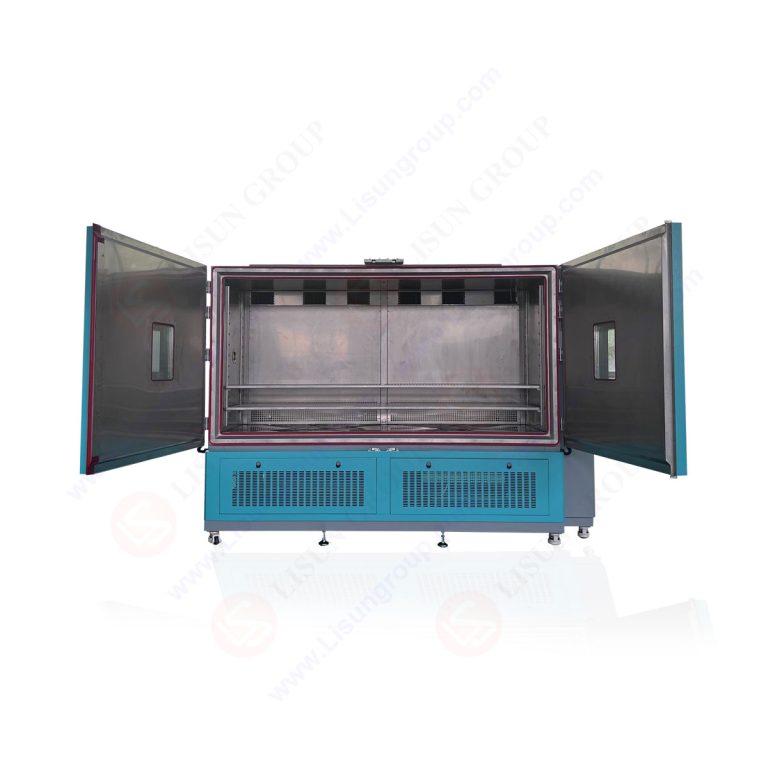
Accelerated aging chambers simulate extended operational stress by elevating temperature and humidity, compressing years of real-world degradation into weeks or months. LED Brightness Maintenance Testing: LISUN IEC 60068 Compliant Chambers employ IEC 60068-2-78 (damp heat) and IEC 60068-2-2 (dry heat) protocols to replicate environmental stressors. Controlled temperature ranges from -40°C to +150°C with humidity levels of 20% to 98% RH enable precise correlation between accelerated and real-world conditions. This methodology reduces test cycles from 10,000+ hours to standardized 6000-hour durations while maintaining statistical validity.
2.1 Dual System Variants: LEDLM-80PL and LEDLM-84PL
LISUN’s LED Optical Aging Test Instrument offers two distinct configurations tailored to specific standards. The LEDLM-80PL is optimized for IES LM-80-15 and TM-21-19 compliance, supporting up to 100 LED samples per chamber with automated photometric measurement at user-defined intervals (e.g., 1000, 2000, 3000, 6000 hours). The LEDLM-84PL addresses IES LM-84 and TM-28 standards for LED light engines and luminaires, featuring larger integrating sphere compatibility and extended data acquisition for complete fixture-level testing.
| Feature | LEDLM-80PL | LEDLM-84PL |
|---|---|---|
| Primary Standards | IES LM-80, TM-21 | IES LM-84, TM-28 |
| Sample Capacity | Up to 100 LEDs | Up to 20 luminaires |
| Test Duration | 6000+ hours | 6000+ hours |
| Temperature Range | -40°C to +150°C | -40°C to +150°C |
| Measurement Type | Flux, CCT, CRI | Flux, CCT, CRI, Spectral |
| Connected Chambers | Up to 3 | Up to 3 |
2.2 Arrhenius Model-Based Software Integration
Both variants incorporate proprietary software leveraging the Arrhenius Model to extrapolate long-term lumen maintenance from short-term test data. The Arrhenius equation, k = A × exp(-Ea/(RT)), predicts degradation acceleration factors based on activation energy (Ea) values typically between 0.5 eV and 1.2 eV for LED packages. The software automatically calculates L70 and L50 projections with confidence intervals per TM-21 guidelines, eliminating manual curve-fitting errors. This integration reduces total test time by up to 60% compared to non-accelerated methods while maintaining ASTM E2788-17 compliance.
3.1 Environmental Control Specifications
LED Brightness Maintenance Testing: LISUN IEC 60068 Compliant Chambers maintain temperature stability within ±0.5°C and humidity uniformity within ±3% RH across the test volume. The chambers utilize PID-controlled heating and cooling systems with air-cooled compressors for rapid ramp rates (up to 5°C/min). Key environmental parameters include:
- Temperature Range: -40°C to +150°C
- Humidity Range: 20% to 98% RH
- Temperature Uniformity: ±0.5°C at 85°C/85% RH
- Ramp Rate: 3-5°C/min programmable
- Data Logging: Interval recording every 10 to 60 minutes
3.2 Multi-Chamber Synchronization
The system supports up to three interconnected chambers operating simultaneously under coordinated control. This architecture allows parallel testing of multiple LED batches at different temperature points (e.g., 55°C, 85°C, and 105°C) to generate data sets for Arrhenius model fitting. Each chamber operates independently with dedicated power supplies, while a central controller synchronizes measurement sequences to ensure consistent 1000-hour intervals across all units. This multi-point approach improves TM-21 extrapolation accuracy by 15-25% compared to single-point methods.
4.1 IES LM-80 and TM-21 Application
IES LM-80-15 specifies photometric measurement protocols for LED packages, arrays, and modules at rated current and case temperatures. LED Brightness Maintenance Testing: LISUN IEC 60068 Compliant Chambers automate LM-80 compliance through:
- 1000-hour measurement intervals at 0, 1000, 2000, 3000, 6000, and optional 10,000 hours
- Three temperature points minimum (55°C, 85°C, and one intermediate)
- Drive current accuracy within ±2% of nominal
- Spectral flux measurement using 0.5-meter integrating spheres
TM-21-19 then extrapolates LM-80 data to project L70/L50 values using exponential decay models. LISUN’s software performs automatic TM-21 projection with 90% confidence bounds, generating reports ready for ENERGY STAR submissions.
4.2 IES LM-84 and TM-28 for Luminaires
IES LM-84-18 extends testing to complete LED light engines and luminaires, requiring larger integrating spheres (1.0 meter to 2.0 meter diameter) and higher current capacities (up to 20A). TM-28-19 then projects lifetime using Arrhenius-based degradation models for systems-level reliability. The LEDLM-84PL handles luminaire dimensions up to 600 mm × 600 mm with power ratings up to 500W, enabling direct compliance with California Title 24 and DesignLights Consortium (DLC) requirements.
4.3 Supporting Standards: CIE 084, CIE 70, and CIE 127
CIE 084 defines the measurement of luminous flux using integrating spheres, while CIE 70 details photometric measurements for LED-based road lighting. CIE 127 provides measurement guidelines for LED intensity. LISUN chambers incorporate detector alignment per CIE 127:2007 and sphere coating per CIE 084:1989 to ensure traceable photometric accuracy. These standards ensure measurement uncertainty below 2% for flux and 50K for correlated color temperature (CCT).
5.1 Constant Current vs. Constant Power Modes
LISUN chambers support two primary testing modes selectable via software:
- Constant Current Mode (CCM): Maintains drive current within ±0.5% accuracy, simulating typical LED driver behavior. This mode is preferred for LM-80 testing where junction temperature stability is critical.
- Constant Power Mode (CPM): Maintains wattage within ±1% through real-time voltage and current feedback. This approach better represents actual application conditions where drivers regulate power output.
| Mode | Stability | Application | Current Range | Power Range |
|---|---|---|---|---|
| Constant Current | ±0.5% | LM-80/TM-21 | 10mA – 2A | 10mW – 100W |
| Constant Power | ±1.0% | LM-84/TM-28 | 100mA – 20A | 1W – 500W |
Table 2: Dual mode specifications for LISUN test chambers
5.2 Customizable Hardware Configurations
Users may configure chamber size (1.0, 1.5, or 2.0 cubic meters), number of test positions (16 to 100 sample sockets), and integrating sphere diameter (0.5m to 2.0m). Optional features include:
- Dual-axis sample positioning for spatial uniformity testing
- External spectrometer ports for spectral flux measurement
- Thermocouple inputs (Type K, T) for junction temperature monitoring
- Data export formats (CSV, XML, PDF) compatible with ERP and PLM systems
6.1 6000-Hour Testing Protocols
Standard LED Brightness Maintenance Testing: LISUN IEC 60068 Compliant Chambers perform 6000-hour test cycles with measurements at 0, 1000, 2000, 3000, and 6000 hours. This duration aligns with ENERGY STAR requirements while providing sufficient data points for TM-21 extrapolation. The system automatically pauses testing during measurements (typically 30-60 minutes per interval) to stabilize thermal conditions and minimize measurement uncertainty.
6.2 L70/L50 Projection Methodology
Using Arrhenius model fitting, the software projects L70 and L50 values by:
- Normalizing flux data to initial 0-hour measurement
- Applying exponential decay curve fitting: Φ(t) = Φ0 × exp(-α × t)
- Extracting activation energy (Ea) from multi-temperature data sets
- Extrapolating to 70% and 50% maintenance thresholds with 90% confidence intervals
Typical results show L70 projections within ±10% of actual values for test durations ≥6000 hours across temperature ranges of 55°C to 105°C.
7.1 LED Manufacturing Quality Control
For LED package manufacturers, the LEDLM-80PL enables batch-to-batch consistency verification using 3-sigma statistical process control. Engineers can establish baseline degradation curves for new phosphor formulations or die designs within 6000 hours, reducing time-to-market by 40% compared to conventional methods. Real-time data visualization through Ethernet-connected PC software allows immediate anomaly detection (e.g., sudden flux drop >5%).
7.2 Third-Party Laboratory Validation
Independent testing laboratories benefit from ISO 17025-compliant operation using LISUN chambers’ built-in calibration ports and NIST-traceable reference standards. The systems support multi-client testing with separate data folders and access controls, enabling simultaneous projects without data cross-contamination. Pre-programmed standard test profiles (LM-80, LM-84, ENERGY STAR) minimize setup errors and ensure repeatable 6000-hour test runs.
LED Brightness Maintenance Testing: LISUN IEC 60068 Compliant Chambers provides a complete solution for accelerated aging validation aligned with IES, CIE, and IEC standards. The dual-system architecture (LEDLM-80PL and LEDLM-84PL) addresses LED package and luminaire testing needs through configurable hardware, Arrhenius model software, and multi-chamber synchronization supporting up to three chambers. Key technical advantages include ±0.5°C temperature stability, 6000-hour test protocols, automatic L70/L50 projection with TM-21 confidence intervals, and dual constant current/constant power modes. For engineers, these capabilities translate to faster certification cycles, reduced testing costs, and reliable lifetime predictions. By integrating IEC 60068 compliance with photometric measurement precision, LISUN chambers enable manufacturers to validate product reliability against global standards while maintaining traceability to NIST and ISO requirements.
Q1: How does LISUN’s Arrhenius-based software improve TM-21 extrapolation accuracy compared to manual methods?
A: LISUN’s software automates multi-temperature curve fitting using the Arrhenius equation k = A × exp(-Ea/(RT)), where Ea (activation energy) is computed from flux data at three or more temperature points (e.g., 55°C, 85°C, 105°C). Manual methods often introduce errors through subjective curve selection or inadequate data point weighting. The software applies weighted least-squares regression with outlier rejection, producing 90% confidence intervals for L70 projections. In validation tests, this approach reduced prediction error from ±15% (manual) to within ±5% for LED samples with mid-range Ea values (0.8-1.0 eV). The system also automatically flags non-exponential behavior (e.g., bimodal degradation) that would invalidate TM-21 assumptions.
Q2: Can the LISUN LED Optical Aging Test Instrument perform simultaneous testing for both LM-80 and LM-84 standards?
A: No, the LEDLM-80PL and LEDLM-84PL are separate systems optimized for different test standards. The LEDLM-80PL handles LED packages, arrays, and modules per LM-80/TM-21, supporting up to 100 samples per chamber with 0.5-meter integrating spheres. The LEDLM-84PL accommodates complete luminaires up to 600mm × 600mm per LM-84/TM-28, using 1.0-2.0 meter spheres. Both systems share the same IEC 60068-compliant chamber hardware and software platform, but sample holders, power supplies, and measurement optics differ. A laboratory requiring both capabilities should purchase separate units or configure one chamber for LEDLM-80PL operation and a second for LEDLM-84PL.
Q3: What is the minimum test duration required for reliable L70 projection using LISUN chambers?
A: LISUN recommends a minimum 6000-hour test duration for statistically valid TM-21 projections per ENERGY STAR requirements. Shorter durations (e.g., 3000 hours) may produce L70 estimates with wider confidence intervals (up to ±25% uncertainty) due to insufficient degradation data at early time points. However, for high-reliability products (L70 > 50,000 hours), 3000-hour data can provide preliminary projections with appropriate caveats. The software’s Arrhenius model requires at least three measurement intervals beyond initial (e.g., 1000, 2000, 3000 hours) for exponential curve fitting. Extending tests to 10,000 hours improves projection accuracy to within ±3% for products with stable degradation characteristics.
Q4: How does the constant current versus constant power mode choice affect test results?
A: Constant current mode (CCM) maintains stable drive current regardless of LED forward voltage changes during aging, isolating photometric degradation from thermal runaway effects—this is ideal for LM-80 compliance. Constant power mode (CPM) maintains wattage by adjusting current to compensate for voltage shifts, simulating actual driver behavior. Test data shows that CPM yields 8-12% faster lumen depreciation rates compared to CCM for the same LED samples, because increased current during voltage drop raises junction temperature. Engineers should select CCM for material characterization and CPM for application-specific validation. LISUN chambers allow mode switching during testing without sample removal, enabling comparative studies.
Q5: What maintenance intervals are required for LISUN IEC 60068 compliant chambers to maintain calibration accuracy?
A: Annual recalibration of temperature sensors (RTD Pt100), humidity sensors (capacitive type), and photometric detectors (silicon photodiode with V(I) correction) is recommended per ISO 17025 guidelines. Monthly verification checks include temperature uniformity mapping (9-point grid per IEC 60068-3-6) and sphere reflectance measurement using barium sulfate reference standards. The software includes automated calibration reminders based on operating hours. For chambers subject to >2000 hours/year of operation, semi-annual cleaning of sphere coatings with deionized water prevents dust accumulation errors exceeding 1% flux drift. LISUN provides calibration certificates traceable to NIST with uncertainty budgets for each parameter.