









Abstract
This article provides a comprehensive technical examination of
LED Luminaire L70 Lumen Maintenance Testing with LISUN Aging Instruments, focusing on accelerated aging methodologies, photometric degradation analysis, and compliance with global industry standards. As LED technology matures, accurate prediction of lumen maintenance life—specifically L70 and L50 metrics—becomes critical for warranty validation and product certification. LISUN’s LED Optical Aging Test Instrument series, comprising the LEDLM-80PL for LM-80/TM-21 compliance and the LEDLM-84PL for LM-84/TM-28 protocols, delivers dual-system flexibility with Arrhenius Model-based software, 6000-hour test durations, and support for up to three connected temperature chambers. This article bridges theoretical degradation models with practical testing configurations, offering LED manufacturers and testing laboratories actionable insights into reliable lifetime prediction.
1.1 Defining L70 and L50 Metrics in Context
Lumen maintenance metrics quantify the luminous flux depreciation of LED sources over operational time. L70 represents the point at which light output falls to 70% of initial lumens, while L50 corresponds to 50% maintenance. These thresholds are defined per IES LM-80 and LM-84 standards, which mandate photometric measurements under controlled temperature and current conditions. For LED luminaires, L70 is the industry-accepted benchmark for useful life, typically projected beyond actual test durations using TM-21 or TM-28 extrapolation algorithms. LISUN’s aging instruments capture luminous flux data at programmed intervals, enabling precise identification of L70 and L50 crossing points.
1.2 The Role of Accelerated Aging in Lifetime Prediction
Accelerated aging tests compress years of operational stress into weeks by elevating ambient temperatures and drive currents. This approach relies on the Arrhenius Model, which quantifies reaction rate acceleration from thermal stress. LISUN’s integrated software automatically calculates acceleration factors based on user-defined activation energies (typically 0.3–0.7 eV for LED packages). The Arrhenius equation, ( k = A cdot e^{-E_a/(R cdot T)} ), where ( E_a ) is activation energy, ( R ) is the universal gas constant, and ( T ) is absolute temperature, forms the backbone of L70 projection from high-temperature data.
1.3 Differences Between Component-Level and Luminaire-Level Testing
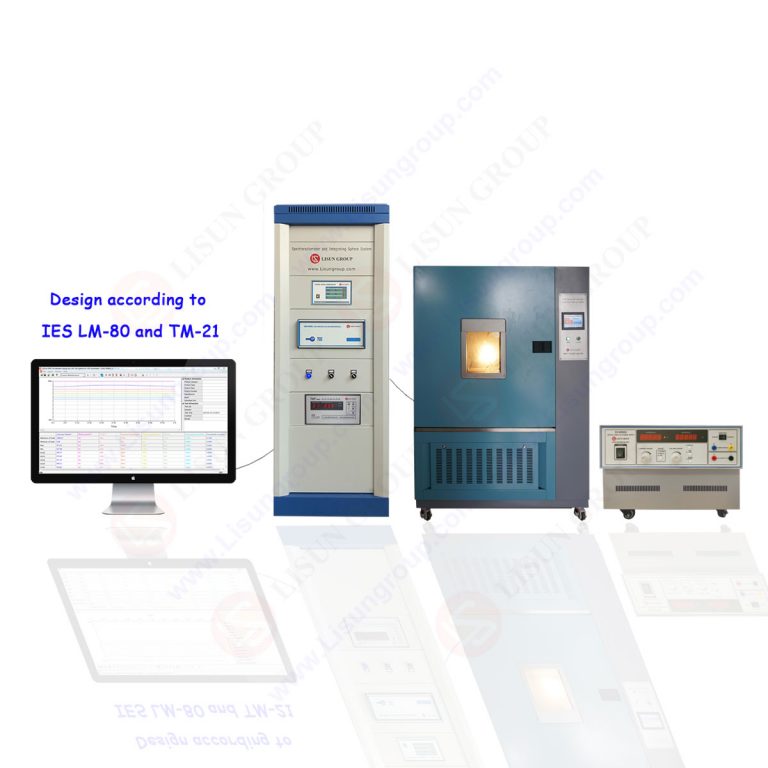
Component-level testing per LM-80 focuses on LED packages, arrays, or modules at three case temperatures (55°C, 85°C, and a user-defined temperature), requiring minimum 6000 hours. Luminaire-level testing per LM-84 evaluates complete fixtures including optics, drivers, and thermal management, often at single ambient temperatures. LISUN offers dedicated chambers for each: the LEDLM-80PL supports multiple DUT positions with independent temperature control, while the LEDLM-84PL accommodates full luminaires with larger internal dimensions.
2.1 Dual System Variants: LEDLM-80PL and LEDLM-84PL
The LEDLM-80PL is optimized for LM-80/TM-21 testing of LED components, featuring 30–60 DUT positions, precise current sourcing up to 2A, and temperature stability within ±0.5°C. The LEDLM-84PL extends capabilities to full luminaires, with DUT dimensions up to 800mm x 600mm x 500mm and programmable AC/DC power supplies for driver characterization. Both systems share a common software platform for data logging, Arrhenius calculations, and TM-21/TM-28 reporting.
2.2 Arrhenius Model-Based Extrapolation Software
LISUN’s proprietary software implements TM-21 nonlinear regression to project L70 (or L50) from collected data. Users input measured luminous flux at each reading interval, and the software fits a two-parameter exponential decay model: ( Phi(t) = Phi_0 cdot e^{-alpha t} ). The decay coefficient ( alpha ) is temperature-corrected using Arrhenius factors, producing a projected lifetime curve. The software automatically flags outliers and computes confidence intervals, aligning with IES guidelines for extrapolation limits.
2.3 Dual Testing Modes and Customizable Configurations
Systems offer two operational modes: Constant Temperature Mode, maintaining steady ambient conditions for standard aging; and Cyclic Temperature Mode, simulating diurnal or seasonal thermal variation per LM-84. Customizable parameters include reading intervals (1 minute to 24 hours), temperature ramp rates (0.5–5°C/min), and power supply voltage ranges (0–300V AC/DC). Up to three temperature chambers can be networked to a single control station, enabling simultaneous multi-condition testing.
2.4 Temperature Chamber Specifications and Connectivity
Each chamber provides a temperature range of -10°C to +100°C, with uniformity better than ±1.0°C across the workspace. Internal sensors monitor ambient and DUT case temperatures at 10-second intervals. Connectivity includes Ethernet, USB, and RS-232 interfaces for remote monitoring and data export to third-party analysis tools.
3.1 IES LM-80: Lumen Maintenance of LED Packages
IES LM-80 defines test methods for measuring lumen maintenance of LED light sources at specified drive currents and case temperatures. The standard requires 6000 hours of data (or 10000 hours for extended reporting) with readings at 1000-hour intervals minimum. LISUN’s LEDLM-80PL automates this process, maintaining temperature tolerance within ±2°C and current accuracy within ±1% of setpoint.
3.2 IES LM-84: Lumen Maintenance of LED Luminaires
LM-84 extends LM-80 principles to complete luminaires, accounting for driver losses, thermal interface materials, and optical degradation. The standard allows for single-temperature testing at rated ambient conditions, with optional elevated temperature for acceleration. LISUN’s LEDLM-84PL supports LM-84 compliance by integrating photometric measurement ports for in-situ luminous flux monitoring via integrating sphere or goniophotometer.
3.3 TM-21 and TM-28 Extrapolation Protocols
TM-21 specifies the exponential decay model for projecting L70 from LM-80 data, limiting extrapolation to 6× the test duration (e.g., 36000 hours from 6000-hour data). TM-28 similarly addresses luminaire-level projections from LM-84 data. LISUN’s software automatically calculates maximum extrapolation limits and generates graphical reports showing projected lumen maintenance curves with 95% confidence bounds.
3.4 IES LM-79-19, CIE 084, CIE 070, and CIE 127 Integration
While LM-79-19 governs photometric testing for SSL products, LISUN’s instruments integrate with LM-79-compliant goniophotometers for initial flux calibration. CIE 084 defines integrating sphere measurement protocols for total luminous flux, and CIE 070 addresses LED intensity measurement conditions. CIE 127 specifies LED optical radiation safety limits, ensuring that aging test data also supports compliance with eye safety standards.
4.1 Key Performance Parameters
The table below compares critical specifications for both system variants.
| Parameter | LEDLM-80PL | LEDLM-84PL |
|---|---|---|
| DUT Type | LED packages, arrays, modules | Complete luminaires |
| Chamber Temperature Range | -10°C to +100°C | -10°C to +100°C |
| Temperature Uniformity | ±0.5°C | ±1.0°C |
| Maximum DUT Positions | 60 | 10 (luminaire) |
| Power Supply | DC 0–30V, 0–2A per DUT | AC/DC 0–300V, 0–5A |
| Photometric Measurement | External integrating sphere | In-situ with fiber optic probe |
| Data Acquisition Interval | 1 min to 24 hours | 1 min to 24 hours |
| Standards Compliance | LM-80, TM-21 | LM-84, TM-28 |
| Arrhenius Software | Included | Included |
4.2 Selecting the Appropriate System
For component manufacturers requiring LM-80 certification, the LEDLM-80PL offers high-density testing with 60 DUT positions. Luminaire manufacturers or testing labs seeking LM-84 compliance should choose the LEDLM-84PL, which accommodates larger fixtures and integrates power cycling profiles. Both systems support networking of up to three chambers for multi-temperature studies.
4.3 Calibration and Maintenance Requirements
Annual calibration of temperature sensors, current sources, and photometric probes is recommended. LISUN provides calibration standards traceable to national laboratories, including NIST-traceable reference lamps for photometric validation.
5.1 Sample Preparation and initial Characterization
DUTs undergo initial photometric measurement per IES LM-79-19, recording total luminous flux, correlated color temperature (CCT), and chromaticity coordinates. For LEDLM-80PL tests, components are mounted on thermal interface materials with case temperature sensors attached. For LEDLM-84PL, luminaires are stabilized at rated input voltage for 30 minutes before initial measurement.
5.2 Data Collection Protocols Over 6000-Hour Durations
Tests run for 6000 hours minimum, with scheduled interruptions for photometric measurements at 0, 1000, 2000, 3000, 4000, 5000, and 6000 hours. LISUN’s software logs in-situ luminous flux via integrating sphere or goniophotometer, automatically correcting for instrument drift. Chamber conditions are recorded continuously, with temperature excursions logged for exclusion from analysis.
5.3 L70 and L50 Interpolation and Extrapolation
Using TM-21 kinetics, the software fits the exponential decay model to collected data. L70 is determined when the fitted curve crosses 70% maintenance, typically requiring extrapolation beyond test duration. LISUN’s algorithm calculates the projected L70 at the use temperature (e.g., 25°C or 55°C) using Arrhenius scaling, reporting results in hours with confidence intervals.
5.4 Common Failure Modes and Data Anomalies
Data anomalies may result from thermocouple detachment, power supply interruptions, or DUT failure. LISUN’s software includes outlier detection algorithms based on Z-scores, flagged for operator review. Common failure modes include catastrophic LED failure (sudden luminous flux drop >10%), driver failure (complete loss of light), and chromaticity shift (Δu’v’ >0.006).
6.1 Activation Energy Determination
The Arrhenius model requires accurate activation energy ( E_a ) for the LED under test. LISUN’s software supports three methods: user-defined ( E_a ) based on known package chemistry, derived from multi-temperature testing (minimum three temperatures), or literature values for generic LED technologies (e.g., 0.4 eV for InGaN blue LEDs).
6.2 Accelerated Factor Calculation and Reporting
Accelerated factor ( AF ) is calculated as ( AF = e^{(Ea/k) cdot (1/T{use} – 1/T_{test})} ), where ( T ) is absolute temperature. The software automatically computes AF for each test temperature and references the use temperature specified by the user (typically 25°C for indoor luminaires, 55°C for outdoor fixtures). Results are tabulated in the final report.
6.3 Lifetime Projection Confidence Intervals
TM-21 requires reporting of 95% confidence intervals for extrapolated L70. LISUN’s software implements bootstrapping methods to compute uncertainty ranges, accounting for measurement noise and model fitting errors. Reports include upper and lower bound projections, enabling conservative warranty statements.
7.1 LED Manufacturing Quality Control
Manufacturers use LISUN instruments to validate production batches against design targets, ensuring L70 >50,000 hours at 25°C. Incoming inspection protocols test 30 samples per batch, with results driving warranty terms and product labeling.
7.2 Third-Party Testing Laboratory Workflows
Accredited labs employ LISUN systems for certification testing, generating reports compliant with IES LM-80 or LM-84. The dual-system architecture allows simultaneous component and luminaire testing, maximizing throughput. Typical lab configuration includes two LEDLM-80PL units and one LEDLM-84PL chamber.
7.3 Automotive and Specialty Lighting Applications
Automotive LED modules require L70 testing per AEC-Q102, with stringent temperature cycling profiles. LISUN’s cyclic temperature mode replicates thermal shock conditions from -40°C to +125°C, while the software tracks lumen maintenance under transient thermal stress.
7.4 Integration with LISUN Photometric Equipment
LISUN’s aging instruments integrate seamlessly with LMS series integrating spheres and GON series goniophotometers, enabling simultaneous aging and photometric characterization. This integrated workflow reduces measurement uncertainty and accelerates certification timelines.
LED Luminaire L70 Lumen Maintenance Testing with LISUN Aging Instruments delivers a robust, standards-compliant framework for predicting LED reliability. By combining the LEDLM-80PL and LEDLM-84PL dual-system architecture, engineers can test components and luminaires under identical software environments, ensuring consistency across product hierarchies. The Arrhenius Model-based extrapolation software automates TM-21 and TM-28 projections, reducing manual calculation errors and providing statistically defensible L70 values. With support for up to three networked temperature chambers and 6000-hour test durations, LISUN’s instruments meet the throughput demands of high-volume manufacturing and accreditation laboratories. The integration of IES LM-80, LM-84, TM-21, TM-28, and CIE standards ensures global regulatory acceptance. For LED manufacturers and testing labs, investing in LISUN’s aging test systems translates directly to faster time-to-market, more reliable warranty predictions, and strengthened compliance portfolios.
Q1: What is the minimum test duration required to obtain a valid L70 projection per IES TM-21 using LISUN instruments?
A: IES TM-21 requires a minimum of 6000 hours of photometric data collected per IES LM-80 protocols. LISUN’s LEDLM-80PL and LEDLM-84PL systems are designed to run uninterrupted for this duration, with automated data logging at user-defined intervals (e.g., 1000 hours). The maximum permissible extrapolation is 6× the test duration, meaning a 6000-hour test can project L70 up to 36,000 hours. For extended projections (e.g., 100,000 hours), testing 10,000 hours or more is necessary. LISUN’s software automatically enforces these extrapolation limits per IES guidelines and generates graphical reports with confidence bounds. Users configuring tests for LM-80 compliance should ensure DUTs remain within temperature tolerances and that photometric measurements are taken at scheduled milestones.
Q2: How does the Arrhenius Model in LISUN software account for LED degradation mechanisms beyond thermal stress?
A: The standard Arrhenius Model addresses only thermal acceleration of chemical reactions, primarily encapsulant yellowing and phosphor degradation. LISUN’s software is configurable to incorporate current acceleration factors using the Eyring Model extension, which adds electric field strength as a variable. Users can input both thermal activation energy and current acceleration coefficients derived from separate current-aging tests. For comprehensive degradation analysis, LISUN recommends combining Arrhenius-based thermal testing with constant current cycling per LM-84, which captures solder joint fatigue and driver component wear. The software also supports multi-stress modeling when users provide empirical data from temperature-humidity tests, extending applicability to moisture-sensitive LED packages.
Q3: What are the key differences between TM-21 (component-level) and TM-28 (luminaire-level) extrapolation methods as implemented in LISUN instruments?
A: TM-21 applies to LED packages, arrays, and modules tested per LM-80, using a two-parameter exponential decay model. TM-28 applies to complete luminaires tested per LM-84, allowing for more complex degradation patterns including driver effects and thermal interface degradation. LISUN’s software implementation for TM-28 supports piecewise regression, where the decay rate can change after an inflection point (e.g., after driver failure). Projection limits also differ: TM-21 allows 6× test duration while TM-28 allows 3× test duration due to higher uncertainty. The LEDLM-84PL software automatically selects the appropriate model based on the DUT type selected at test setup, and reports include both projected L70 values and confidence intervals per the respective standard.
Q4: Can LISUN aging instruments test LED modules with integrated drivers requiring AC input?
A: Yes, the LEDLM-84PL variant includes programmable AC power supplies with voltage range 0–300V, frequency range 50/60 Hz, and current capability up to 5A. This accommodates luminaires with integrated AC-DC drivers. For DC-powered modules, the LEDLM-80PL provides per-DUT current sourcing from 0–2A with 1 mA resolution. LISUN also offers optional power analyzers that monitor real-time input power, power factor, and THD during aging, enabling correlation between electrical degradation and lumen depreciation. Users should configure test setup based on DUT electrical specifications and ensure power supply settings are stable within ±1% throughout the test duration.
Q5: How does LISUN ensure temperature uniformity across multiple DUT positions in the aging chamber?
A: LISUN chambers employ forced air circulation with high-CFM blowers and multiple air intake/exhaust ports to maintain uniformity within ±0.5°C (LEDLM-80PL) or ±1.0°C (LEDLM-84PL). Temperature sensors are placed at three chamber zones (top, middle, bottom) and data is logged continuously. DUT case temperatures are monitored via k-type thermocouples attached to the LED package or heatsink. The control system modulates heater and cooling power using PID algorithms with 0.1°C resolution. Users can also configure temperature mapping at test start by placing reference thermocouples at all unoccupied DUT positions. LISUN recommends not exceeding 80% chamber capacity to ensure airflow does not become blocked by DUTs, which would degrade uniformity.