









This technical article provides a comprehensive analysis of the LED Optical Aging Test Box: IES LM-80 & TM-21 Compliance, focusing on LISUN’s LEDLM-80PL and LEDLM-84PL systems designed for rigorous lumen maintenance testing. As LED manufacturers face increasing demands for reliability data spanning 6,000 hours or more, adherence to IES LM-80-15 and TM-21-19 standards becomes critical for product certification and market acceptance. The article explores dual-system architectures, Arrhenius Model-based predictive software, customizable hardware configurations supporting up to three temperature chambers, and the integration of L70/L50 metrics for lifetime projection. Technical professionals will gain actionable insights into accelerated aging protocols, data acquisition methodologies, and extrapolation techniques that ensure compliance with global lighting regulations. By combining theoretical principles with practical implementation strategies, this guide equips engineers with the knowledge required to optimize LED reliability testing workflows and achieve defensible lumen maintenance data.
1.1 The Imperative of IES LM-80 and TM-21 Standards
The Illuminating Engineering Society (IES) LM-80-15 standard establishes the approved method for measuring lumen maintenance of solid-state lighting (SSL) components, including LED packages, arrays, and modules. This standard mandates testing at multiple case temperatures (typically 55°C, 85°C, and a third temperature selected by the manufacturer) over a minimum duration of 6,000 hours. TM-21-19, the companion standard, provides the mathematical framework for projecting long-term lumen maintenance values—specifically L70 (time to 70% lumen maintenance) and L50 (time to 50% lumen maintenance)—based on LM-80 test data. For the LED Optical Aging Test Box: IES LM-80 & TM-21 Compliance, these standards form the operational backbone, ensuring that test results are reproducible, defensible, and accepted by regulatory bodies such as ENERGY STAR and the DesignLights Consortium (DLC).
1.2 Role of Accelerated Aging in Lumen Depreciation Prediction
Accelerated aging tests leverage elevated temperatures to expedite the degradation mechanisms inherent in LED components, including phosphor thermal quenching, solder joint fatigue, and encapsulant yellowing. The Arrhenius Model, mathematically expressed as ( text{Lifetime} = A cdot e^{E_a/(k cdot T)} ), relates reaction rate to temperature, enabling engineers to predict performance at nominal operating conditions from high-stress test data. The LISUN LED Optical Aging Test Instrument integrates this model directly into its software suite, allowing real-time calculation of activation energy (Ea) and acceleration factors. By testing at multiple temperature setpoints, typically 55°C, 85°C, and 105°C, the system generates sufficient data points for TM-21’s nonlinear regression analysis, which then projects L70 values up to 36,000 hours (6× the test duration) with acceptable statistical confidence.
1.3 Integration of IES LM-84 and TM-28 for Comprehensive Validation
While LM-80 focuses on individual LED components, IES LM-84-20 addresses lumen maintenance testing for integrated LED lamps and luminaires. TM-28-14 provides the projection methodology for these complete systems. The LISUN LEDLM-84PL variant specifically targets LM-84/TM-28 applications, offering a dedicated photometric measurement path that includes an integrating sphere for total luminous flux measurement. This dual-system approach—LEDLM-80PL for component-level testing and LEDLM-84PL for luminaire-level testing—ensures that manufacturers can validate reliability across their entire product portfolio. For the LED Optical Aging Test Box: IES LM-80 & TM-21 Compliance, supporting both standards expands the addressable test scope from individual LED packages to finished lighting products, a critical capability for vertically integrated manufacturers.
2.1 Dual System Variants: LEDLM-80PL vs. LEDLM-84PL
The LISUN product line distinguishes two primary configurations tailored to specific application domains. The LEDLM-80PL is engineered exclusively for LM-80/TM-21 compliance, featuring high-temperature oven modules that accommodate up to 100 LED samples per chamber. Each oven maintains temperature stability within ±2°C across a range from ambient +10°C to 120°C. In contrast, the LEDLM-84PL incorporates an integrating sphere photometer (typically 0.5m, 1m, or 2m diameter) for absolute photometric measurements of complete luminaires, aligning with LM-84 testing protocols. Table 1 provides a comparative overview:
Table 1: Comparative Specifications of LEDLM-80PL and LEDLM-84PL Systems
| Parameter | LEDLM-80PL (Component-Level) | LEDLM-84PL (Luminaire-Level) |
|---|---|---|
| Primary Standard | IES LM-80-15, TM-21-19 | IES LM-84-20, TM-28-14 |
| Sample Capacity | Up to 100 LEDs per chamber | Up to 10 luminaires per chamber |
| Measurement Method | In-situ photodetector array | Integrating sphere (0.5m-2m) |
| Temperature Range | Ambient +10°C to 120°C | Ambient +10°C to 85°C |
| Test Duration | Minimum 6,000 hours | Minimum 6,000 hours |
| Extrapolation Output | L70, L50 per TM-21 | L70, L50 per TM-28 |
| Interface | Software-controlled DAQ | Software-controlled DAQ |
2.2 Arrhenius Model-Based Software and Predictive Analytics
The embedded software suite represents the analytical engine of the LED Optical Aging Test Box: IES LM-80 & TM-21 Compliance. It implements TM-21’s recommended two-parameter exponential decay model: ( Phi(t) = alpha cdot e^{-beta t} ), where ( Phi(t) ) is the normalized luminous flux at time t, α is the initial flux parameter, and β is the decay rate constant. The software automatically performs least-squares fitting on test data collected at 1,000-hour intervals, rejecting outliers that exceed ±3σ from the regression curve. Additionally, the Arrhenius Model module calculates activation energy (Ea) across the three test temperatures, typically yielding values between 0.3 eV and 1.0 eV for modern LEDs. This enables engineers to predict lifetime under any user-defined operating temperature, a feature essential for automotive and outdoor lighting applications where thermal conditions vary significantly.
2.3 Customizable Hardware Configuration and Multi-Chamber Support
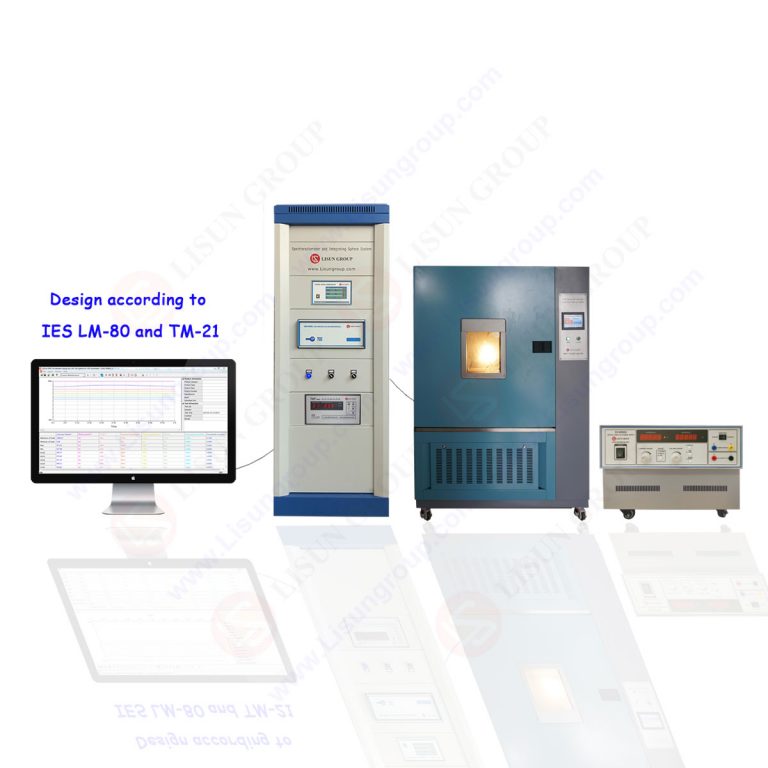
The system’s modular design allows up to three temperature chambers to be connected to a single control unit, each operating independently at different setpoints. This configuration supports simultaneous testing at the three mandatory LM-80 temperatures, reducing total test time by 66% compared to sequential testing. Each chamber incorporates forced-air convection heating with PID temperature controllers, achieving ramp rates of 2°C/minute. The test boards—customizable with user-specific LED layouts—are mounted on thermally conductive aluminum plates to minimize temperature gradients. Data acquisition occurs at user-defined intervals (minimum 1 minute, maximum 24 hours) through high-precision 24-bit analog-to-digital converters sampling photocurrent from calibrated reference photodetectors. This hardware architecture ensures that the 6,000-hour test duration yields statistically robust datasets suitable for TM-21 extrapolation.
3.1 Constant Current vs. Constant Voltage Operation Mode
The LISUN system supports dual-testing modes to accommodate various LED driver topologies. Constant Current Mode (CCM) maintains a fixed forward current (typically 350 mA, 700 mA, or 1A) throughout the test, isolating the LED’s intrinsic lumen degradation from driver effects. This mode is preferred for LM-80 testing of LED packages and arrays. Constant Voltage Mode (CVM) applies a fixed voltage across the LED module, allowing the current to vary as the device impedance changes due to thermal aging. This mode is more representative of real-world operation in linear drivers but introduces additional variability. For the LED Optical Aging Test Box: IES LM-80 & TM-21 Compliance, engineers must select the appropriate mode based on the target standard—LM-80 explicitly requires CCM for component testing, while LM-84 accommodates both modes depending on the luminaire’s intended driver architecture.
3.2 In-Situ Measurement Protocols for Continuous Monitoring
Unlike traditional testing that requires removing samples for periodic measurement, the LISUN system performs in-situ photometric measurements without disturbing the thermal chamber environment. Calibrated silicon photodetectors with V(λ) correction filters are positioned within each chamber, capturing relative luminous flux at 1,000-hour intervals. The measurement protocol follows CIE 127:2007 recommendations for detector-based photometry, ensuring traceability to international standards. Each measurement cycle includes a 30-minute stabilization period before recording, accounting for thermal equilibrium effects. The software automatically normalizes the initial measurement to 100% and tracks relative depreciation throughout the 6,000-hour test duration. This approach eliminates handling-induced variability and maintains continuous thermal stress, which is particularly important for TM-21 extrapolation where missing data points can bias the nonlinear regression.
3.3 Data Collection Architecture and Logger Integration
The system supports up to 128 data channels through its modular logger architecture, each capable of recording photocurrent, voltage, temperature, and humidity simultaneously. Data is stored on an embedded solid-state drive with redundant backup to prevent loss during extended testing. The 24-bit ADC resolution (approximately 0.0001% of full scale) enables detection of as little as 0.01% lumen depreciation—critical for early identification of failure mechanisms. Engineers can configure the logging interval adaptively: high-resolution logging (1-minute intervals) during the first 100 hours to capture initial burn-in effects, followed by extended intervals (1-hour or 24-hour) for steady-state degradation tracking. This adaptive strategy optimizes data storage while ensuring TM-21’s minimum requirement of 5,000 data points per test condition is easily exceeded.
4.1 TM-21 Nonlinear Regression Analysis
TM-21-19 specifies a rigorous methodology for projecting lumen maintenance beyond the test duration. The standard requires that at least 5,000 hours of test data be collected, with the final projection limited to 6× the test duration (e.g., 36,000 hours from 6,000 hours of data). The LISUN software automates the two-parameter exponential curve fitting, computing the decay constant β and its 95% confidence interval using the Levenberg-Marquardt algorithm. For L70 calculation, the equation ( L70 = ln(0.70/alpha) / (-beta) ) is solved iteratively. The software also provides goodness-of-fit metrics including R² (typically >0.95 for well-behaved LEDs), residual analysis, and Durbin-Watson statistics to detect autocorrelation in the residuals. This comprehensive statistical framework ensures that TM-21 reports generated from the LED Optical Aging Test Box: IES LM-80 & TM-21 Compliance meet the rigorous standards expected by ENERGY STAR qualification reviewers.
4.2 Arrhenius Model for Multi-Temperature Extrapolation
When test data is available at three or more temperatures, the Arrhenius Model enables prediction at operating temperatures not tested. The software performs a linear regression of ln(β) vs. 1/T (where T is in Kelvin), with the slope equal to -Ea/k. This activation energy is then used to calculate the acceleration factor (AF) between test temperature and target operating temperature: ( AF = e^{(Ea/k) cdot (1/T{text{op}} – 1/T{text{test}})} ). For example, an LED tested at 85°C with Ea = 0.7 eV yields an AF of approximately 10 when operating at 55°C, meaning 6,000 hours at 85°C is equivalent to 60,000 hours at 55°C. The software presents these projections graphically, overlaying confidence bands (±2σ) to convey prediction uncertainty. This is particularly valuable for automotive applications where under-hood temperatures can reach 105°C, requiring extrapolation far beyond typical test conditions.
4.3 L70 and L50 Metrics in Practical Reliability Engineering
L70 and L50 represent the time to 70% and 50% lumen maintenance, respectively. For general lighting applications, L70 is the primary metric—ENERGY STAR requires L70 ≥ 25,000 hours for residential LED lamps. For industrial and outdoor lighting, L70 ≥ 50,000 hours is typical. L50 is used in applications where functional light output is critical, such as emergency lighting and automotive forward lighting. The LISUN software automatically computes both metrics with 95% confidence intervals. For TM-21 reporting, the software generates standard-compliant data sheets including the test conditions (temperatures, drive current, number of samples), raw data tables, regression coefficients, and extrapolated L70/L50 values. This automated reporting eliminates manual calculation errors and ensures consistency across multiple test projects.
5.1 Temperature Uniformity and Calibration Protocols
For the LED Optical Aging Test Box: IES LM-80 & TM-21 Compliance, temperature uniformity across the test board is critical—TM-21 requires that the LED junction temperature be maintained within ±3°C of the target. LISUN chambers incorporate forced-air convection with internal baffles to achieve ≤2°C spatial uniformity across the entire 500mm × 500mm test board. Each chamber is equipped with four platinum RTD (PT-100) sensors positioned at corners of the board, providing real-time temperature feedback to the PID controller. Annual calibration using NIST-traceable temperature standards ensures drift remains below ±0.5°C over the instrument’s lifetime. The software logs all temperature data with timestamps, creating an audit trail that satisfies ISO 17025 laboratory accreditation requirements.
5.2 Test Board Customization and Sample Mounting
Test boards are fabricated from 3mm thick aluminum with a clear anodized finish for thermal emissivity consistency. Each board accommodates multiple LED configurations via standardized M3 mounting holes on a 20mm grid pattern. For component-level testing, LEDs are soldered to the board using reflow profiles matching the manufacturer’s recommendations. For luminaire testing, fixtures are mounted on adjustable rails within the chamber. The system supports automated current injection through spring-loaded pogo pins, eliminating wiring fatigue issues common in long-duration tests. Each test position is individually fused at 2A to prevent catastrophic failure from propagating across the sample set. This hardware flexibility allows the LED Optical Aging Test Box: IES LM-80 & TM-21 Compliance to accommodate diverse LED form factors, from 3030SMD packages to high-power COB arrays.
6.1 ENERGY STAR and DLC Qualification Requirements
ENERGY STAR certification for LED lamps requires LM-80 test data from an accredited laboratory, followed by TM-21 projection showing L70 ≥ 25,000 hours. The DesignLights Consortium (DLC) similarly mandates LM-80 data for component-level qualification in their SSL Qualified Products List. The LISUN system provides direct compliance with both programs through its automated report generation. Each report includes the mandatory elements: sample size (minimum 20 units per temperature), test duration (minimum 6,000 hours), measurement intervals (every 1,000 hours or less), and detailed TM-21 regression parameters. The software’s built-in compliance checker validates all input parameters before report generation, flagging any deviations from standard requirements. This ensures that reports generated from the LED Optical Aging Test Box: IES LM-80 & TM-21 Compliance are accepted without revision by certification bodies.
6.2 Integration with CIE and International Standards
Beyond IES standards, the system supports CIE 084:1989 (measurement of luminous flux) and CIE 070:1987 (measurement of absolute spectral distribution) for comprehensive photometric characterization. CIE 127:2007 provides additional guidance for LED measurement conditions, including detector spectral mismatch correction and spatial response uniformity. The LISUN software incorporates these corrections automatically, applying calibration factors traceable to national metrology institutes. For export-oriented manufacturers targeting European markets, the system’s compliance with EN 13032-1 (photometric data reporting) and IEC 60068-2 (environmental testing) adds further value. This multi-standard compatibility positions the LED Optical Aging Test Box: IES LM-80 & TM-21 Compliance as a versatile platform for global market access.
7.1 Test Protocol Development and Sample Size Determination
Standard LM-80 testing requires a minimum of 20 samples per temperature condition, but statistical power analysis often recommends 30-50 samples to achieve ±5% confidence intervals on L70 projections. The LISUN system’s 100-sample capacity per chamber enables these larger sample sizes without additional hardware. Engineers should develop test protocols that include: (1) initial photometric characterization at 25°C with a 100ms stabilization time, (2) ramp-up to test temperature at 2°C/min, (3) continuous testing at setpoint with 1,000-hour measurement intervals, and (4) final characterization after 6,000 hours. The software supports protocol templates that automate these steps, reducing operator error. Pre-test burn-in of 100 hours is recommended to stabilize initial lumen output, as TM-21 excludes the first 1,000 hours of data from regression analysis in some cases.
7.2 Common Failure Modes and Data Quality Monitoring
During extended testing, common issues include: photodetector drift (typically <0.5%/year, correctable via reference LED), temperature sensor degradation (flagged when drift exceeds ±1°C), and power supply fluctuations (monitored via on-board voltage reference). The system’s diagnostic dashboard provides real-time alerts for any parameter exceeding user-defined thresholds. For data quality, the software performs automated checks: (1) monotonicity of lumen depreciation (non-decreasing behavior suggests measurement error), (2) outlier detection via Grubbs’ test, and (3) residual pattern analysis (cyclic patterns may indicate thermal cycling issues). Engineers should review these diagnostics weekly during the 6,000-hour test cycle. The LED Optical Aging Test Box: IES LM-80 & TM-21 Compliance maintains a comprehensive error log that aids in post-test reconciliation.
The LISUN LED Optical Aging Test Box, designed for IES LM-80 & TM-21 Compliance, represents a comprehensive solution for lumen maintenance testing in the LED industry. By integrating dual-system architectures (LEDLM-80PL and LEDLM-84PL), Arrhenius Model-based software, and customizable multi-chamber configurations, the system addresses the full spectrum of LED reliability testing requirements—from individual components to complete luminaires. The automated projection of L70/L50 metrics in strict adherence to TM-21-19 protocols ensures that manufacturers can generate defensible lifetime data accepted by ENERGY STAR, DLC, and international regulatory bodies. The support for up to three temperature chambers dramatically reduces test cycle times while maintaining the ±2°C temperature uniformity required for statistical validity. With 24-bit data acquisition, in-situ measurement capabilities, and automated compliance reporting, this test box eliminates the manual analysis burden that traditionally plagues 6,000-hour test campaigns. For LED manufacturers seeking to validate product reliability, accelerate time-to-market, and achieve global compliance, the LISUN system provides a turnkey solution that aligns with current industry standards while anticipating future regulatory developments. Engineers adopting this platform gain a competitive edge through faster, more accurate lumen maintenance projections.
Q1: What is the minimum test duration required for TM-21 extrapolation, and how does the LED Optical Aging Test Box ensure compliance?
A: IES TM-21-19 requires a minimum of 6,000 hours of LM-80 test data for extrapolation up to 6× the test duration (36,000 hours). The LISUN system’s software automatically enforces this requirement, preventing report generation if insufficient data exists. The system also tracks measurement intervals, ensuring that data points are collected at least every 1,000 hours as mandated by LM-80-15. With its ability to maintain three simultaneous temperature chambers, the test box can accumulate the required 6,000 hours across three temperatures in parallel, reducing total calendar time to approximately 8.5 months while generating datasets that satisfy TM-21’s statistical requirements.
Q2: How does the Arrhenius Model software handle activation energy calculation when test data shows multiple degradation mechanisms?
A: The Arrhenius Model implementation in the LISUN software supports segmented analysis for LEDs exhibiting multi-mechanism degradation (e.g., initial rapid decay followed by slower steady-state degradation). The software offers user-selectable data windowing, allowing engineers to exclude the first 1,000 hours of burn-in data per TM-21 recommendations. For cases where Ea varies with temperature, the software can calculate separate activation energies for low-temperature and high-temperature regimes. The system flags nonlinear Arrhenius plots—indicated by R² < 0.85—and suggests additional test temperatures to resolve activation energy uncertainty. This feature is critical for phosphor-converted LEDs where thermal quenching of the phosphor may dominate at high temperatures while semiconductor degradation prevails at moderate temperatures.
Q3: What is the maximum number of LED samples the system can test simultaneously, and how are they individually monitored?
A: Each temperature chamber in the LISUN LED Optical Aging Test Box accommodates up to 100 LED samples, with a maximum configuration of three chambers supporting 300 total samples. Each sample is individually monitored through a dedicated photodetector channel with 24-bit resolution. The modular data logger architecture supports up to 128 channels per control unit, expandable through additional modules. Individual monitoring ensures that single-sample failures do not compromise the entire dataset, and the software can exclude anomalous samples while preserving the statistical integrity of the remaining dataset. This sample capacity exceeds LM-80’s minimum requirement of 20 samples per temperature, enabling manufacturers to meet ENERGY STAR’s more stringent statistical requirements.
Q4: How does the system handle photodetector calibration drift over the 6,000-hour test duration?
A: The system incorporates a redundant reference LED within each chamber that is measured at the beginning of each data collection cycle. The reference LED is maintained at a constant current and is not aged under test conditions, providing a stable photometric benchmark. If the reference LED measurement drifts by more than 0.5% from its initial value, the software applies a correction factor to all sample measurements. Additionally, the photodetectors are calibrated annually using a NIST-traceable luminance standard, and the system logs all calibration coefficients with timestamps. This dual-redundancy calibration approach ensures that the ±2% measurement uncertainty required by LM-80 is maintained throughout the entire test duration.
Q5: Can the LED Optical Aging Test Box be used for testing LEDs driven by pulse-width modulation (PWM) dimming signals?
A: Yes, the system supports PWM-driven testing through its constant current mode with optional PWM simulation. The test board incorporates dedicated PWM driver modules that accept external control signals with frequencies from 100 Hz to 10 kHz and duty cycles from 1% to 99%. The data acquisition system synchronizes photodetector measurements with the PWM signal to capture average luminous flux over multiple PWM cycles. This capability is essential for automotive and smart lighting applications where PWM dimming is prevalent. However, for LM-80 standard compliance, testing must use constant DC current—PWM testing is provided as an optional extension for R&D purposes where real-world operating conditions need to be replicated.