









Here is the comprehensive technical article structured according to your specifications.
Abstract
This article provides a detailed technical analysis of LED Optical Aging Test Instruments: LM-80 Vs LM-84 Standards Explained, focusing on the critical differences between IES LM-80 and LM-84 testing methodologies for LED lumen maintenance validation. We explore how LISUN’s dual-platform systems, the LEDLM-80PL and LEDLM-84PL, address the specific requirements of these standards, including the TM-21 and TM-28 extrapolation methods. Technical insights cover the Arrhenius Model-based aging prediction, 6000-hour test durations, and the calculation of L70 and L50 life metrics. For engineers and lab technicians, understanding these distinctions is vital for accurate reliability projections, regulatory compliance, and cost-effective product development in the solid-state lighting industry.
1.1 IES LM-80-15: The Golden Standard for Lumen Maintenance
The IES LM-80-15 standard is the most widely recognized method for measuring the lumen depreciation of LED light sources, arrays, and modules. This standard requires a minimum test duration of 6,000 hours, with data collection at specific intervals (every 1,000 hours). Testing must be conducted at three distinct case temperatures (typically 55°C, 85°C, and a third at the manufacturer’s discretion, often 105°C). The output data provides raw lumen maintenance values, which are then used as input for the TM-21-19 standard to project long-term L70 and L50 lifetimes.
1.2 IES LM-84-14: The Application-Based Approach
In contrast, IES LM-84-14 focuses on testing complete LED luminaires or integral LED lamps under operating conditions rather than just bare components. While LM-80 looks at the internal source, LM-84 assesses the total light output performance of the finished product. This standard allows for shorter minimum test durations (typically 3,000 hours) and more flexible temperature configurations, as the ambient environment is often prioritized over controlled case temperatures. The data from LM-84 forms the basis for the TM-28-14 extrapolation protocol, which projects lumen maintenance for entire luminaires.
1.3 CIE 127 and CIE 084: Supporting Reference Standards
Supporting these primary standards, CIE 127 provides guidelines for LED measurement accuracy, particularly for total luminous flux using integrating spheres. CIE 084, the standard for the measurement of luminous flux, ensures consistency across different test setups. Both are critical when calibrating the LED Optical Aging Test Instruments used in LM-80 and LM-84 tests to ensure traceability to international photometric standards.
2.1 System Architecture and Configuration Differences
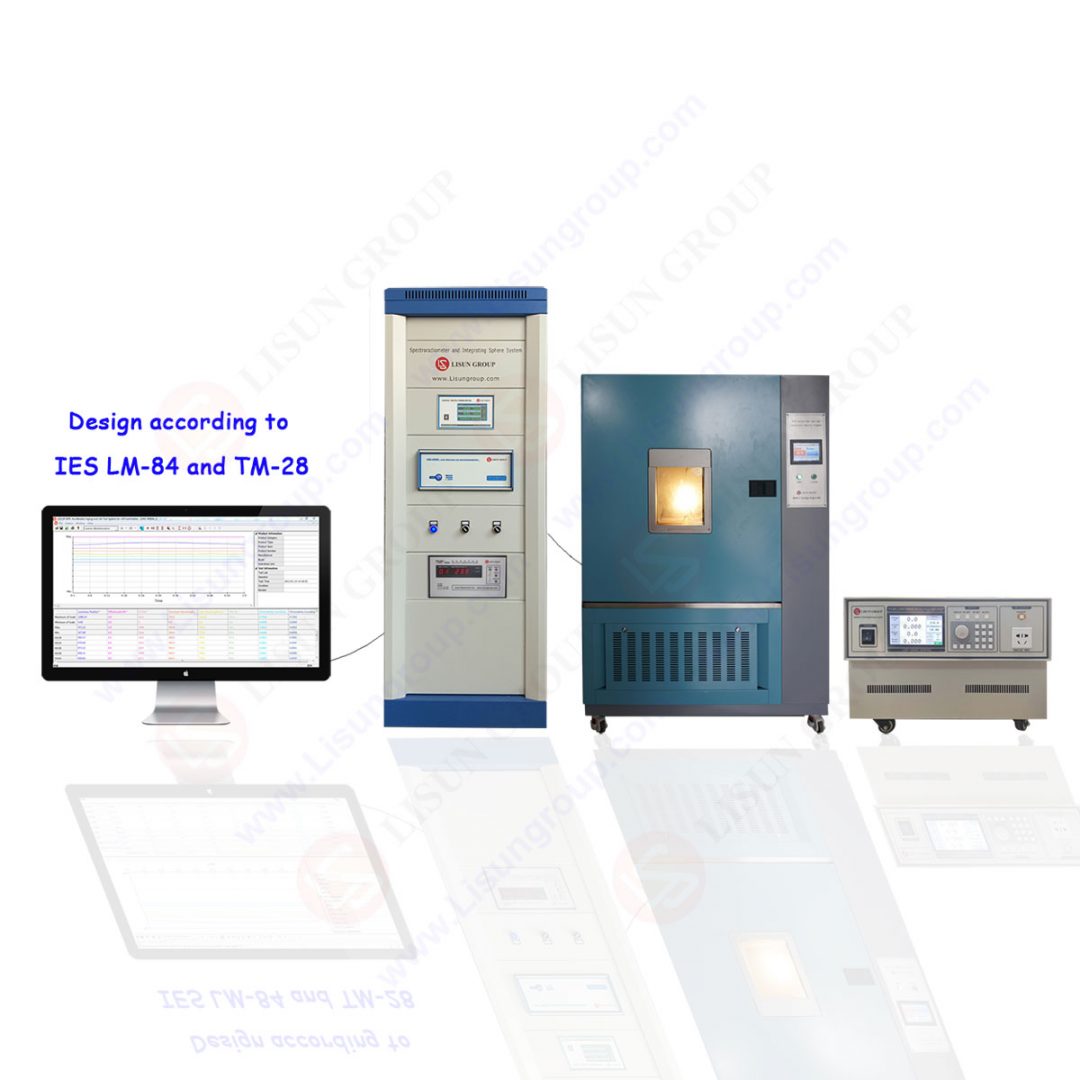
LISUN has engineered two distinct systems to address the specific hardware demands of each standard. The LEDLM-80PL is designed for high-temperature, long-duration stress testing of individual LED packages or modules, featuring precision temperature-controlled ovens. The LEDLM-84PL, conversely, is larger and configured to accommodate complete luminaires, with multiple power supplies and monitoring channels for AC/DC devices. Both systems, however, operate on a common software backbone for data logging.
2.2 Technical Specification Comparison Table
The following table highlights the critical hardware and specification differences between the two systems.
| Feature / Parameter | LEDLM-80PL (LM-80 / TM-21) | LEDLM-84PL (LM-84 / TM-28) |
|---|---|---|
| Primary Standard | IES LM-80-15 | IES LM-84-14 |
| Extrapolation Protocol | TM-21-19 | TM-28-14 |
| Test Target | LED Packages, Modules, Arrays | Complete Luminaires, Integrated Lamps |
| Min. Test Duration | 6,000 Hours | 3,000 Hours (Minimum) |
| Temperature Control | Up to 3 Connected Thermal Chambers (e.g., 55°C, 85°C, 105°C) | Ambient Temperature Monitoring & Control |
| Electrical Testing | Pulsed DC (Low Duty Cycle per LM-80) | Constant AC/DC (Real-World Operation) |
| Key Metrics Output | L70, L50, Lumen Depreciation (%), ΔCCT | L70, L50, Lumen Depreciation (%), ΔCCT, Wattage |
2.3 Customizable Hardware for Specific Test Protocols
Both systems offer extensive customization. For the LEDLM-80PL, engineers can specify the number of test positions per channel (e.g., 20, 30, or 50 LED packages per board) and the precise thermal uniformities required. For the LEDLM-84PL, users can configure the system for high-power (>200W) industrial luminaires or low-power (<5W) decorative lamps, integrating specific photometric sensors for real-time data capture.
3.1 TM-21-19: Projecting L70/L50 from Component Data
TM-21 is the mathematical gating function for LM-80 data. It applies an exponential decay model to the raw data to project lumen maintenance beyond the test duration. The standard stipulates that at least 6,000 hours of data is required for a 6x projection (e.g., projecting to 36,000 hours). The software in the LEDLM-80PL automatically performs this analysis, calculating both L70 (time to 70% lumen output) and L50 (time to 50% lumen output) with confidence intervals, which is critical for warranty validation.
3.2 TM-28-14: Projecting Luminaire Lifetime
TM-28 uses data from LM-84 tests and applies a similar exponential decay model but is tailored for the thermal and operational dynamics of a complete luminaire. This model is generally more conservative than TM-21 because it accounts for driver failures, thermal management inefficiencies, and other system-level interactions that a bare LED module does not experience. The LISUN LEDLM-84PL integrates this model directly, allowing labs to submit compliant reports for ENERGY STAR or DLC listing.
3.3 Arrhenius Model-Based Acceleration Factor
A key differentiator in LISUN’s software is the integration of the Arrhenius Model to estimate acceleration factors. By testing at multiple case temperatures, the system can calculate activation energy (Ea) for the specific LED being tested. This allows the LED Optical Aging Test Instruments to provide estimated lifetimes not just at test temperature, but at any user-defined operating temperature, offering a more practical prediction for real-world applications.
4.1 Constant Current vs. Realistic Operation Modes
The LEDLM-80PL operates primarily in a “Test Mode” that uses constant current pulses (as required by LM-80) to measure the LED without self-heating artifacts. The LEDLM-84PL offers a “Real-World Operation Mode” where the luminaire is driven exactly as it would be in the field, including dimming cycles and varying line voltages, to observe thermal and electrical interactions that degrade performance.
4.2 Integrating Sphere vs. Goniometer Data Collection
Both systems support two primary photometric data collection methods: the integrating sphere (for total luminous flux and spectral power distribution) and the goniometer (for spatial luminous intensity distribution). The LEDLM-80PL typically relies on an external high-precision integrating sphere system, while the LEDLM-84PL can be configured with an in-line monitoring sphere. Data acquisition intervals are programmable from 0 to 1000 hours, adhering strictly to the mandates of IES LM-79-19 for spectral reporting.
5.1 Temperature Chamber Configuration
The integrity of an LM-80 test relies on strict temperature control. LISUN’s system supports up to three temperature chambers simultaneously, allowing parallel testing at 55°C, 85°C, and a user-defined temperature (e.g., 105°C). The temperature uniformity specification is ±1°C within the chamber, ensuring that the junction temperature of the device under test remains stable. For LM-84, ambient temperature cycling is monitored and logged, simulating real-world indoor or outdoor conditions.
5.2 The 6000-Hour Minimum Mandate
Why is the 6,000-hour minimum for LM-80 non-negotiable? It is based on the physics of LED degradation. Early failure rates (infant mortality) are typically seen in the first 1,000-2,000 hours. By requiring 6,000 hours, the standard ensures that the decay pattern is linear on a semi-log scale, enabling statistically valid TM-21 projections. The LISUN system is engineered for 24/7 continuous operation over this duration, with redundant power supplies and data storage to prevent data loss.
6.1 Lumen Depreciation and Chromaticity Shift
The primary metric in both standards is lumen depreciation, calculated as the ratio of measured lumens at time T to initial lumens. However, a critical secondary metric is the chromaticity shift (ΔCCT or Δu’v’). As LEDs age, the phosphor degrades, causing a shift in correlated color temperature (CCT). The LISUN software tracks this shift automatically, generating a ΔCCT vs. time curve. If the shift exceeds 0.004 in the u’v’ diagram, the lamp is considered failed, even if lumen maintenance is still above 70%.
6.2 L70 and L50 Life Calculation
Based on the exponential decay curve, the system calculates:
- L70(6k): Time to 70% lumen output based on 6,000 hours of data.
- L50(6k): Time to 50% lumen output.
For high-quality LEDs, L70 values often exceed 50,000 hours, while L50 may exceed 100,000 hours. These projections are critical for lighting designers specifying maintenance cycles.
7.1 Automotive and High-Reliability Testing
For automotive lighting (e.g., headlamp LEDs), the LM-80 standard is strictly enforced. However, engineers also use the LEDLM-80PL’s Arrhenius feature to test at extremely high case temperatures (e.g., 125°C) to simulate under-hood conditions. The system’s ability to log current and voltage for each individual device is invaluable for detecting solder joint degradation or phosphor thermal quenching.
7.2 Consumer and Architectural Lighting
For architectural, tunable-white, or smart lighting, the LEDLM-84PL is preferred. Testing a complete luminaire under dimmed conditions (e.g., 10%, 50%, 100%) allows manufacturers to market “dimmable lifetime ratings.” The system can cycle the lights on/off thousands of times to test thermal shock on the driver components, a test not covered by standard LM-80 but critical for real-world reliability.
The selection between LM-80 and LM-84, and correspondingly between LISUN’s LEDLM-80PL and LEDLM-84PL, is not a matter of superiority but of application scope. LM-80 remains the benchmark for component level reliability, providing the foundational data for physics-based projections via TM-21. LM-84 offers a pragmatic, system-level view that matches real-world performance. LISUN’s LED Optical Aging Test Instruments: LM-80 Vs LM-84 Standards Explained effectively demonstrates that a modern lab must possess both capabilities. By integrating the Arrhenius Model, supporting up to three temperature chambers, and providing dual extrapolation algorithms (TM-21 and TM-28), these instruments empower engineers to validate products with scientific rigor. The 6000-hour test mandates and the resulting L70/L50 metrics ensure that lighting products meet the stringent demands of ENERGY STAR, DLC, and automotive OEMs. Adopting a flexible, dual-platform strategy is the only path to comprehensive LED reliability validation.
Q1: Why is the 6000-hour minimum test duration mandatory for LM-80 but can be shorter for LM-84?
A: The 6000-hour requirement for LM-80 is based on the need to establish a statistically valid exponential decay curve for the LED itself, which is the heart of the luminaire. LED failures are often infant or wear-out, and a shorter duration might show a premature plateau. LM-84, however, tests the complete luminaire, which includes the driver and optics. Drivers often fail before the LEDs, and the 3000-hour minimum is sufficient to capture driver and thermal management failures. The extrapolation model (TM-28) is adjusted to account for this shorter data set, focusing on system-level reliability rather than semiconductor physics.
Q2: Can LISUN’s LEDLM-80PL system also perform LM-84 tests?
A: While the LEDLM-80PL and LEDLM-84PL share a common software platform and data acquisition architecture, their hardware is optimized for different test articles. The LEDLM-80PL has small thermal chambers designed for tight temperature control of LED modules. It cannot physically accommodate a 4-foot troffer luminaire. Conversely, the LEDLM-84PL lacks the precise ambient temperature control for the three-temperature case testing required by LM-80. For a lab needing to comply with both standards, purchasing both systems is the most efficient and compliant solution, as recommended by LISUN’s product line.
Q3: How does the Arrhenius Model improve the accuracy of TM-21 extrapolation?
A: The TM-21 extrapolation provides a generic exponential curve fit to the data. However, it does not inherently account for the acceleration factor of temperature. The Arrhenius Model in LISUN’s software allows engineers to calculate the Activation Energy (Ea) of the specific LED being tested. By inputting the data from the three temperature case tests (55°C, 85°C, 105°C), the software can calculate a precise acceleration factor. This means the estimated lifetime is not just a statistical projection but a physics-based prediction that accounts for the actual thermal stress the LED will experience in the field, leading to more realistic warranty periods.
Q4: What is the significance of the L70 metric versus the L50 metric?
A: The L70 metric (time to 70% of initial lumens) is the de facto standard for illumination applications (general lighting). It represents the point where most users perceive a noticeable drop in brightness, often triggering maintenance replacement. L50 (time to 50%) is a more durable metric, typically used for applications where absolute failure is more critical than output, such as exit signs, emergency lighting, or outdoor area lighting where some dimming is acceptable. Most ENERGY STAR and DLC specifications require an L70 report for the specific ambient temperature.
Q5: Is it mandatory to test at three case temperatures for LM-80 compliance?
A: Yes, according to IES LM-80-15, testing must be performed at three distinct case temperatures. These are typically: 55°C, 85°C, and a third temperature selected by the manufacturer (often 105°C or the maximum rated temperature). This requirement ensures that the data covers a range of thermal conditions, allowing the Arrhenius model to be accurately applied. Testing at only one or two temperatures invalidates the TM-21 extrapolation and the resulting L70/L50 projections, making the test report non-compliant with most regulatory bodies.