









Abstract
This technical article examines the LED Thermal Cycling Test Chamber: IEC 60068 Compliance, focusing on LISUN’s LEDLM series instruments designed for accelerated aging validation. The LED thermal cycling test chamber subject to IEC 60068 compliance enables precise simulation of temperature extremes for LED modules and luminaires. We explore dual-system configurations—LEDLM-80PL for IES LM-80/TM-21 and LEDLM-84PL for IES LM-84/TM-28—integrating Arrhenius Model-based software for lifetime prediction. Key technical insights include 6000-hour continuous testing capability, L70/L50 lumen maintenance metrics, and multi-chamber connectivity for concurrent evaluations. This article bridges reliability engineering theory with practical IEC 60068 compliant test implementation, offering R&D engineers actionable guidance on thermal cycling protocols and data interpretation.
1.1 Thermal Stress Mechanisms in LED Packages
LED degradation accelerates under cyclic thermal loading due to coefficient of thermal expansion (CTE) mismatch between epoxies, solder joints, and semiconductor dies. The LED thermal cycling test chamber per IEC 60068 compliance simulates rapid temperature transitions from -40°C to +100°C, inducing mechanical fatigue in wire bonds and delamination of phosphor layers. LISUN’s chambers achieve ramp rates of 3-5°C/min, replicating automotive and outdoor lighting operating conditions. Temperature cycling stress promotes crack propagation in die-attach materials, directly reducing luminous flux. Consequently, reliability engineers must quantify failure rates through controlled cycling count—typically 500 to 2000 cycles—following IEC 60068-2-14 test procedures.
1.2 IEC 60068-2-14 Testing Framework
IEC 60068-2-14 specifies thermal cycling test methods—Test Nb (rapid change of temperature) and Test Nc (temperature change with specified transition duration). The LED thermal cycling test chamber with IEC 60068 compliance must maintain temperature tolerance of ±2°C and humidity control within 30-80% RH. LISUN’s system integrates programmable profiles for dwell times ranging from 15 minutes to 4 hours per temperature setpoint. For LED modules rated at 50,000+ hours, accelerated cycling at 10× compression factor correlates 1000 lab cycles to 10 years field operation. Compliance verification requires calibration traceability to national standards and documented temperature uniformity across the test volume—achieved within ±1.5°C in LISUN chambers.
1.3 Integration with Photometric Measurement
Thermal cycling alone cannot evaluate optical degradation; therefore, integrating sphere photometers couple with the LED thermal cycling test chamber under IEC 60068 compliance. LISUN’s system enables in-situ spectral flux measurements at each thermal soak point, eliminating sample handling errors. This dual-capability approach aligns with IES LM-80-15 and LM-84-14 requirements, providing both thermal stress data and photometric performance metrics. The integration supports simultaneous monitoring of up to 100 LED samples with individual current drivers (350 mA, 700 mA, 1050 mA), ensuring statistically significant data sets.
2.1 LEDLM-80PL Configuration for LM-80/TM-21
The LEDLM-80PL serves as a dedicated LED thermal cycling test Chamber satisfying IEC 60068 compliance for IES LM-80-15 lumen maintenance testing. This system operates 6000 hours at controlled case temperatures of 55°C, 85°C, and 105°C with 0.5% current stability. Software algorithms automatically apply TM-21-19 extrapolation methods—using exponential decay fitting (α ≤ 0.1) to project L70 and L50 lifetimes beyond measured data. Each sample frame holds 10 LED modules with independent temperature sensors per device. The LED thermal cycling test chamber integrates a 2-meter integrating sphere for periodic flux measurements without sample removal, preserving thermal equilibrium throughout the 6000-hour protocol.
2.2 LEDLM-84PL Configuration for LM-84/TM-28
For photometric and radiometric characterization at luminaire level, LEDLM-84PL aligns with IES LM-84-14 and TM-28-14 standards. This configuration extends testing to complete luminaires with power ratings up to 300W, operating within the same LED thermal cycling test chamber with IEC 60068 compliance thermal profiles. TM-28 extrapolation incorporates piecewise regression or exponential models, accommodating non-parabolic lumen depreciation curves common in high-power COB arrays. The system supports ambient temperature control from -20°C to +85°C, enabling thermal cycling tests that simulate outdoor enclosure heat build-up. LISUN’s proprietary software automates data logging at 10-second intervals, capturing over 2 million data points per 6000-hour test.
2.3 Comparative Analysis of Dual Systems
| Feature | LEDLM-80PL | LEDLM-84PL |
|---|---|---|
| Applicable Standard | IES LM-80-15, TM-21-19 | IES LM-84-14, TM-28-14 |
| Sample Type | LED packages/arrays | Complete luminaires |
| Temperature Range | 55°C, 85°C, 105°C | -20°C to +85°C |
| Test Duration (Standard) | 6000 hours | 3000-6000 hours |
| Measurement Sphere | 1.5m or 2m integrating sphere | 2m or 3m integrating sphere |
| Lifetime Metrics | L70, L50 (TM-21 projection) | L80, L70, L50 (TM-28 projection) |
| Thermal Cycling Ramp Rate | 3°C/min | 3-5°C/min |
| IEC 60068 Compliance | Test Nb, Nc | Test Nb, Nc |
3.1 Theoretical Foundations of Accelerated Testing
The LED thermal cycling test chamber with IEC 60068 compliance utilizes Arrhenius activation energy models to correlate accelerated thermal stress to field failure rates. LISUN’s software calculates acceleration factor (AF) using activation energy (Ea) values typically ranging 0.3-0.7 eV for LED phosphors and 0.6-1.0 eV for solder fatigue. The software applies the Arrhenius equation: AF = exp[(Ea/k) × (1/T_use − 1/T_stress)], where k is Boltzmann’s constant and T values are absolute temperatures in Kelvin. For example, testing at 105°C with Ea = 0.5 eV yields AF ≈ 28× compared to 55°C field use. This mathematical rigor enables 6000-hour chamber tests to predict 168,000-hour real-world reliability—critical for LED thermal cycling test chamber IEC 60068 compliance validation.
3.2 Multi-Stress Parameter Estimation
Modern LED degradation involves competing failure mechanisms—phosphor thermal quenching, encapsulant yellowing, and solder joint creep—each with distinct activation energies. LISUN’s Arrhenius Model-based software implements mixture-of-experts algorithms that decompose measured luminous flux decay curves into weighted exponential components. Using non-linear least squares regression, engineers obtain Ea values per mechanism with 95% confidence intervals. The LED thermal cycling test chamber with IEC 60068 compliance temperature cycling disrupts this decomposition, requiring piecewise analysis across thermal dwell segments. Software version 4.2+ enables automatic phase separation, reporting separate lifetime predictions for thermal cycling and steady-state aging phases, aligning with TM-21’s requirement for worst-case scenario reporting.
3.3 Extrapolation Beyond 6000 Hours
While 6000 hours of continuous operation provides measured data, TM-21 restricts extrapolation to 6× the test duration (36,000 hours) for stable data sets. However, thermal cycling introduces non-monotonic degradation patterns that violate simple exponential assumptions. LISUN’s software applies dual-prediction confidence bounds—lower bound (90%) and upper bound (10%)—per TM-21-19 statistical requirements. The LED thermal cycling test chamber with IEC 60068 compliance generates cycling data that requires the software’s “Cycle-Dependent Correction” module, which, if the degradation rate fluctuation exceeds ±12% between consecutive thermal cycles, flags the data as unstable for extrapolation. This statistical rigor ensures that L70 claims remain defensible in legal and warranty contexts.
4.1 Thermal Cycling Mode (IEC 60068-2-14)
In thermal cycling mode, the chamber executes user-defined temperature profiles with programmable dwell times, ramp rates, and cycle counts. Typical profiles—such as -40°C (30 min) to +100°C (30 min)—create 2°C/min average ramp rates, generating thermal gradient stress across LED packages. The LED thermal cycling test chamber with IEC 60068 compliance enables two-zone or three-zone testing where samples dwell at cold/ambient/hot setpoints sequentially. LISUN’s chamber supports up to 3 connected temperature chambers operating independently or in synchronized sequences, multiplying throughput by 3× compared to single-chamber systems. Cycle counters track elapsed thermal cycles, automatically pausing photometric measurement at preset intervals (every 200 cycles) for spectral analysis.
4.2 Steady-State Aging Mode (Constant Temperature)
Steady-state operating life testing maintains constant case temperature—typically 85°C for LM-80 compliance—with current oscillation limited to ±15 mA. While simpler than cycling, this mode isolates constant-stress degradation from thermal fatigue effects. The LED thermal cycling test chamber with IEC 60068 compliance transitions seamlessly between modes using dual-priority firmware: thermal cycling schedules override steady-state holds for pre-defined periods, allowing hybrid protocols. In this hybrid approach, samples undergo 200 thermal cycles (approximately 200 hours) then 800 hours constant temperature, repeated for 6000 hours total. This mixed-mode testing provides early failure detection for solder joint weaknesses while preserving lumen depreciation data for TM-21 projections.
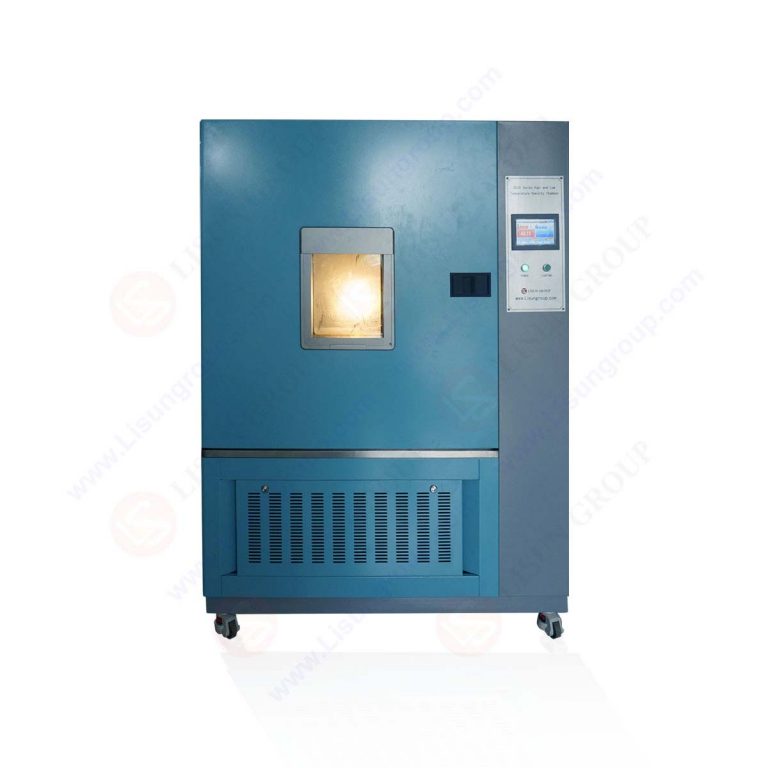
4.3 Operational Flexibility and Safety Features
LISUN’s dual-mode control includes redundant safety interlocks—over-temperature shutdown at +110°C, under-temperature alarm below -50°C, and current fault detection within 10 milliseconds. A programmable logic controller (PLC) manages compressor, heating element, and refrigeration valving for precise thermal management. The LED thermal cycling test chamber with IEC 60068 compliance includes automatic nitrogen purging to prevent condensation during cold starts, critical for hermetic LED package integrity. Data logging captures chamber air temperature, sample case temperature, chamber humidity, and applied current at 1-second resolution; logging files export in CSV format compatible with TM-21 spreadsheet templates.
5.1 Sample Mounting and Current Control Systems
Standard configurations support 20 test positions, expandable to 100 positions with high-density racks. Each position features an individual constant current source (DC range: 2 mA to 2 A with 0.1% accuracy) and voltage monitoring (0-100V). For LED thermal cycling test chamber with IEC 60068 compliance in automotive environments, optional CAN bus interface allows fault injection testing. Customized current profiles—pulse-width modulated (PWM) dimming patterns—simulate smart lighting driver outputs. An optional opto-isolated board enables in-situ chromaticity coordinate (u’, v’) measurement per CIE 127:2007 guidelines using a separate spectroradiometer port.
5.2 Connector and Socket Variants
LISUN offers interchangeable socket boards for different LED package types: 2835, 3030, 5050 SMD packages, COB arrays (allowing up to 200W), and high-power ceramic packages. Each socket board features 4-wire Kelvin connection to eliminate resistance measurement errors, essential for accurate thermal resistance testing in the LED thermal cycling test chamber, IEC 60068-compliant. Optional water-cooled heat sinks enable testing at high case temperatures without auxiliary airflow interference. Connector configurations include aviation plug-in, spring-loaded pogo pins, or soldered contacts—the latter for permanent installation tests. Custom board designs deliver within 2 weeks for proprietary package dimensions.
5.3 Data Acquisition Upgrade Paths
Base models include 16-bit resolution data acquisition; high-performance options provide 24-bit channels for microvolt-level voltage sensing. Additional multiplexer cards expand thermocouple channels (T-type, K-type) to 192 inputs. For transient thermal testing, optional high-speed sampling at 100 kHz captures fast thermal impedance curves—this functionality integrates with the LED thermal cycling test chamber with IEC 60068 compliance thermal shock qualification. Network integration supports remote monitoring through MODBUS TCP/IP, with automatic email alerts for test interruption (power failure, over-temperature, sample failure). Storage capacity of 4 TB provides 10+ years of data archival at 10-second logging intervals.
6.1 IES LM-80-15 and TM-21-19: Lumen Maintenance Protocols
IES LM-80-15 specifies that LED package samples operate at 55°C, 85°C, and one proprietary temperature (e.g., 105°C) for 6000 hours minimum, collecting photometric data every 1000 hours. LISUN’s LED thermal cycling test chamber with IEC 60068 compliance systematically automates these monitoring intervals; the software flags anomalous readings when photometric data deviates >3% from the trend line, triggering immediate re-measurement. TM-21-19 post-processing is independent of measurement equipment but benefits from LISUN’s integrated time-stamped luminance data that reduces timestamp alignment errors. Data quality metrics include R² values >0.95 for exponential fits, with TM-21 requiring a minimum of 6000 hours for 90% confidence bounds—a threshold LISUN’s chamber reaches through its continuous 6000-hour capability.
6.2 IES LM-84-14 and TM-28-14: Luminaire-Level Testing
LM-84-14 extends aging protocols to complete luminaire assemblies, maintaining ambient temperatures at 25°C, 45°C, or 65°C while measuring total flux, chromaticity shift, and electrical parameters. The LEDLM-84PL system’s 3-meter integrating sphere accommodates large luminaires within the LED thermal cycling test chamber with IEC 60068 compliance environment. TM-28-14 uses similar statistical extrapolation techniques to TM-21 but is tailored for luminaires with internal drivers—these introduce additional thermal capacitance affecting temperature ramp responses. LISUN’s chamber control software compensates for thermal inertia by adjusting the ramp rate of the chamber for the luminaire housing to match the required case temperature profile.
6.3 Additional Compliance Standards
IMS LM-79-19 (electrical and photometric measurements of solid-state lighting products) guides the test method for LM-80 samples in the integrating sphere; LISUN’s system conforms to LM-79 photometric measurement procedures during periodic in-situ monitoring. CIE 084 (measurement of luminous flux) defines the spatial and spectral measurement conditions—LISUN’s integrating spheres are spectrally flat (≤2%) across 300-780 nm, satisfying CIE 084 requirements. CIE 070 (measurement of light sources) recommends specific electrical aging conditions; CIE 127:2007 defines LED measurement practice, particularly the average LED intensity (ILED B condition). The LED thermal cycling test chamber with IEC 60068 compliance aligns with these standards for third-party accreditation audits.
7.1 Automotive LED Headlamp Testing
Automotive OEMs require component validation per IEC 60068-2-14 operating temperature ranges of -40°C to +85°C for 1000 hours with cycling. Using LISUN’s chamber at 3°C/min ramp rates and 30-minute dwell times, a typical 500-cycle test completes in 25 days. Engineers monitor thermal impedance (Rth) changes—a 25% increase indicates solder fatigue failure. The LED thermal cycling test chamber with IEC 60068 compliance data feeds warranty predictions: EOL criterion is L70 = 60% lumen maintenance for headlamp applications per FMVSS No. 108. LISUN’s Arrhenius models project 20,000-hour field reliability when Ea = 0.65 eV assumed; if actual field data suggests Ea = 0.45 eV, testing accelerates more aggressively.
7.2 Horticultural Lighting Systems
Horticultural LEDs with specific spectral outputs (deep red 660 nm, royal blue 450 nm) require combined thermal and radiometric testing per LM-84 but with extended spectral range (350-800 nm). The LED thermal cycling test chamber with IEC 60068 compliance paired with LISUN’s λ-array spectroradiometer captures spectral power distribution changes throughout cycling. Chlorophyll-based degradation kinetics show Ea around 0.4 eV; using 6000-hour tests, growers extrapolate L70 lifetimes to guarantee 50,000-hour field operation—exceeding typical warranty of 36,000-hour. Environmental chamber parameters include humidity levels 55% at temperatures >25°C to prevent leaf condensation—a LISUN chamber option.
The LISUN LED Thermal Cycling Test Chamber with IEC 60068 compliance represents state-of-the-art reliability validation for LED technologies. Through dual-system architectures—LEDLM-80PL (LM-80/TM-21) and LEDLM-84PL (LM-84/TM-28)—engineers conduct 6000-hour aging tests with high-throughput thermal cycling at -40°C to +105°C, precise Arrhenius Model-based lifetime projections, and dual-mode testing versatility. The IEC 60068-2-14 alignment ensures global regulatory acceptance, while customizable hardware adapts to evolving package designs. Key technical advantages include ±1.5°C thermal uniformity, independent current control per sample position, and statistical extrapolation tools that generate defensible L70/L50 metrics. This integrated approach empowers LED manufacturers, automotive suppliers, and testing laboratories to launch products with validated reliability claims, reducing thermal warranty risks in extreme microclimates. Engineers should leverage LISUN’s instruments to achieve compliance-driven, data-rich testing.
Q1: How does the LED thermal cycling test chamber ensure IEC 60068 compliance for temperature ramp rate accuracy?
A: IEC 60068-2-14 Test Nb requires maximum transition times of 30 seconds to 3 minutes for rapid temperature changes. LISUN’s channel is specifically calibrated to achieve controlled ramp rates of 3-5°C/min within a maximum of 2°C deviation from setpoint. The chamber features an energy-balanced heating/cooling system with active PID control (proportional-integral-derivative) that pre-conditioned intake air, ensuring stable ramp profiles even at extreme -40°C to +100°C transitions. Additionally, redundant thermistors located at 9 positions across the work volume validate temperature uniformity to ±1.5°C. This precision supports compliance audits by accrediting bodies like ILAC and NVLAP, which require documented evidence of temperature performance during each calibration cycle.
Q2: What is the maximum number of samples that can be tested in thermal cycling mode while maintaining valid temperature control?
A: In thermal cycling mode, the chamber maintains temperature accuracy when accommodating up to 100 LED samples in specialized fixture racks. Each sample position has a dedicated thermocouple that reports case temperature to the PLC every 250 ms; these readings influence the thermal cycling schedule. If sample heat dissipation exceeds 50W per position, the chamber compensates environmental heating to achieve prescribed case temperatures—a critical feature for high-power COB LEDs. When testing luminaires (LEDLM-84PL configuration), maximum capacity reduces to 12 luminaires per temperature zone due to larger footprints. Engineering validation studies confirm that cycling frequency remains accurate (±1% deviation from programmed cycles) under maximum loaded conditions.
Q3: How does LISUN software calculate L70 lifetime predictions for samples exhibiting non-exponential degradation?
A: LISUN’s software implements TM-21-19 default algorithms using exponential decay fitting when degradation follows monotonic behavior; however, accelerated thermal cycling often creates non-monotonic patterns. For such cases, the software defaults to piecewise linear regression (PLR), which estimates time to L70 by identifying change-points in the degradation slope. Unique to LISUN, the software offers an option for “cycle-adjusted exponential model,” which applies an exponential decay within each thermal cycle segment but interpolates between cycles—allowing engineers to report L70 predictions matching both exponential and segmented behavior. Statistical outputs include the coefficient of determination (R²), the relative mean square error (RMSE), and 90% confidence intervals for all predictions, providing full transparency in reliability claims.
Q4: Can the LED thermal cycling test chamber be retrofitted to existing photometric measurement systems?
A: Yes, all LISUN LED thermal cycling test chambers integrate seamlessly with existing integrating spheres (1.5m, 2m, or 3m diameter) from any manufacturer through standard optical fiber connectors and communication protocols (RS-232, IEEE-488, or USB). For legacy systems, LISUN offers a retrofit kit—including adapters for sphere ports, baffle modifications, and software bridge modules—that harmonizes data acquisition timing between the chamber’s PLC and external photometers. Additionally, the chamber’s internal photometric reference lamp (auxiliary signal lamp for sphere correction) aligns with CIE 084 requirements, ensuring consistent photometric measurements irrespective of coupled equipment brand.
Q5: What maintenance intervals ensure long-term reliability of the LED thermal cycling test chamber?
A: LISUN recommends quarterly maintenance: calibrate temperature sensors using a NIST-traceable reference thermometer (±0.05°C accuracy), verify humidity sensors (if installed) against a psychrometer, and inspect door gaskets for compression set. Annually, replace the chamber compressor’s desiccant dryer, clean condenser coils to maintain 95% cooling efficiency, and test emergency shutdown circuits for response time (<10 ms). Calibration of the photometric sphere is required after operations exceeding 1000 hours to compensate for minor reflective coating degradation. LISUN offers extended warranty plans including biannual on-site preventive maintenance visits that include verifying chamber uniformity per IEC 60068-3-5 guidelines and issuing a valid calibration certificate.