









Here is the comprehensive technical article generated according to your specifications.
Abstract
Effective p>LED Thermal Management: Key Test Standards for IEC 60068 Compliance is critical for ensuring long-term lumen maintenance and reliability in solid-state lighting. This article provides a technical deep-dive into the accelerated aging test standards required for compliance, focusing on the Arrhenius Model-based methodologies of IES LM-80/TM-21 and LM-84/TM-28. It details how LISUN’s LED Optical Aging Test Instrument, with its dual-system variants (LEDLM-80PL and LEDLM-84PL) and customizable hardware, enables precise 6000-hour testing across multiple temperature chambers. Readers will gain actionable insights into test fixture design, data extrapolation for L70/L50 metrics, and practical strategies for meeting IEC 60068 environmental stress requirements.
1.1 The Critical Role of Thermal Management in Lumen Depreciation
LED lumen output is inversely proportional to junction temperature. Elevated temperatures accelerate chip degradation, phosphor conversion efficiency loss, and encapsulant discoloration. Thermal management is therefore the primary variable controlling the rate of lumen depreciation. IEC 60068 provides the environmental testing framework—including damp heat, thermal cycling, and steady-state temperature—under which LED performance must be validated.
1.2 Mapping IEC 60068 to Lighting-Specific Standards
IEC 60068-2-2 (Dry Heat) and IEC 60068-2-78 (Damp Heat, Steady State) are directly applicable for qualifying LED thermal design. However, the lighting industry relies on IES-specified photometric methods (LM-80, LM-84) to quantify the resulting degradation. Compliance involves correlating the thermal stress conditions defined in IEC 60068 with the lumen maintenance data generated under IES LM-80 protocols.
2.1 IES LM-80-08 and TM-21-11: The Lumen Maintenance Benchmark
IES LM-80-08 defines the method for measuring lumen depreciation of LED packages, arrays, and modules at controlled case temperatures (e.g., 55°C, 85°C) over a minimum of 6000 hours. TM-21-11 then uses a non-linear least squares exponential fit to project the data to L70 (70% lumen maintenance) lifetimes. The LISUN LEDLM-80PL system is purpose-built for this, supporting up to 3 connected temperature chambers to simultaneously run multiple Ts points.
2.2 IES LM-84-14 and TM-28-14: Testing Complete Luminaires
While LM-80 tests components, IES LM-84-14 addresses complete luminaires, measuring total luminous flux maintenance under stress. TM-28-14 provides the corresponding projection method. This is essential for validating the thermal path from LED package to the heatsink. The LISUN LEDLM-84PL variant integrates an integrating sphere (e.g., LISUN LSP-500) to monitor absolute spectral flux changes during aging, providing data on both lumen depreciation and chromaticity shift.
2.3 CIE 127 and CIE 84: Supporting Photometric Accuracy
CIE 127 provides the measurement standard for LED intensity and total flux, ensuring that integrating sphere data is accurate. CIE 84 defines the measurement of luminous flux of discharge lamps, providing a basis for comparison. These standards ensure the photometric test bench used in thermal aging (like the LISUN system) yields traceable and repeatable results.
3.1 Dual System Variants: LEDLM-80PL vs. LEDLM-84PL
The LISUN instrument family is segmented to match the specific standard being applied:
| Feature / Specification | LEDLM-80PL (For LM-80/TM-21) | LEDLM-84PL (For LM-84/TM-28) |
|---|---|---|
| Primary Standard | IES LM-80-08, TM-21-11 | IES LM-84-14, TM-28-14 |
| Test Object | LED Packages, Arrays, Modules | Complete Luminaires / SSL Products |
| Photometric Sensor | Photometric head (lux/lumen) | Spectroradiometer + Integrating Sphere |
| Temperature Chambers | Up to 3 (e.g., 55°C, 85°C, Ts point) | 1-2 temperature chambers |
| Key Output | L70/L50 life projections | Lumen maintenance + Chromaticity shift |
| Data Points | ≥6000 hours (per LM-80) | ≥6000 hours (per LM-84) |
3.2 Arrhenius Model-Based Software for Acceleration
The heart of the system is its proprietary software, which utilizes the Arrhenius Model: L(t) = A * exp(-Ea/(k*T)). By running tests at multiple temperatures (e.g., 55°C, 85°C, and 105°C), the software calculates the activation energy (Ea). This allows for highly accurate acceleration factors. The system automatically applies the TM-21 exponential decay function to extrapolate 6,000 hours of real-time data to 50,000+ hours of projected lifetime.
4.1 Constant Current (Steady-State) Mode
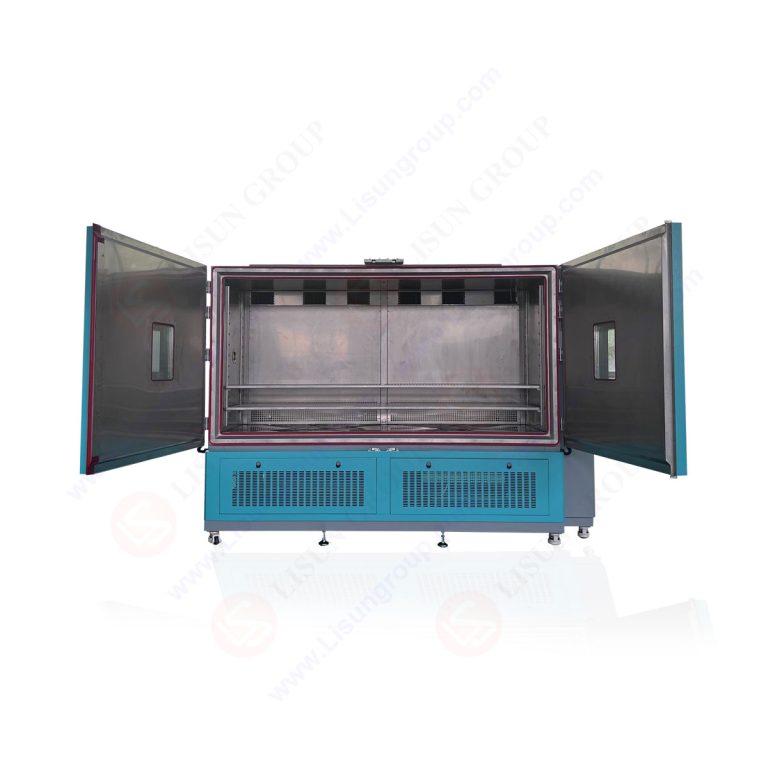
This is the primary mode for IEC 60068 steady-state heat testing. The DUT is driven at a fixed current. The system monitors forward voltage (Vf) changes, which inversely correlate with junction temperature. A rising Vf indicates increased thermal resistance due to solder joint fatigue or phosphor degradation. This mode validates thermal interface material (TIM) integrity.
4.2 Cyclic / Pulsed Mode
To simulate real-world thermal cycling (IEC 60068-2-14), the system can toggle the LED on and off at defined duty cycles. This accelerates mechanical stress on die-attach layers. The LISUN instrument captures photometric data at both the steady-state and the instant the LED turns on, measuring recovery time and thermal hysteresis.
5.1 Scalable Temperature Chamber Integration
The system supports up to three separate temperature chambers, enabling parallel testing at different environmental conditions. For example, a user can run a 55°C aging test in Chamber A, an 85°C test in Chamber B, and a controlled damp heat (IEC 60068-2-78) test in Chamber C. This simultaneous execution reduces total qualification time by 66%.
5.2 Flexible Fixture and Test Board Design
Each chamber accommodates customized mounting plates. For LEDLM-80PL, these are MC-PCBs with defined thermal pads. For LEDLM-84PL, fixtures are configurable luminaire holders with integrated temperature probes. The system supports both thermocouple (K-type) and resistance temperature detector (RTD, PT100) sensors for monitoring case temperature (Tc) with an accuracy of ±0.5°C.
6.1 Lumen Maintenance Data Overtime
The system logs photometric data every 5 to 60 minutes (user-defined) for the full 6000-hour duration. It automatically normalizes data to 100% at the 0-hour point. The key metric is the L70 threshold. For example, an LED with an initial flux of 1000 lumens achieves L70 when its flux drops to 700 lumens.
6.2 Projection Using the Exponential Decay Model
The Arrhenius software applies the TM-21 formula:
Φ(t) = α * exp(-β*t) + γ
Where:
α= Pre-exponential factorβ= Decay rate constantγ= Asymptotic constant (non-zero compensation)
The software fits the curve using a least-squares regression. It then calculates the projected L70 hours. If the 6000-hour test yields a decay rate of 10%, the software can project that L70 will be reached at 45,000 hours at a junction temperature of 85°C.
7.1 Developing a Thermal Qualification Plan
- Define Ts points: Select three case temperatures (e.g., 55°C, 85°C, Ts max per datasheet).
- Setup: Program the LISUN LEDLM-80PL chambers and load test samples (minimum 20 units per TM-21).
- Run: Execute the 6000-hour test in Constant Current mode.
- Analyze: Use the built-in Arrhenius software to determine Ea and project L70.
- Validate: Compare projected lifetime against the warranty requirement (e.g., L70 > 50,000 hours).
7.2 Mitigating Common Failure Modes
- Solder Joint Fatigue: Ensure thermal cycling profile (IEC 60068-2-14) does not exceed 20°C/minute to avoid thermal shock. The LISUN system’s programmable ramp control prevents this.
- Phosphor Saturation: In LM-84 testing, the integrating sphere must be calibrated for high flux. The LISUN LEDLM-84PL uses a spectroradiometer to track blue/yellow ratio shifts, indicating phosphor degradation.
- Driver Interaction: For luminaire tests, the system can also log input power drift, separating LED degradation from driver efficiency loss.
Successful p>LED Thermal Management: Key Test Standards for IEC 60068 Compliance hinges on the rigorous application of IES LM-80/TM-21 and LM-84/TM-28 test methods. The LISUN LED Optical Aging Test Instrument provides a turn-key solution for executing these complex protocols. By offering dual-system configurations (LEDLM-80PL for components, LEDLM-84PL for luminaires), supporting up to three temperature chambers, and utilizing an Arrhenius Model-based software for extrapolation, it enables engineers to accurately predict L70/L50 lifetimes. For R&D and quality teams, investing in this test infrastructure ensures that thermal designs are validated under real-world worst-case conditions, directly supporting product reliability, warranty cost reduction, and compliance with global standards. The system’s customizable hardware and dual testing modes provide the flexibility needed to meet both steady-state and cyclic thermal stress requirements.
Q1: How does the LISUN LEDLM-80PL determine the appropriate number of test samples for TM-21 compliance?
A: Per IES TM-21 guidelines, a minimum of 20 units is required for a statistically sound population. However, the LISUN LEDLM-80PL system supports up to 100 test positions per temperature chamber, depending on the fixture configuration. For proper statistical confidence in the exponential decay model (including the non-linear least squares fit), it is recommended to test at least 25 units per temperature (55°C, 85°C, and a third Ts point). The system’s software automatically rejects outliers using Chauvenet’s criterion and calculates the 90% confidence interval for the L70 projection. This ensures that your reported lifetime is not an over-estimation due to sample variance.
Q2: Can the LEDLM-84PL system be used to test COBs (Chip-on-Board) or only complete luminaires?
A: While the LEDLM-84PL is primarily designed for complete luminaires under IES LM-84, it can be configured to test COB modules if they include a thermal interface and heatsink similar to a luminaire. The key requirement is that the DUT fits within the integrating sphere (e.g., LISUN LSP-500 with a 1.5m or 2.0m sphere) and can be operated at its rated drive current. The system will measure total luminous flux and spectral power distribution. For COBs, you must still monitor the case temperature (Tc) using an embedded thermocouple. The software then applies the TM-28 projection model, which is valid for COB samples that include the actual thermal path used in the final product.
Q3: What is the practical difference between the Arrhenius Model and the exponential decay model used in TM-21?
A: The Arrhenius Model describes the acceleration factor between temperatures. It calculates how much faster a test runs at 85°C compared to 55°C based on activation energy (Ea). The exponential decay model (used in TM-21) describes the shape of the lumen depreciation over time at a single temperature. The LISUN software integrates both: it first runs the LM-80 test at 3 temperatures, uses the Arrhenius Model to verify that the decay rate increases predictably with temperature, and then applies the TM-21 exponential curve to extrapolate from 6,000 hours to L70. Without the Arrhenius step, you cannot validate if your test conditions are realistic or if a different failure mode is dominant at higher temperatures.