









Here is the comprehensive technical article generated based on your detailed instructions.
Abstract
This article provides an in-depth technical analysis of the LISUN Automated LED Aging Testing System for IES LM-80 Compliance, a critical tool for validating LED lumen maintenance and reliability. Designed for LED manufacturers and testing labs, the system integrates dual protocol variants (LEDLM-80PL for LM-80/TM-21 and LEDLM-84PL for LM-84/TM-28), Arrhenius Model-based predictive software, and configurable hardware for accelerated aging. We explore its dual testing modes, support for up to 3 connected temperature chambers, and the specific application of key standards like IES LM-79-19 and CIE 127. By delivering precise 6000-hour test data and L70/L50 projections, this system enables engineers to ensure long-term product quality and regulatory compliance in the competitive lighting market.
1.1 The Role of IES LM-80 in Lumen Maintenance
The solid-state lighting industry relies on IES LM-80-15 (“Measuring Lumen Maintenance of LED Light Sources”) as the benchmark for validating long-term performance. This standard mandates a minimum of 6000 hours of continuous aging testing at specified case temperatures (typically 55°C, 85°C, and a third temperature chosen by the manufacturer). Data points must be collected at 0, 1000, 3000, 6000, and optionally 10000 hours. The LISUN Automated LED Aging Testing System is architected to meet these exacting requirements, automating data capture and minimizing human error.
1.2 Integrating IES TM-21 for Long-Term Projections
While LM-80 provides raw data, IES TM-21-19 (“Projecting Long-Term Lumen Maintenance of LED Light Sources”) offers a statistical method for extrapolating this data to predict L70 (time to 70% lumen maintenance) and L50 values beyond the test duration. The LEDLM-80PL variant of the LISUN system embeds the Arrhenius Model directly into its software, automatically calculating TM-21 projections. This allows engineers to forecast 50,000+ hour lifetimes from a 6000-hour test, a crucial capability for warranty planning and marketing claims.
1.3 Distinction Between LM-80 and LM-84 Protocols
For those involved in integral LED lamps and luminaires, IES LM-84-19 (“Measuring Lumen Maintenance of LED Lamps, Light Engines, and Luminaires”) is the appropriate standard. The LISUN system addresses this via the LEDLM-84PL variant, which follows a different measurement protocol focused on product-level rather than component-level testing. The dual-system design (LEDLM-80PL vs. LEDLM-84PL) ensures that test labs can serve both component and luminaire manufacturers without redundant hardware.
2.1 Hardware Configuration and Thermal Management
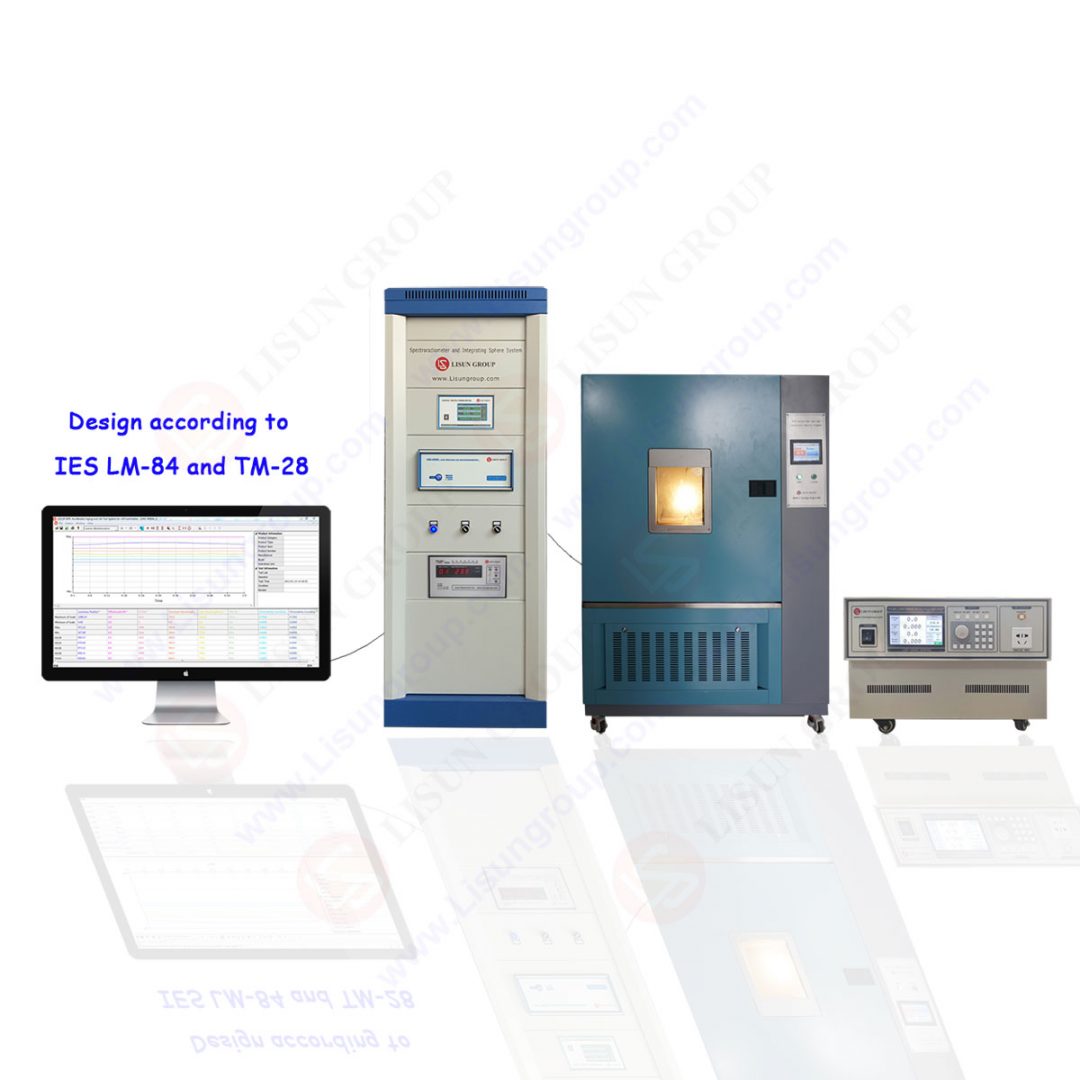
The physical core of the system is a series of aging racks and temperature chambers utilizing forced-air convection to maintain precise case temperatures (±0.5°C control tolerance). A critical design feature is the ability to connect up to three independently controlled temperature chambers to a single control console. This enables simultaneous testing of 50+ LED samples under three different temperature conditions, as required by IES LM-80 for proper Arrhenius modeling. The system supports high-current configurations up to 2A per channel for high-power LEDs.
2.2 Dual Measurement Modes: Operating Mode vs. Test Mode
The system operates in two distinct states to align with standard test procedures:
- Aging Mode (Continuous Operation): The LEDs remain powered on at nominal current, undergoing accelerated aging. The system cycles power and monitors basic electrical parameters (voltage, current, power) at programmable intervals.
- Testing Mode (Measurement Cycle): At each required data collection point (e.g., 1000 hours, 3000 hours), the system temporarily switches to measurement mode. It stabilizes the LED temperature and drives it to a specific junction temperature before performing photometric readings via an integrating sphere or spectroradiometer, ensuring compliance with CIE 127 for accurate luminous flux measurement.
2.3 Software and Data Acquisition Architecture
The proprietary software platform integrates the Microsoft SQL database for robust data logging and offers a graphical interface for real-time monitoring. It automatically detects failed samples, records failure times, and generates trend curves. The system outputs data formatted for direct submission to Energy Star or DLC (DesignLights Consortium) reports, including pre-calculated TM-21 extrapolation tables based on the Arrhenius Model.
3.1 Alignment with CIE 084 and CIE 070 for Accuracy
Photometric measurements rely on the principles of CIE 084 (“Measurement of Luminous Flux”) and CIE 070 (“The Measurement of Absolute Luminous Intensity Distributions”). The LISUN system incorporates a temperature-controlled integrating sphere (8-inch diameter typically used for components) that adheres to the cosine receptor and baffle geometry specified in CIE 084. This ensures that the spectral flux measurements used for lumen depreciation calculations are traceable to international standards, eliminating systematic errors in the test data.
3.2 The Role of IES LM-79-19 in Electrical Characterization
Before, during, and after aging testing, the system performs electrical and photometric characterization as per IES LM-79-19 (“Approved Method: Electrical and Photometric Measurements of Solid-State Lighting Products”). This includes measuring input power, power factor, THD, and total luminous flux. The LEDLM-80PL system is equipped with a power analyzer that complies with the class of instrument accuracy required by LM-79-19 (typically ±0.2% for voltage and current). This dual compliance (LM-80 for aging and LM-79 for characterization) streamlines the overall validation workflow.
3.3 Interpretation of CIE 127 for LED Measurement Accuracy
While often overlooked, CIE 127:2007 (“Measurement of LEDs”) is critical for ensuring that the photocurrent from the LED is correctly interpreted. The LISUN system’s spectroradiometer and photometer heads are calibrated to CIE 127 standards, implementing the correct averaging time and field-of-view settings. This prevents measurement drift caused by temperature-dependent spectral shifts, which is common in high-power LEDs during the 6000-hour aging process.
4.1 Sample Preparation and Chamber Loading
The workflow begins with configuring the aging rack. Each LED is mounted on a specific test board (MCPCB or T3ster compatible), and thermocouples are attached to the defined case temperature measurement point. The LEDLM-80PL system supports up to 3 chambers; typical configuration includes one chamber at 55°C, one at 85°C, and one at 105°C. The software allows the user to assign a unique ID (e.g., “LED_A_85C_01”) to each sample for traceability.
4.2 Automated Data Collection and Threshold Detection
During the 6000-hour test, the system automatically pauses the aging cycle at each required interval. The measurement sequence includes:
- Stabilization period (typically 30 minutes at test temperature).
- Spectroradiometric scan (380nm to 780nm).
- Luminous flux calculation (in lumens).
- Electrical data logging (Vf, If, Power, THD).
The software contains a “Drift Alert” function that flags any sample where lumen maintenance drops below 90% before 3000 hours, prompting early engineering review without manual intervention.
4.3 Report Generation
Upon completion (or at any intermediate point), the system generates a standardized report including:
- Raw data table (time vs. luminous flux for each sample).
- Normalized lumen maintenance curve (including L70 and L50 projections).
- TM-21 or TM-28 extrapolation calculations.
This report structure is compatible with most third-party laboratory data submission platforms.
5.1 Technical Differentiation
The choice between the two variants depends on the device under test (DUT). The LEDLM-80PL is optimized for LED packages, arrays, and modules (LM-80 scope), while the LEDLM-84PL is tailored for LED lamps and luminaires (LM-84 scope). The key difference lies in the thermal management and mechanical fixturing. The 84PL variant includes fixtures for screw-base bulbs (E26, E27, GU10) and requires temperature monitoring of the TMPLED (Temperature Measurement Point of the Light Engine), rather than just the case.
5.2 Specification Comparison Table
| Feature | LEDLM-80PL (LM-80/TM-21) | LEDLM-84PL (LM-84/TM-28) |
|---|---|---|
| Primary Standard | IES LM-80-15, TM-21-19 | IES LM-84-19, TM-28-19 |
| Test Duration | Minimum 6000 hrs (up to 10000 hrs) | Minimum 6000 hrs (up to 10000 hrs) |
| DUT Type | LED packages, arrays, modules | LED lamps, integrated luminaires |
| Max Chamber Temp | 130°C ± 0.5°C | 85°C ± 0.5°C (limited by lamp plastics) |
| Number of Channels | Up to 50 per chamber | Up to 40 per chamber (bulb size dependent) |
| Critical Metric | L70/L50 for LED chip | L70/L50 for integral product |
| Software Feature | Arrhenius Model for TM-21 extrapolation | Exponential Decay Model for TM-28 extrapolation |
5.3 Application Suggestion
- LED Manufacturer (Chip/COB): Use the LEDLM-80PL to qualify new die designs.
- Lighting OEM: Use the LEDLM-84PL to verify final product reliability and obtain DLC listing.
- Third-Party Lab: Invest in both variants to offer comprehensive services for the entire supply chain.
6.1 Theory of Lumen Depreciation Acceleration
Lumen depreciation follows an exponential rate of decay that is highly temperature dependent. The Arrhenius Model equation, embedded in the LISUN software, describes this relationship: k = A exp(-Ea/(RT)), where k is the reaction rate, Ea is the activation energy (typically 0.3-0.7 eV for LEDs), R is the gas constant, and T is the temperature in Kelvin. By testing at three different temperatures (e.g., 55°C, 75°C, and 85°C), the software calculates the activation energy (Ea) specific to the batch of LEDs under test.
6.2 Practical Integration in the Software
The LISUN system automates this complex calculation. After collecting data at 6000 hours for all three temperatures, the user selects the “TM-21 Projection” function. The software uses the Arrhenius plot (Ln(Lumen Output) vs. 1/T) to determine the degradation rate. It then extrapolates this rate to the user-defined use temperature (e.g., 60°C junction temperature) to predict the L70 lifespan. This is often 3-5x longer than the actual test duration, providing confidence for 50,000-hour or 100,000-hour lifetime claims.
7.1 High Voltage and Humidity Stress Options
Beyond standard thermal aging, the system can be configured with optional humidity control chambers (20% to 95% RH) to test for HaST (Highly Accelerated Stress Testing). Additionally, it supports switching mode power supplies for LED drivers, allowing simultaneous 1kV surge testing to assess insulation breakdown in line with IEC 61000-4-5. This makes the system valuable for automotive LED light source qualification (AEC-Q102).
7.2 Data Integrity and Traceability
The system implements a “Secure Mode” that prevents tampering with data points after collection. Each measurement is time-stamped and cryptographically signed. This is essential for laboratories seeking ISO 17025 accreditation, as it provides an unalterable audit trail. The software logs all power interruptions or ambient temperature deviations, ensuring any anomalies are documented and can be excluded from the final TM-21 projection.
The LISUN Automated LED Aging Testing System for IES LM-80 Compliance represents a significant advancement in reliability testing, combining rigorous hardware design with intelligent software integration. By supporting both the LM-80/TM-21 (LEDLM-80PL) and LM-84/TM-28 (LEDLM-84PL) protocols, the system offers unmatched flexibility for testing components and finished luminaires. The automated data logging, Arrhenius-based predictive modeling, and adherence to standards like IES LM-79-19, CIE 084, and CIE 127 ensure that test results are accurate, reproducible, and globally recognized. For manufacturers and test laboratories, this system reduces the manual labor associated with 6000-hour aging trials while providing the critical L70/L50 metrics needed for reliable product launches. Its ability to connect up to three temperature chambers and support high-current channels makes it a future-proof investment for any organization committed to quality assurance and regulatory compliance in the LED industry.
Q1: What is the minimum test duration required by IES LM-80, and can the LISUN system handle customized durations?
A: IES LM-80-15 requires a minimum of 6000 hours of testing, with data collection points at 0, 1000, 3000, and 6000 hours (optional 10000 hours). The LISUN Automated LED Aging Testing System is fully programmable to handle any duration from 1000 to 10000+ hours. The software automatically schedules the data collection intervals as per IES LM-80 or LM-84 requirements, but users can manually override these to perform interim checks. For R&D purposes, the system can be configured for extremely long-term aging studies (>10000 hours), though standard compliance only requires the 6000-hour threshold.
Q2: How does the system ensure temperature accuracy across multiple chambers for TM-21 projections?
A: TM-21 projections rely on precise temperature data. The LISUN system utilizes thermocouples (Type T or K) attached directly to the LED case temperature point (Tsp) as defined in IES LM-80. Each chamber is controlled by its own PID controller with ±0.5°C accuracy. The software records the actual measured case temperature every 10 seconds, not just the ambient chamber air temperature. If the actual case temperature deviates from the setpoint by more than 2°C for more than 5 minutes, the system logs an alarm. This high-fidelity temperature data is critical for the Arrhenius activation energy calculation.
Q3: Can the LEDLM-80PL system be used for testing high-power LEDs (e.g., >5W) without thermal runaway?
A: Yes, the system is built to handle high current loads up to 2A per channel and 120W total per test board. For high-power LEDs (e.g., 10W COBs), we recommend using the optional forced-air cooling kit per channel. The system’s software can also implement a “Thermal Shutdown” function that reduces the test current if the case temperature exceeds a safety threshold. For extremely high-power modules, the LEDLM-80PL can be configured with a liquid-cooled heat sink interface to maintain stable junction temperatures, preventing thermal runaway during the 6000-hour test duration.