









Here is the comprehensive technical article based on your detailed instructions.
Abstract
This article provides a technical deep dive into the LISUN Climatic Chamber: IEC 60068 Compliant Temperature Testing Solutions, focusing on their critical role in LED reliability validation. Designed for LED manufacturing engineers and testing lab professionals, the article examines how LISUN’s dual-system instruments (LEDLM-80PL and LEDLM-84PL) facilitate accelerated aging tests compliant with IES LM-80, TM-21, and IEC 60068 standards. Key insights include the application of the Arrhenius Model for precise lifetime extrapolation, the technical specifications of 6000-hour test durations, and the system’s capacity to support up to three interconnected temperature chambers. By integrating photometric data with environmental stress testing, LISUN provides a comprehensive solution for validating L70/L50 metrics and ensuring long-term product reliability.
1.1 Necessity of Temperature Control in LED Aging
The degradation of LED lumen output is fundamentally a temperature-driven process. Junction temperature directly influences the rate of phosphor degradation and semiconductor decay, making precise thermal management a non-negotiable aspect of reliability testing. A LISUN Climatic Chamber: IEC 60068 Compliant Temperature Testing Solutions platform provides the stable, controlled thermal environment required to isolate temperature as a stress factor. Without such control, data from lumen maintenance tests becomes corrupted by ambient fluctuations, rendering projections of L70 (time to 70% lumen maintenance) statistically invalid.
1.2 Correlation with International Standards
The relevance of environmental simulation extends beyond simple temperature control. IEC 60068, the baseline standard for environmental testing, dictates the methods for steady-state heat tests. When combined with lighting-specific standards like IES LM-80 (Measuring Lumen Maintenance of LED Light Sources) and IES LM-84 (Measuring Lumen Maintenance of LED Lamps, Engines, and Luminaires), the climatic chamber becomes an indispensable tool. These standards mandate specific temperature set points (typically 55°C, 85°C, and a third user-defined point) and humidity levels, demanding a chamber capable of precise, long-duration (6,000+ hour) stability.
1.3 Dual-System Architecture: LEDLM-80PL vs. LEDLM-84PL
LISUN addresses the distinct testing protocols of LM-80 and LM-84 through dedicated hardware variants. The LEDLM-80PL is engineered for component-level testing (LED packages and modules), designed to interface directly with standard PCB-based samples. The LEDLM-84PL, conversely, is built for testing complete lamps and luminaires. This dual-system approach ensures that the mechanical fixtures, optical alignment, and thermal management are optimized for the specific form factor under test, preventing erroneous data caused by improper sample mounting.
2.1 Integrated Photometric Measurement Station
A primary feature of the LISUN solution is the integration of an optical aging test instrument with the climatic chamber. The system houses an integrating sphere (typically 0.3m or 1.0m depending on the sample size) directly within the chamber or connected via a fiber optic link. This design allows for in-situ photometric measurements (luminous flux, color temperature, CRI) at specified intervals without removing the sample from the environmental stress. This automation eliminates thermal shock to the sample and dramatically improves data fidelity over manual, intermittent measurement methods.
2.2 Climatic Chamber Specifications and Control
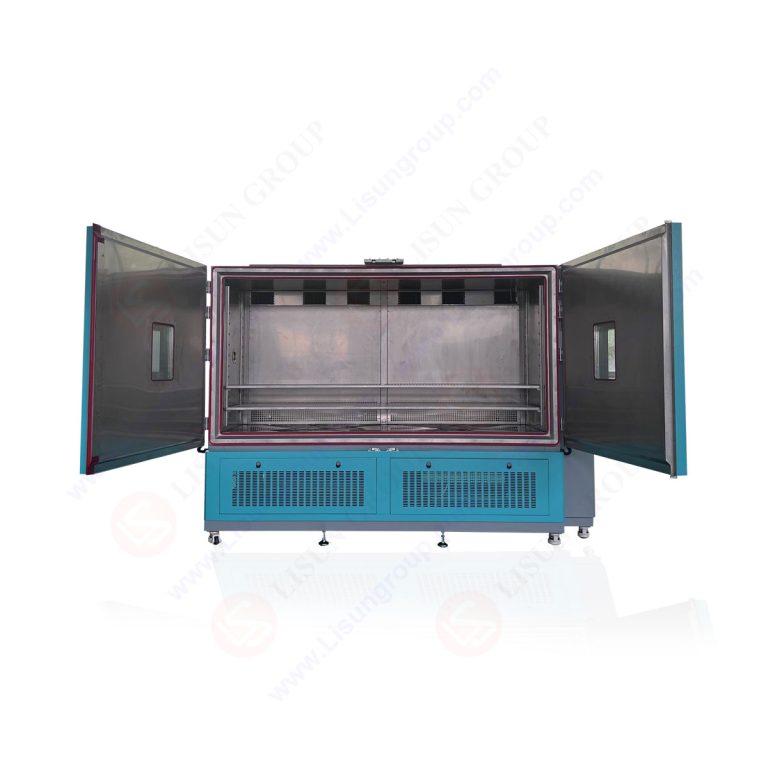
The chamber itself is engineered to meet IEC 60068-2-1 (Cold) and IEC 60068-2-2 (Dry Heat) standards. Key technical capabilities include:
- Temperature Range: Typically -40°C to +130°C or +150°C, covering the full range expected by IES standards.
- Control Precision: ±0.5°C to ±1.0°C stability, ensuring consistent stress levels over 6000+ hours.
- Ramp Rate: Programmable at 1-3°C/min to avoid overshoot and protect sensitive electronic samples.
- Scalability: The system supports daisy-chaining up to three temperature chambers to a single control console, enabling simultaneous testing of multiple test runs or different temperature groups as required by LM-80.
2.3 Data Acquisition and Measurement Modes
The instrument operates in two primary modes: Continuous Test Mode and Cycle Test Mode.
- Continuous Test Mode: The sample operates continuously under constant current. Measurements are taken at standard intervals (0, 1000, 2000, 3000, 4000, 5000, 6000 hours). This is the standard mode for LM-80.
- Cycle Test Mode: The sample is subjected to power on/off cycles (e.g., 3 hours on, 1 hour off) while under temperature stress. This mode simulates real-world application stresses more accurately, as per specific requirements of TM-28 for luminaires.
3.1 Arrhenius Model Integration for Lifetime Projection
The bundled software is not merely a data logger; it is an analytical engine built around the Arrhenius Model. This model calculates the acceleration factor between a stress temperature and a use temperature (e.g., 25°C or 55°C). By inputting the failure data (lumen depreciation) from the 6000-hour test across the different temperature chambers, the software automatically extrapolates L70 and L50 (time to 50% lumen maintenance) values for up to >36,000 hours or more, in full compliance with TM-21 and TM-28 methodologies for projection.
3.2 Real-Time Lumen Depreciation Curve Mapping
The software maps in-situ flux readings onto a normalized depreciation curve. Engineers can visually track the rate of depreciation at different temperatures. The system automatically flags outliers or samples exhibiting sudden failure (infant mortality). The output is a standard-compliant data file suitable for submission to Energy Star, DLC (DesignLights Consortium), or internal QA departments.
3.3 Technical Comparison Table: LEDLM-80PL vs. LEDLM-84PL
| Feature / Specification | LEDLM-80PL (LM-80 / TM-21) | LEDLM-84PL (LM-84 / TM-28) |
|---|---|---|
| Primary Standard | IES LM-80-20 | IES LM-84-20 |
| Projection Standard | TM-21-19 | TM-28-14 |
| Sample Type | LED Packages / Modules / Boards | Complete Lamps, Engines, Luminaires |
| Integrating Sphere | Typically 0.3m or 0.5m (small aperture) | Typically 1.0m or 1.5m (large aperture) |
| Mounting Fixture | Standard thermal interface plate (PCB) | Proprietary socket/adapter for various form factors |
| Power Supply Integration | External DC source (customer provided or LISUN) | Integrated internal AC/DC power control |
| IEC 60068 Compliance | IEC 60068-2-1 & 2-2 | IEC 60068-2-1 & 2-2 |
| Max. Connected Chambers | 3 | 3 |
4.1 IES LM-79-19 and Electrical Measurements
While the climatic chamber tests photometric longevity, IES LM-79-19 (Electrical and Photometric Measurements of Solid-State Lighting Products) governs the initial and periodic performance measurements. The LISUN system integrates an AC/DC power analyzer that measures voltage, current, power factor, and total harmonic distortion during each measurement cycle. This ensures that the recorded lumen flux data is correlated with stable electrical characteristics, isolating optical degradation from electrical failure.
4.2 Photometric and Colorimetric Standard Compliance
The integrating sphere and spectrometer within the system comply with CIE 084 (Measurement of Luminous Flux) and CIE 127 (Measurement of LEDs). This ensures that the collected photometric data is traceable to international photometric standards. For color-based reliability concerns, CIE 70 (Measurement of Absolute Spectral Distribution) is applied to track chromaticity shifts (Δuv) over the aging period, a critical metric for lighting designers and horticultural lighting applications.
4.3 Accelerated Testing and Extrapolation (TM-21 / TM-28)
The core value of the system lies in its ability to produce accelerated life data. By testing at elevated temperatures (e.g., 85°C for LM-80), the Arrhenius equation predicts a failure rate that might take 50,000+ hours in real-time. The software applies the two-phase exponential decay (bimodal) model required by TM-21 for component data, and the regression analysis required by TM-28 for luminaire data. This acceleration saves months of testing time while providing statistically valid, regulatory-grade data.
5.1 Number of Channels and Sample Capacity
The LISUN system is designed for scalability. A standard configuration can test a single set of samples (e.g., 20 to 100 LEDs depending on the LEDLM-80PL channel card). The key specification is the support for up to 3 connected temperature chambers. This allows a testing lab to run:
- Chamber 1: 55°C (Standard use condition for projection)
- Chamber 2: 85°C (High stress acceleration)
- Chamber 3: 105°C (Absolute maximum rating testing) all simultaneously under a single software interface.
5.2 Power Supply and Circuit Protection Customization
For the LEDLM-80PL, customers can specify voltage and current ratings for the constant current sources. Precision is critical, with typical ripple being less than 1% to avoid injecting electrical stress artifacts into the thermal test. For the LEDLM-84PL, the system includes variable frequency drives and programmable AC sources to simulate grid fluctuations (as per IEC 61000) while the sample sits at a steady 85°C temperature, providing a combined stress environment.
6.1 Installation and Calibration Requirements
A dedicated LISUN Climatic Chamber: IEC 60068 Compliant Temperature Testing Solutions installation requires careful consideration of facility power (typically 220V/380V, 3-phase) and heat dissipation from the refrigeration unit. Calibration is performed using NIST-traceable platinum resistance thermometers (PRTs) for temperature and standard lamps for the integrating sphere. LISUN provides comprehensive installation and calibration services to ensure the chamber meets the strict uniformity requirements (±1°C across the working volume) demanded by IEC 60068.
6.2 Workflow for a 6000-Hour LM-80 Test
A standard workflow for a customer involves:
- Sample Preparation: Mounting 20-50 LED packages on a thermal plate.
- Initial Measurement: Measuring flux and color at 0 hours (T0) per LM-79.
- Programming: Setting the chamber to 85°C and the power supply to the rated current.
- Automated Testing: The system runs for 6000+ hours, measuring and logging data every hour (or user-defined interval).
- Data Processing: The software automatically generates the TM-21 projection report and the final LM-80 test report.
7.1 Understanding the Lumen Maintenance Thresholds
L70 (time to 70% lumen maintenance) is the primary metric for general lighting, representing the end of useful life in many applications. L50 (time to 50% lumen maintenance) is critical for industrial or outdoor applications where failure is defined by absolute light loss. The climatic chamber data must show a clear, monotonic decay path to these thresholds. The LISUN system provides statistical confidence intervals (e.g., 90% or 95%) for these projections, which is a requirement for Energy Star reporting.
7.2 Statistical Analysis of Failure Modes
Beyond pure lumen maintenance, the software analyzes the shape of the curve. A sharp drop in early hours suggests a thermal management failure or poor phosphor stability. The system correlates this data with the recorded temperature profile to identify if the failure was due to a chamber ramp rate error or a genuine material defect. This deep diagnostic capability turns a simple pass/fail test into a continuous improvement tool for LED design engineers.
The LISUN Climatic Chamber: IEC 60068 Compliant Temperature Testing Solutions represents a critical infrastructure investment for any organization serious about LED reliability. By merging rigorous environmental stress testing per IEC 60068 with the precise photometric measurement standards of IES LM-80, LM-84, TM-21, and TM-28, it delivers a unified platform for accelerated aging validation. The dual-system architecture (LEDLM-80PL and LEDLM-84PL) ensures that testing protocols are optimized for the specific sample type, from bare emitters to complete luminaires. The integration of the Arrhenius Model for lifetime projection, combined with the hardware capability for 6000-hour continuous operation and support for up to three temperature chambers, provides a comprehensive solution for generating regulatory-grade L70 and L50 data. For engineers seeking to validate product longevity, meet Energy Star requirements, or improve internal quality assurance, this system provides the accuracy, scalability, and data integrity necessary to make informed decisions.
Q1: What is the difference between the LEDLM-80PL and LEDLM-84PL regarding test compliance?
A: The primary difference is the sample type and the corresponding standard. The LEDLM-80PL is designed to comply with IES LM-80-20 for testing LED components (packages and modules), and its data is used for TM-21-19 lifetime projections. It uses smaller integrating spheres (0.3m or 0.5m). The LEDLM-84PL is designed for IES LM-84-20 for testing complete LED lamps and luminaires, with data extrapolated per TM-28-14. It utilizes larger spheres (1.0m or 1.5m) and includes integrated AC power control. The physical mounting fixtures and electrical interfaces are therefore completely different between the two systems, despite sharing a common software and climatic chamber backbone.
Q2: How does the Arrhenius Model within the LISUN software handle data from tests conducted at three different temperatures?
A: The software uses the Arrhenius Model to calculate an activation energy (Ea) for the degradation process based on the failure rates observed at each of the three temperature set points (e.g., 55°C, 85°C, and 105°C). It performs a linear regression of the log of time-to-failure versus 1/Temperature (in Kelvin). The slope of this line is proportional to the activation energy. The software then uses this calculated Ea to project the L70 and L50 values at a user-defined use temperature (e.g., 25°C or 55°C). This multi-temperature analysis is crucial for statistical validity, as per TM-21 guidance, and provides a more robust projection than a single-point test.
Q3: Can the LISUN Climatic Chamber be used for testing products other than LEDs, such as automotive sensors or electronic components?
A: Yes, absolutely. While the article focuses on LED testing, the chamber is a versatile IEC 60068-compliant environmental test system. It can be used for steady-state heat (IEC 60068-2-2) and cold (IEC 60068-2-1) tests on any electronic device. Without the specific photometric measurement hardware (integrating sphere and spectrometer), it functions as a standard high-precision temperature chamber. Users can often disable the optical measurement channel in the software via a password-protected menu, allowing the chamber to be used for general reliability testing (e.g., burn-in of PCBs, capacitors, or connectors) when not performing LED longevity tests.
Q4: What are the common failure modes identified during a standard 6000-hour LM-80 test?
A: The most common failure modes observed are phosphor degradation (leading to color shift and lumen drop), delamination of the silicone encapsulant (causing light extraction loss), and solder joint fatigue (causing intermittent electrical failure). The LISUN software’s real-time lumen and color tracking can distinguish between a slow, linear decay (typical of optimized phosphor) and a sudden, exponential drop (indicative of catastrophic package failure). By correlating this data with the temperature profile logs, engineers can also determine if a failure is due to thermal runaway from poor heat sink design or an intrinsic material weakness.
Q5: How does the integration of IES LM-79-19 precision impact the accuracy of the L70 projection?
A: LM-79-19 provides the metrological framework for the initial (T0) and final (T6000) photometric measurements. The LISUN system uses a spectrometer and sphere calibrated to this standard. A deviation of even 1% in flux measurement at T0 will propagate through the TM-21 projection, potentially causing a 5-10% error in the final L70 value. By integrating the LM-79 measurement method directly into the aging test workflow (including proper self-absorption correction during the test), the LISUN system minimizes systematic errors, ensuring that the extrapolated lifetime is as accurate as the raw data allows.