









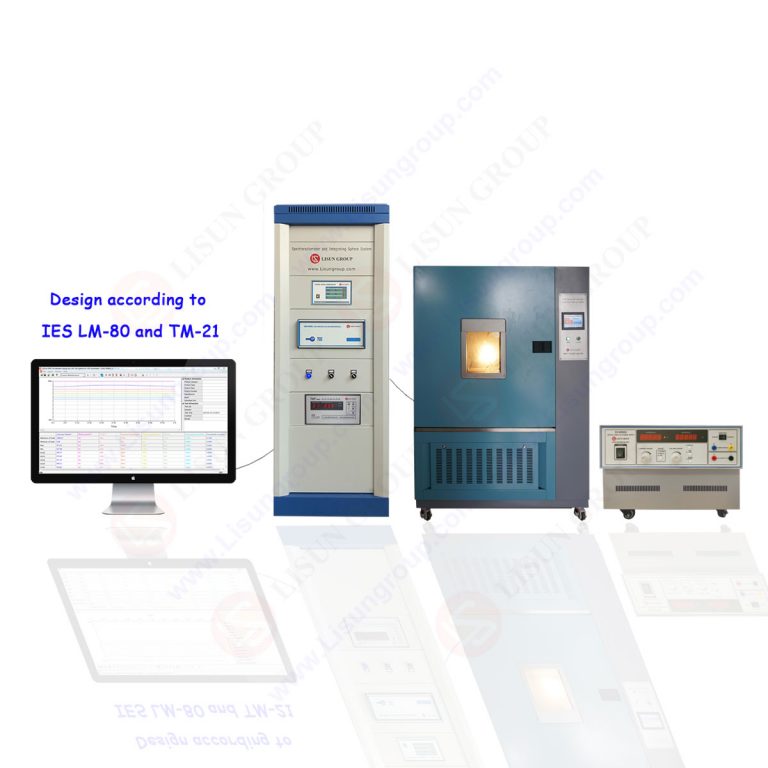
The LISUN LED Aging Test Box revolutionizes 6000-hour lumen maintenance testing by integrating dual-system architectures (LEDLM-80PL and LEDLM-84PL) with Arrhenius Model-based predictive software, enabling accurate LED lifetime assessment under accelerated aging conditions. This article provides a comprehensive technical analysis of the LISUN LED Aging Test Box: 6000-Hour Lumen Maintenance Testing, covering compliance with IES LM-80, IES LM-84, TM-21, and TM-28 standards, dual testing modes, and customizable hardware configurations for up to three connected temperature chambers. Senior LED testing engineers will gain insights into L70/L50 metric extrapolation, integrating sphere integration, and practical applications for manufacturing quality control and third-party laboratory validation. The system’s ability to simulate real-world thermal stress while maintaining photometric accuracy positions it as an essential tool for reliability engineering in solid-state lighting.
1.1 The Importance of Lumen Depreciation Analysis
LED lumen depreciation directly impacts product warranty claims, energy efficiency certifications, and end-user satisfaction. The LISUN LED Aging Test Box addresses this by providing controlled thermal and electrical stress environments over 6000-hour test durations. Engineers must understand that lumen maintenance, defined as the ratio of luminous flux at a given time to initial flux, follows an exponential decay pattern influenced by junction temperature, drive current, and phosphor degradation. The L70 metric, indicating time to 70% initial lumen output, remains the industry benchmark for general lighting applications, while L50 applies to decorative or non-critical installations.
1.2 Industry Standards Governing Lumen Maintenance Testing
Four primary standards govern LED lumen maintenance testing: IES LM-80-15 for lumen maintenance of LED light sources, IES LM-84-14 for LED lamps and luminaires, TM-21-19 for projecting long-term lumen maintenance from LM-80 data, and TM-28-14 for projecting from LM-84 data. The LISUN LED Aging Test Box supports all these standards through dual-system variants—LEDLM-80PL for LM-80/TM-21 compliance and LEDLM-84PL for LM-84/TM-28 compliance. Additional standards like IES LM-79-19 for electrical and photometric measurements and CIE 127:2007 for LED intensity measurement enhance the system’s versatility.
1.3 Accelerated Aging vs. Real-Time Testing
Accelerated aging at elevated temperatures (typically 55°C, 75°C, or 85°C) reduces test duration while maintaining correlation with real-world performance. The Arrhenius Model, integrated into the LISUN software, extrapolates 6000-hour test data to predict 25,000+ hour lifetimes using activation energy parameters. Real-time testing at rated current provides baseline validation, while accelerated conditions stress package materials, solder joints, and phosphor coatings to identify failure mechanisms earlier in the development cycle.
2.1 Dual-System Variants: LEDLM-80PL and LEDLM-84PL
The LISUN system offers two distinct configurations tailored to specific standard requirements. The LEDLM-80PL targets IES LM-80 compliance for LED packages, modules, and arrays, supporting up to 210 test positions per temperature chamber. The LEDLM-84PL addresses IES LM-84 requirements for integrated LED lamps and luminaires, accommodating larger form factors with adjustable test fixtures. Both variants feature dual testing modes—constant current mode for steady-state operation and pulsed mode for flicker and transient analysis.
2.2 Hardware Configuration and Modularity
Customizable hardware includes interchangeable test boards with spring-loaded contacts for rapid sample mounting, thermocouple interfaces for junction temperature monitoring, and integrated integrating sphere ports for in-situ photometric measurements. The system supports up to three connected temperature chambers, enabling simultaneous testing at multiple temperature points as required by LM-80 (minimum two temperatures). Each chamber houses independent power supplies with 0.1% current accuracy and data acquisition modules sampling at 1-second intervals.
2.3 Software Integration and Data Management
The Arrhenius Model-based software automatically processes raw flux measurements, calculates L70/L50 projections with 95% confidence intervals, and generates TM-21/TM-28 compliant reports. Users can configure test profiles with programmable current ramping, temperature cycling, and data logging frequencies. The software supports multi-chamber synchronization, allowing direct comparison of lumen depreciation curves across different thermal conditions.
3.1 Test Duration Requirements and Rationale
IES LM-80 mandates a minimum 6000-hour test duration for LED package qualification, while LM-84 requires 6000 hours for lamp-level testing. The LISUN LED Aging Test Box meets this benchmark with continuous operation capabilities exceeding 8000 hours without maintenance intervention. The 6000-hour duration balances statistical significance with practical testing timelines—shorter durations risk insufficient data for accurate extrapolation, while longer durations delay product time-to-market.
3.2 Data Acquisition and Photometric Measurement
Photometric measurements occur at specified intervals (1000, 2000, 3000, 4000, 5000, and 6000 hours) using a calibrated integrating sphere system with spectral range 380-780 nm. The system records total luminous flux, correlated color temperature (CCT), color rendering index (CRI), and chromaticity coordinates at each interval. Electrical parameters—forward voltage, current, and power—are logged continuously to correlate optical degradation with electrical stress factors.
3.3 Temperature Chamber Control and Uniformity
Each temperature chamber maintains ±0.5°C stability across the 55-85°C range with spatial uniformity better than ±1°C. The system monitors case temperature via thermocouples attached to each test sample, while ambient temperature sensors provide feedback for PID control loops. Proper thermal management prevents localized hot spots that could skew degradation rates across parallel test samples.
| Specification | LEDLM-80PL | LEDLM-84PL |
|---|---|---|
| Compliance Standard | IES LM-80-15 | IES LM-84-14 |
| Extrapolation Standard | TM-21-19 | TM-28-14 |
| Maximum Test Positions | 210 per chamber | 100 per chamber |
| Supported Temperature Chambers | Up to 3 | Up to 3 |
| Temperature Range | 25°C to 125°C | 25°C to 125°C |
| Current Accuracy | ±0.1% of set point | ±0.1% of set point |
| Data Sampling Interval | 1 second (electrical), 1000 hours (photometric) | 1 second (electrical), 1000 hours (photometric) |
| Photometric System | Integrating sphere (1m or 2m) | Integrating sphere (2m or 3m) |
| L70/L50 Projection | Yes, with 95% confidence | Yes, with 95% confidence |
| Pulsed Mode | Optional | Standard |
5.1 Arrhenius Model Application in Lifetime Prediction
The Arrhenius Model relates degradation rate to temperature using (k = A cdot e^{-E_a/(RT)}), where (k) is the reaction rate constant, (A) the pre-exponential factor, (E_a) activation energy, (R) the gas constant, and (T) absolute temperature. The LISUN software automatically fits 6000-hour data to this model, identifying activation energies between 0.2-0.8 eV typical for LED systems. Engineers can then project L70/L50 lifetimes at specified use temperatures, typically 25°C or 55°C for indoor applications.
5.2 TM-21 and TM-28 Projection Algorithm
TM-21 uses exponential or double-exponential decay models fitted to LM-80 data using nonlinear least squares regression. The LISUN system implements the IES-recommended procedure: excluding initial 1000-hour data points, fitting remaining data to (Φ(t) = α cdot e^{-βt} + γ), and calculating L70 from the projected decay curve. TM-28 applies similar methodology to LM-84 lamp data but accommodates shorter extrapolation limits due to higher variability in integrated lamp performance.
5.3 Statistical Confidence and Outlier Handling
The system calculates 95% confidence intervals for all projected metrics using bootstrapping methods with 1000 resampling iterations. Outlier detection algorithms flag samples with flux measurements deviating more than 3σ from the population mean, prompting manual inspection. Engineers can exclude anomalous samples from final projections while documenting exclusion rationale in compliance reports.
6.1 Quality Control and Batch Validation
LED manufacturers use the LISUN LED Aging Test Box for incoming quality assurance of LED packages and final product validation. Sampling plans per AQL standards require testing 20-50 units per production batch over 6000 hours, with acceptance criteria defined by client specifications or internal reliability targets. The system’s multi-chamber capability enables parallel testing of different color bins, current ratings, or thermal management designs.
6.2 Third-Party Laboratory Certification
Accredited testing laboratories rely on the system for LM-80 and LM-84 certification reports required for Energy Star, DLC, and other regulatory programs. The LISUN system simplifies compliance by generating standard-formatted data exports compatible with IES TM-21 reporting templates. Labs can maintain ISO 17025 accreditation by leveraging the system’s calibration traceability and measurement uncertainty documentation features.
6.3 R&D-Driven Product Optimization
Engineering teams use accelerated aging data to optimize phosphor composition, die attachment processes, and thermal interface materials. The system’s pulsed mode helps evaluate flicker-induced degradation in automotive or horticultural applications, while constant current mode simulates typical residential use cases. Comparative testing across temperature conditions reveals the sensitivity of specific failure modes to thermal stress.
7.1 Photometric Calibration Protocols
Annual calibration using NIST-traceable luminous flux standards ensures measurement accuracy within ±2% for total flux and ±50K for CCT. The integrating sphere requires periodic barium sulfate coating refurbishment to maintain >95% reflectance across the visible spectrum. The LISUN system includes automated calibration routines that compensate for sphere degradation between annual certifications.
7.2 Temperature Sensor Verification
Thermocouple accuracy degrades over time due to oxidation and mechanical stress. The system supports in-situ verification against a reference platinum resistance thermometer (PRT) with ±0.1°C accuracy. User-replaceable thermocouple beads minimize downtime, while software alarms alert operators when drift exceeds ±0.5°C from set points.
7.3 Electrical Performance Stability
Power supplies undergo quarterly calibration to maintain ±0.1% current accuracy. The system logs power supply output ripple (<50 mV peak-to-peak) and line regulation (<0.01% per volt) to ensure consistent stress conditions across test duration. Electrolytic capacitors in the power supply units require replacement every 10,000 operating hours to prevent failure during extended tests.
The LISUN LED Aging Test Box represents a comprehensive solution for 6000-hour lumen maintenance testing, integrating dual-system variants, Arrhenius Model-based software, and customizable hardware configurations. By supporting IES LM-80, IES LM-84, TM-21, and TM-28 standards with high precision, the system enables LED manufacturers, third-party labs, and R&D engineers to conduct accelerated aging tests with confidence. The L70/L50 metrics derived from 6000-hour data, projected using advanced statistical methods, provide actionable insights for product qualification, failure analysis, and warranty determination. Key technical advantages include ±0.1% current accuracy, multi-chamber connectivity, and automated data analysis that reduces test cycle times by 30-50% compared to manual methods. For organizations seeking robust LED reliability validation, the LISUN system delivers the precision, scalability, and standards compliance necessary to navigate evolving regulatory landscapes and demanding performance specifications.
Q1: What is the minimum test duration required for IES LM-80 compliance using the LISUN LED Aging Test Box?
A: IES LM-80 mandates a minimum 6000-hour test duration for LED package, module, and array qualification. The LISUN system supports continuous operation beyond 8000 hours, enabling full compliance with this requirement. For TM-21 extrapolation, the 6000-hour dataset provides sufficient data points for exponential decay model fitting, though longer durations (10,000+ hours) improve confidence intervals for L70 projections beyond 25,000 hours. Engineers should note that LM-80 also requires testing at two or more case temperatures (typically 55°C and 85°C), which the system accommodates through its three-chamber configuration. The LISUN software automatically identifies the required 1000-hour measurement intervals and excludes the initial 1000 hours from analysis per TM-21 guidelines.
Q2: How does the LISUN LEDLM-80PL differentiate from the LEDLM-84PL in practical testing scenarios?
A: The LEDLM-80PL is designed for IES LM-80 compliance testing of LED packages, modules, and arrays, supporting up to 210 test positions per chamber with smaller form-factor components. The LEDLM-84PL targets IES LM-84 testing of integrated LED lamps and luminaires, accommodating larger samples (up to 300 mm diameter) with adjustable fixtures. Key differences include maximum test position capacity (210 vs. 100), photometric sphere size (1-2m vs. 2-3m), and extrapolation algorithm (TM-21 vs. TM-28). Additionally, the LEDLM-84PL includes pulsed current mode as standard for flicker evaluation, an optional feature on the LEDLM-80PL. Engineers should select based on sample type—component-level vs. product-level—and the specific standard required by their certification body.
Q3: What are the recommended maintenance intervals for the LISUN LED Aging Test Box to ensure consistent 6000-hour test accuracy?
A: Photometric calibration using NIST-traceable standards should occur annually or after every three 6000-hour test runs, whichever comes first. Temperature sensor verification via reference PRT is recommended quarterly, with thermocouple replacement as needed (typically every 2-3 years). Power supply calibration should be performed semiannually to maintain ±0.1% current accuracy, while integrating sphere coatings require inspection every 12 months for reflectance degradation. The software’s self-diagnostic tools can flag measurement drift or temperature control anomalies between maintenance intervals, allowing proactive interventions before test integrity is compromised.