









Here is a comprehensive technical article generated according to your specifications.
Abstract
Accelerated aging validation is critical for ensuring LED product reliability, yet traditional testing often struggles to balance accuracy with real-world thermal stress simulation. This article examines the LISUN LED Aging Test Chamber: 6000-Hour Thermal Life Testing Solution as a precise instrument for lumen maintenance prediction. We focus on the engineering principles behind the dual-system architecture (LEDLM-80PL and LEDLM-84PL), the application of the Arrhenius Model for L70/L50 extrapolation, and compliance with IES LM-80, TM-21, LM-84, and TM-28 standards. By analyzing dual-test modes and multi-chamber configurations, we demonstrate how this solution delivers accelerated results without compromising data integrity for R&D and QC engineers.
1.1 The Challenge of Real-Time Lumen Depreciation Measurement
LED products are expected to last 50,000 hours or more. Testing to failure in real-time is commercially impractical. Thermal aging chambers bridge this gap by applying elevated temperatures to accelerate the chemical reactions causing lumen depreciation. The LISUN LED Aging Test Chamber specifically targets the 6000-hour mark, a critical threshold defined by IES LM-80 for initial lumen maintenance data.
1.2 The Role of the Arrhenius Model in Prediction
The LISUN software utilizes the Arrhenius Model to establish a correlation between failure rate and temperature. By testing LEDs at multiple case temperatures (commonly 55°C, 85°C, and a manufacturer-defined temperature), the system calculates the activation energy (Ea) for the specific LED package. This data is then used to project L70 (time to 70% lumen output) and L50 values, essential for TM-21 extrapolation.
2.1 LEDLM-80PL: The LM-80/TM-21 Compliant Workhorse
This variant is engineered for testing LED packages, arrays, and modules per the IES LM-80-15 standard. It supports simultaneous monitoring of multiple samples under constant DC current. The system integrates an Arrhenius software module to automatically process raw data and generate TM-21 extrapolated reports.
2.2 LEDLM-84PL: Specialization for LM-84/TM-28 Compliance
Designed for LED light engines and luminaires, the LEDLM-84PL follows the IES LM-84-22 standard. This variant focuses on AC driver-level testing and thermal management verification for complete units. It supports the TM-28 projection method, which accounts for the unique failure modes of integrated electronics.
| Feature | LEDLM-80PL | LEDLM-84PL |
|---|---|---|
| Primary Standard | IES LM-80, TM-21 | IES LM-84, TM-28 |
| Test Sample | LED Packages, Arrays, Modules | LED Light Engines, Luminaires |
| Power Source | DC constant current (High precision) | AC programmable (Dimming-capable) |
| Standard Duration | 6,000+ hours (up to 10,000) | 6,000 hours (minimum) |
| Extrapolation Output | L70/L50 (TM-21) | L70/L50 (TM-28) |
3.1 6000-Hour Duration and Temperature Stability
The chamber is rated to maintain a temperature stability of ±0.5°C across its operating range (ambient +10°C to +100°C). This precision is vital for the Arrhenius Model, where a temperature error of 1°C can misstate lifetime projections by over 5%. The system supports continuous 6,000-hour runs with logging intervals as low as 1 minute.
3.2 Single vs. Multi-Chamber Operation
Users can run a single chamber (standard) or connect up to 3 temperature chambers to a single control unit. This allows simultaneous testing of samples at three distinct temperatures (e.g., 55°C, 85°C, 105°C) required for robust TM-21 analysis. The dual testing modes include:
- Constant Temperature Mode: Maintains a setpoint for standard degradation analysis.
- Temperature Cycling Mode: Simulates thermal shock (e.g., -10°C to +85°C) per CIE 70 for stress testing.
4.1 IES LM-79-19 and IES LM-80 Integration
While LM-80 defines the aging methodology, LM-79-19 defines the photometric measurement (luminous flux, CCT, CRI) before and after aging. The LISUN chamber is designed to interface directly with integrating spheres, allowing for “cold start” measurements as required by LM-79. This ensures that the thermal history of the sample does not skew the initial measurement.
4.2 CIE 084, CIE 70, and CIE 127 Alignment
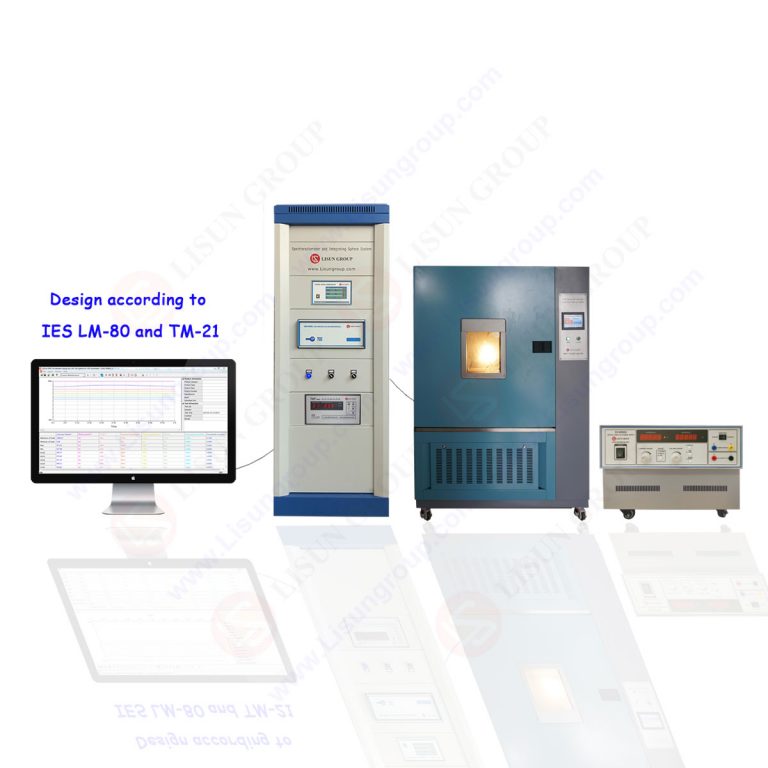
The system adheres to CIE 084 for the measurement of luminous flux and CIE 127 for LED intensity measurement conditions. For thermal stress specific to automotive lighting, compliance with CIE 70 (Photometric and Colorimetric Data) ensures that the aging profile matches real-world vehicle thermal environments, a critical factor for LED reliability in harsh conditions.
5.1 Real-Time Monitoring and Data Logging
The control software provides real-time tracking of voltage, current, temperature (TC and Ts), and lumen intensity. Data is stored in a format compatible with TM-21 and TM-28 reporting templates. High-speed data acquisition allows for detection of early-life failures (infant mortality), which often occur within the first 1,000 hours.
5.2 Photometric vs. Colorimetric Tracking
The LISUN LED Aging Test Chamber: 6000-Hour Thermal Life Testing Solution is unique in its ability to track not just luminous flux depreciation (L70) but also chromaticity shift. This is a key requirement of TM-21 and TM-28, where the Δu’v’ coordinate shift must not exceed 0.007. The chamber supports in-situ measurement via optical fibers, minimizing handling-induced errors.
6.1 Sample Board and Connector Flexibility
The aging chamber accepts custom sample boards designed for different LED form factors (2835, 5050, COBs, etc.). The power supply is modular, supporting up to 16 independent channels per chamber, each capable of providing up to 1.5A of constant current with an accuracy of ±0.5% of reading.
6.2 Safety and Redundancy Systems
Given the 6000-hour duration (approximately 8.3 months), system reliability is paramount. The chamber features:
- Dual over-temperature protection: Independent hardware and software cutoffs.
- UPS interface: Prevents data loss during power outages.
- Sample failure detection: Automatically logs the time of failure and stops the respective power channel to prevent cascading damage.
7.1 From Raw Data to TM-21 L70 Report
The workflow is streamlined: Raw flux vs. time data from the 6000-hour test is automatically fitted to an exponential decay model. The software calculates the activation energy and then extrapolates to 6x the test duration (e.g., 36,000 hours). The final report includes a graph of the fitted curve and the calculated L70 value.
7.2 Troubleshooting Early Failures
Engineers often use the chamber to test for “bathtub curve” failures. For instance, a test group showing a sharp flux drop between 100-500 hours indicates poor die-attach quality or material mismatches. The detailed data log from the LISUN system allows engineers to pinpoint the exact thermal cycle or week of failure, facilitating root cause analysis.
The LISUN LED Aging Test Chamber: 6000-Hour Thermal Life Testing Solution delivers a rigorous, standards-compliant platform for validating LED longevity. By offering specialized hardware for both LM-80 (LEDLM-80PL) and LM-84 (LEDLM-84PL) requirements, it covers the full spectrum from components to finished luminaires. The integration of the Arrhenius Model, support for up to three temperature chambers, and precise data logging ensure that engineers can confidently extrapolate L70 and L50 values up to 10+ years of use. For QC managers and R&D teams, this chamber transforms the 6000-hour test from a regulatory burden into a strategic advantage for reliability engineering. It bridges the gap between rapid innovation and the quantitative proof of lifetime performance demanded by global standards.
Q1: How does the 6000-hour duration in the LISUN chamber relate to a L70 projection of 50,000 hours?
A: IES LM-80 mandates a minimum of 6,000 hours of real-time test data as the basis for projection. The LISUN software uses this data to apply the Arrhenius Model, calculating an activation energy (Ea) specific to your LEDs. TM-21 then allows extrapolation to a maximum of 6x the test duration (meaning 36,000 hours from a 6,000 hour test). A 50,000-hour L70 projection is valid if the calculated Ea and depreciation curve are well-behaved, provided you test at multiple temperatures (e.g., 55°C, 85°C, 105°C) to ensure the model’s accuracy across the intended operating range.
Q2: Can I test AC LED light engines (drivers + LEDs) in the LEDLM-80PL chamber?
A: No, the LEDLM-80PL is optimized for DC constant current testing of passive components (LED packages, arrays). For AC-powered products like light engines or complete luminaires, you should use the LEDLM-84PL variant. This chamber features AC programmable power supplies that can handle dimming signals and primary-side driver failures. Using the wrong chamber may result in inaccurate current regulation or failure to capture driver-specific wear-out mechanisms, leading to invalid LM-84/TM-28 data.
Q3: What is the advantage of connecting 3 temperature chambers to a single controller?
A: This configuration is critical for a statistically valid Arrhenius analysis. According to TM-21, you need data from at least three distinct case temperatures (e.g., Ts = 55°C, 85°C, and a control point) to accurately calculate the activation energy (Ea). By controlling three separate test boxes from one main unit, the LISUN system ensures that all samples, regardless of their thermal environment, are measured with the same photometric sensor and logging algorithms. This eliminates inter-instrument variation and guarantees that the slope of the depreciation curve across temperatures is scientifically valid.
Q4: How does the chamber handle chromaticity shift (Δu’v’) measurements?
A: The chamber supports optional optical fiber ports that allow an external spectroradiometer to measure the sample in situ. This is critical for TM-21 and TM-28, which require monitoring of chromaticity stability. The software records the shift in CIE 1931 (u’, v’) coordinates over the 6000-hour test. A pass/fail condition is typically set at Δu’v’ < 0.007, as specified by Energy Star. If the shift exceeds this value, the software flags the sample, even if the L70 value is acceptable.
Q5: What is the typical installation requirement for the LISUN LED Aging Test Chamber?
A: The chamber requires a clean, climate-controlled environment (ambient 15-30°C) to function optimally. Power supply depends on the number of chambers, but a typical single unit requires 220V/50Hz at 20A. The system generates moderate heat (up to 3 kW) during a 85°C test, so adequate room ventilation is required. It does not require compressed air, as it uses a standard refrigeration-based cooling system.