









Here is a comprehensive technical article generated according to your specifications.
Abstract
This technical article explores the LISUN LED Aging Test System vs LED Life Test System: Key Differences for Lumen Maintenance Testing, providing a critical analysis for reliability engineers. While both systems evaluate LED longevity, they serve distinct purposes under rigorous standards like IES LM-80 and LM-84. The LISUN LEDLM-80PL system is optimized for IES LM-80/TM-21 compliance, featuring 6000-hour test durations and precise thermal chamber control. Conversely, the LEDLM-84PL supports the accelerated LM-84/TM-28 protocol. We dissect their architectural differences, software algorithms (Arrhenius Model), and practical implications for accurate L70/L50 projections, enabling professionals to select the optimal system for product validation and regulatory certification.
1.1 Defining LED Aging Tests
LED aging tests, as performed by the LISUN LED Aging Test System, involve continuous operation of the Device Under Test (DUT) for predetermined durations, typically 6,000 hours for IES LM-80 compliance. The objective is to photometrically characterize the drop in light output (lumen depreciation) over time without catastrophic failure. The system measures luminous flux and chromaticity shift at intervals (e.g., every 1,000 hours) using an integrating sphere, providing the raw data needed for long-term lumen maintenance projections.
1.2 Defining LED Life Tests
An LED Life Test System, in contrast, focuses on the failure rate and operational lifespan of the complete LED module or driver. It is often governed by standards like IEC 62717, which defines failure criteria (e.g., catastrophic failure or exceeding a 70% lumen maintenance threshold). While it also monitors lumen output, its primary function is to stress the device to failure point or to verify the “L70” rating through a binary pass/fail approach. The LISUN LEDLM-84PL can function in this accelerated “life test” capacity by applying higher stress levels over shorter periods.
1.3 The Core Distinction in Objective
The fundamental difference lies in data granularity. A LISUN LED Aging Test System (LEDLM-80PL) is a scientific instrument for characterization, collecting thousands of data points to build a mathematical model (e.g., TM-21) of degradation. An LED Life Test System is an industrial quality control tool for verification, often using a simplified “on/off” cycle approach. For lumen maintenance testing, the aging system is more data-rich, while the life test system is faster but less predictive of long-term behavior under normal conditions.
2.1 Dual System Variants for Specific Standards
LISUN offers two distinct platforms tailored to specific international standards. The LEDLM-80PL is specifically designed for the rigorous IES LM-80-15 and IES LM-80-21 standards, which require a minimum test duration of 6,000 hours at three specific case temperatures (typically 55°C, 85°C, and a third optional temperature). The LEDLM-84PL is optimized for the IES LM-84-22 standard, which allows for accelerated testing at higher temperatures (e.g., 105°C) over a shorter 2,000-hour period, to estimate Lp (Lumen Maintenance Life) per TM-28.
2.2 Hardware Configuration and Customization
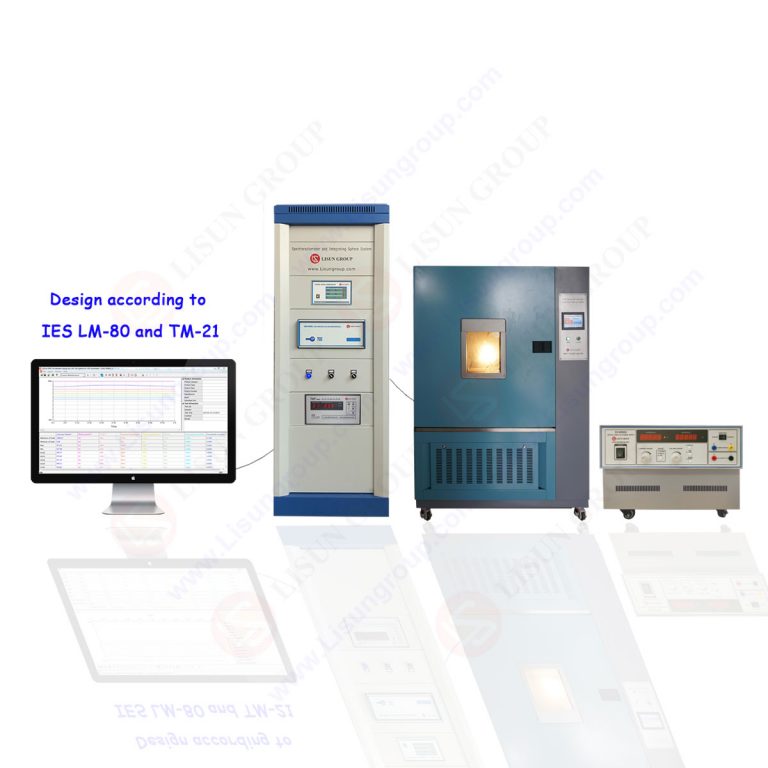
The hardware architecture reflects these differing test philosophies. The LEDLM-80PL features up to 3 connected temperature chambers, each capable of independent temperature control (-20°C to +150°C) and housing multiple trays for DUTs. The LEDLM-84PL typically uses a single, high-temperature chamber to accelerate chemical reactions. Both systems support test trays that can accommodate up to 30 or more individual LED components or modules, with independent current control per channel to ensure consistent junction temperatures during thermal equilibrium.
2.3 Data Acquisition and Software Differences
The software suite is the most critical differentiator in the LISUN LED Aging Test System vs LED Life Test System debate.
- LEDLM-80PL Software: Implements the Arrhenius Model for TM-21 extrapolation, calculating L70 and L50 values with confidence intervals. It provides detailed reports required for LED lighting product qualification (e.g., for Energy Star).
- LEDLM-84PL Software: Utilizes a simpler Eyring Model or a power-law model as per TM-28, focusing on accelerated failure rates and providing rapid life estimates. The data logging interval is often shorter in the life test system to capture rapid changes during accelerated stress.
3.1 IES LM-80 and TM-21 for Aging Tests
The LISUN LED Aging Test System is the gold standard for compliance with IES LM-80 (Measuring Luminous Flux and Color Maintenance of LED Packages, Arrays, and Modules) and IES TM-21 (Projecting Long-Term Lumen Maintenance). These standards mandate specific test durations (6,000 hours minimum, often up to 10,000 hours) and ambient temperature control. The system must stabilize the internal temperature of the aging chamber within ±2°C of the set point. The TM-21 projection utilizes the Arrhenius Model to predict life to L70, often exceeding 50,000 hours.
3.2 IES LM-84 and TM-28 for Life Tests
For the LED Life Test System, IES LM-84-22 (Measuring Luminous Flux and Color Maintenance of LED Lamps, Light Engines, and Luminaires) is the primary standard, and IES TM-28 provides the projection method. TM-28 uses a “windowed” exponential decay model that is suitable for the often-steeper depreciation seen in accelerated tests. The LISUN LEDLM-84PL system is designed to record data at high fidelity during these rapid depreciation phases, using an integrating sphere or goniophotometer for absolute photometric measurements, which is a step beyond the relative measurements allowed in some life test protocols.
3.3 Additional Standards (CIE 084, CIE 70, CIE 127)
Both systems must also respect the measurement geometry defined in CIE 127 (Measurement of LEDs) and CIE 084 (Measurement of Luminous Flux). The LISUN systems integrate photometric detectors that comply with these standards to ensure that the measured lumen output is accurate and traceable. CIE 70 (The Measurement of Absolute Luminous Intensity) is also applicable when testing directional modules. The LISUN LED Aging Test System incorporates these standards into its operational protocols, ensuring that the aging data is scientifically valid.
4.1 Constant Current vs. Constant Voltage Modes
The LISUN systems offer dual testing modes critical for accurate lumen maintenance testing.
- Constant Current (CC) Mode: The preferred mode for testing standard LED modules. The system maintains a precise current (e.g., 350mA ±0.5%) regardless of temperature-induced voltage changes. This ensures that the junction temperature is the primary variable affecting lumen depreciation.
- Constant Voltage (CV) Mode: Used for testing integrated LED lamps or drivers. The system maintains a fixed voltage (e.g., 24V), allowing the current to vary with the DUT’s impedance.
4.2 Temperature Chamber Control and Junction Temperature
Accurate thermal management is paramount in the LISUN LED Aging Test System vs LED Life Test System analysis. The aging system (LEDLM-80PL) must manage thermal equilibrium at multiple set points (e.g., 55°C, 85°C). The life test system (LEDLM-84PL) often runs at a single, higher temperature. Both systems use T-type thermocouples attached to the “Ts” point (solder point) of the LED module to measure the actual case temperature, allowing the software to calculate the junction temperature (Tj) using the power dissipated by the LED and its thermal resistance (Rθj-s). This data is fed into the Arrhenius Model.
4.3 Comparison Table: Aging vs. Life Test System Specifications
| Feature | LISUN LED Aging Test System (LEDLM-80PL) | LED Life Test System (LEDLM-84PL) |
|---|---|---|
| Primary Standard | IES LM-80, TM-21 | IES LM-84, TM-28 |
| Test Duration | 6,000 – 10,000 hours | 2,000 – 3,000 hours (Accelerated) |
| Temperature Chambers | Up to 3 (e.g., 55°C, 85°C, 105°C) | Typically 1 (High stress) |
| Projection Model | Arrhenius Model (Exponential decay) | Eyring/Power Law (Windowed decay) |
| Key Output Metric | L70(6k), L50(6k) with C.I. | Lp (Time to failure) |
| Data Sampling Rate | Every 1 hour or user-defined | Every 15-30 minutes (for rapid decay) |
| Measurement Method | Integrating Sphere (Absolute) | Integrating Sphere or Goniophotometer |
| Software Complexity | High (Data fitting, statistics) | Medium (Pass/Fail, trend analysis) |
5.1 Application in the LEDLM-80PL Aging System
The Arrhenius Model is the core analytical engine of the LISUN LED Aging Test System. The software collects lumen maintenance data from three temperatures (e.g., T1, T2, T3). It then determines the activation energy (Ea) required for the failure mechanism (e.g., phosphor degradation, die attach delamination). Using the Arrhenius equation (L = A * e^(Ea/kT)), the system projects the expected life of the LED at a use temperature (e.g., 55°C or 25°C). This projection is presented as the L70 life (time to 70% of initial lumens) with a 90% lower confidence bound.
5.2 Limitations for Life Test Systems
In the LED Life Test System, the Arrhenius Model is often simplified or replaced by a power-law model due to the higher stress levels. At elevated temperatures (>100°C), the failure mechanism can change (e.g., from phosphor degradation to sudden wire bond failure), violating the assumptions of the Arrhenius Model. Therefore, the LISUN LEDLM-84PL software focuses on estimating a “time-to-failure” based on a predefined threshold (e.g., L70 or catastrophic failure), which is more suitable for life test qualification rather than scientific characterization.
5.3 Interpreting L70/L50 Data from Both Systems
- Aging System (LEDLM-80PL): Provides a statistically robust estimate. If the system reports L70 > 50,000 hours at 25°C, the manufacturer can use this for a 5-year warranty claim. The data is traceable and verifiable.
- Life System (LEDLM-84PL): Provides a comparative result. If a module fails before 2,000 hours at 105°C, it fails the life test. The result is binary or relative, useful for production line screening but not for regulatory submission of a lifetime projection.
6.1 R&D Use Case: Phosphor and Package Development
For an R&D engineer, the LISUN LED Aging Test System is indispensable. When testing new phosphor formulations, the system’s ability to monitor color shift (Δu’v’) simultaneously with lumen maintenance is critical. The LM-80/TM-21 protocol allows the engineer to see if a new phosphor degrades faster (higher Ea) than a reference. The 6,000-hour test is a gate for product launch, ensuring the product meets initial reliability claims.
6.2 QC Use Case: Production Batch Verification
In a QC environment, speed is paramount. A LED Life Test System (LEDLM-84PL) is used for incoming inspection of LED components or for spot-checking production batches. If a supplier’s LED claims L70 > 50,000 hours, the QC team can run a 2,000-hour accelerated life test at 85°C or 105°C. If the sample shows a 15% drop in lumen output, it fails the test, and the batch is rejected. This is far more efficient than waiting 6,000 hours for an aging test.
6.3 Compliance and Third-Party Testing Labs
Third-party testing labs must have both systems. The LISUN LED Aging Test System is necessary for generating official LM-80 reports for clients seeking Energy Star or DLC (DesignLights Consortium) certification. The LED Life Test System is useful for running pre-compliance tests or for clients who only need a “life test” certification for non-regulated applications.
7.1 Key Questions for Decision-Makers
- What are your target standards? If you must submit an LM-80 report, the LEDLM-80PL is mandatory. If you only need to compare competitor products, the LEDLM-84PL is sufficient.
- What is your acceptable test time? A 6,000-hour test is 250 days. A 2,000-hour test is 83 days. The need for speed often dictates the choice.
- Do you need statistical projection? The Aging System provides this; the Life System does not.
7.2 Cost and Throughput Analysis
The LISUN LED Aging Test System is more expensive due to the inclusion of multiple temperature chambers and sophisticated data acquisition cards for long-term stability. The LED Life Test System is more cost-effective for high-throughput screening. Facilities should consider a hybrid approach: using the Life System for daily QC and one or two Aging Systems for formal certification testing.
In summary, the LISUN LED Aging Test System vs LED Life Test System: Key Differences for Lumen Maintenance Testing are defined by their objectives and compliance frameworks. The LISUN LEDLM-80PL Aging System is a comprehensive, data-intensive solution for IES LM-80/TM-21 certification, providing statistically valid L70/L50 projections via the Arrhenius Model over a 6,000-hour baseline. It is the gold standard for regulatory compliance and R&D characterization.
Conversely, the LISUN LEDLM-84PL Life Test System is a practical, high-speed tool for IES LM-84/TM-28 accelerated testing, ideal for production QC and comparative analysis. It sacrifices statistical depth for throughput and efficiency. The choice is not a matter of quality but of application. For lighting manufacturers aiming for market leadership, investing in both systems within a single lab provides the fastest path from product development to regulatory certification. LISUN’s modular hardware and dual software suites ensure that engineers have the precise tool required for every phase of the product lifecycle, all while maintaining full compliance with the rigorous IES and CIE standards.
Q1: Can the LISUN LED Life Test System (LEDLM-84PL) be used to generate an IES LM-80 report?
A: No, it cannot. The IES LM-80 standard mandates a minimum test duration of 6,000 hours at three specific case temperatures (e.g., 55°C, 85°C, and a third selected temperature). The LISUN LEDLM-84PL Life Test System is designed for accelerated testing per LM-84, which typically runs for 2,000 hours at one or two higher temperatures. While its data is useful for internal life projections using TM-28, it does not meet the data collection interval, duration, or temperature profile requirements for generating a formal, certifiable LM-80 report. For that, you must use the LISUN LEDLM-80PL LED Aging Test System.
Q2: Why does the LISUN Aging System use the Arrhenius Model, while the Life system uses a different model?
A: The choice is dictated by the underlying physics of failure (PoF) under different stress levels. The LISUN LED Aging Test System operates within a range (e.g., 55°C to 85°C) where the primary degradation mechanisms (e.g., phosphor degradation, blue chip efficiency loss) follow a predictable, temperature-dependent exponential decay, perfectly modeled by the Arrhenius Model. The Life System (LEDLM-84PL) operates at much higher stresses (e.g., 105°C+). At these temperatures, multiple failure mechanisms may occur simultaneously (e.g., rapid thermal shock, wire bond fatigue), which do not follow a simple Arrhenius relationship. Therefore, the TM-28 standard, used by the Life system, applies a “windowed” or power-law model that better fits the accelerated failure data.
Q3: How do I determine my LED’s junction temperature (Tj) during the aging test?
A: The LISUN LED Aging Test System software automates this calculation. You must first measure or provide the LED’s thermal resistance from junction to solder point (Rθj-s), typically found in the LED datasheet. The system measures the case temperature (Ts) via a T-type thermocouple. It also measures the forward voltage (Vf) and current (If) to calculate electrical power (P = Vf If). The junction temperature is then calculated as: Tj = Ts + (Rθj-s P). The software logs Tj alongside time and lumen data. This value is critical because the Arrhenius Model requires Tj (in Kelvin), not the ambient air temperature, to accurately project the L70 lifetime.
Q4: Can I test 500 LEDs at once in the LISUN LED Aging Test System?
A: Yes, but with a caveat. The LISUN LEDLM-80PL supports up to 3 temperature chambers. Each chamber can hold multiple test trays. A standard LISUN tray typically holds 30 to 50 single-chip LED packages or modules. Therefore, a fully loaded system (3 chambers 2 trays per chamber 50 LEDs per tray) can test up to 300 LEDs simultaneously. However, for statistical validity under IES LM-80, a sample size of 20 is sufficient per test condition. Running 50 per temperature is robust. The limitation is physical space and ensuring uniform thermal equilibrium across all DUTs on the tray. The system is designed to handle this with forced air circulation within the chamber.