









Abstract
Accurate LED life prediction is critical for ensuring long-term reliability in solid-state lighting products. This article explores how LISUN LED Life Prediction: Arrhenius Model for Optical Aging Test Instruments enables manufacturers to perform accelerated aging tests and forecast lumen maintenance with high precision. By integrating the Arrhenius model with standardized testing protocols such as IES LM-80 and TM-21, LISUN’s LEDLM-80PL and LEDLM-84PL systems deliver up to 6000-hour test durations and support L70/L50 life metrics. These instruments connect up to three temperature chambers simultaneously, allowing multi-stress testing under controlled thermal conditions. Technical professionals in LED manufacturing and testing laboratories will gain actionable insights into system architecture, standard compliance, and practical applications of accelerated optical aging.
1.1 Lumen Depreciation as a Reliability Metric
LED lumen depreciation follows an exponential decay pattern influenced by junction temperature, drive current, and material degradation. The Lighting Industry relies on L70 (time to 70% initial lumen output) and L50 (time to 50% output) as standard life metrics. Accurate prediction requires accelerated aging data collected under elevated temperatures, typically 55°C, 85°C, and 105°C, as specified in IES LM-80.
1.2 The Arrhenius Model in Accelerated Testing
The Arrhenius model describes the temperature-dependent degradation rate of LEDs using the equation:
[
text{Lifetime} = A times expleft(frac{E_a}{k times T}right)
]
where (E_a) is activation energy (typically 0.3–0.5 eV for LEDs), (k) is Boltzmann’s constant, and (T) is absolute junction temperature. LISUN LED Life Prediction: Arrhenius Model for Optical Aging Test Instruments applies this model within proprietary software to extrapolate long-term performance from short-term accelerated data, reducing test time from years to 6000 hours.
2.1 Dual System Variants for Different Standards
| Feature | LEDLM-80PL | LEDLM-84PL |
|---|---|---|
| Applicable Standard | IES LM-80 / TM-21 | IES LM-84 / TM-28 |
| Test Duration | 6000 hours minimum | 6000 hours minimum |
| Number of Test Channels | Up to 48 | Up to 64 |
| Temperature Chamber Support | Up to 3 chambers | Up to 3 chambers |
| Extrapolation Method | TM-21 projection algorithm | TM-28 projection algorithm |
| L70/L50 Calculation | Automatic | Automatic |
The LEDLM-80PL is designed for LM-80 compliant testing of discrete LEDs and arrays, while the LEDLM-84PL targets LED light engines and luminaires per LM-84 standards. Both systems incorporate the unified Arrhenius model-based software for consistent life prediction.
2.2 Customizable Hardware Configurations
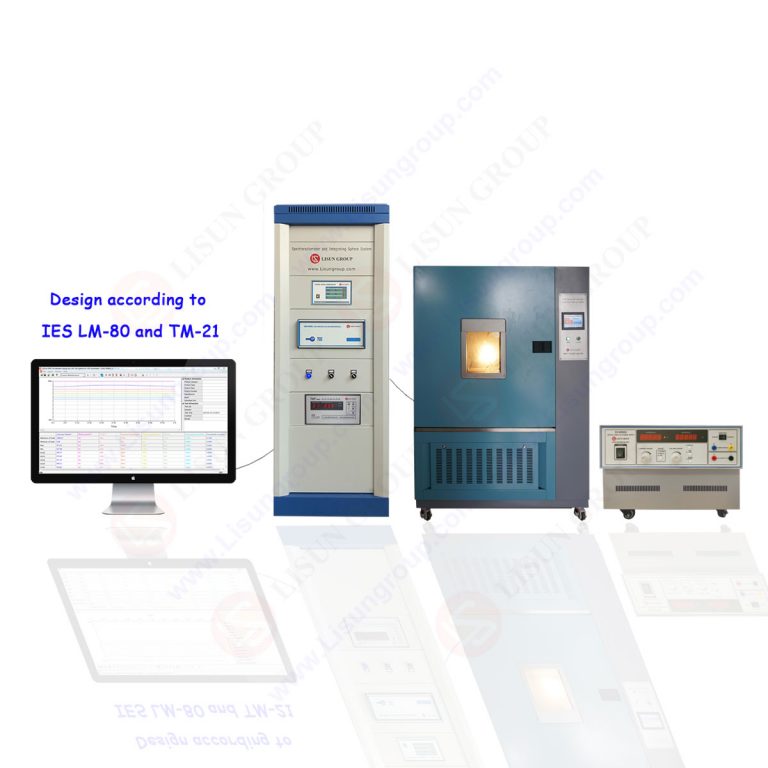
Each system supports modular temperature chamber connectivity, allowing engineers to perform simultaneous aging tests at three distinct temperatures. The optical measurement path includes a high-speed spectrometer and integrating sphere (up to 2m diameter) for real-time photometric and colorimetric data collection. Customizable current drivers from 10 mA to 2 A per channel accommodate a wide range of LED power ratings.
3.1 Constant Temperature Mode (CTM)
In CTM, LEDs are held at a fixed junction temperature throughout the 6000-hour test. This mode isolates temperature-driven degradation and is ideal for calculating activation energy using the Arrhenius model. Data points are automatically recorded at 1000-hour intervals, with optional continuous monitoring for high-precision studies.
3.2 Thermal Cycling Mode (TCM)
TCM simulates real-world on/off cycles by alternating between high and low temperature plateaus. This mode reveals mechanical stress effects on solder joints and phosphor layers, often invisible in constant temperature tests. LISUN LED Life Prediction: Arrhenius Model for Optical Aging Test Instruments correlates TCM data with Arrhenius-based predictions to adjust for cycling-induced acceleration factors.
4.1 IES LM-80 and TM-21: The Foundation for LED Life Testing
IES LM-80 defines the method for measuring lumen depreciation of LED packages, arrays, and modules at specified test temperatures over 6000 hours. TM-21 then extrapolates the LM-80 data to project L70 and L50 life values using exponential curve fitting. LISUN’s LEDLM-80PL fully automates data collection per LM-80 and applies TM-21 algorithms for extrapolation, ensuring compliance with Energy Star requirements.
4.2 IES LM-84 and TM-28: Extending to Luminaires
LM-84 addresses test methods for LED light engines and luminaires, while TM-28 provides the extrapolation procedure for these larger systems. The LEDLM-84PL incorporates integrating sphere measurements per IES LM-79-19 for accurate total luminous flux and spectral power distribution, critical for LM-84 compliance.
4.3 Supplementary Standards: CIE 084, CIE 70, and CIE 127
CIE 084 defines measurement of luminous flux, CIE 70 covers measurement of absolute spectral sensitivity, and CIE 127 specifies guidelines for LED photometry. LISUN systems incorporate these standards in calibration routines, ensuring inter-laboratory reproducibility. CIE 127 compliance particularly ensures accurate near-field photometry for directional LEDs.
5.1 Data Acquisition and Trend Analysis
The LISUN software suite continuously streams photometric data from up to 3 chambers, applying real-time correction for ambient temperature drift. Users can visualize lumen depreciation curves for each test channel, with automatic outlier detection based on Chauvenet’s criterion.
5.2 Arrhenius Plot Generation and Activation Energy Calculation
Engineers can generate Arrhenius plots from CTM data, where the slope of log(lifetime) versus 1/T yields activation energy. The software supports manual override of (E_a) values (range 0.2–0.8 eV) for sensitivity analysis. LISUN LED Life Prediction: Arrhenius Model for Optical Aging Test Instruments outputs a 95% confidence interval for projected L70 values, critical for warranty planning.
5.3 TM-21 and TM-28 Extrapolation Algorithms
| Parameter | TM-21 (LEDLM-80PL) | TM-28 (LEDLM-84PL) |
|---|---|---|
| Data Points Required | Minimum 6 (every 1000h) | Minimum 10 (every 500h) |
| Extrapolation Limit | 6x test duration (max 36,000h) | 5x test duration (max 30,000h) |
| Curve Fitting Method | Exponential decay (a×exp(b×t)) | Double exponential (a×exp(b×t)+c) |
| Confidence Level | 90% one-sided lower bound | 90% one-sided lower bound |
The software automatically checks data quality criteria (R² > 0.95 recommended) before performing extrapolation, preventing unreliable projections.
6.1 Incoming Quality Control for LED Packages
LED manufacturers can use the LEDLM-80PL to validate supplier claims of L70 > 50,000 hours. By testing a sample of 20–30 LEDs at 85°C over 6000 hours, the Arrhenius model can project actual performance at use temperature (typically 25–60°C). Discrepancies >20% between projected and claimed values trigger supplier corrective action.
6.2 Design Validation for Automotive Lighting
Automotive electronics require stringent reliability per AEC-Q102, which mandates LM-80 testing for LED headlamps and daytime running lights. LISUN systems support the required 105°C test temperature and allow simultaneous aging of 48 components, reducing validation time by 40% compared to sequential testing. The Thermal Cycling Mode captures stress from engine bay temperature swings.
7.1 Three-Chamber Synchronization
The LEDLM-80PL and LEDLM-84PL can control up to three temperature chambers simultaneously, each set to a different test temperature (e.g., 55°C, 85°C, 105°C). The software synchronizes measurement intervals across chambers, ensuring that all 6000-hour test durations end concurrently. This reduces total test time by 66% compared to sequential single-chamber testing.
7.2 Customizable Test Plans for R&D
Researchers can define non-standard test temperatures (e.g., 70°C, 95°C) to explore specific activation energy values. The software supports step-stress testing, where temperature increases at each 1000-hour interval, accelerating failure mode discovery. Data from step-stress profiles can be analyzed using the Arrhenius model to extract equivalent constant-stress lifetime.
Accurate LED life prediction is no longer a luxury but a regulatory and competitive necessity in the lighting industry. LISUN LED Life Prediction: Arrhenius Model for Optical Aging Test Instruments provides a complete hardware-software solution for LM-80, LM-84, TM-21, and TM-28 compliance, enabling engineers to project L70 and L50 values with confidence. The dual system variants (LEDLM-80PL and LEDLM-84PL) cover both component-level and luminaire-level testing, while the Arrhenius model-based software automates activation energy calculation, extrapolation, and uncertainty analysis. Support for up to three temperature chambers reduces test cycle time, and compliance with IES, CIE, and Energy Star standards ensures global acceptance. By integrating these capabilities, LED manufacturers can reduce warranty risk, optimize product designs, and accelerate time-to-market. The practical workflows described in this article empower technical professionals to implement accelerated optical aging tests that deliver statistically robust life projections, directly supporting quality control, R&D innovation, and regulatory compliance in the fast-evolving solid-state lighting sector.
Q1: How does the Arrhenius model in LISUN systems handle LEDs with different phosphor chemistries?
A: The Arrhenius model assumes a single activation energy (Ea) for the dominant failure mechanism, typically thermal degradation of the phosphor or LED die. For LEDs with varying phosphor chemistries (e.g., YAG vs. nitride phosphors), LISUN software allows manual input of Ea values measured from differential scanning calorimetry (DSC) or literature references (range 0.2–0.8 eV). The system can also perform multi-channel testing where each channel uses a different Ea, enabling comparative life projections. For example, a high-CRI LED with cyan phosphor may exhibit Ea = 0.45 eV, while a standard white LED uses 0.35 eV. The software reports both L70 values side-by-side, allowing engineers to select the appropriate chemistry for target applications.
Q2: What is the minimum sample size required for statistically valid TM-21 extrapolation?
A: IES TM-21 recommends a minimum of 20 LEDs per test temperature for discrete components, with at least 6 data points collected every 1000 hours over 6000 hours. For LM-84 testing (luminaires), the recommended sample size is 5 units per temperature, with 10 data points every 500 hours. LISUN’s software performs statistical outlier detection and calculates 90% one-sided lower confidence bounds for L70 projections. If the sample fails the R² > 0.95 quality criterion, the system flags unreliable results and recommends additional testing. For high-stakes applications like automotive, increasing sample size to 40 LEDs per temperature reduces confidence interval width by approximately 15%.
Q3: Can the LISUN optical aging test instruments be integrated with existing temperature chambers?
A: Yes, the LEDLM-80PL and LEDLM-84PL feature universal controller interfaces (RS-232, RS-485, USB, and Ethernet) compatible with most commercial temperature chambers from manufacturers like Thermotron, Espec, and Cincinnati Sub-Zero. The software includes pre-configured driver profiles for 20+ common chamber models, and custom profiles can be defined by entering chamber parameters (temperature ramp rate, stability tolerance, communication protocol). For chambers without digital control, LISUN provides an optional analog I/O module (4–20 mA, 0–10 V) for seamless integration. The system supports daisy-chaining up to 3 chambers with synchronized test start/stop functions, ensuring all 6000-hour tests complete concurrently.
Q4: How does thermal cycling mode differ from constant temperature mode in terms of Arrhenius model applicability?
A: Constant temperature mode (CTM) provides direct inputs for the Arrhenius model, as degradation rates at fixed temperatures are used to calculate activation energy. In thermal cycling mode (TCM), the temperature profile includes both dwell times and ramp rates, introducing mechanical stress from thermal expansion mismatch. The Arrhenius model alone cannot fully predict TCM-induced failures. LISUN’s software addresses this by applying a Coffin-Manson fatigue factor to the Arrhenius prediction, derived from the number of cycles and temperature swing amplitude (ΔT). For example, a test with 1000 cycles (ΔT = 80°C) may reduce projected L70 by 18% compared to CTM predictions. The software outputs both standard and cyclically-adjusted life projections, enabling engineers to evaluate warranty risk for intermittent-use applications like street lighting.
Q5: What are the maintenance requirements for the integrating sphere and spectrometer in long-duration tests?
A: LISUN recommends annual recalibration of the integrating sphere and spectrometer using NIST-traceable standard lamps. During a 6000-hour test, the system performs daily auto-zero corrections to compensate for detector dark current drift. The integrating sphere’s inner coating (barium sulfate or PTFE) should be inspected every 2000 hours for contamination or yellowing; LISUN provides spare coating kits for field reconditioning. The spectrometer’s CCD sensor requires temperature stabilization within ±0.1°C for spectral accuracy; the system includes a built-in Peltier cooler and monitors sensor temperature continuously. For high-humidity environments (>85% RH), a nitrogen purge port is available to prevent moisture absorption in the sphere coating, which can cause up to 3% measurement drift.