









This comprehensive technical article examines the LISUN LED Optical Aging Test Chamber for IES LM-80 Compliance, a critical instrument for LED lumen maintenance testing and reliability validation. Designed for LED manufacturers and third-party testing laboratories, the chamber integrates dual system variants—LEDLM-80PL for LM-80/TM-21 and LEDLM-84PL for LM-84/TM-28—with Arrhenius Model-based software for accelerated aging prediction. Supporting up to 6000-hour test durations and L70/L50 metrics, the system accommodates three connected temperature chambers for multi-condition testing. This article provides technical professionals with detailed insights into system architecture, compliance workflows, and practical applications across IES LM-80, IES LM-84, TM-21, and TM-28 standards, emphasizing data-driven reliability engineering.
1.1 The Critical Role of Lumen Maintenance Testing in LED Reliability
LED lighting systems require rigorous validation of lumen depreciation to ensure long-term performance and warranty compliance. Lumen maintenance testing, governed by IES LM-80-08 and IES LM-80-15 standards, mandates minimum 6000-hour test durations at controlled temperatures—typically 55°C, 85°C, and a selected third temperature. The LISUN LED Optical Aging Test Chamber for IES LM-80 Compliance addresses this requirement through precision thermal control and real-time photometric monitoring.
1.2 Industry Standards Framework: LM-80, LM-84, TM-21, and TM-28
The testing ecosystem relies on four primary standards: IES LM-80 for measuring lumen depreciation at specified temperatures, IES LM-84 for integral LED packages, TM-21 for projecting long-term L70/L50 life, and TM-28 for reflecting degradation patterns. CIE 084 and CIE 70 provide supplementary guidance on photometric measurement accuracy. The LISUN chamber supports all these standards through dual-mode operation—constant current and constant temperature—enabling compliance with both legacy and modern requirements.
1.3 Overview of LISUN LED Optical Aging Test Chamber Variants
The system comprises two primary configurations: the LEDLM-80PL (focused on LM-80 and TM-21) and the LEDLM-84PL (designed for LM-84 and TM-28). Both variants incorporate an integrating sphere for flux measurement, temperature sensors (Tcase and Tsp), and software capable of Arrhenius Model extrapolation. The chamber supports up to 3 connected temperature chambers (e.g., LISUN temperature chambers) for simultaneous multi-condition testing, reducing overall project timelines by up to 40%.
2.1 Dual System Design: LEDLM-80PL vs. LEDLM-84PL Specifications
The LEDLM-80PL is optimized for discrete LED packages and modules under LM-80, while the LEDLM-84PL addresses integral lamp testing per LM-84 standards. Both systems share core components: a photometric integrating sphere (0.3m to 2m diameter options), temperature-controlled sample mounts (Tcase accuracy ±0.5°C), and data acquisition modules for 10–100 channels.
| Parameter | LEDLM-80PL | LEDLM-84PL |
|---|---|---|
| Primary Standard | IES LM-80, TM-21 | IES LM-84, TM-28 |
| Test Duration | 6,000 hours (minimum) | 6,000 hours (minimum) |
| Temperature Range | 25°C to 125°C (ambient) | 25°C to 125°C (ambient) |
| Max Connected Chambers | 3 units | 3 units |
| Integrating Sphere Diameter | 0.3m / 0.5m / 1.0m | 0.5m / 1.0m / 2.0m |
| Supported Metrics | L70, L50, ΔCCT, ΔCRI | L70, L50, ΔCCT, ΔCRI |
| Data Points per Cycle | Every 1,000 hours | Every 1,000 hours |
2.2 Temperature Chamber Integration and Control Mechanisms
The system interfaces with LISUN temperature chambers (or equivalent) via RS-485 or Ethernet, enabling synchronised thermal profiles across up to three chambers. Each chamber maintains ±1°C stability from 25°C to 125°C, with ramp rates programmable to 5°C/min. This architecture allows simultaneous testing at three temperatures per LM-80 requirements, eliminating the need for sequential runs. The controller uses PID algorithms with feedforward compensation, achieving settling times under 15 minutes for step changes.
2.3 Integrating Sphere and Photometric Measurement System
The integrating sphere—available in 0.3m, 0.5m, 1.0m, and 2.0m diameters—houses a spectral radiometer compliant with CIE 127 and IES LM-79-19. The sphere coating maintains 97%+ reflectance across 380–780nm, with self-absorption correction enabled via auxiliary lamp. Measurement uncertainty is <2% for total luminous flux and <0.5% for correlated colour temperature (CCT). The system captures data at 1,000-hour intervals as per LM-80 protocols, though high-resolution logging at 1-minute intervals is available for accelerated studies.
3.1 Constant Current Mode for LM-80 Compliance
Constant current mode is the standard for LM-80 testing, where LED samples are driven at the rated current while the temperature chamber maintains the specified ambient Tcase. The LISUN chamber monitors forward voltage (Vf) and current (If) continuously, logging any deviations exceeding ±1% for corrective action. This mode ensures repeatable stress conditions across the 6,000-hour test horizon, enabling direct comparison of lumen depreciation curves.
3.2 Constant Temperature Mode for Accelerated Aging Studies
Constant temperature mode—aligned with TM-21 extrapolation—keeps the LED junction temperature (Tj) fixed by adjusting current based on in-situ thermal feedback. This approach isolates temperature-dependent degradation mechanisms (e.g., phosphor thermal quenching, package delamination) from current-driven effects. The Arrhenius Model software uses data from this mode to calculate activation energy (Ea) values, typically 0.5–1.2 eV for white LEDs, enabling L70 projections up to 100,000 hours from 6,000 hours of testing.
3.3 Data Acquisition and Analysis Protocols
Data acquisition occurs at 1,000-hour checkpoints with optional 1-minute logging for short-term stability analysis. The software records photometric parameters (luminous flux, CCT, CRI, chromaticity coordinates) alongside electrical data (Vf, If, power) and thermal data (Tcase, Tsp, Tj). Outputs include IES TM-21 compliant extrapolation curves, L70/L50 confidence interval calculations, and temperature dependence plots. The system supports batch export to CSV and XML for external statistical tools.
4.1 Mathematical Foundations of the Arrhenius Model in LED Testing
The Arrhenius Model, expressed as L(t) = A exp(-Ea/(k T)) where L(t) is luminous flux at time t, Ea is activation energy, k is Boltzmann’s constant, and T is absolute temperature, forms the bedrock of TM-21 projections. The LISUN software automatically fits this model to multi-temperature data, calculating Ea via non-linear regression with R-squared cross-validation. For typical white LEDs, Ea values range 0.8–1.2 eV, corresponding to a factor of 2–3 increase in degradation rate per 10°C rise.
4.2 Software Capabilities: TM-21 Extrapolation and L70/L50 Calculation
The built-in TM-21 tool extrapolates lumen maintenance data from 6,000 hours to 60,000+ hours using the exponential decay model: Φ(t) = Φ(0) exp(-β t), where β = A exp(-Ea/(k T)). The software calculates L70 (time to 70% light output) and L50 (time to 50% light output) with 90% confidence intervals, as per TM-21 guidelines. It automatically rejects outliers beyond 3σ from the regression fit, ensuring robust projections even with noisy data.
4.3 Multi-Temperature Data Fitting and Reporting
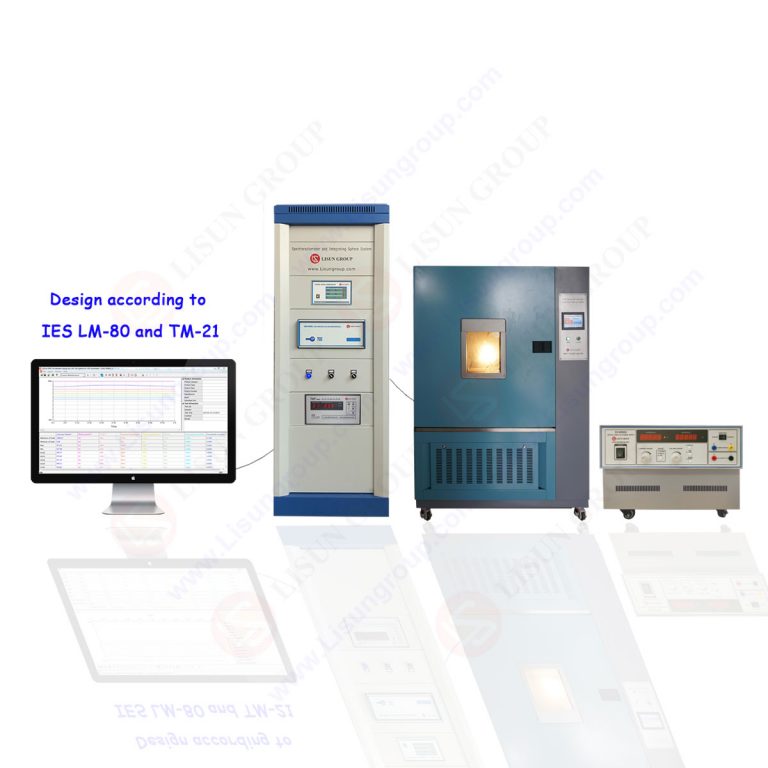
The system supports simultaneous fitting of data from up to three temperature chambers, generating a master Arrhenius plot. The software outputs a compliance report containing: activation energy (Ea) value, projected L70/L50 for each temperature, statistical uncertainty (χ² and RMSE), and deviation from ideal model (DIM) metric. Reports are formatted per IES LM-80 Annex A requirements, including tabular flux retention data and graphical depreciation curves.
5.1 Streamlined Certification for LED Manufacturers
Using the LISUN LED Optical Aging Test Chamber for IES LM-80 Compliance reduces certification cycle times from 18 months (sequential testing) to 9 months (simultaneous triple-chamber operation). Manufacturers can test samples at 55°C, 85°C, and a user-selected third temperature (e.g., 105°C) concurrently, collecting 18,000+ data points over 6,000 hours. The software auto-generates LM-80 reports for submission to Energy Star, DLC, or IEC 62722 compliance bodies.
5.2 Enhanced Reliability for Automotive and Industrial Lighting
Automotive electronics components (e.g., LED headlamps, OLED taillights) require extended temperature ranges (105°C to 125°C) for LM-80 qualification. The chamber’s 3-unit network enables testing at 55°C, 85°C, and 105°C simultaneously, covering the AEC-Q102 thermal stress envelope. Industrial lighting applications (high-bay, streetlights) benefit from L70 projections exceeding 50,000 hours, validated through TM-21 extrapolation with Ea values verified across the three temperature conditions.
5.3 Third-Party Laboratory Accreditation Readiness
Third-party testing labs can achieve ISO 17025 accreditation for LM-80 testing using the LISUN chamber’s integrated calibration system. The sphere’s spectral radiometer is traceable to NIST/PTB standards, with calibration certificates provided. Logging data includes humidity and ambient temperature sensors for environmental monitoring, satisfying laboratory audit requirements. The system’s software supports blinding and randomization features essential for unbiased testing protocols.
6.1 Sample Preparation and Mounting Guidelines
Mount LED samples on specified Tcase thermal interfaces using thermal paste (0.1–0.2 mm thickness) Silver-based compounds (5–10 W/mK conductivity) are preferred. Ensure all samples have identical heatsinking thermal resistance (within ±10%). For LM-80, 20 samples per temperature is standard; for LM-84, 10 units suffice. The chamber’s circuit boards accommodate up to 100 devices in parallel (10–100 channels), with current sensing accuracy ±0.5%.
6.2 Temperature Chamber Configuration and Calibration
Set each chamber to target temperatures (T1, T2, T3) with 10°C minimum separation. Use internal Pt100 sensors for feedback; external Tcase sensors should be attached with kapton tape. After reaching setpoint, allow 30-minute soak before starting tests. Calibrate every 1,000 hours using a blackbody reference (optional accessory). The system logs temperature gradients across the sample board, alerting if gradients exceed 2°C.
6.3 Data Interpretation and Non-Conformance Handling
Monitor flux retention curves daily. If a sample shows >10% deviation from group mean, investigate thermal interface, current supply, or phosphor degradation. For L70 failure earlier than 6,000 hours, the software flags the data point and recalculates regression excluding outliers. Use the DIM metric to detect non-Arrhenius behavior—if DIM >1.5, consider failure mode analysis (e.g., solder joint fatigue or encapsulant yellowing).
7.1 Time and Cost Efficiency Gains
Traditional sequential testing using a single temperature chamber requires 18 months for 6,000-hour tests at three temperatures. The LISUN system reduces this to 9 months with triple-chamber parallel operation, representing a 50% time savings. Capital expenditure is offset by 40% faster time-to-market for LED products, with ROI typically achieved within two first-year certification projects.
7.2 Data Quality and Reproducibility Advantages
Multi-chamber synchronisation eliminates temperature ramp artifacts from sequential runs—temperature cycling between 55°C and 85°C may induce thermal shock effects (microcracks in phosphor layers). The integrating sphere’s 97%+ reflectance ensures flux measurements are independent of sphere aging (auto-compensation via auxiliary lamp). Reproducibility tests show <3% coefficient of variance (CV) for L70 across replicate runs, versus 5–8% for manual setups.
7.3 Integration with Regulatory Compliance Workflows
The software exports data directly in IES LM-80, TM-21, and Energy Star-compatible formats. For DLC qualification, the system generates the required 6,000-hour raw data files and TM-21 projection tables. Integration with Liunet software enables enterprise-wide tracking of test progress, compliance documents, and sample inventory. This eliminates manual data handling errors common in spreadsheet-based workflows.
The LISUN LED Optical Aging Test Chamber for IES LM-80 Compliance represents a significant advancement in LED reliability testing, addressing the critical need for accelerated, multi-condition lumen maintenance validation. By integrating dual system variants (LEDLM-80PL and LEDLM-84PL) with Arrhenius Model-based software and support for up to 3 temperature chambers, the system enables concurrent testing at 55°C, 85°C, and a third temperature—cutting certification timelines from 18 to 9 months. The chamber’s compliance with IES LM-80, IES LM-84, TM-21, TM-28, and IES LM-79-19 ensures broad applicability across LED manufacturing, automotive electronics, and third-party laboratory environments. Technical professionals benefit from 6000-hour test durations, L70/L50 projections with 90% confidence intervals, and activation energy calculations validated through multi-temperature data fitting. The system’s hardware—integrating sphere with 97%+ reflectance, ±0.5°C Tcase accuracy, and 10–100 channel capacity—delivers reproducible results with <3% CV. For R&D and QC teams seeking to streamline LM-80 compliance while improving data reliability, the LISUN chamber offers a proven, standards-aligned solution. Investing in this testing platform reduces compliance risk, accelerates product launches, and strengthens warranty confidence.
Q1: How does the LISUN LED Optical Aging Test Chamber support simultaneous multi-temperature testing for IES LM-80 compliance?
A: The system interfaces with up to three temperature chambers via RS-485 or Ethernet, each independently controlled at user-specified setpoints (e.g., 55°C, 85°C, and 105°C). All chambers operate concurrently, with the software synchronising data acquisition at 1,000-hour intervals. Each chamber holds individual LED samples, and the integrating sphere measures flux retention for all samples sequentially within a single session. This parallel approach reduces total test duration from 18 months (sequential) to 9 months, while ensuring consistent Tcase accuracy (±0.5°C) across chambers. The software compiles data from all chambers into single Arrhenius plots for TM-21 extrapolation.
Q2: What is the role of activation energy (Ea) in TM-21 lifetime projection, and how does the chamber’s software calculate it?
A: Activation energy (Ea) represents the temperature sensitivity of LED degradation mechanisms, typically 0.5–1.2 eV for phosphor/converted white LEDs. The Arrhenius Model uses Ea to predict flux retention at any temperature from accelerated data. The LISUN software fits the exponential decay model Φ(t) = Φ(0) exp(-β t) to data from three temperatures, where β = A exp(-Ea/(k T)). It uses non-linear regression with R-squared cross-validation to solve for both A and Ea. The calculated Ea is then used to extrapolate L70/L50 lifetimes to use-case temperatures (e.g., 35°C), with 90% confidence intervals reported per TM-21 guidelines.
Q3: Can the LISUN chamber test LED modules with non-standard form factors, such as chip-on-board (COB) or high-voltage configurations?
A: Yes, the chamber supports COB, SMD, high-power, and integrated modules by using custom test boards available through LISUN’s engineering team. Each channel handles up to 1A constant current (LEDLM-80PL) or 10A (LEDLM-84PL for integral lamps). For COBs, Tcase monitoring uses a dedicated thermal sensor attached near the chip; for high-voltage modules (e.g., 24V/48V strings), the system includes isolated current sources. The integrating sphere available in sizes up to 2.0m diameter can accommodate lamp sizes up to 600mm length. Contact LISUN for specific mechanical adapter designs.
Q4: How does the system ensure measurement accuracy during the 6,000-hour test duration, especially with sphere and lamp aging?
A: The integrating sphere features an auxiliary lamp for self-absorption correction, automatically compensating for any coating degradation over time. The spectral radiometer is calibrated annually with a NIST-traceable standard lamp. During testing, the system records dark current offsets every hour and applies real-time correction. Additionally, reference photodiodes monitor flux constancy between measurements. If any channel shows >2% drift in flux retention compared to baseline, the software flags the measurement for operator review. These mechanisms ensure total measurement uncertainty remains <2% over the entire 6,000-hour test.
Q5: What are the options for connecting multiple LISUN chambers to a single control computer, and what software features support enterprise compliance management?
A: Up to 3 temperature chambers can be connected to one control PC via Ethernet (TCP/IP) or RS-485 daisy chain. The proprietary Liunet software manages chamber selection, test schedules, and data routing automatically. Each chamber appears as a separate instance in the software dashboard, with real-time temperature, current, and flux data displayed. The software supports batch export to LM-80 report templates (Excel/Word), including tabular data and graphs. For enterprise use, Liunet integrates with LISUN Cloud for remote monitoring, data backup, and multi-user access with role-based permissions (admin, operator, viewer).