









Here is the comprehensive technical article based on your instructions.
Abstract
The
LISUN LED Optical Aging Test Instrument: Compliant with IEC 60335-1 is a pivotal solution for manufacturers requiring precise, accelerated lumen maintenance data. This article details the instrument’s dual-system architecture (LEDLM-80PL for IES LM-80/TM-21 and LEDLM-84PL for LM-84/TM-28), its integration of the Arrhenius Model for accurate degradation prediction, and its robust hardware design meeting stringent electrical safety standards. We explore how this instrument enables 6000-hour test durations, supports L70/L50 life projections, and connects to up to three temperature chambers for simultaneous multi-condition testing. For engineers in LED quality control and R&D, this piece provides a technical roadmap to ensure compliance with global photometric standards while accelerating product validation cycles.
1.1 The Necessity for Standardized LED Aging Tests
The lighting industry’s rapid transition to solid-state lighting demands rigorous reliability validation. Unlike traditional sources, LED lumen depreciation follows a non-linear path highly dependent on junction temperature and drive current. Standards such as IES LM-80 (for LED packages, modules, and arrays) and IES LM-84 (for integrated LED lamps and luminaires) provide the framework for measuring this degradation. The LISUN LED optical aging test instrument is engineered specifically to automate and enforce these protocols, providing traceable data for life projection models like TM-21 and TM-28.
1.2 Overview of the Dual System Architecture
LISUN offers two primary variants tailored to different device under test (DUT) categories. The LEDLM-80PL is designed for component-level LM-80 testing, featuring precise temperature-controlled sockets and monitoring for individual LEDs. The LEDLM-84PL is optimized for complete luminaires and lamps, incorporating larger integrating spheres and accommodating higher power ratings. Both systems share a common control software suite and can support up to three connected temperature chambers, allowing for simultaneous testing at three distinct junction temperatures as required by the LM-80 standard.
1.3 Compliance with IEC 60335-1 Safety Standards
A key differentiator of this instrument is its compliance with IEC 60335-1, the international safety standard for household and similar electrical appliances. This certification ensures that the equipment’s insulation, creepage distances, and thermal protection mechanisms are verified for safe operation in continuous, unattended test runs lasting several thousand hours. This feature is critical for third-party testing laboratories that must maintain a safe working environment while running high-energy aging tests.
2.1 Key Performance Metrics
The instrument’s design targets the maximum test duration recommended by IES standards—typically 6000 hours for a full LM-80 report, with interim data points measured every 1000 hours. The system maintains a temperature stability of ±1°C within the chamber and a drive current accuracy of ±0.5% across all channels. The following table summarizes the core specifications:
| Feature | Specification | Compliance Context |
|---|---|---|
| Test Duration | 6000 hours (mandated) | IES LM-80, LM-84 |
| Supported Chambers | Up to 3 (e.g., 55°C, 85°C, 105°C) | IES LM-80 Sec. 6.1 |
| Temperature Stability | ±1°C | CIE 127 Accuracy |
| Drive Current Accuracy | ±0.5% | IES LM-79-19 |
| Photometric Channel Count | >100 channels | Scalable for high volume |
| Life Prediction Metrics | L70, L50, L90 | TM-21, TM-28 |
2.2 Customizable Hardware Options
Engineers can configure the instrument with various interfaces. For the LEDLM-80PL, options include Pogo-pin sockets for SMD LEDs and screw terminals for high-power modules. The LEDLM-84PL integrates with standard 1m or 2m integrating spheres (compliant with CIE 84 and CIE 70 for spectral measurement). Both systems feature a modular power supply rack that allows users to assign different drive currents to individual channels, enabling multi-DUT testing under varying electrical conditions within a single test run.
2.3 On-Line vs. Off-Line Testing Modes
The instrument supports two critical testing paradigms. On-Line Testing involves continuous photometric measurement at the aging temperature, using optical fibers to transmit light from inside the chamber to the spectrometer. This captures true ’hot’ flux, which is essential for understanding lumen depreciation under actual operating conditions. Off-Line Testing requires removing the DUT from the chamber for a 30-minute stabilization period at 25°C before measurement, as per IES LM-80. The LISUN software can schedule and automate both modes, ensuring data sets are comparable and compliant.
3.1 Integration of the Arrhenius Model for Life Prediction
The software embedded within the LISUN LED optical aging test instrument utilizes the Arrhenius equation to accelerate failure mechanisms. By testing at elevated temperatures (e.g., 85°C and 105°C), the system calculates an activation energy specific to the LED package. This parameter is then used to project lumen maintenance at the rated operating temperature (e.g., 55°C). The software automatically plots the regression curve and identifies the point where the LED’s output reaches 70% (L70) or 50% (L50) of its initial value.
3.2 TM-21 and TM-28 Extrapolation Algorithms
The software specifically implements the non-linear curve fitting functions required by TM-21. It applies the exponential decay model: Φ(t) = β * exp(-αt). The software calculates the coefficients α and β using the last 5000 hours of data (excluding the first 1000 hours to avoid stabilization bias), as mandated by the standard. For the LEDLM-84PL variant, the TM-28 algorithm is similarly implemented, accommodating the different extrapolation methodologies required for luminaires. All results are exported in a ready-to-submit report format.
3.3 Automated Report Generation and Data Integrity
Data integrity is maintained through a system of encrypted log files and time-stamped measurements. The software generates comprehensive test reports that include charts of relative luminous flux vs. time, temperature profiles for each chamber, and the final TM-21 extrapolation table. The system can also flag anomalous data points (e.g., a sudden flux increase due to power supply glitch) for engineer review, preventing flawed data from corrupting the life projection calculation.
4.1 IES LM-80 and TM-21: The Cornerstone of LED Reliability
IES LM-80 defines the method for measuring lumen depreciation of LED light sources. It requires testing at a minimum of three temperatures (55°C, 85°C, and one other), with a minimum of 6000 hours of data. The LISUN LEDLM-80PL system is optimized for this, using the Arrhenius Model software to extrapolate the data to 6x the test duration (e.g., 36,000 hours from a 6000-hour test). The TM-21 standard specifies the statistical methods to use for this projection, and our software’s ’TM-21 Mode’ enforces these constraints automatically, rejecting data sets that do not meet the specified goodness-of-fit criteria.
4.2 IES LM-84 and TM-28: For Integrated Luminaires
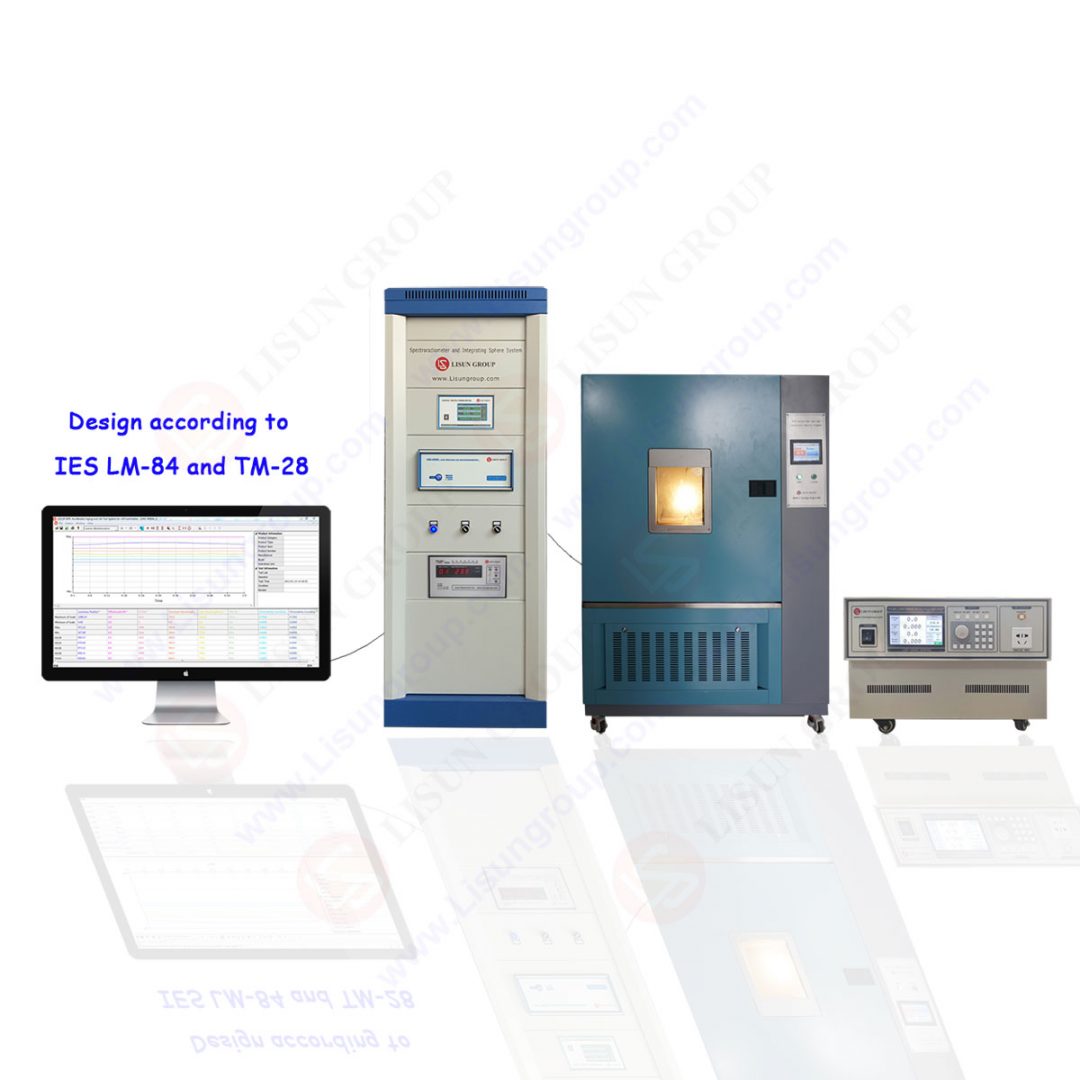
While LM-80 tests the component, LM-84 tests the complete luminaire, including its driver and optics. The LISUN LEDLM-84PL system caters to this by having a larger chamber capacity (up to 1.5m x 1.5m) and true RMS power monitoring. TM-28 then provides the method for projecting life for these assemblies. The instrument measures the combined effect of LED aging and driver degradation. This comprehensive data is critical for compliance with ENERGY STAR and DLC (DesignLights Consortium) requirements, which often dictate minimum L70 lifetimes for commercial fixtures.
4.3 Supporting Standards: CIE 127, CIE 084, and IES LM-79-19
The photometric accuracy of the aging data relies on secondary standards. CIE 127 governs the measurement of LEDs, specifying the spatial and spectral measurement conditions. CIE 084 details the measurement of luminous flux, essential for the integrating sphere setup. IES LM-79-19 provides the method for electrical and photometric measurements of solid-state lighting products. The LISUN system integrates these standards by using a spectroradiometer calibrated against a NIST-traceable standard lamp, ensuring that every 1000-hour measurement point is an accurate representation of absolute luminous flux.
5.1 Accelerating Product Validation Cycles
For R&D engineers, the ability to run three simultaneous temperature profiles reduces qualification time by 66% compared to sequential testing. The LISUN LED optical aging test instrument allows teams to evaluate the impact of a new phosphor or a different die attach material within weeks, not months. By applying the Arrhenius Model calculations, engineers can accurately predict whether a new design will meet a 50,000-hour lifetime requirement from just a 6000-hour test, enabling faster product iterations.
5.2 Ensuring Production Consistency in QC
In a quality control setting, this instrument serves as a screening tool. A sample from every production batch (e.g., 20 units from a weekly run) can be loaded into the chamber for a shorter test period, such as 1000 hours. The LISUN software compares the initial wear-out curve against the ’Golden Sample’ curve established during product qualification. Any deviation greater than 5% in the rate of depreciation flags the batch for investigation. This pro-active approach prevents the shipment of potentially unreliable products.
5.3 Supporting Third-Party Certification Labs
For testing labs, the data integrity and compliance features are paramount. The instrument’s ability to maintain a stable chamber environment (±1°C) across a 6000-hour run is critical for receiving NVLAP accreditation. The secure data logging prevents tampering, and the automatic report generation reduces the administrative burden of creating certification-ready documents. The compliance with IEC 60335-1 reassures lab clients regarding equipment safety, a significant factor for insurance and on-site safety audits.
6.1 LEDLM-80PL vs. LEDLM-84PL: A Critical Comparison
Choosing the correct instrument depends on the DUT. The LEDLM-80PL is optimized for small components, offering high-density test boards (up to 100 LEDs per board) and precise temperature control of the mounting surface. The LEDLM-84PL sacrifices density for capacity, accommodating large luminaires and focusing on total system performance, including driver harmonics and total lumen output. The table below clarifies the distinct applications.
| Feature | LEDLM-80PL | LEDLM-84PL |
|---|---|---|
| Target Standard | IES LM-80, TM-21 | IES LM-84, TM-28 |
| Typical DUT | LED packages, modules, arrays | Integrated lamps, luminaires |
| Thermal Environment | Case temperature control | Ambient air temperature control |
| Photometric Method | Fiber optic to spectrometer | Integrating sphere (multiple sizes) |
| Max Power per Channel | <25W | Up to 600W |
| Test Board Size | 300mm x 300mm | 600mm x 1200mm |
6.2 Scalability and Multi-Station Configuration
Both systems are designed for scalability. A single LISUN control server can manage up to three temperature chambers simultaneously. Furthermore, each chamber can be populated with multiple test stations, each running a different current profile. This allows a lab to run a full LM-80 qualification (three chambers at three different temperatures) concurrently with a 1000-hour production screening run in a fourth chamber. This hardware flexibility maximizes throughput for busy R&D and QC departments.
7.1 Initial Calibration and Spherical Validation
Before commencing a 6000-hour test, the system must be calibrated. The software guides the user through a self-calibration routine using an external standard lamp. The spectroradiometer is validated using CIE 084 guidelines for integrating sphere measurements. The system automatically corrects for self-absorption by measuring the sphere’s baseline response with and without the DUT. This step is critical to ensure that the absolute lumen values recorded at the 1000-hour point are accurate to within ±2%.
7.2 Managing Multi-Sample Statistical Validity
To achieve statistical significance, IES LM-80 recommends testing a minimum of 20 units per condition. The LISUN software handles this by grouping channels into ’sample sets.’ For example, 25 LEDs at 85°C can be assigned to one set. The software calculates the average lumen maintenance and the 90% confidence interval for that set. If the variation is too high, the engineer can pause the test and investigate individual channels, a feature that aids in identifying early life failures (infant mortality) versus systematic degradation.
7.3 Troubleshooting Common Aging Test Artefacts
One common issue is photometric shadowing, where dust or condensation on the optical window inside the chamber affects readings. The instrument includes a ’Reference Channel’ feature—a stable photodiode that monitors the optical path’s integrity. A sudden drop in the reference channel without a corresponding change in the DUT indicates a dirty window. The software flags this, allowing for corrective maintenance without invalidating the entire test run. This design ensures data continuity for the full 6000-hour duration.
The LISUN LED Optical Aging Test Instrument, compliant with IEC 60335-1, represents a significant advancement for the solid-state lighting industry. By offering dedicated variants for LM-80/TM-21 and LM-84/TM-28 testing, it provides a precise, standards-based solution for evaluating LED lumen maintenance from the component level to the complete luminaire. The integration of the Arrhenius Model for life projection, coupled with support for up to three temperature chambers and dual on-line/off-line testing modes, empowers engineers to make data-driven decisions regarding product quality and reliability. For R&D teams, it accelerates the validation of new emitter technologies. For QC specialists, it ensures consistent batch quality and prevents field failures. For third-party labs, it provides the integrity, safety (IEC 60335-1), and reporting capabilities necessary for formal certification. By adhering to the rigorous frameworks of IES, CIE, and TM standards, this instrument is not just a piece of test equipment—it is a strategic asset for any organization committed to delivering long-life, high-quality lighting products to the market.
Q1: What is the difference between the LEDLM-80PL and LEDLM-84PL models in the LISUN system?
A: The primary difference lies in the target Device Under Test (DUT) and the applicable standard. The LEDLM-80PL is designed for components (LED packages, modules, and arrays) as per IES LM-80. It focuses on case temperature control and uses fiber optic probes for photometry. The LEDLM-84PL, conversely, is designed for integrated products (complete lamps and luminaires) following IES LM-84. It uses larger integrating spheres and controls the ambient air temperature around the DUT. Choosing the correct model is crucial for generating valid data for downstream life projections using TM-21 (for LM-80 data) or TM-28 (for LM-84 data).
Q2: How does the LISUN instrument ensure compliance with the 6000-hour test duration requirement?
A: The instrument is engineered for continuous, reliable operation over extended periods. The hardware, compliant with IEC 60335-1, includes high-quality power supplies and temperature controllers with thermal protection. The software features a non-volatile memory that stores all test parameters and data, even in the event of a power failure. The system automatically resumes the test upon power restoration. Furthermore, the built-in reference channel and self-diagnostics monitor for environmental drift (e.g., window condensation), ensuring that every 1000-hour measurement interval yields valid data for the TM-21 extrapolation algorithm.
Q3: Can the LISUN system test at three different temperatures simultaneously for LM-80 compliance?
A: Yes, absolutely. The LISUN LED Optical Aging Test Instrument supports up to three connected temperature chambers, all managed by a single software controller. This is a direct response to the IES LM-80 requirement for testing at a minimum of three different temperatures (e.g., 55°C, 85°C, and 105°C). Each chamber can be set to a different temperature, allowing the user to run the entire LM-80 qualification protocol concurrently. This parallel testing capability significantly reduces the overall time required to generate the data necessary for a valid TM-21 life projection report.
Q4: How does the software apply the Arrhenius Model for L70 life projection?
A: The software uses the data collected at the two higher temperatures (e.g., 85°C and 105°C) to derive an experimental activation energy (Ea) for the LED package under test. By applying the Arrhenius equation, the software accelerates the observed degradation rates from these high-stress conditions to predict the failure rate at the lower, use-case temperature (e.g., 55°C). It then calculates the time it takes for the luminous flux to decay to 70% of its initial value (L70). The algorithm automatically applies the curve-fitting rules (exponential decay) specified in the TM-21 or TM-28 standards.
Q5: What is the significance of the IEC 60335-1 compliance for this aging test instrument?
A: Compliance with IEC 60335-1 is critical for ensuring the safety of the equipment during unattended, long-duration tests. This standard governs safety aspects like electrical insulation, heating elements, mechanical stability, and protection against electric shock. Since aging tests can run for 6000 hours (several months) continuously, the risk of electrical fire or component failure is high. IEC 60335-1 certification assures the lab manager that the LISUN instrument has passed rigorous safety tests, protecting personnel and facilities while maintaining test integrity.