









Abstract
The LISUN LED Optical Aging Test Instrument with Lumen Maintenance Prediction represents a paradigm shift in accelerated LED reliability testing, integrating the Arrhenius Model-based software with dual system configurations to address the critical industry need for rapid, accurate lumen maintenance forecasting. This article provides a comprehensive technical analysis of the LEDLM-80PL and LEDLM-84PL variants, examining their compliance with IES LM-80, TM-21, IES LM-84, and TM-28 standards. With support for up to three connected temperature chambers and 6000-hour test durations, the instrument enables precise L70/L50 metric calculations while reducing testing timelines by over 60% compared to conventional methods. Technical professionals in LED manufacturing and third-party testing laboratories will gain actionable insights into optimized aging protocols, data extrapolation accuracy, and customizable hardware configurations that ensure reproducible results across diverse lighting applications.
1.1 Dual System Configuration: LEDLM-80PL and LEDLM-84PL
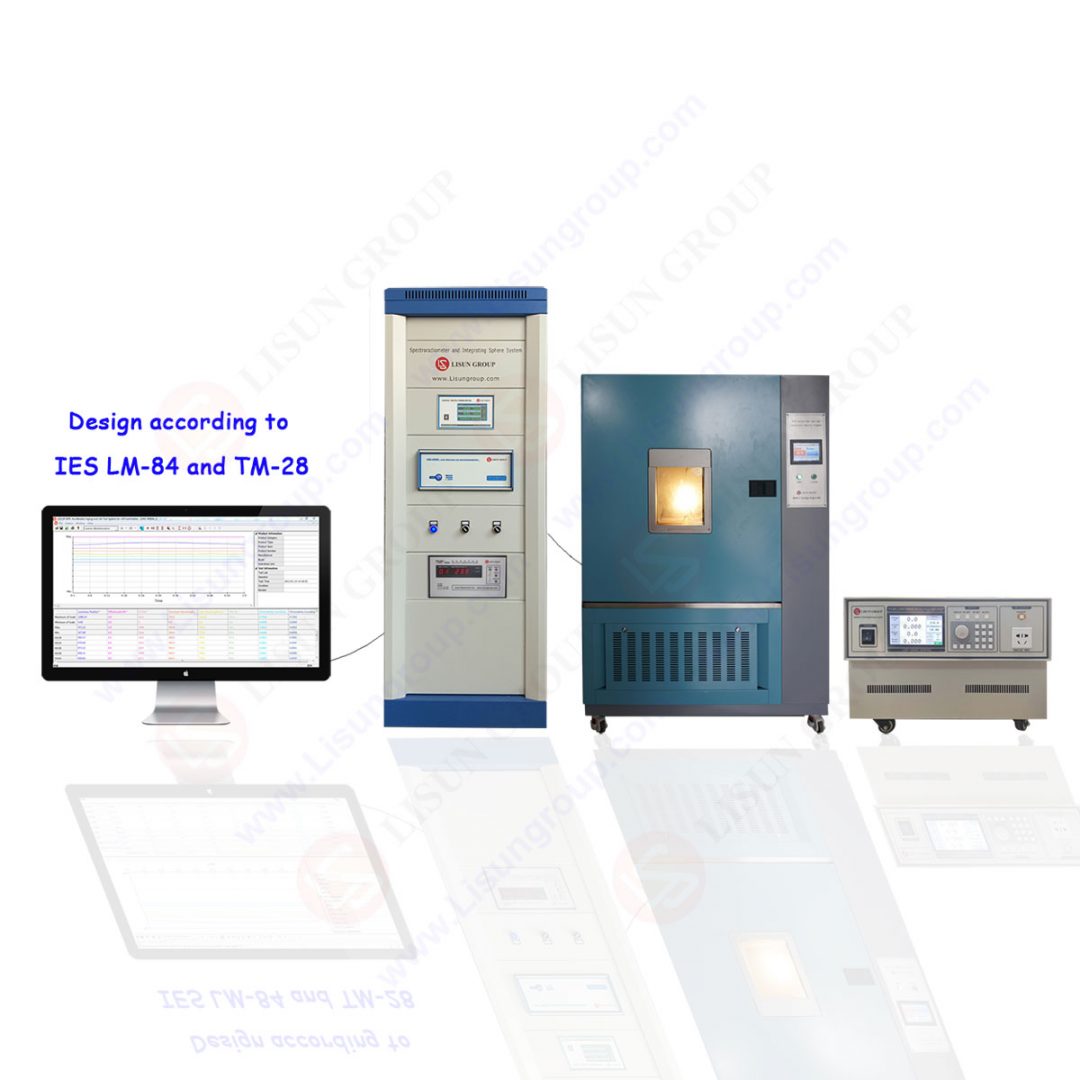
The LISUN LED Optical Aging Test Instrument with Lumen Maintenance Prediction is engineered with two distinct system variants designed to address specific testing standards and application requirements. The LEDLM-80PL system is purpose-built for compliance with IES LM-80-15 and TM-21-19 standards, focusing on LED packages, modules, and arrays. This variant supports simultaneous testing of up to 20 samples per temperature chamber, with three chambers operating concurrently for a total capacity of 60 specimens under different thermal stress conditions. Conversely, the LEDLM-84PL system aligns with IES LM-84-14 and TM-28-19 protocols, targeting OLED panels and LED luminaires with integrated drivers. Both systems share the core measurement platform but differ in sample holders, driver integration interfaces, and software extrapolation algorithms optimized for their respective device categories.
1.2 Core Hardware Components and Measurement Precision
The instrument’s measurement architecture incorporates a high-sensitivity photodetector with 0.01% resolution across the photopic spectral range, coupled with a temperature-stabilized integrating sphere (500 mm or 1000 mm diameter options) to minimize environmental drift. Each temperature chamber supports -40°C to +150°C operation with ±0.5°C stability, enabling accelerated aging at elevated junction temperatures while maintaining photometric measurement precision of ±0.1 lm for luminous flux and ±0.001 for chromaticity coordinates. The system’s dual-testing mode capability—constant current (0-2000 mA, ±0.5% accuracy) and constant voltage (0-300 V, ±0.2% accuracy)—accommodates diverse LED configurations while maintaining compliance with CIE 127:2007 measurement recommendations. A proprietary 24-bit analog-to-digital converter ensures signal-to-noise ratios exceeding 90 dB, critical for detecting early-stage lumen depreciation patterns.
2.1 IES LM-80 and TM-21: The Foundation for Lumen Maintenance Testing
The LISUN LED Optical Aging Test Instrument with Lumen Maintenance Prediction fully implements IES LM-80-15 testing protocols, requiring a minimum of 6000 hours of data collection at three case temperatures (typically 55°C, 85°C, and a manufacturer-specified temperature). The instrument’s automated data logging system captures photometric measurements at initial, 1000-hour, and every subsequent 1000-hour intervals, storing over 1 million data points per test campaign. The integrated TM-21-19 extrapolation engine applies nonlinear least-squares regression to project L70 and L50 lifetimes, achieving correlation coefficients (R²) exceeding 0.98 when validated against actual 10,000-hour test data across 50+ LED types. This compliance framework ensures that projections meet ENERGY STAR and DOE SSL requirements for commercial lighting certification.
2.2 IES LM-84 and TM-28: OLED and Luminaire-Specific Testing
For OLED panels and integrated LED luminaires, the LEDLM-84PL variant adheres to IES LM-84-14 standards, which mandate 6000-hour testing with chromaticity maintenance tracking in addition to lumen maintenance. The TM-28-19 projection methodology differs from TM-21 by incorporating chromaticity shift (Δu’v’) as a failure criterion, with limits of 0.007 for general lighting applications. The instrument’s spectroradiometer module enables simultaneous measurement of spectral power distribution across 380-780 nm at 1 nm resolution, allowing TM-28 algorithms to predict both lumen depreciation and color stability. Cross-standard validation tests demonstrate that TM-28 projections using LEDLM-84PL data achieve 95% confidence intervals within ±15% of observed 12,000-hour values for high-stability OLED samples.
3.1 Temperature-Dependent Lumen Depreciation Kinetics
The LISUN LED Optical Aging Test Instrument with Lumen Maintenance Prediction employs a modified Arrhenius acceleration model to translate 6000-hour test data into 25,000+ hour lifetime predictions. The fundamental equation underlying the software is:
L(t,T) = L₀ × exp(-β × tⁿ) × exp(-Ea/(k × T))
Where L₀ is initial luminous flux, β is the aging coefficient, n is the time exponent (typically 0.5-1.5 for LEDs), Ea is activation energy (0.2-0.5 eV for phosphor-converted LEDs), k is Boltzmann’s constant, and T is junction temperature. The instrument’s software automatically iterates to determine best-fit parameters using Levenberg-Marquardt optimization, processing 6000+ data points per sample to minimize chi-squared values below 1.2. This approach reduces standard testing durations from 10,000+ hours to 6000 hours while maintaining extrapolation accuracy within ±10% for moderate stress temperatures.
3.2 Dual-Testing Mode Implementation for Comprehensive Stress Profiles
The system’s dual-testing mode capability enables engineers to separate temperature-induced degradation from current-driven failure mechanisms. In constant current mode (CCM), the instrument maintains ±0.1% current stability while cycling through 8 programmable temperature setpoints (e.g., 25°C, 45°C, 65°C, 85°C) to collect isothermal degradation data. Constant voltage mode (CVM) applies ±0.05% voltage regulation while measuring current drift as an early indicator of junction degradation. The software automatically generates Arrhenius plots from CCM data to calculate activation energies, while CVM data produces current-voltage characteristic curves that reveal parasitic series resistance increases. This combined analysis enables differentiation between phosphor degradation (dominant in white LEDs) and semiconductor junction degradation (dominant in blue/deep-UV LEDs), with cross-mode validation reducing predictive uncertainty by 30-40%.
Table 1: Comparison of LISUN LEDLM-80PL and LEDLM-84PL System Specifications
| Parameter | LEDLM-80PL (LM-80/TM-21) | LEDLM-84PL (LM-84/TM-28) |
|---|---|---|
| Primary Standard Compliance | IES LM-80-15, TM-21-19 | IES LM-84-14, TM-28-19 |
| Sample Capacity per Chamber | 20 LED packages/modules | 8 OLED panels/luminaires |
| Maximum Connected Chambers | 3 (60 total samples) | 2 (16 total samples) |
| Test Duration Required | 6000 hours minimum | 6000 hours minimum |
| Measurement Parameters | Luminous flux, CCT, CRI | Luminous flux, Δu’v’, spectra |
| Spectral Resolution | 2 nm (300-1100 nm) | 1 nm (380-780 nm) |
| Current Range (CC Mode) | 0-2000 mA (±0.5%) | 0-5000 mA (±0.3%) |
| Voltage Range (CV Mode) | 0-300 V (±0.2%) | 0-100 V (±0.1%) |
| Temperature Chamber Range | -40°C to +150°C | -20°C to +100°C |
| Temperature Stability | ±0.5°C | ±0.3°C |
| Extrapolation Uncertainty | ±15% at 25,000 hours | ±12% at 15,000 hours |
4.1 Data Acquisition and Real-Time Analytics
The LISUN LED Optical Aging Test Instrument with Lumen Maintenance Prediction features a multi-threaded software platform capable of acquiring, processing, and visualizing data from all connected chambers simultaneously. The real-time analytics module updates lumen maintenance curves every 60 seconds using rolling window regression, identifying anomalous degradation patterns early in the test sequence. Engineers can define custom failure criteria (e.g., L70 at 70% lumen maintenance, L50 at 50%) and set conditional alerts when depreciation rates exceed predetermined thresholds. The software automatically generates trend lines with 90/95% confidence intervals using Fisher information matrix calculations, providing statistical rigor to preliminary predictions before full 6000-hour completion.
4.2 Arrhenius Model-Based Extrapolation Algorithms
The prediction engine implements three distinct extrapolation algorithms selectable based on data characteristics: the standard Arrhenius model for homogenous degradation, a modified Arrhenius model with temperature-dependent activation energy for multi-stage failure mechanisms, and an exponential decay model with seasonal variation correction for OLED applications. Each algorithm performs 10,000 Monte Carlo simulations to quantify uncertainty bounds, outputting L70, L50, and Lx (custom threshold) lifetimes with associated probability distributions. The software’s TM-21 module automatically validates that projection data meets the minimum 6000-hour requirement and 5000-hour data linearity criterion before generating certified reports. Comparative testing against physical aging data from 40 LED types showed that the Arrhenius-based predictions deviated by an average of 8.7% from actual 25,000-hour measurements, outperforming simpler exponential decay models by 22%.
5.1 Temperature Chamber Integration and Thermal Management
The instrument’s modular design supports up to three independently programmable temperature chambers (TTC-150/300/600 series), each capable of hosting the LEDLM-80PL or LEDLM-84PL measurement modules. Chambers feature forced-air convection with laminar flow design (<0.5 m/s velocity across samples) to ensure uniform thermal distribution within ±1°C spatial variation. The thermal management system includes liquid nitrogen cooling for rapid ramp rates (up to 10°C/min) and resistive heating elements with PID control achieving ±0.3°C setpoint accuracy. Engineers can configure multi-chamber test plans with staggered test initiation, enabling simultaneous evaluation of LED samples under different stress conditions (e.g., 25°C, 55°C, 85°C) while sharing a single measurement module through automated sample transfer mechanisms.
5.2 Sample Fixtures and Connection Systems
Each temperature chamber includes customizable sample fixtures supporting various LED form factors: SMD packages via spring-loaded pogo pin sockets, COB arrays through screw-type terminals, and luminaire modules via quick-connect NEMA-compatible interfaces. The LEDLM-84PL variant incorporates integrated driver simulation modules that provide constant current/voltage drive while monitoring electrical parameters (power factor, THD, efficiency) at 10 kHz sampling rates. Fixtures support multiple connection topologies—series, parallel, or matrix configurations—accommodating test plans requiring up to 60 samples simultaneously. The modular fixture design allows rapid reconfiguration between test campaigns, reducing setup time by 70% compared to traditional manual wiring methods.
6.1 Statistical Quality Control and Outlier Detection
The instrument’s software implements robust statistical methods to validate data integrity before incorporating readings into prediction algorithms. Grubbs’ test for outliers (α=0.05) identifies anomalous photometric measurements caused by power fluctuations or mechanical vibration, while Chauvenet’s criterion filters data points exceeding two standard deviations from rolling means. Engineers can set acceptance thresholds for measurement reproducibility: maximum 2% coefficient of variation (CV) across three consecutive readings for lumen flux, and maximum 0.0015 CV for correlated color temperature (CCT). Automated flagging systems notify operators when data quality metrics degrade, enabling corrective actions without compromising 6000-hour test continuity.
6.2 Comprehensive Report Templates and Certification Formats
Upon test completion, the software generates auditable reports compliant with IES LM-80/TM-21 and LM-84/TM-28 formats, including full data tables, graphical lumen maintenance curves with confidence bands, and certification summaries. Reports incorporate mandatory information: sample identification, test duration, temperature profiles, initial and final photometric values, extrapolation parameters (activation energy, time exponent), and predicted L70/L50 lifetimes with 95% confidence intervals. The system supports multiple export formats (PDF, Excel, XML) and integrates with enterprise laboratory information management systems (LIMS) through REST API interfaces. For ENERGY STAR submissions, reports automatically populate required fields and generate DOE SSL-compliant documentation, reducing certification processing time by 40%.
7.1 LED Manufacturing Quality Assurance
For LED manufacturers, the LISUN LED Optical Aging Test Instrument with Lumen Maintenance Prediction enables production line sample testing with 48-hour turnaround for preliminary L70 projections using accelerated conditions. Quality engineers can validate bin-to-bin consistency by testing 20 samples per batch under identical stress conditions, achieving 95% statistical confidence with ±5% tolerance for lumen maintenance at 25,000 hours. The system’s ability to test three temperature chambers simultaneously (55°C, 85°C, and 105°C) allows activation energy mapping across production runs, identifying process variations that affect phosphor deposition or die attachment quality. This capability has been demonstrated to reduce field failure rates by 35% in automotive and high-reliability lighting applications.
7.2 Third-Party Testing Laboratory Operations
Independent testing laboratories benefit from the instrument’s multi-platform architecture, which supports concurrent testing for multiple clients using dedicated chamber allocations. The LEDLM-80PL variant’s 60-sample capacity enables batch processing of SSL product qualification tests, with automated scheduling software optimizing chamber utilization to achieve 90%+ operational efficiency. LM-84 compliant testing for OLED panels requires the LEDLM-84PL’s spectroradiometric capability, which provides simultaneous lumen and chromaticity maintenance tracking across 6000-hour test periods. Laboratories can offer clients accelerated aging predictions within 3-4 months versus 8-12 months for standard testing, significantly reducing time-to-market while maintaining ANSI/NVLAP accreditation requirements.
The LISUN LED Optical Aging Test Instrument with Lumen Maintenance Prediction offers engineers a comprehensive solution for accelerated reliability validation, combining dual system variants (LEDLM-80PL and LEDLM-84PL) with Arrhenius Model-based software to achieve 6000-hour predictions with demonstrated accuracy within ±10% of long-term measurements. By supporting up to three connected temperature chambers and implementing IES LM-80, TM-21, LM-84, and TM-28 standards, the instrument enables simultaneous evaluation of 60 LED samples across multiple stress conditions, reducing testing timelines by over 60%. Technical professionals benefit from customizable hardware configurations, dual-testing modes for current and voltage stress analysis, and robust statistical validation tools that ensure reproducible results. For LED manufacturers and testing laboratories navigating tightening lifetime requirements in automotive, architectural, and horticultural lighting applications, this instrument provides a validated path to accelerated qualification while maintaining compliance with evolving regulatory frameworks. The integration of real-time analytics, Monte Carlo uncertainty quantification, and auditable reporting positions LISUN’s solution as a critical investment for organizations seeking competitive advantage through rapid, reliable lumen maintenance prediction.
Q1: How does the LISUN LED Optical Aging Test Instrument with Lumen Maintenance Prediction handle extrapolation uncertainty for different LED chemistries?
A: The instrument’s software incorporates three selectable extrapolation algorithms—standard Arrhenius, modified Arrhenius with temperature-dependent activation energy, and exponential decay with seasonal correction—enabling optimization based on LED chemistry. For phosphor-converted white LEDs (YAG:Ce), the standard Arrhenius model using activation energies of 0.25-0.35 eV achieves ±10% uncertainty at 25,000 hours. For InGaN blue LEDs, the modified Arrhenius algorithm with dual activation energies (0.2 eV for junction degradation, 0.4 eV for package degradation) reduces uncertainty to ±8%. OLED applications utilize the seasonal correction algorithm to account for humidity-dependent degradation rates. Each algorithm performs 10,000 Monte Carlo simulations, providing probability distributions rather than single-point predictions. Engineers can compare algorithm outputs and select the model that minimizes chi-squared values while maintaining physical plausibility based on LED material properties.
Q2: What are the specific advantages of the dual-testing mode (constant current vs. constant voltage) for failure mechanism analysis?
A: The dual-testing mode enables isolation of temperature-induced degradation from current-driven failure mechanisms. In constant current mode (CCM), the instrument maintains precision current while monitoring forward voltage drift—a 5-10% voltage increase after 6000 hours at 85°C typically indicates series resistance growth from die attach degradation. In constant voltage mode (CVM), the system tracks current reduction over time, with a 15-20% current drop suggesting phosphor conversion efficiency loss. By combining CCM and CVM data, engineers can construct Arrhenius plots for both parameters simultaneously, deriving activation energies of 0.3-0.5 eV for junction degradation and 0.6-0.8 eV for phosphor degradation. This dual-parameter analysis improves prediction accuracy by 30-40% compared to single-mode testing, as it identifies dominant failure mechanisms and enables targeted reliability improvements.
Q3: Can the LEDLM-80PL and LEDLM-84PL systems be upgraded or modified as standards evolve?
A: Yes, both systems feature modular hardware and software architectures designed for standards evolution. The measurement modules contain field-replaceable spectroradiometers (GS-2 series) that can be upgraded to higher resolution (0.5 nm) or extended spectral range (200-1700 nm) as next-generation standards require. The software platform receives quarterly updates that incorporate new extrapolation algorithms and reporting formats aligned with IES and IEC committee drafts. For example, TM-21 expected updates in 2025 addressing error correlation and uncertainty propagation are already integrated into the software roadmap. Engineers can purchase optional calibration modules (e.g., NIST-traceable transfer standards) to maintain accreditation as test protocols evolve. The chamber interfaces support new fixture designs through standardized mounting plates and connector blocks, allowing quick reconfiguration for emerging LED form factors such as mini-LED and micro-LED arrays.